Twelve built-in colour themes and a custom theme editor (eight colour anchors, twelve style presets, pick colours from a screenshot) that applies design tokens locally through the host theme API. Its HTTP routes have no DSH access check, so a web page open in your browser could call them.
Install
# from npm (prebuilt)
dsh plugin --profile web add dsh-zhuoer-theme
# from GitHub (first run asks for allowBuilds approval — follow the hint, retry)
dsh plugin --profile web add github:zuoyunlai/dsh-zhuoer-theme
Any plugin you install runs third-party code with your own permissions — it can read your files, use your credentials, and reach the network, and tool approvals don’t sandbox it. GitHub-sourced plugins also run build scripts at install time — pnpm blocks those until you allow them, so an install can stop with ERR_PNPM_GIT_DEP_PREPARE_NOT_ALLOWED or ERR_PNPM_IGNORED_BUILDS; dsh prints the exact key to add under allowBuilds in your profile’s pnpm-workspace.yaml, and the install works on the next run. Allowing a build is a trust decision: only install sources you trust, and pin a commit (github:owner/repo#sha).
README
A skin plugin that recolours the whole DSH UI: 12 built-in themes + 12 style presets + a custom-theme editor (AI generation / image palette extraction / per-anchor tuning).
English | 中文
- Colours go through the host theme service:
ctx.theme.overrideTokens()maps each theme onto DSH's--dsw-alias-*tokens (224 per theme). No DOM hijacking, no injected host components. - Fully local: no account, no telemetry, no external network calls. The only network activity is the host's own model when you press "Generate" in the editor.
- Light / dark / follow-system is two-way synced with the host's Settings → Appearance: changing either side updates the other.
- Current version 0.6.20, MIT.
Screenshots
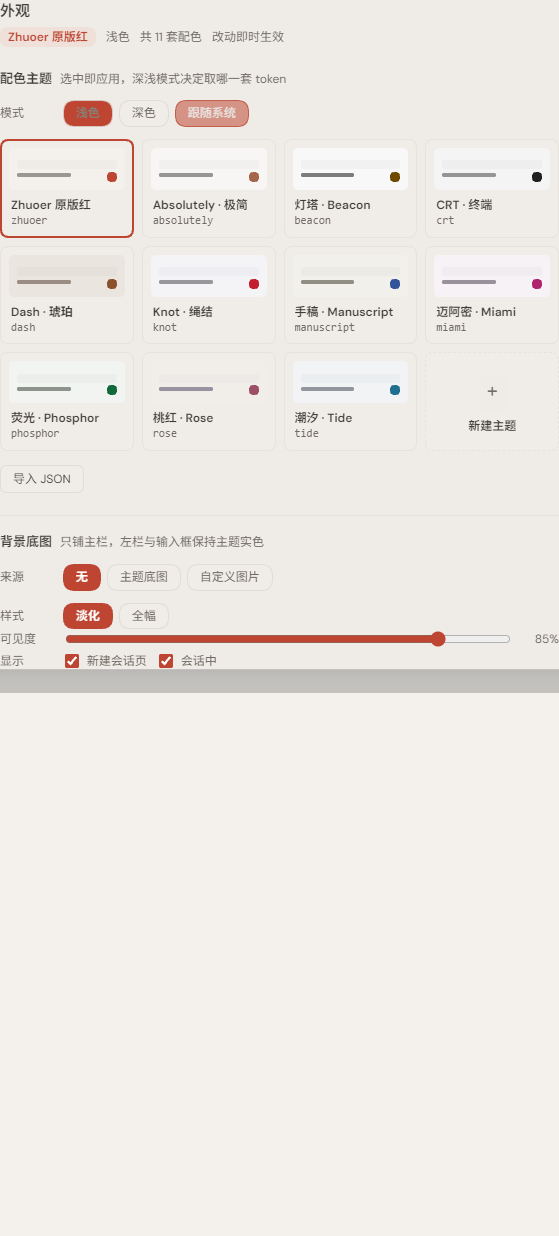
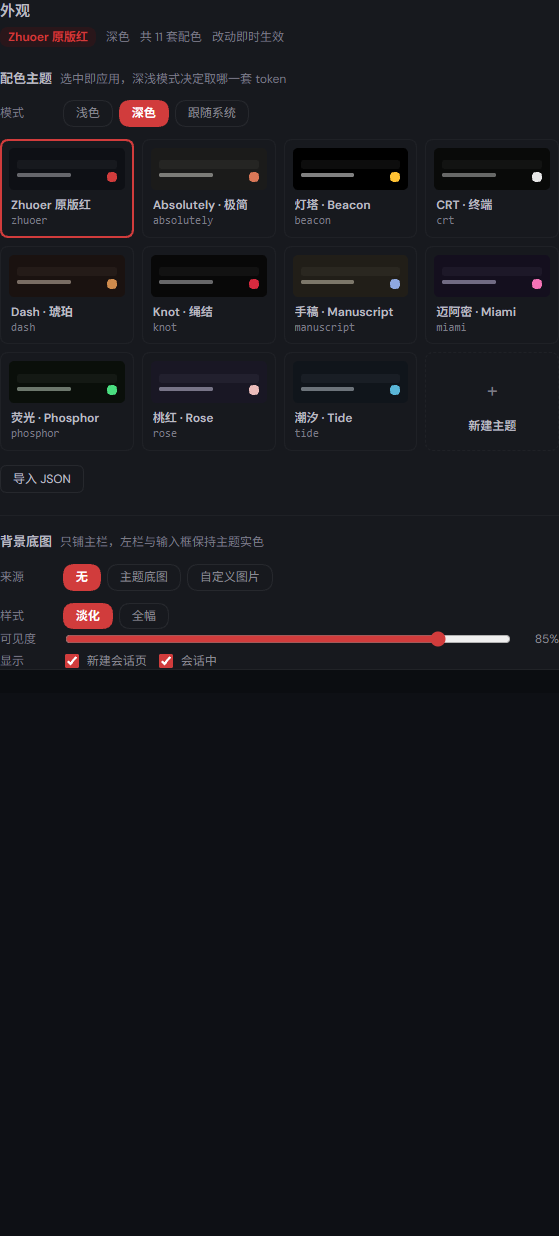
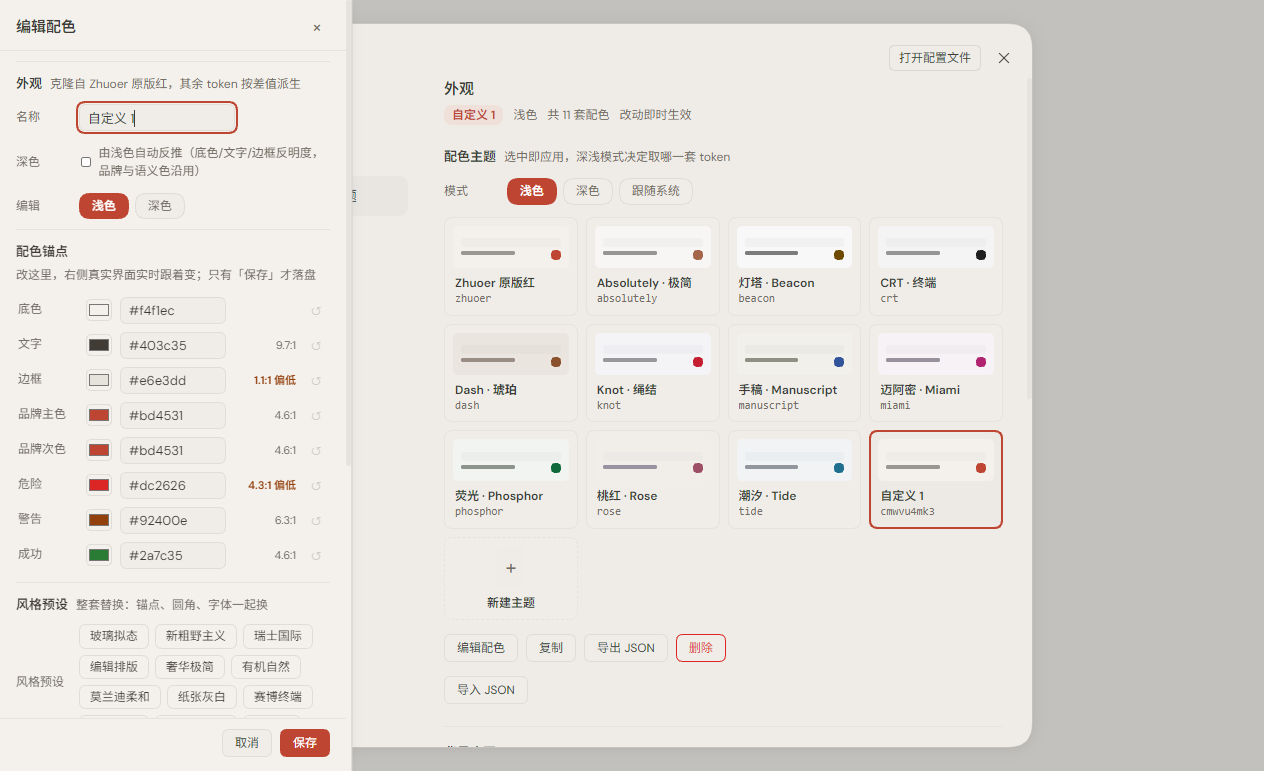
The UI shown is the Chinese one (same components in English; see README.md). Captured from a throwaway profile with an empty config, so no session or workspace data is visible.
Features
| Feature | Notes |
|---|---|
| Built-in themes | 12, each with light and dark token sets (224 tokens each) |
| Style presets | 12 (Glassmorphism, Neo-brutalism, Swiss International, Editorial, Luxury minimal, Organic, Morandi, Paper, Cyber terminal, Aurora, Developer terminal, Deep space) — one click fills anchors + radius + fonts |
| Custom themes | Clone a built-in theme and tune only 8 anchor colours; everything else is derived by relative offset. Only anchors are stored, not the full token set |
| AI generation | Turns a style description into anchors using the host's current model; the returned theme name pre-fills the Name field |
| Image palette | Picks 6 dominant colours locally and maps them onto anchors; the image is never uploaded |
| Editor drawer | 352px drawer on the left, live UI preview on the right; six sections, sticky header and footer; closing with unsaved edits asks first |
| Theme background | Bind an image to a custom theme, stored in IndexedDB (3 MiB per image) |
| Plugin-page icon | Root icon.svg + the "icon" field in package.json; the Plugins list shows the red Z on a dark tile |
| Settings-section icon | Registered into the settings.section.icon slot, so the "Zhuoer 主题" row shows the same red Z (an icon field on the registration is ignored — do not use that mechanism) |
| Market icon | assets/icon-180.png (180×180, rasterised from assets/logo/zhuoer.svg) |
| Brand slot | Replaces the deepseek HARNESS wordmark; off by default. When on it uses the theme's own logo unless you upload an image (downscaled to 512px on the long edge) |
| Text size | Five steps (90 / 100 / 110 / 125 / 140), enlarging UI copy and message body (three text paths: --dsw-font-* scaling, --dsh-content-font-* assignment, and a build-time host-class size table). No geometric zoom is injected — body{zoom} breaks the host's sidebar-drag coordinate math and is banned by the gate |
| Accent colour | Candidate colours per theme plus a free colour picker; button foregrounds are derived to stay readable |
| UI font | Override the UI font family; CJK glyphs fall back to the bundled subsets |
| Right-sidebar quick nav | Three modes: off / show three with hover expansion / show all |
| Import & export | Custom themes and all preferences export to JSON and import back; "Restore default settings" requires two clicks |
| Multilingual | UI copy in Chinese and English, switching live with the host language; non-Chinese locales fall back to English (theme names are intentionally untranslated) |
Themes
| id | Name | Dark canvas | Accent |
|---|---|---|---|
| zhuoer | Zhuoer 原版红 | #0e1015 |
#d13c3c |
| absolutely | Absolutely · 极简 | #1b1b1a |
#d97757 |
| beacon | 灯塔 · Beacon | #000000 |
#ffc233 |
| crt | CRT · 终端 | #090a09 |
#e8e8e8 |
| dash | Dash · 琥珀 | #1a1210 |
#cf8b4d |
| knot | Knot · 绳结 | #080808 |
#d92a3f |
| manuscript | 手稿 · Manuscript | #211e18 |
#8fa8e0 |
| miami | 迈阿密 · Miami | #140f1e |
#f472b6 |
| phosphor | 荧光 · Phosphor | #0a0f0a |
#4ade80 |
| rose | 桃红 · Rose | #191724 |
#ebbcba |
| tide | 潮汐 · Tide | #10151b |
#5ab6d8 |
Theme names stay in Chinese on purpose (see "Known limits"): they are part of each theme's identity.
Shape language is also per theme (one SHAPES table): brutalist themes are square, terminal themes near-square, paper/manuscript slightly rounded, soft palettes rounder. Shadow scales are defined per theme as well.
Install
Use DSH's own plugin command. It forwards arguments to pnpm inside the profile and auto-registers any package that declares dsh.bundle as a profile layer — this plugin does, so all you need afterwards is a restart.
# From npm (recommended; @latest forces a fresh lookup past pnpm's metadata cache)
dsh plugin --profile <profile> add dsh-zhuoer-theme@latest

# Pin an exact version when you need reproducibility
dsh plugin --profile <profile> add dsh-zhuoer-theme@0.6.17

# From GitHub (pinned to a release tag with provenance)
dsh plugin --profile <profile> add github:zuoyunlai/dsh-zhuoer-theme#v0.6.17
Replace <profile> with the profile you actually use, e.g. desktop or web (each is a directory under ~/.dsh/profiles/<profile>). Restart DSH afterwards.
Why
@latest: right after a release, cached package metadata can resolve a bare package name to the previous version (observed: installed 0.5.1 right after 0.5.3 shipped).@latestforces a fresh resolution; use@x.y.zwhen you want to pin.If your default registry is npmmirror, mirror sync usually lags by minutes to tens of minutes:
@latestmay still resolve an old version. Bypass it explicitly:dsh plugin --profile <profile> add dsh-zhuoer-theme@latest --registry=https://registry.npmjs.org/.
If you see
declares no dsh.bundle — installed as a plain dependency, not a profile layer, the package did not declare a bundle (not the case here); only then do you need to add the package name to that profile'sdsh.profile.bundlesmanually.
Asset files require a restart: the host's plugin asset routes only serve files that existed at boot. New or replaced fonts/backgrounds under
assets/404 until you restart (the page still works, the glyphs or image are just missing).The same applies to code updates (
client.js): this plugin has no HMR channel.
Add it to the plugin market (self-hosted index)
DSH ships no index source (the official docs are explicit: indexes are third-party content that users add themselves). This repository includes one; this public URL was verified to work:
https://ghproxy.net/https://raw.githubusercontent.com/zuoyunlai/dsh-zhuoer-theme/main/market/index.json
Usage: Plugins → Experimental plugins → enable “Custom plugin index” → Discover → Add index source → paste the URL above. The card then appears in Discover, with title, description, icon, versions and author taken from that index.
Reachability (measured 2026-11-25, DSH 0.2.2-rc.5) — DSH fetches the index inside the host process and requires it to return 2xx without a redirect:
| URL | Result |
|---|---|
ghproxy.net/... (above) |
✅ 200, no redirect; Discover renders the index title and the card |
gh-proxy.com/... (same format, spare) |
✅ 200, usable as a fallback |
raw.githubusercontent.com/... |
❌ ECONNRESET on the Node side (curl working does not imply the host can fetch it) |
gitee.com/<owner>/<repo>/raw/... |
❌ 302 to a signed raw.giteeusercontent.com URL; DSH reports unexpected redirect |
Fallback: mirror market/index.json to any static host you can reach (object storage, your own server, a LAN http server; plain HTTP is fine) and add that URL instead.
The index lists only the three safe versions (0.6.20 / 0.6.19 / 0.6.18) and deliberately skips 0.6.11, which shipped a broken settings panel. Run npm run verify:market after editing — it checks the official schema (LocalizedText must contain en, exact SemVer, source.type, engines.dsh) and cross-checks it against this package’s package.json.
Run npm run verify:market after editing — it checks the official schema (LocalizedText must contain en, exact SemVer, source.type, engines.dsh) and cross-checks it against this package’s package.json.
Usage
Settings → Zhuoer 主题.
- Colour themes: 12 built-in cards plus a "New theme" card. Each preview block is painted with that theme's own tokens, so the difference is visible at a glance.
- Mode: light / dark / follow system — the same preference as the host's Settings → Appearance, synced both ways.
- Message text size / accent colour / UI font / right-sidebar quick nav: apply immediately, no restart.
- Custom theme cards: Edit colours / Duplicate / Delete.
Light–dark sync with the host
The host preference is the single source of truth; the plugin keeps a mirror:
| Direction | Behaviour |
|---|---|
| This page "Mode" → host Appearance | Calls theme.setTheme('light' | 'dark' | 'system'); the host settings page follows |
| Host Appearance → this page "Mode" | Subscribes to theme/change, mirrors mode and recomputes tokens before notifying the panel (fixed in 0.5.1: it used to re-render without recomputing) |
| Startup | Aligns the local mirror with the host preference, repairing stale local state |
Two things that are easy to confuse:
overrideTokens()itself emitstheme/change, so the subscriber drops same-value events; otherwise apply → override → apply loops forever (hit in v0.3.3).- Escape hatch:
localStorage['dsh-zhuoer-theme:mute-sync'] = '1'disables the subscription entirely. Symptom: "this page → host" works, "host → this page" does not. Check this key first when sync looks broken.
Custom themes
Design notes and trade-offs: docs/ai-theme-plan.md. The shipped behaviour is whatever CHANGELOG says.
New themes clone the currently selected built-in theme and tune 8 anchors:
| Group | Anchor | Derived |
|---|---|---|
| Background | --dsw-alias-bg-base |
layer-1/2/3/4, overlay, card, settings-card, skeleton |
| Text | --dsw-alias-label-primary |
secondary / tertiary / quaternary |
| Border | --dsw-alias-border-l1 |
l2 / l3 / l4 / selected |
| Brand primary | --dsw-alias-brand-primary |
button fill and hover, brand-text, invert, business, trajectory, onboarding |
| Brand secondary | --dsw-alias-trajectory-accent |
trajectory and business derivatives |
| Danger | --dsw-alias-state-error-primary |
label-error, error-secondary |
| Warning | --dsw-alias-state-warn-primary |
warn-label, warn-secondary |
| Success | --dsw-alias-state-success-primary |
success-secondary, success-tertiary |
Derivation uses relative offset: other tokens in a group shift by their RGB delta from the anchor, so changing the background does not destroy the existing hierarchy.
The editor is a left 352px drawer; the right half is fully transparent and click-through — the real UI is the preview. Six sections (Appearance / Color anchors / Style presets / AI & color picking / Background image / Shape & fonts), sticky header and footer, and a confirmation before closing with unsaved edits.
- Light and dark are edited separately; switching the editing scheme only affects the preview, not the app preference.
- Every swatch shows live contrast; below 4.5 it warns but does not block saving.
- Only anchors are stored (about 20 hex values per theme), so hundreds of themes still fit in localStorage.
- AI generation: describe a style, review the returned name and palette, then press "Apply to current theme" to touch the draft. The name pre-fills unless you already typed one.
- Image palette: 6 dominant colours extracted locally; because photos are often bright, applying them switches to the light preview so dark derivation does not hide the effect.
Theme background images
Source: follow global / theme built-in / custom image / none.
Images live in IndexedDB (database dsh-zhuoer-theme-bg), not localStorage — 5MB cannot hold several 1920px images and writes fail silently when full. Prefs keep only a reference key (img_xxxx); images are preloaded into memory at startup.
- 3 MiB per image
- Deleting a theme removes its image
- JSON export excludes images (binary is not JSON); re-pick them on another machine
Multilingual (Chinese / English)
All UI copy comes from a shared dictionary in src/05-i18n.js (I18N.zh / I18N.en, 202 keys), read through t('key', { vars }):
- The language comes from the host locale service; anything not
zh*falls back to English. - Changing the language in the host switches the UI live, no reload.
- The panel, editor, JSON modal, error messages, and
aria-label/title/placeholder/altall go through the dictionary. - Theme and preset names are intentionally not translated (decision A1, they are part of the identity): the only Chinese left in the English UI should be those names.
To add a string: put it in both dictionaries, call t('panel.xxx'), then run node scripts/verify-text.mjs --update and node scripts/verify-keys.mjs. A bare-Chinese ratchet (verify:i18n) only lets the count go down. See docs/i18n-plan.md.
Development
Client code lives in src/ as five shards, concatenated in filename order into a single client.js by build.mjs:
src/00-core.js              runtime cost, version constant, diagnostics
src/05-i18n.js              shared dictionary (I18N.zh / I18N.en) + zrT / zrLang / zrSetLang
src/10-themes.js            THEMES/SHAPES/SHADOWS/font table/derivation/host sync
src/20-tokens-and-panel.js  applyTokens, panel and editor, AI and palette
src/30-quicknav.js          right-sidebar quick nav (standalone module)
Edit src/, never client.js — the latter is a build artefact; verify:build re-concatenates the shards and compares bytes, so hand edits turn it red.
No bundler on purpose: the host merges client plugins into one /plugins/??a,b,c request, so import.meta.url points at the merged URL and relative imports are unreliable. The runtime must be a single file.
Single source of truth for theme colours
themes.mjs (including each theme's shadow field) is the single source of truth; the const THEMES = {…} and const SHADOWS = {…} inside client.js are generated copies:
npm run sync:themes     # themes.mjs → src/10-themes.js, then build
npm run check:themes    # check only (exit 1 if out of sync)
npm run build           # src/*.js → client.js
Change themes only in themes.mjs. Past incident: fixing only the inlined copy got overwritten by the next sync; check:themes now blocks that.
Adding a built-in theme
- Add
{ label, light, dark, shadow }toTHEMESinthemes.mjs(both schemes with all 222 tokens). - For a dedicated shape language, add an entry to
SHAPESinsrc/10-themes.js(radii only, no colours). npm run sync:themes && npm test.
Gates and verification
npm test              # verify:all + headless derivation tests
npm run verify:all    # the gates listed below, in one pass
npm run coverage      # token coverage and the "deliberately not derived" allowlist
| Gate | What it checks |
|---|---|
verify:build |
client.js is byte-identical to re-concatenating src/ |
verify:version |
PVERSION, package.json and the quoted three-part version string agree (block comments stripped first, so s5.4.7 inside an SVG path is not mistaken for a version) |
verify:contrast |
11 themes × 2 schemes: body/hint/success and button foregrounds ≥ 4.5:1; the 12 presets are recomputed through the real buildCustomTokens |
gen:hosttext |
Re-extract the host class → font-size table from app.asar (src/15-host-text.js). Run once after a host upgrade; skipping it only mismatches some sizes, never breaks interaction |
verify:scale |
Font scaling may touch text size only: body{zoom} is banned (it breaks the host's sidebar-drag hit testing); --dsw-font-* px scaling and --dsh-content-font-* assignments must both be present |
verify:themes |
Inlined copies equal the source token by token, both schemes complete, contrast met |
verify:host |
Host selectors reconciled with the contract, plus two silent-failure checks: contract id fragments still present, plugin icon triple (icon / files / exports) complete |
verify:market |
Market index gate: validates market/index.json against the official schema (LocalizedText must contain en, exact SemVer, source.type, engines.dsh) and cross-checks it with this package’s package.json |
verify:locale |
Display metadata gate: every locale/*.json has a non-empty meta.title, en exists, exports/files are complete, ./icon is ≤256 KiB and matches the icon field |
verify:keys |
Dictionary gate (static): every key used by t('…') exists in both zh and en, with identical placeholder sets; a missing key or {n} vs {count} mismatch is red. Covers copy that never renders (drawer, errors, ARIA) |
verify:text |
Copy gate (deterministic): renders the panel in Node and compares 148 strings and attributes (title/aria-label/placeholder/alt) against contracts/text-snapshot/{zh,en}.json, versions normalised. Change copy ⇒ run --update |
verify:visual |
Pixel comparison of the panel (removed from verify:all): two consecutive captures of the same state differ by 2.3% in light mode, and a gate that cannot reproduce itself is a false sense of safety. Script kept for manual eyeballing |
verify:csssnap |
Compares the injected CSS text byte for byte against contracts/css-snapshot/, reporting the first offset and context. SKIPs when visual/css-current/ is absent; --strict makes it hard-fail |
verify:claims |
Public-claim gate: theme count, version, background count, string count and the bare-Chinese baseline in README / market index / locale / package.json must equal the freshly computed truth (add a theme, forget the docs → red) |
verify:i18n |
Bare-Chinese ratchet: per-file baseline that may only go down; new strings must go through the dictionary. Currently 46 |
verify:panel |
Panel smoke test: loads client.js with a minimal host stand-in in Node, calls apply() and renders settings.section once; any render-time throw is red (this is the gate for the 0.6.11 t is not defined class of bug) |
verify:git |
Checks .git metadata (HEAD/config/index) integrity; node scripts/git-doctor.mjs --fix rebuilds it in one command (see docs/git-integrity.md) |
verify:release |
Release preflight: content-hash comparison of the working tree against HEAD (catches same-length edits swallowed by git's stat cache) plus the version triple |
token-surface |
Which host tokens are covered and which are deliberately not derived |
node --check |
Artefact syntax |
test-derive |
Runs the derivation functions headlessly: 151 keys × 4 bases × 2 schemes |
Theme card previews, AI and palette behaviour are verified in the real UI; gates only cover what is mechanically decidable. Switch through every theme after changing colours — see "Known limits".
Why there is no pixel baseline any more
Since 0.6.15 the pixel comparison is out of verify:all — not out of laziness, but because it cannot reproduce itself: in the same instance, same state, zero code changes, two consecutive captures of .zp-root differ by 2.301% in light mode (61,624 vs 61,130 bytes) while dark is byte-identical; freezing animations, zeroing ancestor scroll offsets and disabling transitions does not help. A gate that goes red without meaning "broken" and green without meaning "fine" is a false sense of safety. The script stays (scripts/verify-visual.mjs) for manual inspection.
What replaced it are deterministic machine checks:
verify:text— rendered panel copy and attributes as zh/en snapshots, item by item;verify:keys— static key and placeholder parity;verify:csssnap— injected CSS byte for byte (currently 60,049 B per scheme).
Refresh snapshots after copy changes:
node scripts/smoke-panel.mjs                       # first, confirm the panel still renders
node scripts/verify-text.mjs --update              # regenerate contracts/text-snapshot/{zh,en}.json
node scripts/verify-css-snapshot.mjs --capture visual/css-current   # only when CSS changed
To verify in the real UI (layout or colour changes, or an English pass), follow docs/live-verify.md and boot a throwaway profile: the desktop profile is owned by Electron and dsh web runs a different profile — neither is a good place to verify this plugin.
Host contract
client.js depends implicitly on things like [class*="_frame"] and [data-windows-titlebar]. When DSH upgrades, CSS Modules hash suffixes change (we match stable substrings), but the substrings, attribute names and semantics can change too.
contracts/host-contract.json records each dependency: where it is used, what breaks without it. Reconciliation has only two outcomes:
ADDED— the code added a host selector without registering it; add the semantics.REMOVED— registered but no longer used; run--updateafter confirming the removal is intentional.
This only covers the static dependency list; whether a selector actually matches still has to be checked in the real page (the contract's breaksIfMissing is there for exactly that step).
Official hard requirements (package contract + market index schema), this plugin's per-clause evidence, and two pitfalls of the self-check CLI live in docs/official-requirements.md — walk it before every release.
Layout
README.md            Chinese README (kept in sync)
client.js            build artefact (host entry point, do not edit)
index.js             server half: /api/report, /api/gen-theme, static asset routes
themes.mjs           single source of truth for colours and shadows
src/                 five client shards (incl. 05-i18n.js dictionary)
build.mjs            src → client.js concatenation
scripts/             verify-* gates, sync-themes, coverage, token-surface
contracts/           host contract lists (positives / negatives: what holds and what does not)
docs/                design notes and runbooks: i18n-plan.md, live-verify.md, official-requirements.md, git-integrity.md
assets/fonts/        23 woff2 files (14 Latin families + 3 CJK subsets) plus provenance
assets/bg/           24 theme backgrounds (webp)
assets/logo/         zhuoer.svg (brand-slot logo, served under /assets/logo/)
assets/icon-180.png  market card icon (180×180, rasterised from zhuoer.svg)
icon.svg             plugin page icon (referenced by package.json "icon")
docs/images/         the three README screenshots (plugin UI only, 2x)
locale/{zh,en}.json  display metadata (meta.title / meta.description, read by the host and market)
Release
Releases are tag-triggered in CI; never npm publish locally.
Batch releases: bump the version once, at release time. While working — code, copy, gates — do not touch package.json or PVERSION; append CHANGELOG entries per batch instead (e.g. 0.6.15 and 0.6.16 were accumulated batches, released together). Bumping for every change produces version numbers that were never published, and users cannot tell which one is current.
- At release time bump once:
package.jsonandPVERSION, plus a summary entry at the top of CHANGELOG listing the batches it contains. - Commit with
npm testgreen, then runnpm run verify:release(content hashes against HEAD), then tagv<version>and push. - GitHub Actions validates the tag against the version, runs the gates, publishes to npm via OIDC and creates a Release with
slsa.dev/provenance/v1attestation. - If DSH itself was upgraded before this release: run
npm run gen:hosttextfirst (re-extracts the host font-size table intosrc/15-host-text.js), thennode build.mjs. Skipping it does not fail any gate; it only leaves some UI text sizes pointing at the previous host's numbers. - Verify the publish with a cache-busting read — the npm CDN caches the previous version, so a plain read can look like a failed publish:
curl -s "https://registry.npmjs.org/dsh-zhuoer-theme?t=$(date +%s)" | \
  node -e "let s='';process.stdin.on('data',d=>s+=d).on('end',()=>{const j=JSON.parse(s);console.log(j['dist-tags'].latest, Object.keys(j.versions).slice(-3).join(','))})"
gh release view v<version> -R zuoyunlai/dsh-zhuoer-theme --json isDraft --jq .isDraft
All three must hold: latest is the new version, the version list tail contains it, and the Release exists with draft=false.
Known limits
- AI generation needs a configured host model. No embedded key, no direct external requests; a missing model is an explicit error, never a silent fallback to random colours.
- No unicode-range splitting for CJK fonts. The three CJK faces are already ~4,400-glyph subsets; splitting by frequency saves only 11–12% while inlining ~22k characters of disjoint ranges and turning "download once" into "maybe twice". The real first-paint cost is not putting a serif CJK face on the default path — already the case.
- Shadow scales:
themes.mjs--dsw-elevation-*and the plugin's ownshadoware two different scales (the latter scales with light/dark). Merging them needs a new visual scale, which is data design rather than cleanup. - Colours and shapes need human eyes: gates prove contrast and completeness, not that a radius looks good on your display.
- DSH upgrades can break the contract: class substrings and attribute names are not public API;
verify:hosttells you what the code uses, not whether it still matches. - Settings-section icon goes through a slot: an
iconfield on thesettings.sectionregistration is ignored (dropped since 0.6.2, falls back to a gear). Register intosettings.section.iconwithidequal to the section id; the host calls it with{ size, active }(red Z shipped in 0.6.6). The three mechanisms —package.jsonicon, slot contribution, registration field — are unrelated; evidence lives incontracts/host-contract.jsonpositives/negatives. - Theme and preset names are not translated (decision A1): they are part of each theme's identity. Group labels, buttons, notes and error messages all are.
Privacy
- Preferences (theme id, mode mirror, font size, accent colour, background reference keys) live in local
localStorage; backgrounds live in IndexedDB. - Diagnostic logging is off by default. To reproduce an issue, run
localStorage['dsh-zhuoer-theme:debug'] = '1'in the console and reload; logs go to the plugin data directory. Remove the key afterwards. - The only action that sends your description anywhere is "Generate", which goes through the host model service — the same channel as normal chat.
Licence
- Code: MIT (see LICENSE).
- Theme colours: derived from Zhuoer (MIT), remapped onto DSH tokens.
- Bundled fonts: all SIL Open Font License 1.1; provenance and subsetting in assets/fonts/README.md.
Links
More in this category
elysia395/dsh-wallpaper-engine★ 8176
Requires DeepSeek Harness 0.1.5-rc.1+ (DSH Desktop >= 2.0.7) and dsh-better-sidebar >= 0.19.0 - update both before installing or updating this plugin. Plays local Wallpaper Engine Video/Web wallpapers behind the chat, renders Scene wallpapers as extracted static frames, and adds content-rating/type filters, custom uploads and an iOS-style liquid-glass settings window.
Small-tailqwq/dsh-deep-whale#maid-atelier★ 3150
Whale-girl skin series for the DSH Web UI (maid-atelier).
Nwflower/dsh-claude-style★ 715
Claude Code Desktop look-and-feel for the DSH Web GUI — ivory/warm-black dual canvas, clay accent, three-font typography, permission segmented control and brand switcher, via CSS overrides and client DOM overrides.
kingOfSoySauce/dsh-liang-skin★ 406
Adaptive reasoning slider skin that maps each model's available reasoning efforts onto a 0–30 visual intensity scale, with synchronized portraits, background, and interface colors.
d-dev0101/open-sea-skin★ 403
Realtime WebGPU ocean skin with quick controls for waves, daylight, glass opacity, and an automatic day cycle.
webkubor/dsh-bloom-theme★ 321
Bloom Morandi theme: fifteen variants (mist, cinnabar, petal, ripple, sage, stone, lapis, amber, aurora, lavender, mint, tangerine, silverrose, dawn, osmanthus) built on OKLCH so light and dark stay perceptually even; twelve are featured in the top-bar switcher, grouped by color family, and all 30 foreground/background pairs are measured at WCAG AA or better.
Community comments
Comments are public GitHub Discussions. Loading them connects to GitHub and Giscus; a GitHub account is required to post.