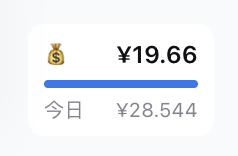
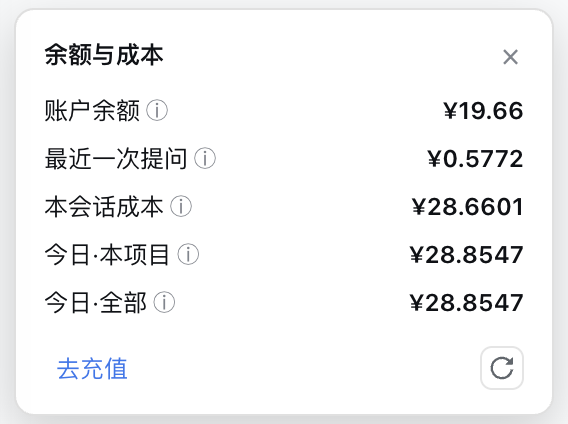
A balance and cost widget for the DSH web GUI: a sidebar footer card shows the account balance, a remaining-ratio bar and today costs; clicking opens a four-tier cost breakdown (last prompt / this session / today-this-project / today-all) with term explanations and a one-click top-up link. Zero external dependencies, works on Node 24.
Install
# from npm (prebuilt)
dsh plugin --profile web add dsh-balance-widget
# from GitHub (first run asks for allowBuilds approval — follow the hint, retry)
dsh plugin --profile web add github:LL-cmyk-so/dsh-balance-widget
Any plugin you install runs third-party code with your own permissions — it can read your files, use your credentials, and reach the network, and tool approvals don’t sandbox it. GitHub-sourced plugins also run build scripts at install time — pnpm blocks those until you allow them, so an install can stop with ERR_PNPM_GIT_DEP_PREPARE_NOT_ALLOWED or ERR_PNPM_IGNORED_BUILDS; dsh prints the exact key to add under allowBuilds in your profile’s pnpm-workspace.yaml, and the install works on the next run. Allowing a build is a trust decision: only install sources you trust, and pin a commit (github:owner/repo#sha).
README
中文 | English
A balance & cost widget for the DeepSeek Harness (DSH) Web GUI and desktop app: a persistent sidebar footer card shows the account balance and today's cost; clicking opens a five-tier cost breakdown (balance / last prompt with its session name / today-this-session / today-this-workspace / today-all-workspaces).
Preview
| Sidebar card | Five-tier cost popover |
|---|---|
 |
 |
How it differs from similar plugins
| Aspect | This plugin | Others (dsh-balance / dsh-token-price / ...) |
|---|---|---|
| Zero external dependencies | ✅ Imports no @deepseek-ai/* packages, no native modules |
❌ Most depend on dsh SDK packages |
| Node 24 ready | ✅ Works out of the box on any profile layout | ⚠️ Many community plugins still error on Node 24 |
| Boot stability | ✅ Registers routes via official ctx.webServer; never conflicts with apiproxy |
⚠️ Some self-host HTTP servers that crash dsh web on boot |
| Always-fresh auto refresh | ✅ Sidebar card refreshes balance & costs every 60s; opening the popover triggers an immediate refresh | Some always-on badges refresh on a timer |
| Peak/off-peak pricing | ✅ Built-in official 2026-09-10 rate table, re-synced from the official page at startup and every 12h | Partial support |
| Security | ✅ API key stays in the host process; loopback-only guard | Varies |
In one line: The zero-dependency, Node 24-ready balance/cost widget that never breaks dsh web or the desktop app on boot.
Features
- Account balance — The balance comes from the host account service
deepseekAccount, provided by@deepseek-ai/dsh-deepseek-account-platform— the official "Settings → Account & balance" page's own source, so both surfaces show the same number and no API key is needed; unsigned hosts and older runtimes (0.1.x) fall back to DeepSeek's officialGET /user/balance. The¥balance is color-coded by threshold (healthy / amber belowlowThreshold/ red belowcriticalThreshold). The API key is resolved through the host credentials service and never leaves the host process; the browser only talks to same-origin routes. - Last prompt cost (estimate) — Parses the most recent session file and prices the last turn's token usage, answering "how much did that last prompt cost", with the session name labeled underneath.
- Today · this session cost (estimate) — The current session's usage today (calendar day) × DeepSeek's official peak/off-peak price table. Follows the configured model (default
deepseek-v4-flash, switchable todeepseek-v4-pro) and the Beijing-time peak/off-peak windows automatically. - Today · this workspace cost (estimate) — Sums today's token usage × price across every session in the current workspace (anchored by the current session).
- Today · all workspaces cost (estimate) — Walks every session under
~/.dsh/sessions/and sums today's (calendar day) token usage × price. - Peak/off-peak status — a status dot before the card's amount is tinted by the current window (amber at peak / green at off-peak), a "Peak/Off-peak" tag sits next to the popover title, and hovering it shows the current price tier (input/output per 1M tokens).
- Token usage — Also shows the session's input (incl. cache hits) / output tokens.
- One-click top-up — a "Top up" link in the popover footer jumps to the official DeepSeek top-up page (platform.deepseek.com/top_up) in a new tab.
- Sidebar card — a persistent card at the sidebar footer shows balance and today's cost; globally visible, auto-refreshes every 60s (balance via the official API, costs parsed locally), and opening the popover triggers an immediate refresh.
- Balance color warning — the balance number is tinted in three tiers: default (healthy) → amber (below
lowThreshold) → red (belowcriticalThreshold). - Official price auto-sync — fetches the DeepSeek official pricing page on startup and every 12h; falls back to built-in rates on failure.
- Agent tool — a
deepseek_billingtool lets the model answer "how much balance do I have / how much did today cost".
Why this plugin
- Zero external dependencies — the host half imports no
@deepseek-ai/*packages and no native modules, so it loads from any profile layout and works on Node 24 (many community cordis plugins still lag on Node 24). - Uses official APIs only — routes are registered through
ctx.webServer(the same seamdsh-sshuses) with loopback-only guards; no conflicting custom HTTP servers.
Architecture
host half (lib/index.js)
  ctx.webServer.register:
    GET /api/dsh-balance/balance     → official /user/balance (loopback-only guard)
    GET /api/dsh-balance/active-cost → last prompt + today-this-session (with session name, most recent session)
    GET /api/dsh-balance/today-cost  → today's costs (dual: current workspace + all workspaces)
  Zero @deepseek-ai/* imports; loads from any profile layout.
  Also registers a deepseek_billing tool for model-driven queries.

client half (lib/client.js)
  ctx.slots.inject("sidebar.footer.action")
    → persistent sidebar footer card (balance + today's cost, peak/off-peak status dot; a 36×36 icon button while the sidebar is collapsed)
    → click opens five-tier cost popover + peak tag + ⓘ term explanations
Installation
From npm (once published):
dsh plugin --profile web add dsh-balance-widget
From GitHub (development):
git clone https://github.com/LL-cmyk-so/dsh-balance-widget.git
cd dsh-balance-widget
dsh plugin --profile web add "link:$(pwd)"
Then restart dsh web.
The desktop app (DeepSeek Harness.app) is supported too, with desktop as the install target: install it from the desktop app's sidebar "Plugins" panel, or add the package to ~/.dsh/profiles/desktop/package.json (dependency plus dsh.profile.bundles), then restart the desktop app. Because the desktop app is launched by the GUI, note that this plugin shells out to nothing — there is no PATH to configure.
Configuration
Where the config file lives
DSH plugin configuration lives in:
~/.dsh/profiles/web/cordis.patch.yml
All options
Append to cordis.patch.yml (only change the lines you need; the rest stay at defaults):
- id: balance-widget
  name: dsh-balance-widget
  config:
    balanceBaseURL: https://api.deepseek.com   # official balance endpoint (rarely changed)
    balanceApiKeyEnv: DEEPSEEK_API_KEY          # credential ref for the API key (rarely changed)
    requestTimeoutMs: 5000                      # balance request timeout (ms)
    modelId: deepseek-v4-flash                  # pricing model (or deepseek-v4-pro)
    lowThreshold: 5                             # balance below this (¥) turns the icon amber
    criticalThreshold: 1                        # balance below this (¥) turns the icon red
Example: custom balance thresholds
By default the icon turns amber below ¥5 and red below ¥1. To warn at ¥10 / ¥3 instead:
- id: balance-widget
  name: dsh-balance-widget
  config:
    lowThreshold: 10
    criticalThreshold: 3
Restart dsh web for changes to take effect.
Example: price with V4-Pro
If you mainly use DeepSeek-V4-Pro, point the pricing model at it for a more accurate estimate:
- id: balance-widget
  name: dsh-balance-widget
  config:
    modelId: deepseek-v4-pro
Note: the provider has announced that V4-Pro is being retired — from 2026-09-14 12:00 CST, V4-Pro requests are routed to V4.1-Flash and billed at Flash rates. Keeping deepseek-v4-pro past that date will over-estimate costs, so the default Flash tier is the better choice.
Note: cordis.patch.yml may already contain lines for other plugins — append new lines without touching existing ones.
Pricing
Built-in DeepSeek official peak/off-peak pricing (CNY per 1M tokens), effective 2026-09-10. Peak windows are Beijing time Mon–Fri (China's statutory holidays excluded) 09:00–12:00 and 14:00–18:00; everything else is off-peak, weekends (including 调休 make-up workdays) and statutory holidays all day included. Peak prices are double the off-peak rates:
| Model | Window | Cache hit (input) | Cache miss (input) | Output |
|---|---|---|---|---|
| V4.1-Flash | Off-peak | 0.02 | 1.0 | 4.0 |
| V4.1-Flash | Peak | 0.04 | 2.0 | 8.0 |
| V4-Pro | Off-peak | 0.15 | 4.5 | 13.5 |
| V4-Pro | Peak | 0.30 | 9.0 | 27.0 |
The official page currently lists only deepseek-flash and deepseek-v4-pro; older names (deepseek-v4-flash, deepseek-v4-flash-vision-exp, deepseek-chat) still work and are billed at the Flash rate. The plugin re-parses the page at startup and every 12h, and falls back to the table above only when parsing fails. Costs are estimates; the provider's bill is authoritative.
Search calls (estimated)
Every query of a web_search call is a separate auxiliary model call (@deepseek-ai/dsh-web-search-deepseek, deepseek-v4-flash by default, up to maxUses per request). The session log records only the pre-dispatch web/deepseek-search-llm-request event — no usage field — so the real token counts exist in no local file.
The plugin therefore counts requests × a calibrated constant: ~6k cache-miss input + ~2k output tokens per search, i.e. ¥0.014 off-peak and ¥0.028 at peak (calibrated 2026-09-22 against the balance delta: 14 searches measured ¥0.0133 each). Searches are attributed to the session, workspace and day they belong to, but each amount is an estimate (±30% order).
Security & permission boundaries
This section is for the DSH Store / plugin audit: dependencies, runtime permissions, external services, and failure bounds.
Dependencies & compatibility
- Zero runtime dependencies: imports no
@deepseek-ai/*packages; no third-party host deps peerDependencies["@deepseek-ai/dsh"]:>=0.1.2-rc.1 <0.3.0(DSH compatibility range; 0.1.5 / 0.1.7 / 0.2.0 verified)engines.node:^22.19.0 || >=24.0.0peerDependencies["react"]:^18.2.0(browser rendering only)
Runtime permissions
files: reads only~/.dsh/sessions/session JSONL (cost stats); never writes or mutates any session filenetwork: only the DeepSeek official endpoints —api.deepseek.com(GET /user/balance, used only when unsigned or on an older host; a signed-in runtime reads the host'sdeepseekAccountservice instead, so no plugin request leaves the process) andapi-docs.deepseek.compricing page (fetched every 12h); no third-party proxycommands: none. Session logs are decompressed with Node's built-in zstd (node:zlib, needs Node >=22.15), so nozstdbinary and noPATHdependencycredentials: readsDEEPSEEK_API_KEYon the fallback path only (resolved via the host credentials service), used only in the host process behind a loopback-only route guard; the browser never sees the key. A signed-in account reads no key at all- All host routes are bound to the loopback address and unreachable externally
External services
- Host account service
deepseekAccount(DSH 0.2.0+ with a signed-in account; the balance is the official page's own value, truncated to cents the way that page displays it) - DeepSeek official balance endpoint
GET /user/balance(fallback: unsigned or older host; on click / 60s refresh) - DeepSeek official pricing page (on startup + every 12h, for peak/off-peak rates)
Failure bounds
- Balance fetch failure: the panel shows the error and keeps the last successful snapshot (no interruption)
- Pricing fetch failure: falls back to the built-in 2026-09-10 rate table,
pricingSourcemarkeddefault(syncedonce parsing succeeds) - Node without built-in zstd (<22.15), or a session file that yields no frame: returns an actionable error instead of failing silently
- Missing/corrupt session files: that session is skipped; other sessions are unaffected
- All costs are estimates; the provider's bill is authoritative
Changelog
v0.6.3 — China's statutory holidays are now priced off-peak all day
- 🐛 Fixed: the peak/off-peak check excluded weekends but not China's statutory holidays. The official rule is "Beijing time Mon–Fri (China's statutory holidays excluded) 09:00–12:00 and 14:00–18:00 are peak; everything else — weekends and statutory holidays all day — is off-peak", so a statutory holiday falling on a weekday was priced at 2×. Measured against the built-in 2026 arrangement: Spring Festival 2/18, Dragon Boat 6/19, Mid-Autumn 9/25 and National Day 10/1–10/7 were all mispriced as peak, doubling their cost
- 📅 The 2026 statutory holiday table is built in (国办发明电〔2025〕7号; 33 days across New Year, Spring Festival, Qingming, Labour Day, Dragon Boat, Mid-Autumn and National Day — 19 of them on weekdays, exactly the ones that used to be priced at 2×), matched on the Beijing calendar day. Make-up workdays that fall on a Saturday or Sunday were already off-peak (the official rule lists weekends outright); they are now pinned by tests too
- 🧪 Differential verification: 14 fixture sessions (each with its own fake
$HOME, driven through the real route, real zstd frames and real pricing) assert ¥1.00 all day on holidays, ¥2.00 inside a normal weekday peak window, and the first working day after a holiday plus the lunch/evening boundaries — 14/14 pass. Running the same cases against the pre-fix code fails all six holiday cases (¥2.00) - ⚠️ Maintenance note: the table needs an annual refresh (the State Council publishes the next arrangement, usually in the previous November); years it does not cover fall back to the old weekend-only rule
- 📄 Docs: the pricing section and the peak/off-peak tooltips (both languages) now state "statutory holidays excluded / make-up workdays included" precisely
v0.6.2 — the balance now prefers the official account service (same source as the settings page, no API key needed)
- ✨ The balance is read from the host account service
deepseekAccount(provided by@deepseek-ai/dsh-deepseek-account-platform) whenever DSH >= 0.2.0 ships it and a DeepSeek account is signed in. That service is the official "Settings → Account & balance" page's own source, so the card and the settings page show the same number. Amounts follow the official rule — positive values are truncated to cents (55.6787307800000000→55.67, matching the page) — with the purchased wallet fromvalue[], the granted wallet frombonusWallets[], their sum as the total, and one entry per currency - 🚪 Every fallback is unchanged: when signed out, when the host has no such service (DSH 0.1.x), or when the account read fails (expired token and friends), the balance comes from the original
GET /user/balance+DEEPSEEK_API_KEY, exactly as in 0.6.1; a failed account read logs one warning saying why - 🔑 Signed in, no key is read at all: the balance no longer hard-depends on
DEEPSEEK_API_KEY, so an account-only install still shows a balance - 🔎 Auditable: the balance response carries a
balanceSourcefield (deepseekAccountor the fallback path), so it is always clear where a number came from - 🧪 Verified: a fake cordis ctx drives the real routes through 13 assertions — account mapping, multi-currency and bonus summation, cent truncation, signed-out fallback, missing-service fallback, throwing-account fallback with a warning, account winning over an API key, the agent billing tool reading the same source, and a guard that the credential key's spelling is never mistaken for the service name
- 📏 Measured same-source (2026-09-29, after a real restart): the official
account/getBalancereturned¥55.0685054200000000while the card showed¥55.06— identical to the cent
Why this release, said out loud. After desktop 0.2.0 shipped, the official app put a signed-in balance page under Settings → Account & balance. That means the platform now recognises the pain point — people need to see their balance. It just takes several clicks to reach, which for everyday use still loses to a card that sits in the sidebar and reads at a glance.
So this release adapts anyway: the balance is read from the official account service, identical to the settings page to the cent, and no API key is needed. But we are not pretending otherwise — now that the platform has taken the need over, this plugin will be replaced sooner or later. A little wistful, yet a tool's job is to make itself unnecessary: we are entering the farewell period. From here we only keep compatibility maintenance in step with DSH, with no new features. Thanks for letting it watch your balance all this time.
v0.6.1 — compatibility range widened to DSH 0.2.0 (upgrading would otherwise drop the plugin silently)
- 🐛 Fixed: DSH 0.2.0 adds a plugin compatibility gate (
evaluatePluginCompatibilityindsh-app-boot). It matches every declared@deepseek-ai/dsh/@deepseek-ai/dsh-*peer range against the running version — prereleases included (semver.satisfies(..., { includePrerelease: true })) — and a mismatching, non-exempted bundle is skipped silently at startup (loadProfileDirectoryfiles it underskippedBundles: no error, no manifest change). The old declaration>=0.1.2-rc.1 <0.2.0happened to cover0.2.0-rc.1(which is why the widget works on the current 0.2.0-rc.1 desktop, verified live) but not 0.2.0 final — so the first stable-desktop upgrade would have made the sidebar card vanish, with the plugin manager demanding a manualdsh plugin allow-versionexemption. The range is now<0.3.0(verified to cover 0.2.0 / 0.2.1 / 0.3.0-rc.1) - ✅ Live 0.2.0 compatibility check (against the 0.2.0-rc.1 desktop app, driven in a real browser): all five host routes answer; session logs are still
SESSION_FORMAT_VERSION = 4andtotalTokens = inputTokens + outputTokens + cacheReadTokensholds for all 394 usage events (pricing math unchanged); thesidebar.footer.actionslot, thedsh.client.platform === "web"loading gate and theIconRefreshOutlineRegularname are all unchanged; every one of the 19--dsw-*tokens the plugin uses still exists (15 of them redefined underbody[data-ds-dark-theme], and the popover portalled intodocument.bodystill inherits the theme); React is still 18.3.1; the 36×36 collapsed-rail button and the popover anchoring behave as before - 📦 Scope: the compatibility range in
package.jsonplus documentation; no runtime code changed
v0.6.0 — desktop app support, and a UI that matches the desktop shell
- 🖥️ Desktop app support (DSH 0.1.7 / DeepSeek Harness.app)
- Session logs are no longer decompressed by the
zstdCLI — Node's built-in zstd (node:zlib) does it instead. The desktop app is launched by the GUI, so its PATH is only/usr/bin:/bin:/usr/sbin:/sbinand the Homebrewzstdis invisible: every cost tier (today's spend, last prompt) failed outright there - v4 session logs are decoded frame by frame. The log is append-only: each flush appends its own zstd frame (a measured 726 KB v4 log held 97 of them). Node's one-shot decompressor returns only the first frame (258 B) — and silently dropping 99% of the data is worse than failing. Frames are now located by their magic number; v0 / v3 / v4 logs decode byte-identically to
zstd -dc - The refresh glyph is resolved per DSH version. 0.1.7 renamed product icons to size-neutral weights (
IconRefreshOutlineRegularplus asizeprop) and droppedIconRefreshOutline14; rendering the missing name as a component throws React #130, and the sidebar slot answers a crashed entry by dropping the whole card — the "card flashes, then vanishes on click" report. The glyph is now resolved from whichever name exists, with a local SVG fallback - The client inject declaration is empty:
@deepseek-ai/dsh-client-runtimewas never a real package (absent in both 0.1.5 and 0.1.7); the browser half needs only react and the shell's seed modules
- Session logs are no longer decompressed by the
- 🎨 Visual alignment with the desktop shell
- Dropped the card's state border (green off-peak / amber peak, which read as "selected") in favour of a 6px status dot before the amount; fill, 12px radius and 14px amount text now use the same design tokens as the desktop's own session rows
- The card fills the sidebar column — it used to be flex-shrunk to 131px and overflowed by 8px
- New collapsed-rail state: in the 56px icon rail the card becomes a 36×36 icon button (matching the rail's other buttons) with the status dot as a badge
- The popover is portalled into
document.body: the sidebar column clips its children (overflow:hidden), so in the rail the panel was cut off at the sidebar edge. Its width now follows the card (measured at open time, 240px floor) and re-anchors through aResizeObserverwhile the sidebar or the window is resized - Shadow and focus ring now come from the shell's tokens (
--dsw-shadow-lv3,--dsw-focus-ring-*) - 📄 Docs: both README screenshots regenerated for the new look
v0.5.5 — README assets now render on the npm package page
- 🐛 Fixed: the screenshots and the language switch used repository-relative paths (
docs/screenshot-corner.png,README.en.md). The npm package page renders the README body only and does not resolve in-repo paths, so both screenshots and the language link were broken on npm. They are now absolute URLs: screenshots viaraw.githubusercontent.com, the language switch via a GitHub blob link - 📦 Scope: documentation only; no code change
v0.5.4 — search calls are now counted (previously dropped entirely)
- 🐛 Fixed: the auxiliary model calls behind
web_searchcontributed nothing to cost. DSH writes only a pre-dispatchweb/deepseek-search-llm-requestevent per search (no usage), so any log-derived pricing undercounts systematically — measured 2026-09-22: all 1073 searches of the day were missing. Searches are now priced as requests × a calibrated constant and attributed to their session / workspace / day and turn - 📏 Calibration: ~6k cache-miss input + ~2k output tokens per search (¥0.014 off-peak, ¥0.028 at peak). Measured 2026-09-22 from the balance delta: 14 searches in one window, balance delta ¥0.28, minus ¥0.094 of log-derivable conversation cost → ¥0.0133 per search
- ⚠️ Scope: the search portion is an estimate (±30% order); conversation text is still priced exactly from the logs
v0.5.3 — weekends no longer mispriced as peak
- 🐛 Fixed: the peak/off-peak check looked only at the hour and ignored the weekday, so weekends were priced as peak (2×) during 09:00–12:00 and 14:00–18:00, up to doubling "today's cost". The official rule is Mon–Fri 09:00–12:00 and 14:00–18:00 (everything else, weekends included, is off-peak); Saturday and Sunday are now excluded first, using the Beijing-time weekday
- 📄 Docs: the pricing section and the peak/off-peak tooltips now state the Mon–Fri restriction
v0.5.2 — DSH 0.1.5: new session format & new pricing page
- 🐛 Fixed: DSH 0.1.5 writes session logs under a generation-tagged name (
session.v3.jsonl.zstd), but the plugin only matchedsession.jsonl.zstd, so every session created after the upgrade was invisible — viewing one produced red error text in the popover, and today's cost was understated (measured ~36% low). Logs are now found by taking the highest generation per session directory; a migrated session's older file is a subset of the new one, so reading only the newest avoids double-counting the session - 🐛 Fixed: the official pricing page renamed the Flash column to
deepseek-flashand cut its rates. The parser's model-id anchor landed on a page footnote, so the sync reported success while silently keeping the stale, higher rates — overstating costs by ~1.7x. The parser now anchors on the table's row labels and applies that column to every Flash-family name - 💰 Rates: the built-in fallback table now carries V4.1-Flash pricing (off-peak 0.02 / 1.0 / 4.0, peak 0.04 / 2.0 / 8.0 CNY per 1M tokens); the V4-Pro tier is unchanged
- 📄 Docs: corrected the
pricingSourcevalues todefault/synced(previously misdocumented asbuiltin)
v0.5.1 — Cold-start speedup & cleanup
- 🚀 Performance: today-cost cold start dropped from ~5.4s to ~0.01s — only session files modified today are decompressed (mtime filter), parsed results are cached by (path, mtime), and parsing runs in parallel
- ⏰ Refresh wording: README now matches the code — the persistent card auto-refreshes every 60s (the old "no polling" claims contradicted the code and have been corrected)
- 🌏 Timezone fix: peak/off-peak windows are now computed in Beijing time (UTC+8) explicitly instead of the host's local timezone
- 🧹 Cleanup: removed a dead client-side pricing stack (PRICING/priceSession) that was never called; all pricing now goes through the host
- 📐 Pricing parsing hardened: peak rates are parsed explicitly from the official page (no more hard-coded "off-peak × 2"); if a cache-hit rate cannot be parsed the whole table falls back to built-in rates instead of silently pricing cache hits at 0
- 🏷️ Card label: the card footer now reads "Today · all" to make clear it is the global (all-workspaces) figure
- 🎨 Visual refresh: SVG wallet icon replaces 💰, press/pop micro-animations, muted secondary tiers in the popover
v0.5.0 — Five-tier costs & peak/off-peak status
- ✨ Added: the cost breakdown is now five tiers — balance / last prompt / today-this-session / today-this-workspace / today-all-workspaces
- The last-prompt row labels the session name underneath (based on the most recent session)
- "Today · this session" = the current session's usage today; "Today · this workspace" = all sessions in the current workspace today (workspace anchored by the current session); "Today · all workspaces" = everything across all workspaces today
- ✨ Added: peak/off-peak status visuals — card and popover borders tinted by window (orange at peak / green at off-peak), a "Peak/Off-peak" tag next to the popover title with a hover tooltip showing the current price tier
- 🎨 Changed: removed the remaining-ratio bar; the balance number is now color-coded directly by threshold (healthy / amber / red)
- 🗑️ Removed: the "This session" row (all-time session total) from the popover
v0.2.0 — Last prompt & today total cost
- ✨ Added: popover now shows "last prompt cost" and "today total cost"
- Last prompt: prices the current session's last turn from the session file
- Today total: walks every session under
~/.dsh/sessions/and sums today's usage
- 🐛 Fixed: session-id prefix duplication in the last-cost route (both
session--prefixed and bare ids resolve)
v0.1.0 — Initial release
- 🎉 Account balance (official
/user/balance) + session cost (estimate) + token usage - On-demand refresh: no polling, queries only on click, costs zero tokens
Verify
- Config tree:
dsh --profile web --dump-configshould show abalance-widgetentry. - Balance route: after restarting dsh web,
curl -s http://127.0.0.1:3080/api/dsh-balance/balanceshould return{ ok, balance_infos, modelId }. - Session costs:
curl -s http://127.0.0.1:3080/api/dsh-balance/active-costshould return{ lastPrompt, todaySession, title, sessionId, peak, workspaceName, ... }; append?session=SESSION_IDto target a specific session. - Today costs:
curl -s http://127.0.0.1:3080/api/dsh-balance/today-costshould return{ workspace: { cost, ..., cwd }, all: { cost, ... }, modelId }. - Legacy route:
curl -s "http://127.0.0.1:3080/api/dsh-balance/last-cost?session=SESSION_ID"still works and returns{ cost, inputTokens, outputTokens, modelId }.
License
MIT
Links
More in this category
bowenliang123/dsh-context★ 1831
DSH context insight panel: Context dashboard + /context command + Context browser — one-stop context lifecycle management with categorized composition, content details, evolution trends, compaction/injection events, and stats.
Han-1413141/dsh-cost-meter★ 369
Per-session and daily API cost, budget with usage %, official balance, history dashboard, and one-click official price sync with peak/off-peak pricing.
wssfk12138/dsh-damage-pulse★ 237
Tracks DeepSeek token usage, per-call and session costs, and account balance with cache-aware charge animations in the DSH Web UI.
zh667/TokenLedger★ 202
Sidebar usage panel that attributes tokens to the relay site that served each request, read from your existing provider config: today/month/all-time totals, per-site and per-model breakdowns, a year activity heatmap, and New API / Sub2API / DeepSeek balances.
Ychris12138/dsh-usage-stats★ 169
Multi-provider usage dashboard with provider/model token breakdowns, calendar drill-downs, account balances, and OpenCode Go / Z.ai subscription quota tracking.
PolinniZhong/dsh-personal-center★ 118
Personal center for DeepSeek Harness: cross-session usage statistics, per-model cost estimation, global custom instructions, a global font-size adjuster, a data-driven desktop pet with bitmap & vector skins, and a conversation status overview, all local and offline.
Community comments
Comments are public GitHub Discussions. Loading them connects to GitHub and Giscus; a GitHub account is required to post.