Cost tracking priced from an online catalogue (models.dev + OpenRouter, 8000+ models, each call priced at its own instant): a per-turn cost line, a Cost tab attributing spend to tool output / model output / system prompt / commands, budget, monthly forecast, ~166 live-rate currencies, and a bill_stats agent tool.
Install
# from npm (prebuilt)
dsh plugin --profile web add dsh-bill
# from GitHub (first run asks for allowBuilds approval — follow the hint, retry)
dsh plugin --profile web add github:Jannchie/dsh-bill
Any plugin you install runs third-party code with your own permissions — it can read your files, use your credentials, and reach the network, and tool approvals don’t sandbox it. GitHub-sourced plugins also run build scripts at install time — pnpm blocks those until you allow them, so an install can stop with ERR_PNPM_GIT_DEP_PREPARE_NOT_ALLOWED or ERR_PNPM_IGNORED_BUILDS; dsh prints the exact key to add under allowBuilds in your profile’s pnpm-workspace.yaml, and the install works on the next run. Allowing a build is a trust decision: only install sources you trust, and pin a commit (github:owner/repo#sha).
README
English | 中文
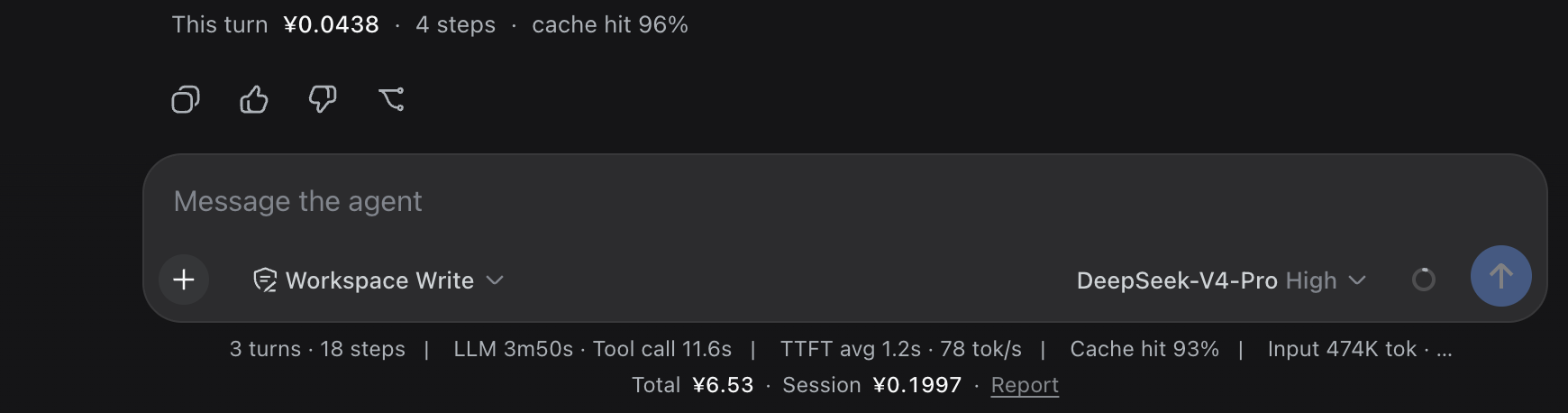
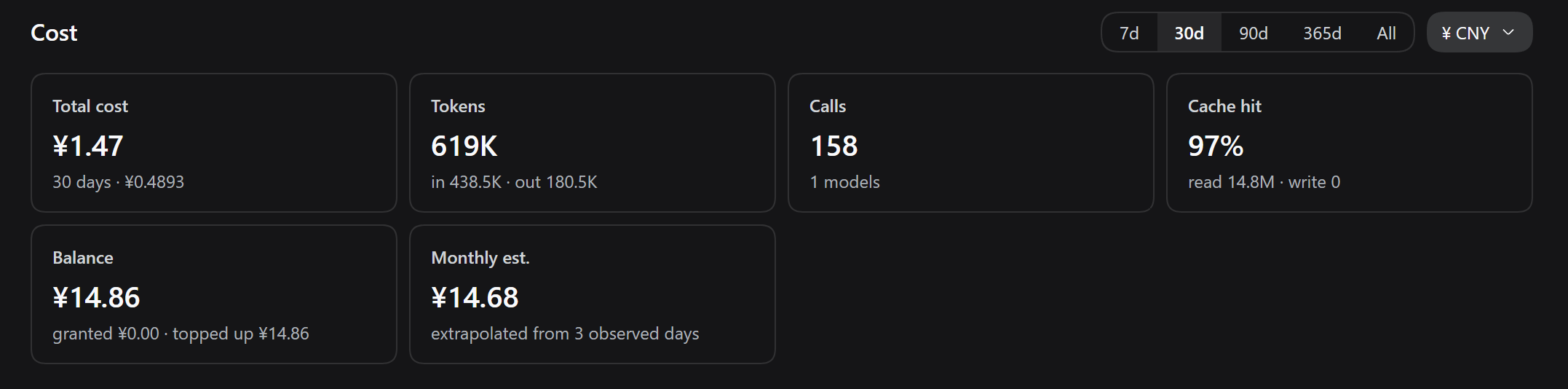
Cost tracking for DSH (DeepSeek Harness). A line under each turn tells you what that turn cost; the conversation's Cost tab tells you what that session's money went on, and the global Cost panel beside Plugins does the same for the whole account.
Install
dsh plugin --profile web add dsh-bill
Restart dsh web to pick it up.
Features
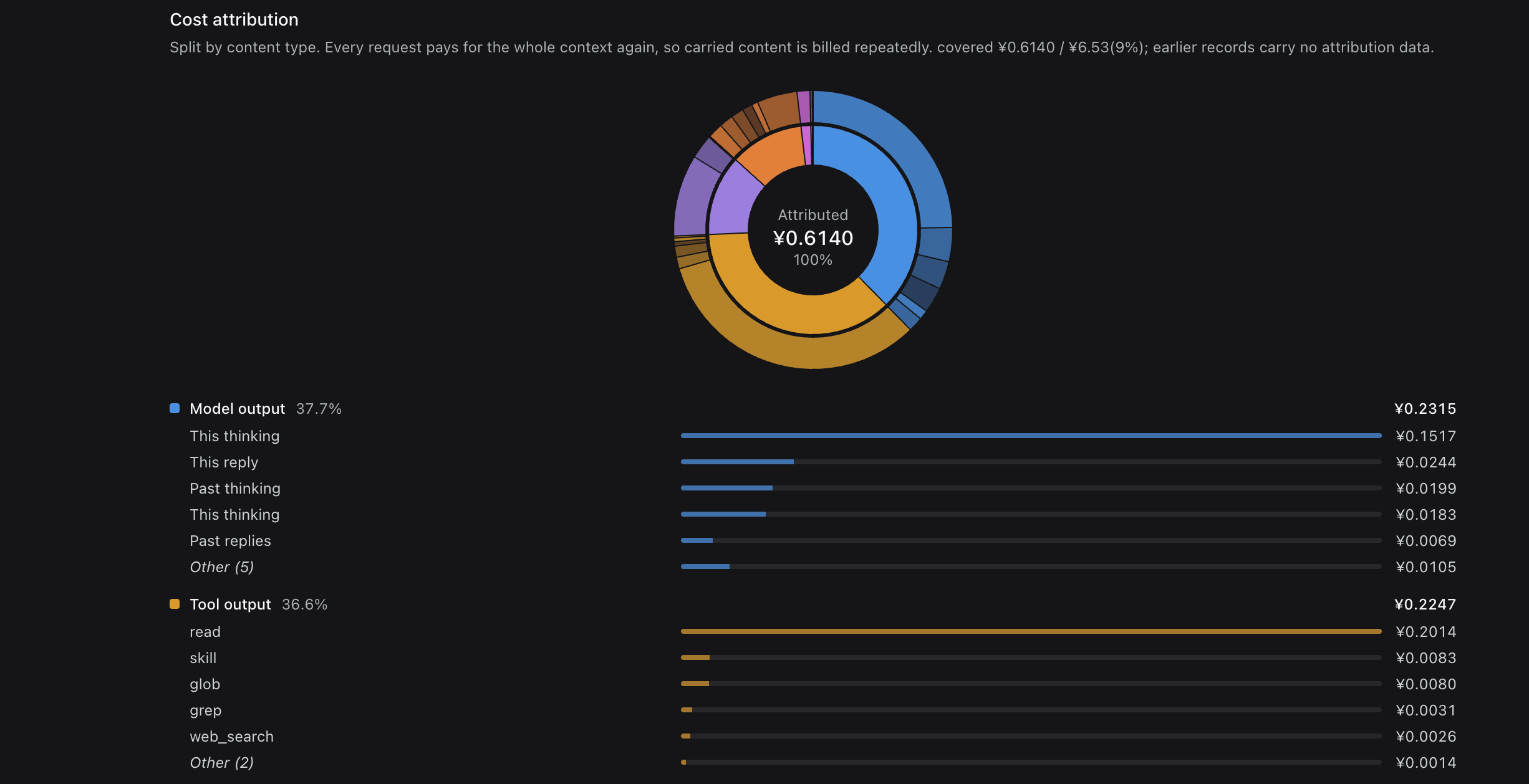
- Cost attribution — the bill split by kind of content: tool output, model output, system prompt, terminal commands (grouped by
git/pnpm/rg), tool input, attachments, system reminders, user input. The sunburst drills in. - Per-turn cost — one line under every finished turn: what it cost, how many steps, the cache-hit rate. It reads the session log itself, so turns from before you installed the plugin are covered too.
- Always on screen — this session's cost as a pill beside the shipped stats in the composer dock, today's spend against the budget in the sidebar, and each session's cost in its sidebar hover card (DSH 0.1.7+). The dock's figure moves while a turn is still running, from the output that has streamed so far, and becomes the billed figure the moment the provider reports it. Each of the five surfaces can be turned off individually in settings.
- Report — a Cost tab in each conversation (beside Chat and Trajectory) scoped to that session, and an account-wide Cost panel opened from the sidebar icon beside Plugins (DSH 0.1.7+): total, tokens, cache hit, peak share; account-wide also monthly forecast, account balance, budget and a per-session split; broken down by model and by purpose (including loop overhead such as context compaction); a daily trend and a weekday × hour heatmap.
- Budget — a daily / monthly / all-time limit that turns amber past 80% and red when you go over.
- Multi-currency — live rates for ~166 currencies; each model's base rate is shown in the currency its vendor prices it in.
- Agent tool —
bill_stats, so the model can answer questions about spend directly.agentTool: falsein the plugin config leaves it unregistered, for anyone who never asks the model about spend and would rather not pay its schema on every request. - English and Chinese follow the DSH language setting; history from before the install is backfilled from the session log.
How it differs from similar plugins
Three substantive differences:
No hand-maintained price table. Every other plugin ships a built-in table of 2–4 DeepSeek models, which means no prices at all once you switch provider — and which is why they all need a "edit the price table by hand" entry point. dsh-bill pulls models.dev and OpenRouter through llm-pricing, covering 8000+ entries, so a new model is priced the day it ships.
Price is a timeline, not a number. The others compute a cost and store it (or recompute at today's price), so history goes wrong the moment a vendor changes its rates or a call crosses a peak/off-peak boundary. dsh-bill prices each call at that call's own instant, and never recomputes history.
It answers "on what". The others answer only "how much" — they consume the provider's aggregate token counts and never look at the request content. dsh-bill splits the request into classified segments at capture time and apportions cost by position in the cache prefix.
They do some things better: usage-stats reads balances and subscription quotas from 11 providers (dsh-bill only does DeepSeek), cost-meter can read OpenCode Go's subscription quota, and both surface more always-on entry points than dsh-bill does.
The sample is the cost-related plugins under the GitHub dsh-plugin topic with ★ ≥ 40, plus the four published to npm. Lower-starred plugins such as deepseek-harness-wallet were not checked individually.
| dsh-bill | cost-meter | usage-stats | dsh-cost | cost-log | dsh-usage | usage-billing | |
|---|---|---|---|---|---|---|---|
| stars / version | — | ★42 / 1.3.1 | ★40 / 0.2.0 | ★3 / 0.2.1 | ★2 / 1.0.0 | ★2 / 0.1.1 | 0.2.2 |
| price source | online catalogue | built-in table + hand-scraped docs | none | built-in table | built-in table | user-entered | built-in table |
| models covered | 8000+ entries | 4 DeepSeek | — | 4 DeepSeek | 2 DeepSeek | one at a time, by hand | DeepSeek |
| unlisted model | flagged, excluded from totals | billed at flash rate | flagged unknown | billed as v4-pro | flagged ≈ |
flagged -- |
counted as 0 |
| history never recomputed | ✓ | ✗ | — | ✗ | ✓ | ✓ | manual backfill |
| content attribution | ✓ | ✗ | ✗ | ✗ | ✗ | ✗ | ✗ |
| forecast | ✓ | ✗ | ✗ | ✗ | ✗ | ✗ | ✗ |
| budget | ✓ | ✓ | ✗ | ✗ | ✗ | ✗ | ✗ |
| account balance | ✓ | ✓ | ✓ | ✓ | ✗ | ✗ | ✗ |
| pre-install history | ✓ | ✗ | ✓ | ✗ | ✓ | ✓ | ✓ |
| agent tool | ✓ | ✗ | ✗ | ✗ | ✗ | ✗ | ✓ |
| currencies | 166, live rates | 3, fixed rates | — | follows UI language | ¥/$ | single | ¥ only |
Pricing
- two catalogues, models.dev and OpenRouter, cached for 24h and written to disk, falling back to a built-in historical snapshot on failure;
- DeepSeek's own direct rates override the catalogue, and the peak / off-peak rate is chosen from the call's timestamp;
- model names are normalised, and anything that still fails to match is flagged
?and excluded from totals — nothing is estimated; priceOverridescan override or add any price (rarely needed).
Attribution method
Every request pays for the full context again, so one tool output read into the conversation keeps being billed on every subsequent request until it slides out of the window. Attribution is computed per request and summed.
Two things matter:
- Price by position. Under prefix caching the first N tokens of the prompt bill at the cache rate and the rest at full rate — on DeepSeek the two differ by up to 156×. Segments are ordered exactly as the provider received them, the cached prefix is charged at the cache rate, and only the tail pays full price. Apportioning by an average unit price files the money under the wrong category.
- Counts only. Attribution happens at capture time on the live request; only the per-category amounts are written to disk. No prompt text is stored.
Per-segment token counts are estimated from character share (providers return only a total), and the total is the real billed figure, so the parts sum exactly to what you paid.
The session log holds token counts and model routes but not the request bodies — which is why pre-install history can be backfilled as spend, but cannot be attributed retroactively. The report states what fraction is covered.
Configuration
The budget, its currency, the display currency shared by every figure, and which of the five surfaces are shown are all set on the Cost page in settings, and stored in $DSH_HOME/dsh-bill/prefs.json. The two currencies are separate settings: the budget's is the promise ("¥100 a month") and does not follow the display. (Not in the harness's own settings document: its API proxy serves a fixed allowlist of namespaces to the browser, so a plugin's namespace is never readable or writable from there.)
maxRecords (the in-memory ring buffer size, default 20000), agentTool (register bill_stats, default true), backfillTimeoutMs (the total budget for the boot-time history import, default 60000) and priceOverrides are plugin config and are validated at startup — a mistyped field is reported by name rather than leaving the report quietly empty. ~/.dsh/profiles/web/cordis.patch.yml is only needed when you want to override a price:
- insert:
    - id: bill
      name: 'dsh-bill'
      config:
        priceOverrides:
          'anthropic/claude-sonnet-4-6':
            inputPerM: 3.0        # USD per million input tokens (uncached)
            outputPerM: 15.0
            cacheReadPerM: 0.3
            cacheWritePerM: 3.75
Data and privacy
- each call's provider / model / token usage and attributed amounts are written to
$DSH_HOME/dsh-bill/records.jsonl(a 20 000-entry ring buffer; older entries are folded into a rollup); - the API key used for the account balance is read and used host-side and never reaches the browser;
- nothing is sent anywhere except the price catalogues, the exchange-rate endpoint, and the balance query; no conversation content is stored.
Implementation
| Layer | How |
|---|---|
| Capture | hooks the llm/stream waterfall, wraps the stream to observe usage chunks, passes everything through untouched |
| Pricing | llm-pricing resolves catalogue / peak rate / override at the call's own instant |
| Attribution | the request is split into classified segments at capture time and apportioned by position in the cache prefix |
| Backfill | lists the session log once, imports sessions it never recorded with a cancellable budget, deduplicating on turn:step |
| Per turn | the billTurns session projection folds the session log host-side and pushes to the client — no polling; billLive pushes the open step's estimated output as its own small value |
| Storage | in-memory ring buffer plus append-only JSONL, folded into a rollup before eviction; preferences in their own small JSON document; atomic replace and file locking borrowed from dsh-atomic-write |
| Transport | the ctx.connection.rpc channel /dsh-bill when there is one, falling back to POST /dsh-bill/api |
| UI | conversation.view / main + sidebar.panellist / conversation.chat.turnTail / conversation.composer.dock / sidebar.footer.action / sidebar.session.row.hover / settings.section, built on the host's --dsw-* design tokens |
License
MIT
Links
More in this category
bowenliang123/dsh-context★ 1728
DSH context insight panel: Context dashboard + /context command + Context browser — one-stop context lifecycle management with categorized composition, content details, evolution trends, compaction/injection events, and stats.
Han-1413141/dsh-cost-meter★ 361
Per-session and daily API cost, budget with usage %, official balance, history dashboard, and one-click official price sync with peak/off-peak pricing.
wssfk12138/dsh-damage-pulse★ 236
Tracks DeepSeek token usage, per-call and session costs, and account balance with cache-aware charge animations in the DSH Web UI.
zh667/TokenLedger★ 202
Sidebar usage panel that attributes tokens to the relay site that served each request, read from your existing provider config: today/month/all-time totals, per-site and per-model breakdowns, a year activity heatmap, and New API / Sub2API / DeepSeek balances.
Ychris12138/dsh-usage-stats★ 169
Multi-provider usage dashboard with provider/model token breakdowns, calendar drill-downs, account balances, and OpenCode Go / Z.ai subscription quota tracking.
PolinniZhong/dsh-personal-center★ 118
Personal center for DeepSeek Harness: cross-session usage statistics, per-model cost estimation, global custom instructions, a global font-size adjuster, a data-driven desktop pet with bitmap & vector skins, and a conversation status overview, all local and offline.
Community comments
Comments are public GitHub Discussions. Loading them connects to GitHub and Giscus; a GitHub account is required to post.