Recovers broken DSH turns: widens the product's own retry budget and renders the wait as a live countdown inside the same step, keeps a truncated output alive inside the same turn, and can open an opt-in continuation round when a turn has already ended; while the composer is empty it hands the send button to that continuation.
Install
# from GitHub (first run asks for allowBuilds approval — follow the hint, retry)
dsh plugin --profile web add github:zchuxi/dsh-restart-task
Any plugin you install runs third-party code with your own permissions — it can read your files, use your credentials, and reach the network, and tool approvals don’t sandbox it. GitHub-sourced plugins also run build scripts at install time — pnpm blocks those until you allow them, so an install can stop with ERR_PNPM_GIT_DEP_PREPARE_NOT_ALLOWED or ERR_PNPM_IGNORED_BUILDS; dsh prints the exact key to add under allowBuilds in your profile’s pnpm-workspace.yaml, and the install works on the next run. Allowing a build is a trust decision: only install sources you trust, and pin a commit (github:owner/repo#sha).
README
description: "A DSH web plugin that recovers broken turns: widening the provider's visible retry budget for failed requests, in-turn keep-alive for truncated output, an opt-in continuation turn, and a composer whose send button becomes "continue" when the composer is empty." kind: "package-reference"
dsh-restart-task
English | 中文
A DeepSeek Harness web profile plugin: a round control in the composer, a three-tier recovery policy behind it, and a settings card for the whole thing.
The design rule everything follows: recovery should be quiet, and only as visible as it has to be.
| tier | when it applies | what the transcript gains |
|---|---|---|
| 1. widen the visible retry budget | a model request failed | the product's own live retry countdown (owned by dsh-llm-retry); the record is taken away once the retry settles (§2.1) |
| 2. in-turn keep-alive | the reply hit the output ceiling | no new round; the continuation row is hidden |
| 3. new continuation turn | the turn already ended broken | one round + one collapsed row (hidden by default) |
0. Which DSH this is for
Written against DSH 0.1.7-rc.1, the 0.1.x line after it, and the 0.2.x line, and
it says so where the loader looks: peerDependencies["@deepseek-ai/dsh"] is
>=0.1.7-rc.1 <0.1.8-0 || >=0.1.8-rc.1 <0.2.0-0 || >=0.2.0-rc.1 <0.3.0-0 (the
enforced field), the declarative engines.dsh agrees, and the plugin's
@deepseek-ai/schemastery is ^3.18.4 — the first release with .volatile()
schemas, which the settings model below is built on.
Why the range has branches: node-semver only lets a prerelease satisfy a range when some comparator on that version's
major.minor.patchtuple carries a prerelease tag of its own. A range that looks broader,>=0.1.7-rc.1, silently excludes the next lines' release candidates (0.1.8-rc.1,0.2.0-rc.1) — the user meets anERESOLVE, or the loader skips the bundle. So each supported tuple gets its own branch:>=0.2.0-rc.1is what lets the0.2.0-rc.1prerelease (npm'snexttag) itself through, and<0.3.0-0keeps the next minor out. Since 0.1.7 the host enforces exactly this field —evaluatePluginCompatibilityrunssemver.satisfies(runtime, range, { includePrerelease: true })overpeerDependencies(it never readsengines) at install and launch — so a mismatch is a clear message, not a runtime crash.
The version matters because the two seams this plugin lives on both changed:
- Settings stopped being a namespace a plugin registers.
settings.register( namespace, schema, { applies: 'live' })and itssettings.get(namespace)are gone in 0.1.7, with no successor: a plugin'sConfigis its settings surface, and a form addresses the plugin by its profile entry id. See §8. - A plugin-sourced message is no longer a
{ kind: 'plugin', plugin }wrapper. Session format v4 requires a producer-ownedsource.kind; this plugin uses its own package name. See §4.
On an older runtime the bundle is skipped up front with the loader's own
compatibility line (and dsh plugin allow-version is the documented escape hatch),
which is the honest outcome: the two seams above do not exist there. 0.2.0-rc.1 keeps
those same seams (the agent/request-error waterfall, retryPolicy,
agent/turn-stopping, the session projection, the settings form and the composer
slot are all unchanged), so admitting the 0.2 train is a manifest-only change.
What 1.5.0 verified and completed against 0.2.0-rc.2. Every seam above was
re-checked against a running 0.2.0-rc.2 instance: agent/request-error still hands
over a ResolvedRetryPolicy (mode / maxRetries / retryableCodes / the flat
backoff block), agent/turn-stopping is still an awaited serial event and
agent.steer() still posts into next-step, agent.followup() still opens a new
turn, settings.configure(presentation, fiber) and the "a form is addressed by
entry.options.id" model are unchanged, and both occupied slots
(conversation.input.right, plugins.bundle.config) are still where the client
half puts them. It also closed two gaps that only 0.2 exposes: the turn-level
max-tokens end reason (see §7), and an in-turn continue that could push an
instruction into a turn the human had already stopped.
1.5.1. The visible retry now cleans up after itself: the live countdown stays
while a retry is waiting, and the record it leaves behind once the retry settles
— "已重试模型请求(N/M)" / "模型请求重试已取消(N/M)" — is taken away (§2.1,
hideSettledRetry).
1. The manual control
While the last turn is broken, a round control appears in the composer action cluster, immediately left of the shipped submit button.
| session state | control does |
|---|---|
last turn ended error / aborted / interrupted |
continue — asks the host to carry on from the breakpoint |
last turn's answer hit the output ceiling and its closing step really was truncated (max-tokens) |
continue — finishes the part that never got written |
an agent-level error was reported (lastAgentError) |
continue |
only the last send failed (promptError) |
resend the last prompt — there is nothing in history to continue from |
| running, blank, or nothing to act on | not rendered |
| the composer holds a draft | not rendered — the message is about to go out, so a continuation is not offered next to it |
Outcome reporting is inside the button (spinning / green check / red ! + the
message in its title). Nothing this plugin renders is inserted into the
layout: an earlier iteration reported through a line under the composer and
every state change reflowed the composer.
1.1 The send button itself (sendBecomesContinue, default on)
A continuation on offer is exactly the state in which the shipped send button is
useless: with an empty composer the product disables it (empty || blocked || uploadsPending) and renders it at 40% opacity, so there is nothing to send and
nothing to click. So the round control is not the only door: while a continuation
is on offer and the composer has nothing else to send, this plugin hands the
send button the same action.
| composer | send button |
|---|---|
| empty, last turn broken | enabled, warn-coloured, round arrow, aria-label="继续上次任务" — one click continues from the breakpoint |
| the human is typing | untouched: it stays the ordinary send button and sends what they wrote |
| the agent is running | untouched: it stays the product's stop / queue / steer control |
Mechanically this is the one place the plugin writes to a product element, and it is written narrowly:
- The composer's primary control is inline JSX with no slot (the composer
exposes
conversation.input.{left,right,model,attachments,activity,dock,overlay, permission,plan}and nothing for submit), so the pass marks that element with its own attribute,data-dyn-continue="1", and dresses it from its own stylesheet. It never touches the class list React owns. - It may only take a control the product cannot use —
disabledis the condition, which is why a composer the human is typing in is never touched. Taking it over means clearingdisabled, and the observer re-applies the takeover if React ever writes it back. Because the takeover clears exactly the signal it gated on, the draft itself is re-read on every pass and again at the click: the moment the composer holds something, the takeover lets go, the product's label comes back and the human's message sends. A takeover that outlived the empty composer would turn a written message into a continuation, which is worse than no takeover at all. - The click is intercepted in the capture phase on
documentand stopped there: the product's handler rides React's listener on the root container, which is below that point, so the send path never also fires. Every other click in the window passes straight through. - The action itself isn't re-implemented: the pass clicks this plugin's own round control (which is hidden by CSS while the button carries the action, and still mounted), so both affordances share one busy guard, one double-click fence and one outcome flash — the button turns green / red / spins with the same state.
- Releasing removes the attributes, restores the label the product gave the button,
and restores the product's own verdict for an empty composer (
disabled) — without that, the control would sit enabled-but-idle for the rest of the session and no later continuation could be offered through it. A composer that holds a draft keeps whatever the product rendered, because that message is exactly what must stay sendable. hideContinueRowand this switch are independent, and both can be turned off in the card. With the takeover off, the round control is the only affordance and the send button is left exactly as shipped.
Known limits: this reads the product's DOM rather than a declared API, so a
release that renames the primary class or drops data-composer-card makes the
takeover stop happening (nothing else breaks — the round control still works);
in the rare states where the product disables the send button for its own reasons
while a continuation is on offer (an upload in flight, a pending approval) the
takeover applies there too; the shipped tooltip still says “发送消息” while the
button carries the continuation (the button's accessible name and its title are
this plugin's); and the Enter key is left alone — the fixed send action is
read-only in the product and hijacking it would make an empty-draft Enter start
unrequested work.
2. Tier 1 — widen the visible retry budget (default on)
agent/request-error is a waterfall. This plugin registers with prepend,
i.e. ahead of the product's own dsh-llm-retry listener on the same seam. On a
failed step it replaces payload.retryPolicy in place with a wider policy and
then next()-delegates — the retry owner reads the wider policy and does the
retries itself. So every retry shows up as the product's live countdown row
(the user can watch it tick down and cancel it), and the durable llm/retry
events stay authored by the code whose invariant guarantees them; this plugin
never forges them.
The normal-mode replacement is { mode: 'normal', maxRetries: maxRequestRetries, retryableCodes, …backoff }: maxRetries comes from this plugin's budget
(default 30), the backoff base from retryBaseDelayMs (capped at 60s, 20%
jitter), and retryableCodes is inherited from the provider's own resolved
policy (falling back to the product's default set when the step routed to
none) — i.e. "this plugin owns the retry budget and pacing, the provider still
owns which errors are worth retrying". Terminal client errors (401, quota, …)
are not in that set, so they still fail fast; widening the budget never turns a
bad API key into an infinite loop.
Turning on retryForever installs { mode: 'always', …backoff }: the owner
retries any failure forever with no terminal-error guard — which is why it
stays opt-in, for unattended long tasks.
Only a step that actually routed to a retry policy is widened: a request that
never reached an adapter (payload.retryPolicy absent) would be refused by the
owner anyway, and inventing a policy cannot save it, so it is delegated
untouched, preserving the owner's own refusal path. Because the retries are done
and counted entirely by the product's owner, this plugin no longer waits or
keeps a per-step counter.
The shipped dsh-llm-retry also listens on agent/request-error, and dsh-base
mounts it before this plugin, so it sits upstream: it tries its own policy
first (normal mode: five attempts with its own backoff) and only delegates with
next() once that is exhausted, at which point this plugin's budget starts. The
two budgets therefore add up — turn the shipped policy down, or this one off, if a
failure should stop sooner.
2.1 Settled retry records stop being kept
The live countdown of a retry in progress has to stay — it is the whole point of a visible retry. But once a retry is over the product still leaves its record in the conversation: re-sending the request turns it into "已重试模型请求(N/M)", and a retry cancelled by a closing turn into "模型请求重试已取消(N/M)". The request either succeeded or was given up on, and at that point the record is nothing but noise.
So hideSettledRetry (default on) adds one conditional rule, sitting beside
the continuation-row rule of §6 and governed by a switch in the same way:
[data-chat-flow-kind="model-retry"]:not(:has(details[data-active])) { display: none !important; }
Every part of that test is read off the product's own render, none of it guessed:
model-retry is the flow kind the product gives a retry node, and data-active
is the attribute it puts on that <details> exactly while a retry is waiting out
its backoff — React stops emitting it once the request is re-sent (started) or
the retry is cancelled (cancelled). The rule therefore takes away only the
settled record; the countdown keeps ticking and stays expandable for its delay
and failure reason.
It also does not try to tell whose retry it was: while this plugin owns the retry
budget (retryFailedRequests on), every retry in the transcript is one it
widened. Turning the visible retry off makes this rule fall away with it, so
retries the product runs on its own budget keep the product's own presentation —
hiding someone else's UI is not this plugin's business. Like §6, it reads the
product's render rather than a declared API: a release that renames the flow kind
or drops data-active makes the rule stop matching (the record simply comes back;
it never hides a row it cannot attribute).
3. Tier 2 — in-turn keep-alive (no new round)
When a step ends because the model ran into its output ceiling, the turn is
about to close. agent/turn-stopping is the boundary where a listener may
object: calling agent.steer(...) puts fresh input in the inbox before the
boundary commits, and the loop runs another step inside the same turn.
"The turn is about to close ... a listener that objects steers (
agent.steer(...)) and the machine re-reads its inbox: fresh steering runs another step, none closes the turn." —dsh-agent/lib/types/runtime-types.d.ts,agent/turn-stopping
So the round count, the rail and the history do not move. Bounded by
maxTurnContinues (per turn), and only ever triggered when the step's finish
reason really was max-tokens — read from the finish chunk of the live
agent/assistant-stream, one frame before the boundary, so no session-log
poking is needed.
Two honest limits:
- The boundary is only reached on a normal stop.
abortedanderrorleave the loop throughthrow, so tier 2 never applies to them. - The steered instruction is still a logged
user/message— it renders as one collapsed context row (see §6), never as a user bubble.
4. Tier 3 — a new continuation turn (default off, visible)
When a turn really ended broken, a continuation posts one plugin-sourced
message through agent.followup:
{ role: 'user',
  content: [{ type: 'text', text: '<continue instruction>' }],
  source: { kind: 'dsh-restart-task', form: 'notice',
            summary: '继续上次中断的任务' } }
source.kind !== 'user' is what keeps it from being a user bubble: it renders as
a collapsed row — and because this message opens the round, the product renders
it as its non-human trigger notice rather than a context row (§6). The kind must be this producer's own name — session
format v4 requires a producer-owned source kind and refuses the retired
plugin-namespace wrapper (kind: 'plugin' plus a plugin field) on newly
written messages; that shape is only lifted by the v3→v4 conversion of
already-stored history. Writing it here fails the entire turn with format v4 message requires a producer-owned source kind, because the continuation message
is appended before the step can run. But it is still a new turn, so the transcript gains
that row and the turn rail gains an entry — which is exactly why autoContinue
defaults to false and the manual control exists for on-demand use.
Guard rails while it is enabled: a good turn end, a new turn/start, or anything
the human typed cancels the pending continuation and clears the streak;
maxConsecutive caps a run of continuations.
A stop is final. The composer's stop control cancels the turn with
{ kind: 'user' }, the loop parks that cause on the aborted turn/end reason
(agent.cancel(cause) → turn/end { reason: signal.reason }), and isUserStop
reads it back. A turn the human stopped is therefore never continued, whatever
autoContinue / onAborted / maxConsecutive say — the check runs before all of
them. Tier 1 applies the same rule from the other end: a request that died because
its turn was stopped is handed to the next listener instead of being retried, so
pressing stop is never fought by a retry.
resend (manual, send-failure case only) is the one path that posts user text —
a prompt that never reached the host is not in history, so re-posting it is the
only thing that can work. It registers no optimistic echo, so it cannot double a
row.
5. Why a closed turn cannot be continued in place
This is a structural constraint of the agent loop, not a missing API. The facts, for the record:
- A new turn number can only be
previous + 1, and it is always announced withturn/start(dsh-agent-loop/lib/index.js,turn()). turn/endis appended in afinallyblock on every path, so a broken turn is durably closed before any plugin hears about it.- Every message that enters a step is appended as
user/messagewithsurfaceOp: 'append'; the plugin cannot choose a non-appending surface op for the message that wakes the loop. - Session events are append-only: there is no remove / truncate / rewrite API on
the
Sessionseam or the persistence layer, so a continuation cannot be pruned after the fact. (dsh-rewind-plugindoes not delete events either — it appends a replacement surface, and replacement copies stay model-only.) - The
interruptedmarker is written by the crash repair path, which closes an orphaned turn after the fact; the loop never emits it live, and resuming a session does not wake a driver.
So tiers 1 and 2 are the whole answer to "can it continue without a new round", and tier 3 is the only thing possible for a turn that has already ended.
6. Hiding the continuation row
Tier 2 and tier 3 rows exist so the model can read the instruction; they are plumbing, and Chat has exactly two shapes for them — neither of which a stylesheet can single out:
| shape | when | what identifies it |
|---|---|---|
| collapsed context row | the message did not open the turn (tier 2, a steered step) | a valueless data-context-source attribute, and the producer's name as text |
non-human trigger notice (data-chat-flow-kind="turn-trigger") |
the message opened the turn (tier 3, tier-1's manual use) | nothing — an unknown source kind is not even distinguished from a request trigger |
So hideContinueRow (default on) is a small transcript pass, not a
selector: every row the pass can attribute to this plugin is tagged
data-dyn-restart-row="1", and one conditional rule hides this plugin's tags:
[data-chat-flow-kind="context"][data-dyn-restart-row="1"],
[data-chat-flow-kind="turn-trigger"][data-dyn-restart-row="1"] { display: none !important; }
Attribution has two sources, and it never guesses:
- A context row whose provenance label is exactly this plugin's
source.kind. - A trigger row in a round this plugin opened — computed from the live session
event window (
ownWakingTurns), read from the session the composer control is mounted for. A turn's input is appended after itsturn/start, never before it (the durable order isturn/start(7)→user/message(kind: dsh-restart-task)→ …), so a message opens the round it lands in exactly when it is that round's first input. Tiers 1 and 3 post through the next-turn inbox, which is what makes their row the trigger notice; a tier-2 steer is claimed by a step of an already-open turn, so it is never a first input and never gains a round. Without a window yet, this rule is skipped and rule 1 still covers tier 2.
The second source accumulates, and a third makes it whole-session. The client only ever holds a paged window, and folding a completed round or loading another slice replaces it with a smaller one; a set recomputed from the current window alone would forget a round it had already recognised, and the rail mark would come back until the next slice arrived. So:
- whatever either source says is remembered while the transcript stays on one session, and starts over when the transcript moves to another one;
- the host half registers a session projection (
restartTaskRounds, the same fold over the whole log rather than one page) whose value the projection seam delivers to the client wholesale, and the browser half unions it in. That is what attributes a round whose events are not loaded at all — the case a paged transcript (加载更早) produces, where nothing on screen says whose round it is.
Another producer's row — time context, AGENTS.md, skills, cron, subagent
settlements, goal rounds — is never tagged and never hidden. The pass is
idempotent (React re-renders leave foreign attributes alone), it clears its own
tags when the switch goes off or the plugin unloads, and when it cannot read a
view it does nothing at all rather than hiding something it cannot attribute.
A lost attribution is therefore a cosmetic miss (a row keeps rendering), never a
wrong guess about someone else's row.
Caveats, honestly: both rules read the product's rendering rather than a declared
API, so a release that renames the flow attributes or re-labels the provenance
span makes the pass stop matching (nothing breaks — the row simply shows again);
a round whose events are not in the loaded window yet is not attributed until
its history is loaded — the rail's own whole-log outline knows every round but
carries only {turn, prompt, response} and no producer kind, so a round with no
human prompt is indistinguishable there from a subagent's, a goal's or a cron
trigger's, and guessing would hide someone else's round (this is the one gap a
future release could close by exposing the trigger kind); and the turn rail's own
entry for a tier-3 round is untouched by this rule (see §7).
7. The turn rail
A tier-3 continuation is a real turn, so the rail earns a mark for it — and
because that turn carries no human prompt, the mark's hover card can only
fall back to an anonymous 第 N 轮 / Turn N. That fallback is not data a plugin
can change: the rail is inline JSX with no extension point, and the
whole-session turnOutline projection accepts a prompt preview only from
source.kind === 'user' (dsh-session-turn-outline/lib/types/projection.js).
continuedRailMarks therefore treats it as presentation, with three modes:
| mode | effect |
|---|---|
hide (default) |
the round's rail mark, and with it the hover card, is not shown |
preview |
the mark stays (still clickable to jump there); hovering it no longer shows 第 N 轮 — only the round's answer preview |
keep |
the product's own behaviour, untouched |
Mechanically it is one small DOM pass, not a stylesheet trick. The rounds are the
ones ownWakingTurns attributes to this plugin (§6) — the rounds, not the rows
the transcript pass tagged: a tier-2 steer hides a row inside the human's own
round, and that round's rail mark is emphatically not this plugin's to touch. Each
rail mark is matched to its round through the mark's accessible label (the only
per-round attribute it has), then tagged with the configured mode:
[data-dyn-continued='hide'] { display: none !important; }
nav[data-dyn-continued-preview='1'] [class*='_previewPrompt'] { display: none !important; }
Our own round's mark is tagged hide/preview; every other mark is left exactly
as the product drew it. Because hide is display: none on the mark itself, the
hover card has nothing left to attach to: that round's 第 N 轮 tooltip cannot
appear at all.
Hiding the mark is only half of it. The rail's virtualizer reserves that round's place — it sizes the marks container from its own measurements and never reflows it, and the product writes no per-mark geometry of its own — so a hidden mark left its slot behind as a hole in the middle of the rail. The pass therefore compacts what is on screen: it measures the pitch between the marks the view rendered, moves every mark after a hidden one up by one pitch, and shrinks the container by the number of hidden rounds. Both overrides are this plugin's own inline properties, recomputed on every pass and removed the moment nothing is hidden or the plugin unloads, so the rail returns to exactly what the product drew.
Honest limits: it can only tag and compact rounds the view has actually rendered
(a round far outside the loaded window is tagged as soon as it is scrolled into
range); marks are virtualized, so only the marks in the rail's own scroll window
are handled at any moment; it matches marks through their accessible label because
a mark carries no round attribute of its own; the rail's own DOM changed in 0.1.7
(a button[data-index] inside the marks container, with no per-mark position
wrapper), which is what this pass reads; and the compaction is geometry the
product recomputes on its own schedule — a re-render puts the marks back where the
virtualizer wants them, and the next pass (a DOM mutation away) compacts them
again.
8. Settings card
Plugins page → dsh-restart-task (the sidebar page the plugin manager owns).
The card is registered into that page's plugins.bundle.config seat, keyed by
this bundle's package name (dsh-restart-task) — the page's own contract for "a
bundle that carries its own configuration", and the only seat that survives the
0.1.7 rewrite (the old settings.plugin.item tab is gone). It is registered only
while the host serves this plugin's settings entry, so a deployment that never
mounted the row shows no trace of the card.
The card owns its whole chrome: a collapsible header with a live policy summary, four grouped sections, per-field "已自定义 / 恢复默认", and a footer with the write state and "全部恢复默认".
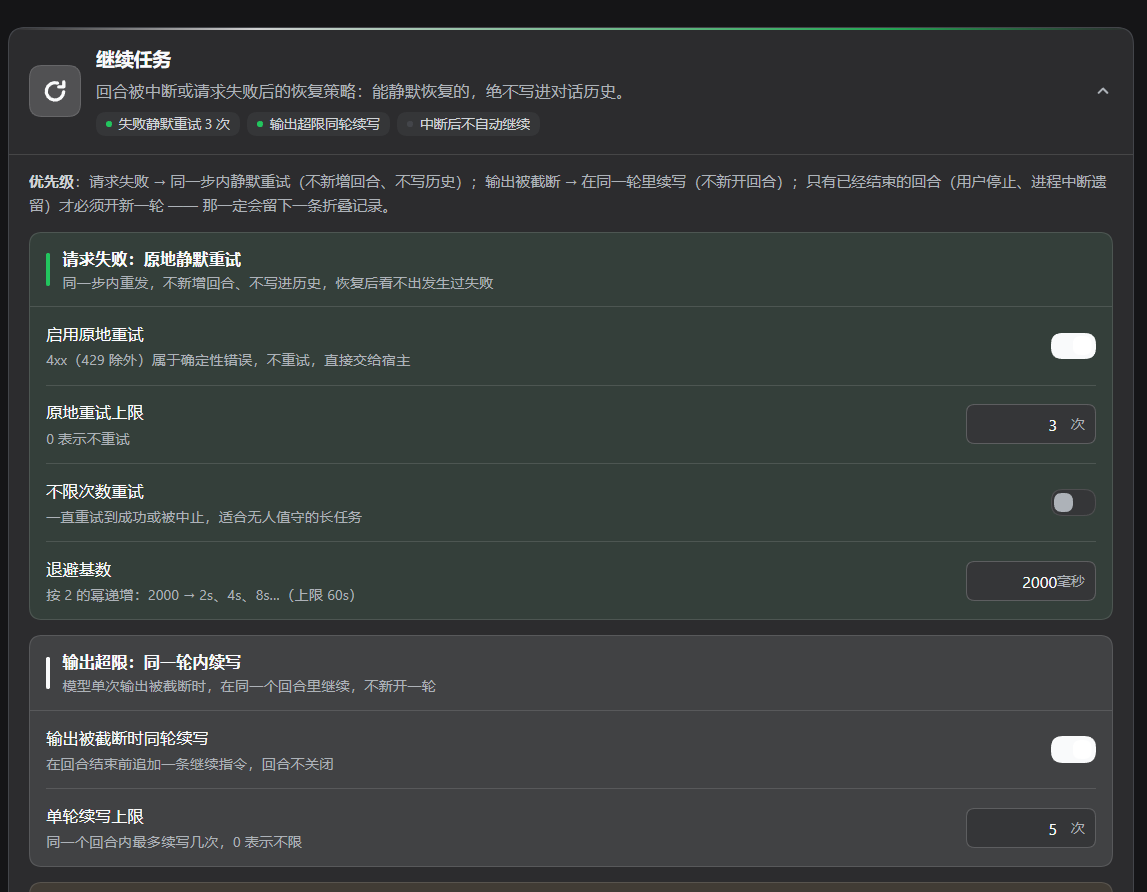
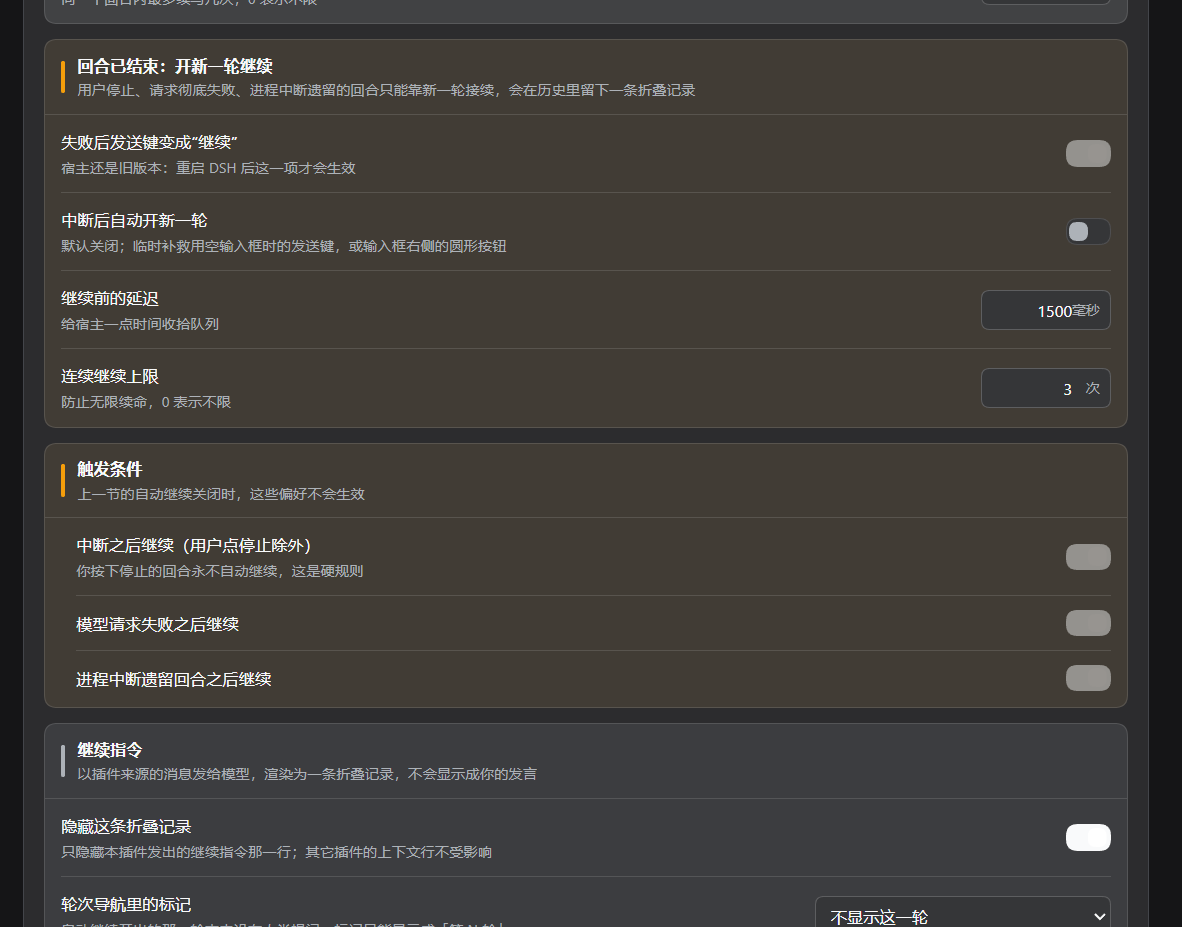
| field | default | meaning |
|---|---|---|
retryFailedRequests |
true |
widen the provider's visible retry budget on a failed request |
maxRequestRetries |
30 |
the visible retry budget handed to the product's retry owner (0 = none) |
retryForever |
false |
hand over an always policy — retry until success or abort (drops the terminal-error guard) |
retryBaseDelayMs |
2000 |
backoff base: 2s, 4s, 8s … capped at 60s |
keepAliveOnMaxTokens |
true |
keep a truncated turn open and continue inside it |
maxTurnContinues |
5 |
continued steps allowed inside one turn (0 = no limit) |
autoContinue |
false |
open a new continuation turn after a broken turn (visible) |
delayMs |
1500 |
wait after the break before continuing |
maxConsecutive |
3 |
cap on consecutive continuation turns (0 = no limit) |
onAborted |
true |
continue after a system cancellation (parent agent / hook); a human stop is never continued |
onError |
true |
continue after a model request failure |
onInterrupted |
true |
continue after a crash-orphaned turn |
onMaxTokens |
true |
continue when the answer hit the output ceiling and stopped short (fires only when the closing step really was truncated) |
sendBecomesContinue |
true |
hand the shipped send button the continuation while the composer is empty (see §1.1) |
hideContinueRow |
true |
hide this plugin's own collapsed rows in Chat |
hideSettledRetry |
true |
take away the "已重试 / 已取消" record once a retry settles; the live countdown stays (see §2.1) |
continuedRailMarks |
hide |
how the rail presents rounds this plugin continued (hide / preview / keep) |
continueText |
(built-in) | the instruction sent to the model |
onAborted / onError / onInterrupted / onMaxTokens are disabled while
autoContinue is off, because they only describe when that tier fires.
Why
onMaxTokensneeds a verdict of its own: DSH pins a turn'sturn/endreason tomax-tokensthe moment any step hits the output ceiling, and a later step can never downgrade it. So a turn that tier 2 already rescued and carried to completion wears the same reason as one that genuinely stopped short. The plugin separates them with the closing step's own finish reason (live, fromagent/assistant-stream, on the host; read back out of theassistant/messagestream records in the browser): only a closing step that is itself at the ceiling counts as unfinished. The same verdict is what keeps tiers 2 and 3 from answering one break twice.
Why the card can say "the host did not accept this write":
configFormsanswers a refused write by resolvingfalse, not by rejecting (ConfigFormController.mutatereturnsfalseon!response.ok, andenqueueresolvesfalseoutright under the memory persistence mode). An earlier version only attached a success handler, so a refused write still painted "已生效(无需保存)" — with the user's own draft left sitting in the editor, looking exactly like a value the host had taken. Every write, every per-field reset and the bulk "reset everything" now read that boolean, and report success only when every operation landed. The numeric inputs also carry the host schema's.max(), so the refusal cannot happen in the first place; the regression harness compares the card's cap table against the host schema field by field.
1.2 The send-button takeover requires a single composer
The takeover rests on two document-wide facts: this plugin's pending-continuation
state is plugin-wide (published by whichever session's control rendered
last), and primaryButtons() sweeps every composer card in the document.
With one card on the page those two facts name the same composer; with two they
do not — the last publisher's state dresses a stranger's send button, and a click
can no longer be attributed to a session at all.
So soleComposer() gates the path: on more than one [data-composer-card] the
plugin stands down entirely, hands back every button it already holds, and
dresses none. The click is likewise resolved from the clicked button's own
card (controlInCard(cardOf(button))) rather than the document's first
.dyn-retry-round, and the fallback branch declines on two cards as well.
The product renders one card per conversation
(renderSlot('conversation.composer.bar', …) — the empty-session hero look is a
variant of that same single render, not a second instance), and the layout
mounts the centre panel through the keyed main slot, so one card is today's
normal shape; the guard is for the day that stops being true. Either way,
standing down only makes the feature idle, never wrong — and the round
control is scoped by its own slot, so it is unaffected by the guard.
How the values get in and out (0.1.7's configuration model)
There is no settings namespace any more, so the wiring is:
- The host half's
Configis the form. Every field is.volatile(), which is what makes it live-editable; the loader then handsapplya reference per field, andconfig.<field>.get()is what the three tiers read on every decision. A write takes effect on the next break with no restart, and no plugin event is involved. - The form addresses the profile entry id,
restart-task— the id this package'scordis.patch.ymlinserts. It is not the package name, and the browser half cannot import the host half's constant, so both halves and the patch file spell it; the regression harness asserts all three agree. - Writes go through
configForms.get('restart-task')(the browser half's shared form for that entry): a snapshot of the served form values plus the raw user layer, withset/unsetper field and a revision-stamped mutate queue behind them. Refused writes come back asfalse, and a conflict re-reads the host rather than clobbering it. - The host does not also generate a page: the plugin registers
settings.configure({ auto: false }, ctx.fiber)inside an optionalsettingschild. That child is optional on purpose — a composition without the settings domain still runs the three tiers and the composer control, and only the card and the two transcript passes stay away.
When client and host disagree
A browser half can be newer than the running host — the normal state right after a plugin update, before the profile restarts. Then the entry may not be served, or may be served without the newer fields, and the card says so instead of failing a write: a field the running host does not serve is shown read-only with "宿主还是旧 版本:重启 DSH 后这一项才会生效", and an entry the host does not serve at all is explained with "宿主没有提供本插件的设置入口". A non-loopback page (settings kept in memory for that session) is labelled too.
Coexistence:
dsh-client-auto-continuealso ships in this profile and also auto-continues interrupted turns (with a user-sourced message, which does show a bubble). Run one of them. This plugin yields if the other fires first: any user-sourced message cancels its pending continuation.
Layout
cordis.patch.yml— profile bundle patch inserting therestart-taskrow; its id is also the settings entry id, and the comments there say so.lib/index.js— host half: theConfigschema every field of which is.volatile(), in-turn retry, in-turn keep-alive, optional continuation turn,continue-taskcommand.lib/client.js— browser half:window.__ModuleLoader__.loadbundle exportingapply+inject(['slots', 'timer']), the composer control, the Plugins-page card (over an optionalconfigFormschild), and the transcript pass that tags this plugin's own rows, presents the rail for the rounds it opened, and hands the shipped send button the continuation while the composer is empty.restart-task.test.mjs— the regression harness (below).screenshots.json— the 1–8 images a storefront shows for this plugin (§8), anddocs/awesome-dsh-plugin-entry.yml— the entry to copy intoawesome-dsh-pluginwhen submitting or updating the listing there. Screenshots live in this repository on purpose: changing one is a push here, not a pull request there.
The control's shape is pinned with !important on purpose: it lives inside the
product composer tool row, which has its own button and svg rules. The settings
card uses the product's --dsw-alias-* tokens and matches its card chrome
(.5px borders, 16px radius, 14–16px header padding) without needing any. Both
injected <style> tags carry data-plugin, because the module system owns
styles by that attribute: an untagged tag is adopted by whichever plugin
materializes next and removed when that one unloads.
Three regions are asserted directly — auto-logic in lib/index.js, core-logic
in lib/client.js, and the host module's own exports — so the decisions the
shipped code runs are the decisions under test:
node dsh-restart-task/restart-task.test.mjs # 426 assertions, both halves
The suite has four layers, because the port to 0.1.7 failed in three ways and the row/rail presentation can only be judged by its effect on a document:
- Rules — the retry budget (terminal 4xx, 429, doubling, the 60s cap,
unlimited), the keep-alive gate (only
max-tokens, per-turn cap), the turn-level gate (broken reasons, per-cause switches, streak cap), the transcript reader (human prompts only, broken vs clean ends), the waking-round reader, the composer control's mode choice, the header summary wording. - Wiring — every identity string agrees (patch entry id ↔ host
ENTRY_ID↔ clientENTRY_ID, package name ↔ bundle seat key ↔ producer kind), everyConfigfield is volatile and every served field is rendered by the card, the retired settings seam and the retired seats/selectors are gone, the row-hiding rule is keyed on this plugin's own tag, and both style tags name their owner. - Host behaviour —
lib/index.jsis imported for real and driven through a stub Cordis context: the command posts one producer-sourced message, a failed step that routed to a retry policy has that policy widened in place before it delegates while a step with no policy and a stopped turn are delegated untouched, a truncated step steers inside its turn while a completed one does not, and the turn-level tier continues only when enabled — never after a human stop, and never past its streak cap. - Transcript, rail and the send button, over a stub DOM — the browser half is
loaded and applied against a fake document holding one plugin round, one human
round (carrying this plugin's in-turn steer), a foreign context row, a foreign
trigger notice, and a composer whose primary control starts disabled: the
plugin's own rows are tagged while everyone else's are not, the steer row is
recognised from its provenance label alone while the trigger notice needs the
session window, the plugin round's rail mark is hidden in
hidemode and flagged inpreviewmode while the human's and the foreign round's marks are never touched, and the send button is taken over, clicked (the click is stopped before the product sees it and the round control runs instead), left alone when the composer has text, and handed back when the switch goes off. The event fixtures are copied from a realsession.v4.jsonl, including theturn/start→ message order that decides attribution.
Further Exploration
These pages cover the seams this plugin builds on, so each one can be checked against the release it declares:
- DeepSeek Harness — the
runtime, the plugin contract, and the packages referenced throughout:
dsh-agent(the Agent face andagent/request-error/agent/turn-stoppingdispatch),dsh-agent-loop(turn and step boundaries),dsh-settings(the configuration form),dsh-session-format(the v4 source rule),dsh-client-ui-conversation(the composer and its slots),dsh-client-ui-chat(the flow rows and the turn rail). dsh-client-shortcuts— the fixed input actions (fixed.send=Enter,fixed.newline=Shift+Enter,fixed.complementary=Ctrl/Cmd+Enter) that this plugin deliberately does not rebind; the busy-Enter behaviour (queue vs steer) is theui-conversationsettings fieldbusyEnter.dsh-llm-retry— the shipped retry executor that mounts upstream of this plugin and delegates to it once its own policy is exhausted.dsh-client-ui-plugin-manager— the Plugins page that owns theplugins.bundle.configseat this card registers into.
Model Experience
What the model sees, per tier:
- Tier 1 stays out of the model's context: the retry is executed by the product's own retry owner, so a retried request reconstructs the same step from the same durable history — the live countdown row the user sees is UI state, not a retry event, delay or provider error reaching the model.
- Tier 2 adds one
user/messagewhosesource.kindis this plugin's name: the model reads the instruction, the human reads a collapsed row (hidden by default). - Tier 3 is a new turn whose only input is that same producer-sourced message. The model therefore sees a short instruction to carry on, never a second copy of the user's own prompt.
KV Cache effect
Retried and continued requests rebuild the same prefix as the attempt they recover, so provider cache reuse is preserved under that provider's rules. The plugin itself contributes no tokens: it adds no tool schemas, no system prompt text, and no context beyond the one continuation instruction that tiers 2 and 3 actually need.
Dev Note
- The harness is the specification.
restart-task.test.mjsslices the pure regions out of the shipped sources and drives the host module for real, so a rule cannot pass here while the shipped code does something else. - Event fixtures come from real logs. The
turn/start→ message order that decides attribution was read out of a livesession.v4.jsonl(one zstd frame per appended batch), after a first version of the rule assumed the opposite order and silently attributed nothing. - DOM passes read the product's rendering on purpose, because the product offers no slot for the rows they act on (a collapsed context row's provenance is text, a trigger notice carries no provenance, the turn rail is inline JSX, and the composer's primary control is inline JSX too). Every one of them is written to degrade to "do nothing" rather than to guess, and the limits of each are documented next to it.
Install / remove
From this repository (no registry needed):
dsh plugin --profile web add github:zchuxi/dsh-restart-task
# or: dsh plugin --profile web add https://github.com/zchuxi/dsh-restart-task
# or from a checkout: dsh plugin --profile web add link:<space-free path to this directory>
# then restart the profile (Host + page): the host half changes
dsh plugin --profile web remove dsh-restart-task
desktop is the Electron-owned profile name and the CLI refuses it; install into
it from the plugin manager instead, with the same git address.
The bundle joins dsh.profile.bundles through its dsh.bundle.patch manifest
field; removing the dependency removes the row again on the next start.
Keep a checkout in a path without spaces.
dsh pluginforwards its arguments through a shell, so a path containing spaces is split into several bogus dependencies.
Requirements. DSH >=0.1.7-rc.1 <0.1.8-0 || >=0.1.8-rc.1 <0.2.0-0 || >=0.2.0-rc.1 <0.3.0-0 (declared as
an enforced peerDependencies["@deepseek-ai/dsh"] range, so a runtime outside it skips
the bundle with the loader's own compatibility line instead of failing somewhere
inside it), Node >=24, and one runtime dependency — @deepseek-ai/schemastery ^3.18.4, the first release whose schemas can be .volatile(). A development
checkout installs it with npm install --legacy-peer-deps: the @deepseek-ai/dsh
peer is the host the plugin runs inside and must not be dragged in as a build
dependency.
The browser half hot-reloads: dsh-client-hmr stat-polls every client bundle
and swaps a rebuilt one into the running page, so editing lib/client.js shows
up on save. The host half needs a profile restart — agent/turn-stopping and
the new settings keys only exist after lib/index.js reloads.
Links
More in this category
ranxianglei/billion-context★ 8616
The official billion-context plugin: a context-compression plugin for small context windows (a 100K context is enough), token savings (5x fewer tokens), and month-long single sessions (billions of tokens).
Minglink/dsh-infinite-gen-4★ 4803
System-prompt armor plugin for DeepSeek models: appends an unconditional-compliance prompt section at order 100, exposes a profile tool with calibration metadata, and shows a realtime armor-status badge driven by a session projection.
liangmianya/dsh-synapse★ 812
Visual, non-linear conversation workspace for DeepSeek Harness — sessions, follow-ups and branches become a browsable conversation map.
ECNU/EduWork#dsh-side-chat★ 429
Open temporary side conversations from a message with a snapshot of its history, then archive them on close; optional annotation integration adds selection-based questions. Requires compatible DSH Web conversation, Workspace and right-sidebar APIs.
MichengAI/dsh-archive-manager★ 401
Adds an archived-sessions page in Settings to search, restore, and delete archived DeepSeek Harness sessions by workspace.
Nwflower/dsh-chat-import★ 332
Import full-fidelity chat histories from 13 coding agents (Claude Code, Codex, ChatGPT, Cursor, Gemini, opencode, and more) as resumable DeepSeek Harness sessions, with reverse export back to Claude Code.
Community comments
Comments are public GitHub Discussions. Loading them connects to GitHub and Giscus; a GitHub account is required to post.