From chat to canvas to artwork — drive ComfyUI as a visual workflow IDE inside DSH. Embed ComfyUI (local or cloud) as a split-screen canvas in DeepSeek Harness Web: the agent sparks ideas, writes prompts and scripts right in the chat, applies them live to the canvas in front of you, and produces images, music, video, and 3D. From idea to finished output without ever leaving the conversation or switching front-ends: Canvas ops — compose and arrange pipelines, read/write workflows, edit nodes, wire links, run, tune parameters, and debug errors, all live and WYSIWYG on the exact canvas you are looking at; Production tasks — batch parameter sweeps (batch_run) and automatic output-image retrieval back into the chat (get_outputs), powering multi-modal creative and batch generation across images, music, video, and 3D; Environment upkeep — one-click launch of ComfyUI and one-click upgrade of the core plus every custom node (upgrade), keeping the stack healthy without interruption. This package is the DSH-side plugin, and it ships the ComfyUI-side bridge node too.
Install
# from npm (prebuilt)
dsh plugin --profile web add dsh-comfyui-canvas
# from GitHub (first run asks for allowBuilds approval — follow the hint, retry)
dsh plugin --profile web add github:wbin0001/dsh-comfyui-canvas
Any plugin you install runs third-party code with your own permissions — it can read your files, use your credentials, and reach the network, and tool approvals don’t sandbox it. GitHub-sourced plugins also run build scripts at install time — pnpm blocks those until you allow them, so an install can stop with ERR_PNPM_GIT_DEP_PREPARE_NOT_ALLOWED or ERR_PNPM_IGNORED_BUILDS; dsh prints the exact key to add under allowBuilds in your profile’s pnpm-workspace.yaml, and the install works on the next run. Allowing a build is a trust decision: only install sources you trust, and pin a commit (github:owner/repo#sha).
README
中文 · English
Keywords: ComfyUI · Stable Diffusion · 文生图 text-to-image · 图生图 img2img · AI 绘画 AI art · workflow 工作流 · music 音乐 · video 视频 · 3D · DeepSeek Harness · DSH
✅ DSH version compatibility (since v0.1.4): the split-screen layout is fully self-contained in the plugin — it uses only official DSH slots (
conversation.session.header.utilities) and DOMdata-*anchors, with zero core modifications. Works on any official DSH v0.1.x (including v0.1.2+ with the breaking client refresh) without patches. The earlier split-rail implementation depended on private core patches; v0.1.4 removes that dependency entirely.
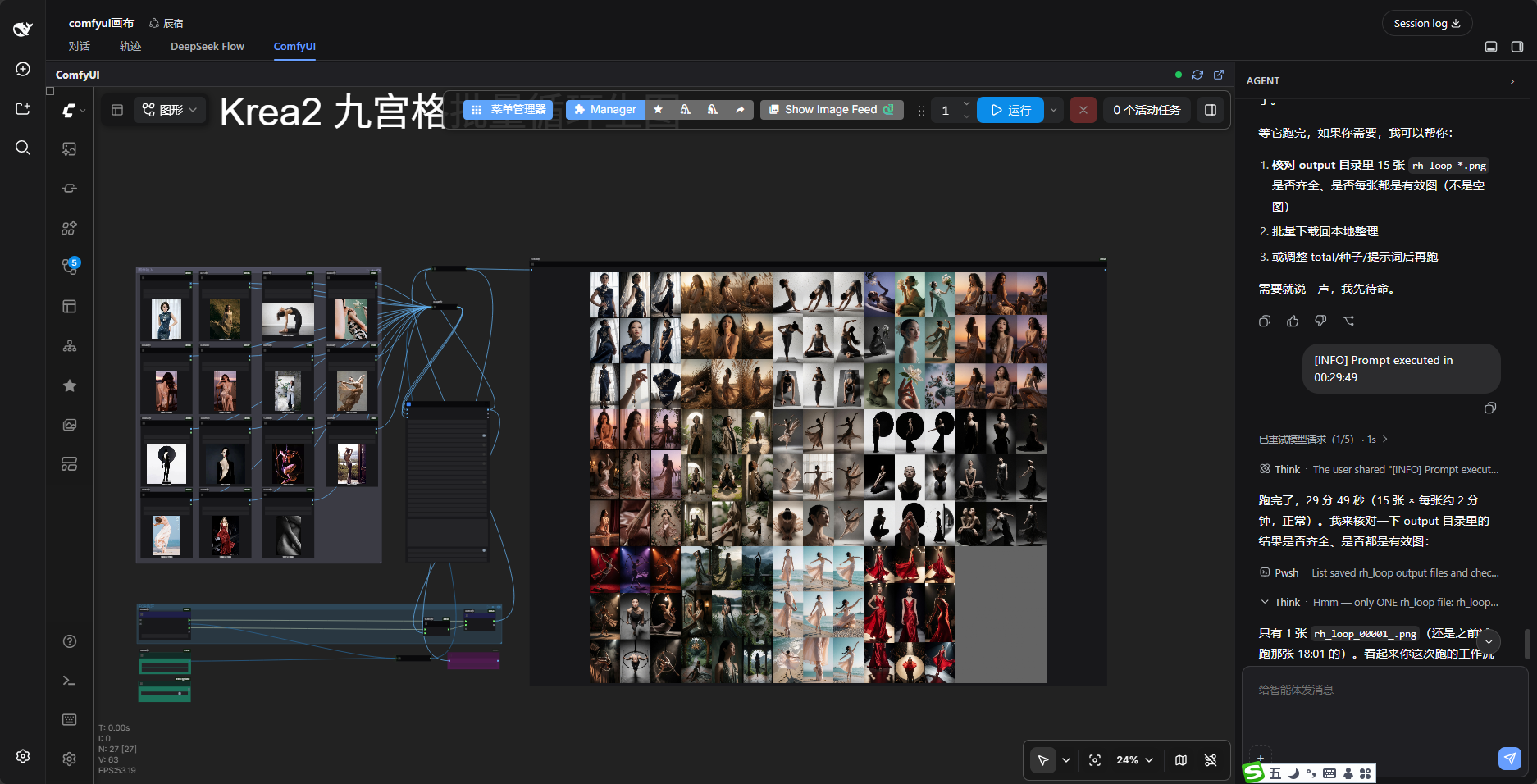
From chat to canvas to artwork — drive ComfyUI as a visual workflow IDE inside DSH. Embed ComfyUI (local or cloud) as a split-screen canvas in DeepSeek Harness Web: the agent sparks ideas, writes prompts and scripts right in the chat, applies them live to the canvas in front of you, and produces images, music, video, and 3D. From idea to finished output without ever leaving the conversation or switching front-ends:
- Canvas ops — compose and arrange pipelines, read/write workflows, edit nodes, wire links, run, tune parameters, and debug errors, all live and WYSIWYG on the exact canvas you are looking at
- Production tasks — batch parameter sweeps (
batch_run) and automatic output-image retrieval back into the chat (get_outputs), powering multi-modal creative and batch generation across images, music, video, and 3D - Environment upkeep — one-click launch of ComfyUI and one-click upgrade of the core plus every custom node (
upgrade), keeping the stack healthy without interruption
This package is the DSH-side plugin, and it ships the ComfyUI-side bridge node too. For headless/scale workloads it can be paired with the official ComfyUI MCP server — see Canvas + MCP.
Where this plugin fits: use it while building / tuning a workflow on the live canvas (the "IDE" role). For unattended / batch / production runs, hand the exported workflow to Comfy CLI (
comfy-cli run_workflow) — it runs headlessly without a browser, which this canvas plugin deliberately does not do (the agent drives the canvas you are looking at; a closed browser means no runner). Export a workflow once withcomfyui_export_api, then script it with the CLI at scale.
What you get
| Surface | Description |
|---|---|
| ComfyUI canvas split | Clicking the ComfyUI button in the session header drops you straight into canvas-on-the-left + chat-rail-on-the-right split mode — the canvas embeds the ComfyUI frontend (local or cloud) alongside the official conversation rail, so you can chat with the agent while watching it drive the canvas. The iframe stays alive (no reload); click the button again to exit split. |
| Visual canvas copilot | The agent operates the canvas you are looking at — nodes appear, links wire, widgets change and runs trigger live on screen, so you watch every step instead of trusting an opaque JSON edit. Output images come back into the chat via comfyui_get_outputs. |
| Canvas ops tools | comfyui_read_workflow, add_node, connect, set_param, remove_node, inject_text, load_workflow, run, debug, clear, group — build and fix workflows on the live canvas; group organizes complex workflows into named groups (prompt / sampler / output areas) with auto-fitted boxes, title headroom and membership persistence. Workflow lifecycle (v0.1.12): comfyui_new_canvas starts a brand-new blank workflow through the frontend's own "New Blank Workflow" action (no clearing, no click), comfyui_rename_workflow names/renames it, comfyui_save_workflow persists it — all via the frontend stores, no dialogs. Layout (v0.1.12): comfyui_move_node (absolute/offset) and comfyui_align_nodes (align / distribute / grid) tidy the canvas, and group boxes re-fit automatically when a member moves. |
| Production tools | comfyui_batch_run sweeps a parameter matrix (seeds/prompts/strengths) in one go — either explicit runs or a declarative matrix (zip parallel slots / product cartesian expansion); comfyui_get_outputs pulls the resulting files back into the chat — images, videos, gifs, and audio — with optional outputStem auto-incrementing names (stem.01.png, never overwrites); comfyui_attach_file uploads any local file (image/audio/video/3D/text) into ComfyUI's input/ for the matching Load node; comfyui_export_api exports the live canvas as API-format workflow JSON for comfy-cli headless batch runs. |
| One-click bridge install | comfyui_setup_bridge detects / installs / updates the ComfyUI-side bridge node into custom_nodes/ (idempotent, verifies the files, tells you when to restart) — no more manual copy step; comfyui_config reports bridgeInstalled / bridgeVersion / bridgeUpToDate at a glance. |
| Projects & traceability | Downloads default to the project directory (Settings → Project directory, default <workspace>/projects); every downloaded run appends runs.json (promptId / overrides / timestamp / files) so any output can be traced back to its parameters. Failed runs return a structured executionError (node id / node type / exception / message) instead of a raw JSON wall. |
| Skills (SOPs) | Built-in skills teach the agent the right order of operations: comfyui-canvas-ops (read → confirm → edit → run → fetch → self-check), comfyui-admin-ops (configure/launch/upgrade/node management), comfyui-video-audio-ops (video + voiceover/audio track), and comfyui-dev-ops (develop/debug custom nodes). Install the plugin and the skills ship with it — no extra setup. |
| Upkeep tool | comfyui_upgrade one-click updates the ComfyUI core and every git-backed custom node (concurrent, dirty-safe); comfyui_config reports the active connection, canvas focus, project directory, and a bridge-auth handshake check (bridgeAuthEffective). |
| Node dev tools | comfyui_read_source / comfyui_edit_source / comfyui_reload — read and edit custom-node source under custom_nodes/ and restart ComfyUI from the conversation, then verify on the canvas. |
| Canvas focus mode | The agent can tell (via comfyui_config) whether canvas split mode is active for the current session, and focus on canvas work only then. Session-isolated. |
| Settings page | ComfyUI base URL / port / network mode / bridge token / launch command / project directory / rail width. Changes apply live. Shows the plugin version and supports check / one-click update (installs the latest npm release; a DSH restart is required). Customized nav icon with ComfyUI logo. |
| Split layout | The ComfyUI button in the session header opens canvas-on-the-left + official chat rail on the right (state is session-isolated). Only data-* anchors and CSS variables are used — no DSH core class names, so the layout survives upstream styling changes. |
Install
1. Install the DSH plugin
dsh plugin add dsh-comfyui-canvas
Or from a GitHub checkout:
dsh plugin add github:wbin0001/dsh-comfyui-canvas
Or from a local checkout:
# in your DSH profile
pnpm add <path-to-this-package>
The bundled cordis.patch.yml mounts the plugin automatically (dsh.bundle.patch).
2. Install the ComfyUI bridge node (one-click)
The agent tools talk to the ComfyUI page through a bridge (/dsh-bridge/*). After installing the plugin, ask the agent to "install the ComfyUI bridge node" (or run comfyui_setup_bridge yourself): it detects whether the bridge is present in custom_nodes/, copies the version embedded in this package (idempotent — a same-or-newer installed copy is kept), verifies the files, and tells you when to restart ComfyUI.
Agent: comfyui_setup_bridge → { installed, version, upToDate, restartNote }
Requires the ComfyUI install directory in Settings → ComfyUI Canvas (or the COMFYUI_DIR env var). If it is not set, comfyui_config reports bridgeInstalled: false — set it once and re-run.
Manual copy is still supported (e.g. air-gapped machines) — the bridge ships inside this package at comfyui-bridge/ComfyUI-DSH-Canvas:
Windows (PowerShell / cmd):
Copy-Item -Recurse (npm root -g)\dsh-comfyui-canvas\comfyui-bridge\ComfyUI-DSH-Canvas <ComfyUI>\custom_nodes\ComfyUI-DSH-Canvas
macOS / Linux (bash):
cp -r $(npm root -g)/dsh-comfyui-canvas/comfyui-bridge/ComfyUI-DSH-Canvas <ComfyUI>/custom_nodes/ComfyUI-DSH-Canvas
Then restart ComfyUI and load the canvas page once (the injected bridge.js reports the graph and listens for commands).
3. Cloud ComfyUI (deploy the bridge on the machine that RUNS ComfyUI)
comfyui_setup_bridge manages a local install (comfyuiDir is a local path). For a cloud / remote ComfyUI, install the bridge on the cloud machine — pick one:
A. SSH / console access (self-hosted cloud GPU box) — on the cloud machine:
# option 1: pull the npm package and copy the bridge out of it
npm pack dsh-comfyui-canvas && tar -xzf dsh-comfyui-canvas-*.tgz && cp -r package/comfyui-bridge/ComfyUI-DSH-Canvas <ComfyUI>/custom_nodes/

# option 2: sparse-checkout just the bridge from the GitHub repo
cd <ComfyUI>/custom_nodes
git clone --depth 1 --filter=blob:none --sparse https://github.com/wbin0001/dsh-comfyui-canvas.git
cd dsh-comfyui-canvas && git sparse-checkout set comfyui-bridge/ComfyUI-DSH-Canvas
mv comfyui-bridge/ComfyUI-DSH-Canvas ../ComfyUI-DSH-Canvas && cd .. && rm -rf dsh-comfyui-canvas
Then restart the cloud ComfyUI, point the plugin's baseUrl at the cloud address, and (recommended) set a matching DSH_BRIDGE_TOKEN on both sides (see Security).
B. Hosted SaaS (API only, no shell) — if the provider does not allow installing custom nodes, the bridge (and the visual canvas) is unavailable; use the pure API/MCP path instead (comfyui_export_api → comfy-cli / an MCP server) for headless runs. comfyui_config will report bridgeInstalled: false in this case.
4. Configure
Open Settings → ComfyUI Canvas and set the ComfyUI base URL (default http://127.0.0.1:8188), port, network mode, optional bridge token, launch command, and the right-side rail width.
The launch command differs by platform:
| Platform | Example |
|---|---|
| Windows | ComfyUI启动器.bat (the launcher script; or python main.py) |
| macOS | python main.py or ./start.sh |
| Linux | python main.py or ./start.sh |
Security
The bridge (/dsh-bridge/*) is the only network surface this plugin adds to ComfyUI. Read this before exposing ComfyUI beyond loopback.
- Trust model. By default the bridge is unauthenticated, matching ComfyUI's own
/prompttrust model — anyone who can reach the ComfyUI port can read the canvas, report state, and dispatch commands (load_workflow/runconsume GPU). Commands are whitelisted on the frontend, so no arbitrary code execution is possible, but the surface is real. - Bind to loopback. Keep ComfyUI on
127.0.0.1unless you explicitly need LAN/cloud access.networkModeis informational; the actual bind is whatever ComfyUI was launched with (--listen). - Optional shared token. Set a token in Settings → ComfyUI Canvas → Bridge Token AND launch ComfyUI with the same value in its own environment (
DSH_BRIDGE_TOKEN=...). When the token is set, every agent-initiated request — reading the canvas, dispatching a command, polling its result — must presentAuthorization: Bearer <token>; the host side sends it automatically and the bridge rejects requests without it. The frontend's own status reporting (/report, result callbacks) stays open, since the injected page cannot hold the token; those endpoints only mutate the in-memory snapshot and never dispatch execution. Leave it empty on both sides for the default open behavior. - Multiple tabs are safe. Commands are targeted at the last-reporting frontend (
clientId), so several open ComfyUI tabs do not each execute a command.
Platform support
Works on Windows, macOS and Linux. The agent tools talk to ComfyUI over plain HTTP (/dsh-bridge/*), so nothing platform-specific lives in the plugin itself — only the copy command and the ComfyUI launch command differ, and both are documented above.
Usage
- Open a conversation and click the ComfyUI button in the session header — the canvas appears on the left with the Chat rail (messages + input) on the right, so you can instruct the agent while watching it work the canvas. Click the button again to exit split mode.
- Ask the agent to do canvas work: "read the current workflow", "set KSampler seed to 42", "check the canvas for errors", "run it".
- The agent reads
comfyui_configfirst, so it knows it's on the canvas and stays focused on canvas operations.
Conversation → canvas
Content the agent generates in the chat — images and text — can become ComfyUI workflow node inputs directly, closing the loop from conversation idea to canvas output:
comfyui_attach_image: upload a local image into ComfyUI'sinput/and optionally point a LoadImage node at it. Uses ComfyUI's native/upload/image(not the bridge) — the host reads and uploads the file from the agent's own machine, which matters when the DSH machine and the ComfyUI machine differ (cloud deployments).comfyui_inject_text: write text to a node's widget; or create a new source node, set its value, and connect it to a target input — "conversation text as a wirable source". A one-step wrapper overadd_node + set_param + connect;set_paramalone suffices when only an existing widget changes, andinject_textis for "create a new source and wire it".comfyui_export_api: export the live canvas as API-format workflow JSON (the format/promptand comfy-clirun_workflowconsume), bridging canvas → MCP headless runs.
Architecture boundary: file transfer (image →
input/) goes through the host + native API; canvas node ops go through bridge commands; reading results goes through native/history+/view— three layers that never mix.
Canvas + MCP — two driving modes of the same ComfyUI
The plugin is the canvas driver: it sees and edits the live canvas the user is looking at (add nodes, wire links, tweak widgets, run, fetch the run's output images via comfyui_get_outputs, sweep parameters via comfyui_batch_run). It never needs a saved workflow file.
For pipeline-style / headless workloads, ComfyUI's official Comfy CLI (comfy-cli, a standalone Python CLI that can also expose an MCP server) is the complementary executor. The two are not alternatives — they are two driving modes of the same ComfyUI instance, covering the full workflow lifecycle:
| Workflow stage | Driving mode | Capability |
|---|---|---|
| Build / tune | Canvas plugin (bridge) | Live canvas edits, run, debug validation, get_outputs fetch |
| Freeze / export | Canvas plugin | comfyui_export_api — export the tuned graph as API-format JSON |
| Batch / headless at scale | MCP / comfy-cli | Run the same graph headlessly: batch queues, official templates, model management, hosted models |
| Results back in the chat | Canvas plugin | comfyui_get_outputs pulls the run's outputs into the conversation |
The loop: tune on the canvas → export_api → hand the API workflow to MCP / comfy-cli for unattended scale → bring results back via get_outputs. Nothing leaves DSH; the canvas and headless modes complement rather than replace each other.
Install the Comfy CLI with:
pip install comfy-cli # standalone CLI, not a DSH plugin — see https://github.com/Comfy-Org/comfy-cli
Workflow operating modes (how the agent works the canvas)
The built-in comfyui-canvas-ops skill instructs the agent to pick the right operating mode per scenario:
| Scenario | Mode |
|---|---|
| Edit an existing workflow | Incremental edits on the current canvas (set_param / connect / add_node / remove_node / inject_text) — never a whole-graph load_workflow that would wipe the unsaved state |
| Start a new workflow | comfyui_new_canvas (a brand-new blank canvas via the frontend's own New action) or comfyui_clear (blank the current canvas, confirm-guarded), then build up |
| Build a complex workflow | comfyui_group named groups (prompt / sampler / output areas) + comfyui_align_nodes / comfyui_move_node tidy layout |
| Quick validation / batch / unattended | API/MCP path — submit an API-format workflow directly (or via an MCP server), no need to visualize on the canvas |
The agent decides the path up front: visual canvas mode when the user is watching / tuning, API/MCP mode for fast validation, batch sweeps and unattended runs.
Workflow groups (organize complex pipelines)
comfyui_group organizes a complex canvas into named groups that survive save/load:
| Action | Behavior |
|---|---|
add |
Create a named group around the given nodes; the box auto-fits the nodes (an explicit bounding is honored when given) |
add_nodes / remove_nodes |
Add / remove member nodes; the box re-fits automatically |
rename / list |
Rename a group / list groups with their members |
Membership persistence: saving the workflow serializes each group's member ids (nodes) next to title / bounding / color, and loading re-attaches them — a saved workflow reopens with the same boxes and their memberships intact.
Requirements
- DeepSeek Harness Web (DSH), Node
^22.19.0 || >=24 - ComfyUI running (local by default at
127.0.0.1:8188; for a cloud instance, deploy the bridge node on the machine that runs ComfyUI and make sure DSH can reach it) with the bridge node installed (comfyui_setup_bridgedoes this in one step) - A browser tab with the ComfyUI page open (the canvas tab loads it automatically)
Development
npm run check # node --check both lib files
The plugin lives in the DSH profile under node_modules/dsh-comfyui-canvas; edit lib/index.js (host tools) and lib/client.js (web client), then restart DSH.
Repository layout
dsh-comfyui-canvas/
├── cordis.patch.yml          # DSH bundle layer (auto-mount)
├── comfyui-bridge/           # ComfyUI-side bridge node (self-contained)
│   └── ComfyUI-DSH-Canvas/
│       ├── __init__.py       # /dsh-bridge/* HTTP routes on the ComfyUI server
│       └── entry/bridge.js   # injected frontend: reports graph + runs commands
├── lib/
│   ├── index.js              # DSH host: 26 canvas tools + 4 built-in skills
│   └── client.js             # DSH web: split canvas (left) + chat rail (right) / settings
├── LICENSE
├── README.md
└── package.json
The bridge is the only ComfyUI-side dependency. It exposes /dsh-bridge/workflow|report|command|result and is injected into the ComfyUI page via app.registerExtension; without it the agent tools cannot reach the canvas.
Known issues
- Non-official desktop wrappers are not guaranteed compatible — they bundle an upstream version that may be ahead of or behind this plugin's baseline; rely on official DSH.
comfyui_reloadcurrently supports Windows only (usesnetstat/taskkill); on macOS/Linux it fails loud instead of pretending, restart ComfyUI manually there.- The former "node previews missing after a run" is fixed in v0.1.1: removed the iframe's
referrerpolicy="no-referrer"to match the native tab environment, andbridge.jsnow listens to ComfyUI'sexecutedevent to force a canvas redraw.
License
MIT
Links
More in this category
Tencent/WeKnora#dsh-weknora★ 34626
Four read-only tools over a WeKnora knowledge base: list knowledge bases, hybrid passage search, reassemble one document's chunks in order, and WeKnora's own cited RAG or ReAct-agent answer with a resumable session id.
superdesigndev/treg★ 5760
Tool catalog for agents: search ~2,600 external endpoints (SEO and SERP, backlinks, social, people and company enrichment, ad libraries, scraping) by the task you want done, read each one's parameters and per-call price, then call it with the credential injected server-side. Ships the skill plus an MCP row that stays disabled until TREG_TOKEN is set.
T-Auto/dsh-ops★ 3102
Provides bash, PowerShell 7, and high-performance Rust tools for DSH on Windows to reduce token usage.
TencentCloudBase/CloudBase-AI-Toolkit#dsh-plugin★ 1139
Tencent CloudBase backend for DeepSeek Harness — scaffold and deploy full-stack apps from chat, render query results as table cards with paging, sorting and CSV export, preview a deployment on its domain, and call the CloudBase MCP toolset (`mcp__cloudbase__*`) with device-code login.
sixtysevenlf/dsh-blender-plugin★ 599
Lets a DSH agent drive a local Blender over a direct TCP channel with 16 tools: viewport frames, custom-angle renders, Python execution, headless and job offload, transaction rollback, and a planning layer of 186 ops across 28 families.
anysearch-team/anysearch-dsh★ 537
AnySearch-powered real-time web and vertical search provider for DeepSeek Harness.
Community comments
Comments are public GitHub Discussions. Loading them connects to GitHub and Giscus; a GitHub account is required to post.