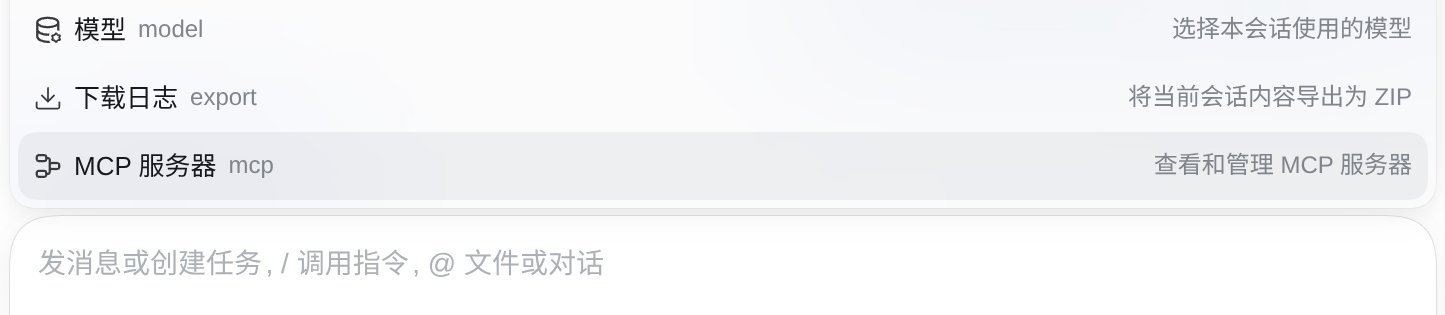
Adds a /mcp command that opens a panel to view, add, edit and remove MCP servers, writing the profile patch for you instead of hand-editing cordis.patch.yml.
Install
# from GitHub (first run asks for allowBuilds approval — follow the hint, retry)
dsh plugin --profile web add github:p33333333333333l/dsh-mcp-servers
Any plugin you install runs third-party code with your own permissions — it can read your files, use your credentials, and reach the network, and tool approvals don’t sandbox it. GitHub-sourced plugins also run build scripts at install time — pnpm blocks those until you allow them, so an install can stop with ERR_PNPM_GIT_DEP_PREPARE_NOT_ALLOWED or ERR_PNPM_IGNORED_BUILDS; dsh prints the exact key to add under allowBuilds in your profile’s pnpm-workspace.yaml, and the install works on the next run. Allowing a build is a trust decision: only install sources you trust, and pin a commit (github:owner/repo#sha).
README
Manage MCP servers in DSH with /mcp. View connection status and available tools, import configurations, and add, edit or remove local stdio and remote HTTP servers.
Install
Add this plugin market index in DSH, then install MCP Servers:
https://p33333333333333l.github.io/dsh-mcp-servers/index.json
Or install directly through the plugin manager:
git+https://github.com/p33333333333333l/dsh-mcp-servers.git
Restart DSH or refresh the page after installation.
Use
Enter /mcp in the conversation input and select MCP Servers, or press Enter. The panel follows your interface language (English or Chinese).
- Add or edit a server in the form, or delete it after confirmation.
- Import servers by pasting JSON or choosing a file, then reviewing the preview.
- Check the status dot beside each name: green means running, yellow means pending, red means failed, and gray means disabled or inactive. Hover for details.
Press Esc or enter /mcp again to close the panel.
Server settings
Server names allow letters, numbers, underscores and hyphens, up to 32 characters. Tools appear to the model as mcp__<server-name>__<tool-name>.
| Connection | Settings |
|---|---|
| Local process (stdio) | Command such as npx or /usr/bin/node; one argument per line; optional working directory; environment variables as KEY=VALUE, one per line |
| Remote HTTP | Server URL such as https://example.com/mcp; optional headers as NAME=VALUE, one per line |
Block startup when the connection fails makes the MCP client fail to activate if it cannot connect.
Environment variables and headers can reference environment values with !!js:
Authorization=!!js "Bearer " + process.env.MCP_TOKEN
DSH evaluates the expression when loading the configuration. Existing expressions are preserved when edited. For multiline values, start each continuation line with a Tab; the panel adds this marker when displaying existing values.
Import
Accepts a mcpServers object or a plain object keyed by server name:
{
  "mcpServers": {
    "local": { "command": "npx", "args": ["-y", "example-mcp"] },
    "remote": { "type": "http", "url": "https://example.com/mcp" }
  }
}
Local servers support command, args, env and cwd. Remote servers support url and headers; type may be omitted or set to "http" or "streamable-http".
Duplicate names, invalid data or unsupported fields (including SSE and disabled) reject the whole batch without overwriting existing servers. Failed writes or reloads roll back the batch.
Imported environment variables and headers stay literal strings, including unchanged !!js text on later edits. The reserved dictionary key __jsExpr is not accepted.
Configuration changes and limits
- The panel manages the current DSH profile. Install the plugin separately in each profile you use.
- Changes update that profile's
cordis.patch.yml. Back up~/.dsh/profiles/<profile>/cordis.patch.ymlbefore first use. - Saving reconnects the MCP client and may interrupt active tool calls. Deleting a server removes all its tools.
- Servers defined as top-level overrides rather than in an
insertlist can be viewed, but must be removed manually. - The panel uses your authenticated DSH session. Set
manage: falsein the plugin configuration for read-only access:
- insert:
    - id: mcp-manager
      name: 'dsh-mcp-servers'
      config:
        manage: false
License
Links
More in this category
Tencent/WeKnora#dsh-weknora★ 37546
Four read-only tools over a WeKnora knowledge base: list knowledge bases, hybrid passage search, reassemble one document's chunks in order, and WeKnora's own cited RAG or ReAct-agent answer with a resumable session id.
DayuanJiang/next-ai-draw-io#dsh-plugin★ 36997
Draws draw.io diagrams in DeepSeek Harness through the next-ai-drawio MCP server: the link in the reply opens a live preview in the right sidebar, you can edit the diagram by hand, and each AI change is a version you can restore. Node.js 18+; npx downloads the MCP server on first use.
superdesigndev/treg★ 8164
Tool catalog for agents: search ~2,600 external endpoints (SEO and SERP, backlinks, social, people and company enrichment, ad libraries, scraping) by the task you want done, read each one's parameters and per-call price, then call it with the credential injected server-side. Ships the skill plus an MCP row that stays disabled until TREG_TOKEN is set.
T-Auto/dsh-ops★ 5864
Provides bash, PowerShell 7, and high-performance Rust tools for DSH on Windows to reduce token usage.
sixtysevenlf/dsh-blender-plugin★ 2147
Lets a DSH agent drive a local Blender over a direct TCP channel with 15 tools: viewport frames, custom-angle renders, Python execution, headless and job offload, transaction rollback, and a planning layer of 228 ops across 34 families.
helloHub1212/dsh-windows-mcp★ 1456
Bridges the CursorTouch/Windows-MCP desktop automation server into DSH through the official MCP client bridge, registering its screenshot, UI tree snapshot, mouse and keyboard input, clipboard, process and registry tools as mcp__windows__* tools for the model, and adds a windows_mcp_doctor diagnostic tool. Computer Use is off by default and is switched on from the plugin panel.
Community comments
Comments are public GitHub Discussions. Loading them connects to GitHub and Giscus; a GitHub account is required to post.