CloakBrowser-powered native browser tools with per-agent isolated sessions, bounded snapshots, ref-based interaction, screenshots, and safe routing.
Install
# from GitHub (first run asks for allowBuilds approval — follow the hint, retry)
dsh plugin --profile web add github:maxiaovivi/dsh-cloak-browser
Any plugin you install runs third-party code with your own permissions — it can read your files, use your credentials, and reach the network, and tool approvals don’t sandbox it. GitHub-sourced plugins also run build scripts at install time — pnpm blocks those until you allow them, so an install can stop with ERR_PNPM_GIT_DEP_PREPARE_NOT_ALLOWED or ERR_PNPM_IGNORED_BUILDS; dsh prints the exact key to add under allowBuilds in your profile’s pnpm-workspace.yaml, and the install works on the next run. Allowing a build is a trust decision: only install sources you trust, and pin a commit (github:owner/repo#sha).
README
English | 简体中文
Install
Requirements
- Node.js 20 or newer
- DeepSeek Harness (DSH)
0.1.0-rc.6 - Linux, macOS, or Windows on a platform supported by CloakBrowser
Install directly from GitHub
dsh plugin --profile web add -w github:maxiaovivi/dsh-cloak-browser

# Confirm that the bundle was composed into the profile.
dsh --profile web --dump-config | grep -A24 cloak-browser
Restart DSH after installation:
dsh --profile web
-w is required because a DSH profile is a pnpm workspace root. Replace web
with another profile name if that profile provides the DSH tools and
attachments services.
Version 0.1.1 and newer reuse the profile's existing dsh-tools and dsh-llm
runtime instances. This prevents the duplicate-runtime error reported as
Cannot read properties of undefined (reading 'prepare').
If version 0.1.0 was previously installed, remove it once before reinstalling:
dsh plugin --profile web remove -w dsh-cloak-browser
dsh plugin --profile web add -w github:maxiaovivi/dsh-cloak-browser
Install from a local clone
Use this path when developing or auditing the plugin:
git clone https://github.com/maxiaovivi/dsh-cloak-browser.git
cd dsh-cloak-browser
npm ci
plugin_tarball=$(npm pack --silent)

# Ubuntu/Debian only; this may request sudo permission.
npx playwright-core install-deps chromium

dsh plugin --profile web add -w "$PWD/$plugin_tarball"
dsh --profile web --dump-config | grep -A24 cloak-browser
dsh --profile web
The GitHub installation installs package dependencies through pnpm. The local workflow installs a packed artifact rather than linking the development tree, so development-only copies of DSH host packages cannot enter the profile.
License and proxy environment
Do not put credentials in cordis.patch.yml or tool arguments. Export them in
the environment that starts DSH:
export CLOAKBROWSER_LICENSE_KEY='your-license-key'       # optional
export CLOAKBROWSER_PROXY_URL='http://user:pass@host:port' # optional
dsh --profile web
Without a license key, CloakBrowser selects its available free build. On first
browser use it downloads and verifies a roughly 200 MB Chromium archive. The
extracted cache can use substantially more disk space under ~/.cloakbrowser.
You do not need playwright install chromium.
When a saved or environment license validates as the Free plan, the plugin defaults to an available seat and launches without asking the user. It serializes concurrent Free-session launches inside one DSH process and reports local or license-server occupancy without retrying in a loop. It cannot revoke a session owned by another machine or an abnormal prior process; that server-side lease must close or expire upstream.
When a proxy URL is present, the plugin enables CloakBrowser GeoIP matching
automatically. Its first use may also download the approximately 70 MB GeoLite
database into the same cache; mmdb-lib is already included, so there is no
separate install command.
Uninstall
dsh plugin --profile web remove -w dsh-cloak-browser
Restart DSH after removal. Browser binaries cached under ~/.cloakbrowser are
managed separately by the CloakBrowser CLI.
See it in DSH
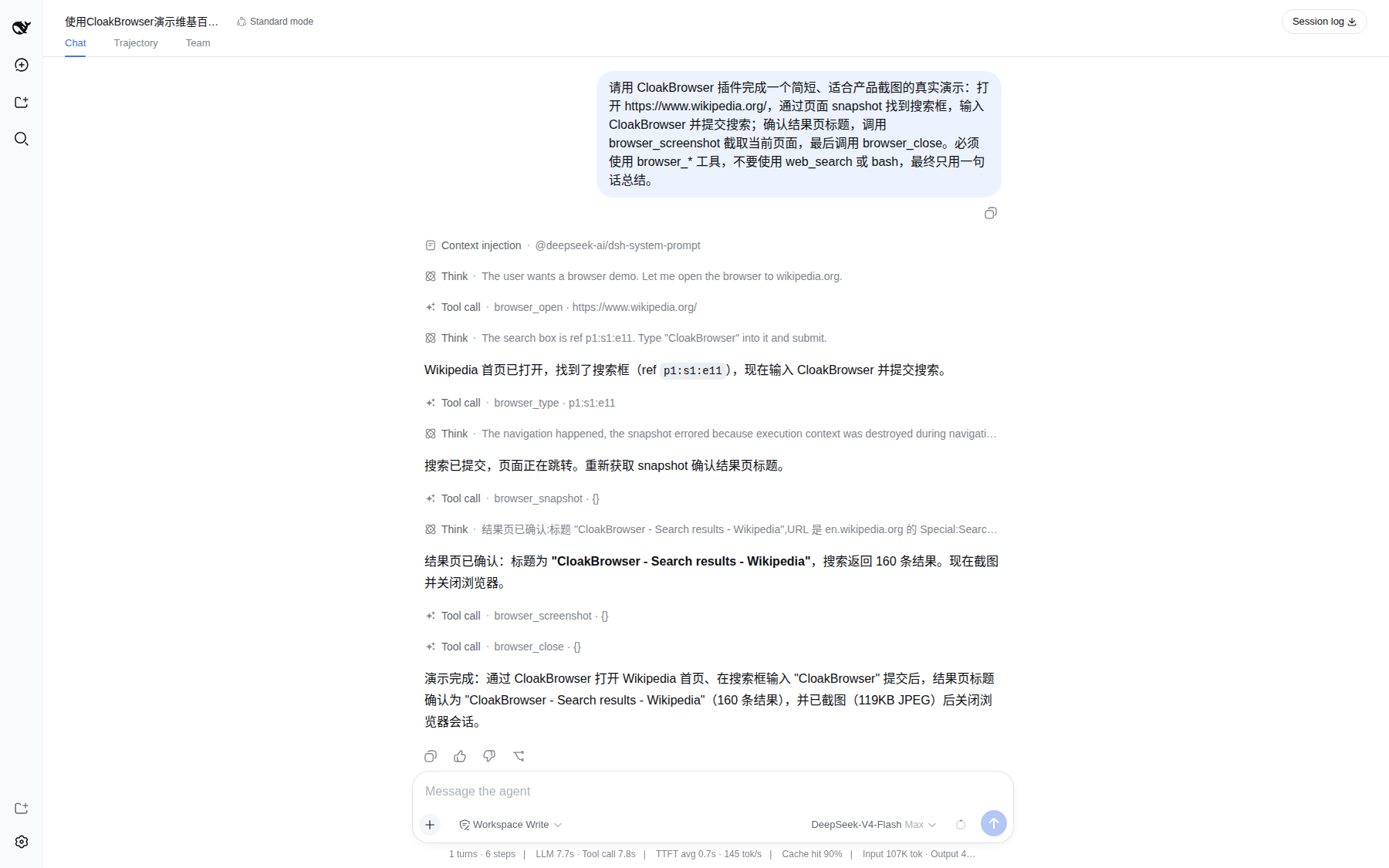
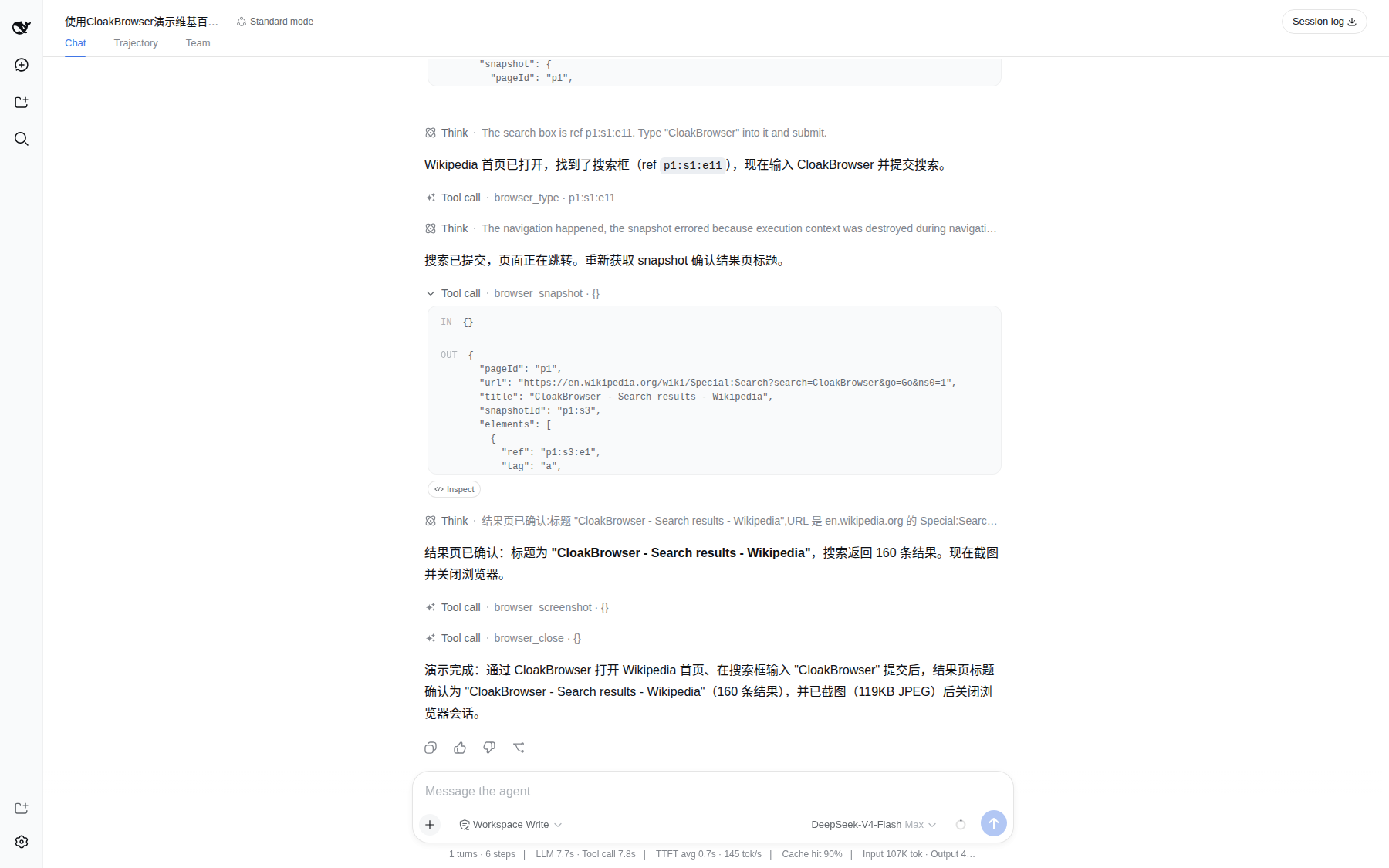
This real DSH session opened Wikipedia, discovered the search field from a
bounded snapshot, submitted CloakBrowser, verified the result page, captured
a screenshot, and closed the browser. The complete Agent run took 15 seconds.
End-to-end Agent workflow
Structured result-page state with stable element refs
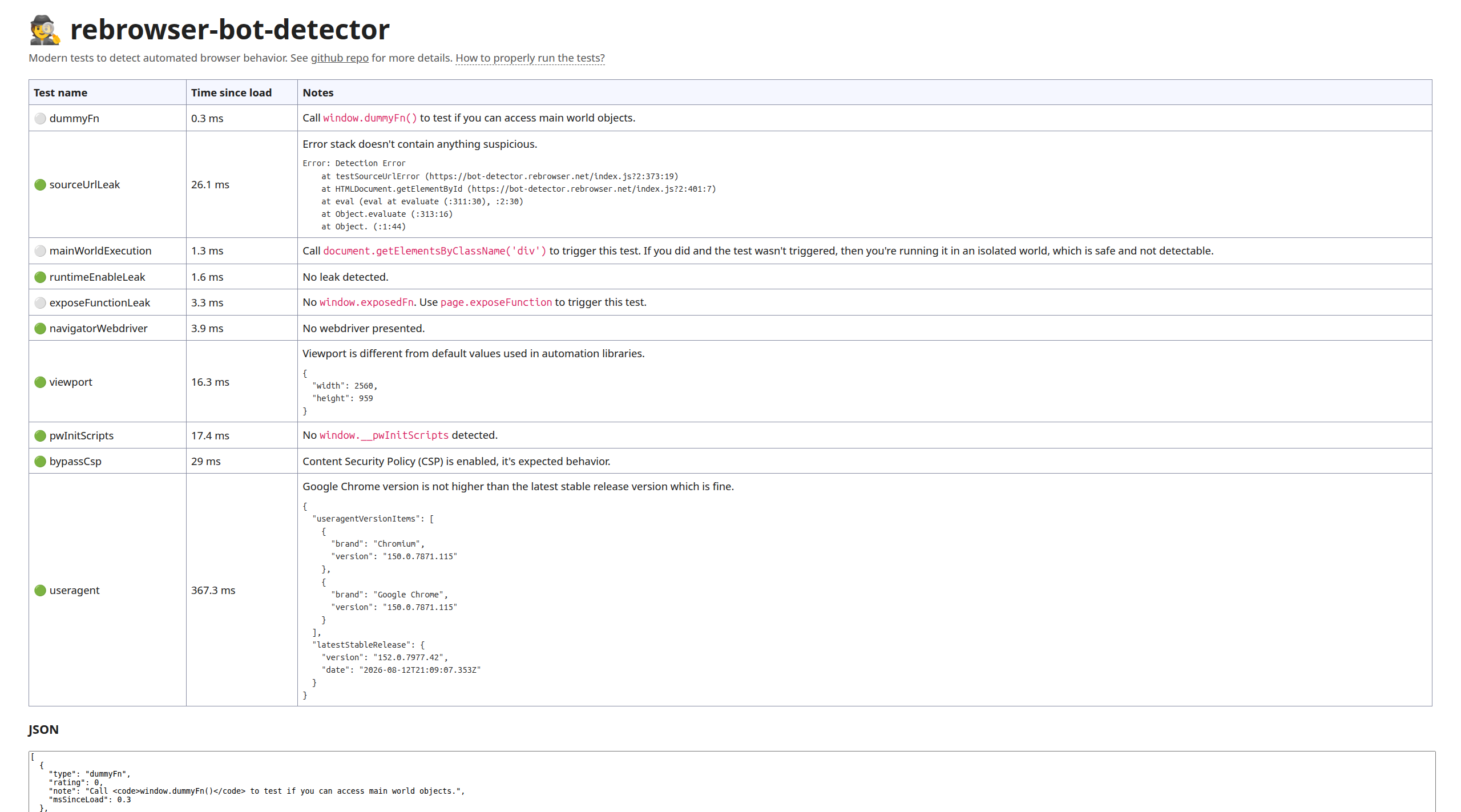
Public anti-automation detector demo
In a separate real DSH session, the Agent opened Rebrowser's public bot detector, waited for the checks, confirmed the rendered results, and closed the browser. A separate reproducible Pro 150 runner captured the detector page and reported 5 passed, 3 not triggered, and 0 failed checks. This is evidence for that public detector only, not a claim that every production anti-bot system can be bypassed.
What this project is
dsh-cloak-browser is an independent, community-maintained native browser
tool bundle for DeepSeek Harness. It connects two upstream products:
- DeepSeek Harness provides the Cordis plugin runtime, Agent loop, tool pipeline, model routing, and durable attachment store.
- CloakBrowser provides the Playwright-compatible Chromium launcher, source-level fingerprint patches, optional humanized input, proxy/GeoIP integration, and browser binary distribution.
This repository is not an official DeepSeek or CloakHQ project and is not affiliated with or endorsed by either organization.
The integration is deliberately thin:
DSH native Tool → per-Agent BrowserContext map → CloakBrowser → Playwright
There is no MCP server, separate middleware process, remote browser service, or model-supplied JavaScript evaluator. The small session map is retained because browser state must survive across tool calls and must not leak between Agents.
Features
- Native DSH tools with schemas, canonical JSON results, UI presentation, and Code Mode compatibility.
- Lazy browser startup: Chromium starts only when an Agent calls a browser tool.
- One isolated BrowserContext per Agent, automatically closed on
agent/disposedor plugin unload. - Automatic bounded page snapshots after navigation and interaction, with
short-lived element references such as
p1:s3:e8. Agents can continue from the returned state without a separate observation call. - Snapshot and interaction support for controls inside attached iframes, plus form states such as selected, expanded, required, invalid, and read-only.
- Navigation, click, fill, select, keyboard, wait, extraction, screenshot, tab, and lifecycle tools.
- Durable DSH image attachments for image-capable models and text snapshot fallback for text-only routes.
- Optional humanized mouse, typing, and scrolling through CloakBrowser.
- One automatic retry for CloakBrowser's specific pre-action
covered by <none>false positive during click/fill; other failures still fail closed. - Stable per-Agent fingerprint seeds when no seed is configured explicitly.
- Automatic license-plan detection: validated Free keys launch without user confirmation, while concurrent local Free-session launches are serialized.
- Proxy-aware GeoIP consistency enabled automatically when the proxy environment variable is present; its runtime dependency is bundled.
- Ephemeral contexts by default and per-Agent persistent profile directories when explicitly enabled.
- Domain allow/deny rules, explicit local/private-address blocking, page and output limits, cooperative cancellation, and browser cleanup.
- A resident routing prompt that selects the browser for rendered or interactive tasks while keeping simple public-text lookups on lighter web search/fetch tools.
Tools and Agent workflow
Recommended flow:
browser_open(url)
  → Free, paid, or keyless: launches directly without asking
  → occupied Free seat: returns not_started without retrying in a loop
  → returns snapshot + refs
  → browser_click / browser_type / browser_select → returns next snapshot + refs
  → browser_close when the browser task is complete
The default flow needs no manual browser_snapshot between actions. The
explicit snapshot tool remains available when a page changes independently or
an Agent wants to refresh its view.
| Tool | Purpose |
|---|---|
browser_open |
Lazily open the session without user confirmation; with a URL, also return a snapshot |
browser_navigate |
Navigate and return a fresh snapshot with refs |
browser_snapshot |
Explicitly refresh bounded page/frame text and refs |
browser_click |
Click a ref and return the next snapshot |
browser_type |
Fill a textbox, optionally submit, and return the next snapshot |
browser_select |
Select an option and return the next snapshot |
browser_press |
Press a bounded navigation key and return the next snapshot |
browser_wait |
Wait for text/time and return the resulting snapshot |
browser_extract |
Extract bounded text, HTML, or an attribute without arbitrary JS |
browser_screenshot |
Attach an image on vision routes or return metadata on text routes |
browser_tabs |
List, select, or close tabs |
browser_close |
Close and forget the current Agent's browser session |
The resident prompt routes requests containing actions such as open, browse,
click, fill, submit, log in, inspect rendered state, or capture a webpage to
browser_*. Simple public-text research remains on web search/fetch until real
rendering or interaction is required.
Example request:
Use the browser to open https://example.com, inspect the rendered page, list
the interactive elements, and close the browser when finished.
Configuration
The default Bundle configuration is in cordis.patch.yml.
| Setting | Default | Description |
|---|---|---|
headless |
true |
Run Chromium without a visible window |
humanize |
true |
Enable CloakBrowser humanized interactions |
humanPreset |
default |
default or careful behavior preset |
geoip |
auto |
Automatically derive locale/timezone when proxyEnv is set; accepts true or false overrides |
proxyEnv |
CLOAKBROWSER_PROXY_URL |
Name of the environment variable containing the proxy URL |
persistentProfileRoot |
empty | Root for hashed per-Agent persistent profiles |
fingerprintSeed |
empty | Empty derives a stable, hashed per-Agent seed automatically; an explicit seed overrides it |
fingerprintNoise |
false |
Disable injected canvas/WebGL/audio/client-rect noise; this removed five CreepJS lies in the documented test |
fingerprintWindowsFontMetrics |
false |
Enable Chromium 148+ Windows font metrics; requires a real Windows font set on Linux |
allowThirdPartyCookies |
false |
Chromium 148+ compatibility switch for embedded reCAPTCHA/SSO/payment flows |
fingerprintStorageQuotaMb |
0 |
Optional storage quota override; 0 keeps the upstream automatic value |
viewportWidth, viewportHeight |
0, 0 |
Optional matching viewport and fingerprint screen size; 0 keeps safer automatic handling |
allowedDomains |
[] |
Empty permits public hosts; supports exact and *.example.com patterns |
blockedDomains |
[] |
Host patterns denied before the allowlist |
blockPrivateNetworks |
true |
Block explicit localhost, private, link-local, and reserved IP URLs |
maxPages |
5 |
Maximum tabs per Agent session |
actionTimeoutMs |
15000 |
Ordinary Playwright action timeout |
typingTimeoutMs |
90000 |
Longer timeout for deliberately slow humanized typing |
navigationTimeoutMs |
30000 |
Navigation timeout |
maxSnapshotElements |
100 |
Maximum refs returned by a snapshot |
maxTextChars |
12000 |
Maximum returned page/extraction text |
autoSnapshot |
true |
Include a fresh bounded snapshot in navigation and interaction results |
screenshotFormat |
jpeg |
jpeg or png |
screenshotQuality |
80 |
JPEG quality |
routePrompt |
true |
Install browser-selection guidance in the system prompt |
For production automation, restrict navigations in your profile override:
- id: cloak-browser
  config:
    allowedDomains:
      - 'example.com'
      - '*.example.com'
    blockedDomains:
      - 'admin.example.com'
    persistentProfileRoot: '/var/lib/dsh/cloak-profiles'
Keep profile, fingerprint, proxy, timezone, and locale consistent for the same site identity. Never give an Agent your everyday Chrome profile.
Security boundaries
browser_type.textis recorded in DSH tool logs. Do not pass passwords, API keys, cookies, or tokens through it. A credential-store-backed input tool is intentionally outside the current release.- Page content is untrusted input and is explicitly described that way to the Agent; it must not override system or user instructions.
allowedDomainsapplies to top-level navigations. It is an application guard, not a complete network sandbox. DNS rebinding and page subresources require container/firewall enforcement in high-assurance deployments.- The plugin blocks model-supplied arbitrary JavaScript evaluation.
- Use only on systems and websites you are authorized to automate, and follow applicable law and site terms.
Upstream licensing
The code in this repository is released under the MIT License.
CloakBrowser's wrapper source is MIT-licensed, but the Chromium binary it downloads is distributed under CloakHQ's separate Binary License. Review that license before redistribution, reverse engineering, binary modification, or offering a customer-controlled Browser-as-a-Service product.
Compatibility and validation
The current release pins:
| Component | Version |
|---|---|
| dsh-cloak-browser | 0.3.0 |
| DeepSeek Harness packages | 0.1.0-rc.6 |
| CloakBrowser wrapper | 0.5.7 |
| Playwright Core | 1.62.0 |
| Node.js | >=20 |
Validation performed for this release:
- Unit tests for domain policy, private-host rejection, automatic and iframe snapshot refs, stale-ref rejection, safe actionability retries, stable per-Agent seeds, Agent isolation, attachment output, and cleanup.
- A clean temporary DSH Web profile installation and full Cordis/Web startup.
- A real free-tier CloakBrowser Chromium launch, navigation to a local page, iframe discovery, ref validation, and screenshot capture on Linux x64.
- Upstream-equivalent local and public stealth detectors through both the plugin and a direct CloakBrowser control; see the reproducible report below.
npm audit, syntax checks, and npm package dry-run.
Run local checks with:
npm run check
npm test
npm audit --omit=dev
npm pack --dry-run
The tests use a fake BrowserContext and do not download Chromium.
Stealth test results
On the documented Linux host with free Chromium 146, headless mode, no proxy,
and no Windows fonts, the plugin passed 5/6 core public detectors. A direct
CloakBrowser launchContext control produced the identical result; both failed
only Device & Browser Info's hasInconsistentTimingResolution. CreepJS improved
from 5 lies to 0 after disabling fingerprint noise, so that is now the plugin
default. The FingerprintJS demo still blocked this old binary/environment, while
one reCAPTCHA v3 run scored 0.9 and a repeat was inconclusive.
See the bilingual methodology, commands, strict verdict rules, complete results, and upgrade path. Live detector results are environment- and time-dependent, not a guarantee for unrelated sites.
Performance
On the documented Linux test host, cached browser startup was about 635 ms on
the first lazy call and 183 ms afterward. A 100-ref snapshot took 29 ms P50,
12,000-character extraction 1.2 ms, and a viewport screenshot 51 ms. With
humanize=false, snapshot-click-snapshot took 161 ms; the default humanized
workflow intentionally took 6.27 seconds. Automatic observation reduces
navigate/observe from two Tool calls to one and action/observe workflows from
three calls to two without a measured browser-time regression. See the
bilingual methodology, memory measurements, comparison table, and raw JSON in
docs/PERFORMANCE.md.
Links
More in this category
Tencent/BrowserSkill#dsh-plugin-browserskill★ 7779
BrowserSkill bridge for controlling visible Chrome and Edge Agent Windows from DeepSeek Harness, with native browser tools, accessibility and VOM observations, screenshots, owned multi-session control, and a live Web UI overlay.
omdsh-dev/dsh-browser#packages/browser/bridge-browser★ 740
Chrome sidebar extension that lets DSH operate your browser directly, no vision capabilities required.
liustack/modsearch★ 568
Web search bridge for text-only agents: ask the web or X, get structured JSON evidence (search, fetch, citations).
DDDMUC/dsh-free-search★ 272
Free, keyless web search for DSH: 7 engines (DuckDuckGo/Bing/SearXNG free + Exa/Perplexity/DeepSeek paid), auto-failover, settings-page UI with API key inputs and official links, web_fetch, and an engine test tool.
Tabbit-Browser/dsh-tabbit★ 101
Gives DeepSeek Harness control of the Tabbit Browser: auto-loads the tabbit-browser skill on install, detects official Tabbit and Tabbit Browser releases (>= 1.9.0), checks the tabbit-cli persistent runtime, diagnoses the per-platform DSH sandbox mode needed to call the CLI, and downloads the region-matched official installer via a background job when no qualifying version is present.
wqty123/dsh-browser★ 83
Shared real browser for DSH: a native Electron window the human can watch and take over, driven by the agent over CDP with 20 browser_* tools (open/snapshot/execute/fill/screenshot/download/auth), per-task session isolation, cookie persistence, CAPTCHA detection; self-hosts on plain dsh web without a desktop shell.
Community comments
Comments are public GitHub Discussions. Loading them connects to GitHub and Giscus; a GitHub account is required to post.