Academic assistant plugin.
Install
# from GitHub (first run asks for allowBuilds approval — follow the hint, retry)
dsh plugin --profile web add github:lzszq/dsh-scholar
Any plugin you install runs third-party code with your own permissions — it can read your files, use your credentials, and reach the network, and tool approvals don’t sandbox it. GitHub-sourced plugins also run build scripts at install time — pnpm blocks those until you allow them, so an install can stop with ERR_PNPM_GIT_DEP_PREPARE_NOT_ALLOWED or ERR_PNPM_IGNORED_BUILDS; dsh prints the exact key to add under allowBuilds in your profile’s pnpm-workspace.yaml, and the install works on the next run. Allowing a build is a trust decision: only install sources you trust, and pin a commit (github:owner/repo#sha).
README
简体中文 | English
DSH Scholar is an AI research workspace for computational research. It keeps project conversations, research materials, code and data, controlled experiment runs, evidence, and TeX manuscripts in one recoverable project. You can start from a new question or continue work that already exists elsewhere.
DSH Scholar is still under active development. Use it for supervised computational-research workflows, review every approval and research claim, and keep independent backups of important source material and results.
What it provides
- Stage-aware research guidance: Chat supports natural conversation, Grill Me intake, file upload, visual-model input, explicit slash commands, and an authoritative next-step prompt for the current research stage.
- Governed research workflow: Scope, Idea, Contract, Evidence, Direction, and Release decisions remain explicit, revision-bound, and auditable.
- Controlled execution: Runner Profiles describe local, local-Docker, or remote-SSH environments, including pinned container images and declared NVIDIA GPU capability.
- Integrated workspace: project-scoped Chat, editable files, session-bound Web terminals, run logs, artifacts, TeX source, compilation diagnostics, and PDF preview share the same context.
- Traceable methodology: Protocol revisions, run classifications, synthesis requests, assurance results, reviewer findings, knowledge-pack activation, and claim-to-evidence links are recorded as durable research state.
- Visible collaboration: Trajectory and Topology expose subagent parent-child relationships, status, follow-ups, and outputs.
Intended use and boundaries
- DSH Scholar assists researchers; it does not assume responsibility for scientific judgment, approval, authorship, or publication.
gate-onlyis the normal mode. Agents cannot impersonate a Human principal, fabricate accepted Evidence, or bypass a research Gate.full-automeans automatic approval only for the allowlisted Scope, Idea, Contract, and Budget Gates of an exact registered FixtureProfile. Its only canonical action executor is currentlysurvey_run. Release, Direction, Intake, Evidence, and unsupported actions remain Human-controlled or are parked with a typed reason.- A name-only
/new <name>project always starts asgate-onlyand collects its Brief through Grill Me; it does not silently inheritfull-auto. - Formal experiments must bind immutable code and data snapshots, a frozen Protocol where required, and an explicit Runner Profile. Chat text, ordinary stdout, and Interactive Terminal output do not automatically become formal Evidence.
- Images sent to a visual model are untrusted, current-turn Chat context. They do not automatically become OCR output, Brief answers, Evidence, Claims, Gate decisions, or proof that a command ran.
- The product focuses on computational research such as machine learning, data science, and bioinformatics. It is not intended for clinical decisions, human studies, wet-lab work, or other high-risk research.
Quick start
The local workspace requires Linux, Node.js 24, pnpm 11.20.0, and Docker Engine for controlled experiments, TeX compilation, and clean-room reproduction.
1. Install and build
pnpm install --frozen-lockfile
pnpm run build
2. Start the standalone workspace
bash scripts/start-standalone-ui.sh
Open http://127.0.0.1:18610 and paste the token from:
~/.dsh-scholar-standalone/research-ui-standalone/standalone-token
The standalone workspace and DSH use the same Research Kernel at 127.0.0.1:7412 and the same canonical project data directory at ~/.dsh/research-kernel. Upgrading either surface must keep that directory unchanged so existing projects remain accessible. Browser tokens and display preferences live separately in the standalone BFF directory. Use --no-token only on an isolated, supervised, loopback-only development instance.
3. Configure an execution environment
Open Settings → Execution environment and select an explicit Runner Profile:
- local machine for trusted development and smoke checks;
- local Docker with a pinned image, optionally requiring the NVIDIA runtime and GPU capability;
- remote SSH with server-side endpoint, credential, known-hosts, and target-identity SecretRefs.
Formal Jobs do not execute until the selected profile and target pass readiness checks. A missing Runner, offline target, unavailable SecretRef, capability mismatch, or incomplete Contract/Protocol is shown as preparation or a blocker instead of being treated as ready. See the runtime guide for target registration, target-scoped heartbeat credentials, Runner startup, ports, and security constraints.
4. Install the plugin in DSH
Install the current DSH prerelease through its moving next tag, then record the exact installed version:
npm install -g @deepseek-ai/dsh@next
npm ls -g @deepseek-ai/dsh --depth=0
The @dsh-scholar/* packages are not published yet. Build this repository and add its absolute path to DSH's web profile:
cd /absolute/path/to/dsh-scholar
pnpm install --frozen-lockfile
pnpm run build
dsh plugin --profile web add /absolute/path/to/dsh-scholar
dsh plugin --profile web why @dsh-scholar/research-plugin
dsh web
To update Scholar, rebuild this same checkout and add the same absolute path again. To uninstall it:
dsh plugin --profile web remove @dsh-scholar/research-plugin
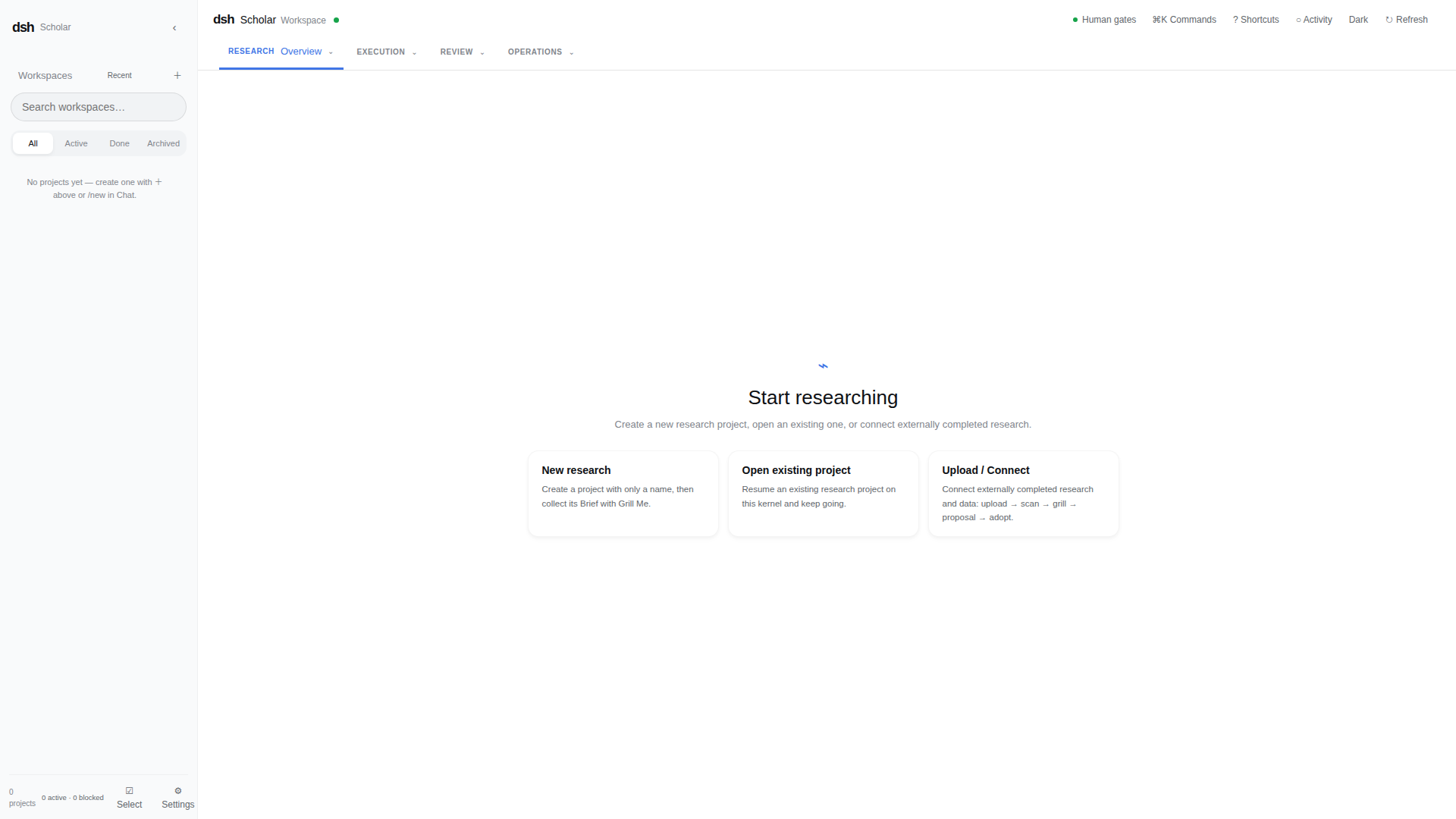
The plugin adds Scholar tools, slash commands, Skills, settings, and a compact dsh Scholar tab. An unlinked DSH conversation can bind an existing project or create a name-only project. A linked conversation shows only its current stage, next action, and execution summary; use Open in new page or the configured shortcut for the complete workspace.
Plugin configuration
Open Settings → Plugin config → dsh Scholar in DSH. Saved plugin changes take effect after the next DSH restart.
| Setting | Default | Meaning |
|---|---|---|
| Default governance mode | gate-only |
Applies only when a fully configured project explicitly qualifies for that mode. Name-only creation remains gate-only. |
| Unattended runs | Off | Does not bypass Human Gates; an interaction requirement parks the project. |
| Standalone URL | http://127.0.0.1:18610/ |
Target for Open in new page and the shortcut. Only HTTPS or loopback HTTP is accepted. |
| Open-page shortcut | Alt+Shift+S |
Can be disabled and does not fire while typing or using an IME. |
When full-auto is enabled for a valid fixture, Settings also reports worker state, restart-required state, the fixture-only boundary, and the latest park reason. Release remains Human-controlled. The Standalone URL cannot contain credentials, query parameters, or fragments. Copy standalone access token is available only from a loopback DSH instance after an explicit click; the page never displays the token and does not expose Kernel, Runner, Provider, or SSH secrets.
Visual models in Chat
Scholar reads the live model catalog from DSH instead of guessing capability from a model name. Configure the actual DeepSeek-compatible image endpoint as an image-capable catalog entry in the DSH profile:
- id: llm-deepseek
  name: '@deepseek-ai/dsh-llm-deepseek'
  config:
    models:
      - id: your-vision-model
        name: Your Vision Model
        inputModalities: [text, image]
Restart DSH, choose the model marked with 👁 in Scholar, attach or paste PNG, JPEG, WebP, or GIF images, then send a normal-language Chat message. The same upload may enter project Intake, but its visual bytes are consumed only by that successful free-conversation turn. A text-only or undeclared model is rejected before provider network I/O; Scholar never silently falls back to a text answer.
Start or continue research
Choose one of three entry points:
- New research: provide only a project name, then answer the Grill Me questions in Chat to complete the Brief.
- Open an existing project: continue its persisted stage, project conversations, files, tasks, runs, and methodology history.
- Upload / join: add papers, code, data, images, or logs and attach them to an existing stage. Uploaded material first enters isolated Intake and never becomes Evidence automatically.
The usual flow is:
Create or join → Grill Me → Scope → survey → Ideas → Baseline → Contract
→ controlled Runs → classification and synthesis → Evidence and Claims
→ TeX writing and review → private bundle → Human Release Gate
Chat accepts ordinary natural language and top-level slash commands. Explicit commands are deterministic advanced entry points; prose is interpreted against the project's current authoritative NextAction. For example:
/new  /status  /survey  /ideas  /ideas generate 3  /ideas select <idea_id>
/gates  /contract  /run  /evidence  /claims  /write  /review
/release-bundle  /release
/run executes only when its exact snapshots, Protocol, Runner, target, and budget are ready. /release creates or opens a Human Release decision; it does not let an Agent publish automatically.
Example workflow
The repository includes a supervised MNIST handwritten-digit workflow that demonstrates project intake, controlled Docker runs, evidence review, and manuscript-ready results without treating the fixture as a benchmark claim.
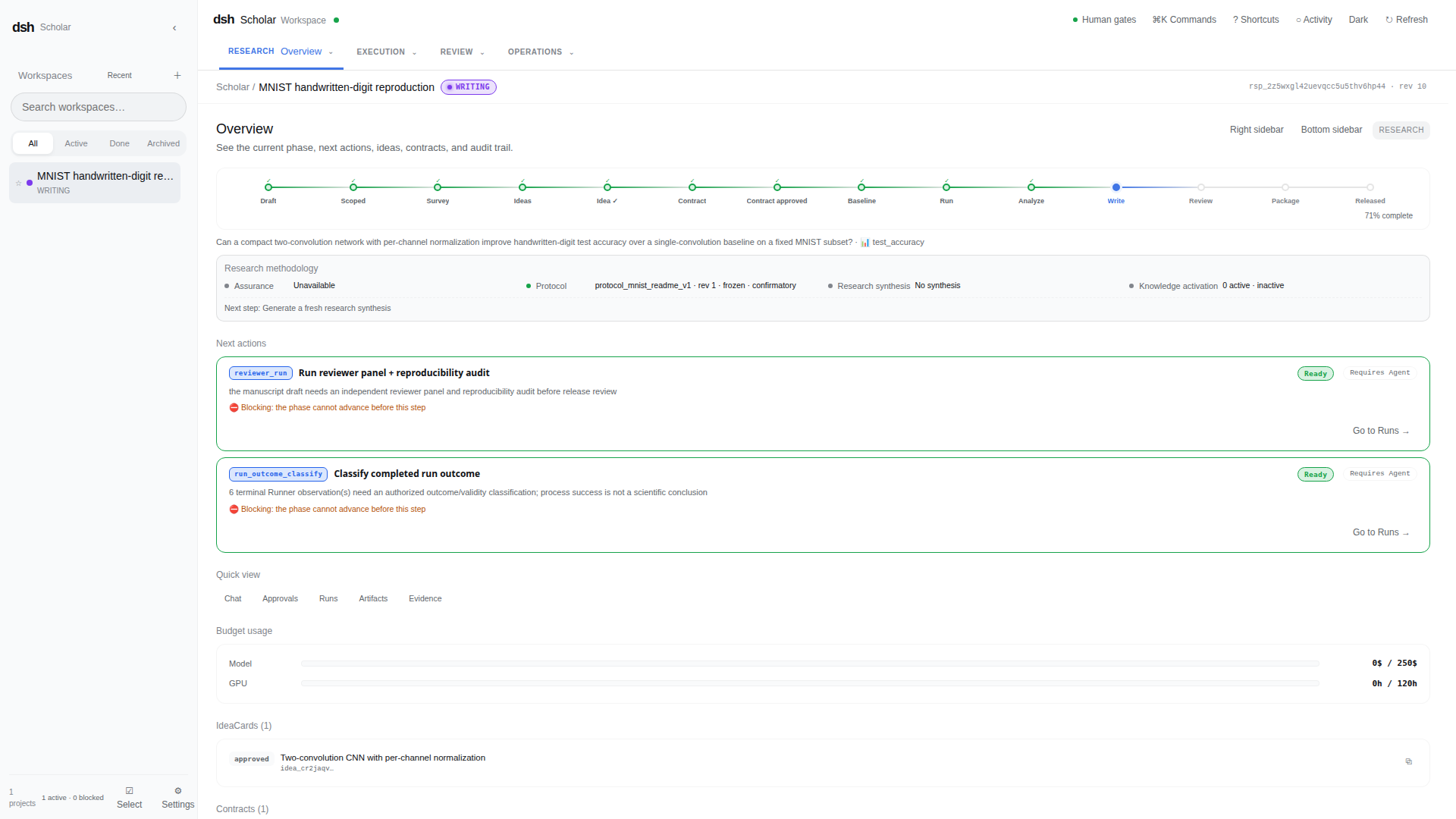
See the MNIST reproduction guide for the pinned inputs, rerun procedure, and detailed receipts.
Workspace areas
| Area | Purpose |
|---|---|
| Chat | Natural conversation, Grill questions, uploads, visual-model input, command completion, and stage-aware guidance. |
| Workspace | Browse, search, edit, upload, and manage project files with version/etag conflict protection. |
| Run / Terminal | Inspect formal Job state and read-only logs, or operate a project/session-bound Web PTY. |
| Evidence / Artifacts | Preview and download outputs, and review metrics, provenance, confidence, and claim links. |
| Manuscript | Edit TeX, inspect compilation diagnostics, and preview the latest successful PDF generation. |
| Trajectory / Topology | Inspect research history and enter subagent nodes to review their work and follow-ups. |
| Settings | Configure model and OCR providers, MinerU, budgets, Runner Profiles, targets, Docker images, GPU requirements, and SSH SecretRefs. |
Validation boundary
The repository's automated acceptance covers builds, schemas, Kernel and Client behavior, governance and security regressions, persistence/restart behavior, DSH plugin contracts, visual-request admission with a controlled adapter, and controlled local-Docker fixtures. Real browser/ARIA observation, a clean DSH Host cold start, a production visual/reviewer provider, remote SSH/GPU execution, production mTLS termination, and environment-specific TeX rendering remain deployment-specific manual acceptance items. Check the current implementation status and manual acceptance checklist before relying on those paths.
Documentation
- Usage guide
- Runtime and deployment guide
- DSH host integration
- Security and research-integrity baseline
- Acceptance specification
License
This project is licensed under the BSD 3-Clause License.
Links
More in this category
Tencent/WeKnora#dsh-weknora★ 30675
Four read-only tools over a WeKnora knowledge base: list knowledge bases, hybrid passage search, reassemble one document's chunks in order, and WeKnora's own cited RAG or ReAct-agent answer with a resumable session id.
superdesigndev/treg★ 3596
Tool catalog for agents: search ~2,600 external endpoints (SEO and SERP, backlinks, social, people and company enrichment, ad libraries, scraping) by the task you want done, read each one's parameters and per-call price, then call it with the credential injected server-side. Ships the skill plus an MCP row that stays disabled until TREG_TOKEN is set.
TencentCloudBase/CloudBase-AI-Toolkit#dsh-plugin★ 1126
Tencent CloudBase backend for DeepSeek Harness — scaffold and deploy full-stack apps from chat, render query results as table cards with paging, sorting and CSV export, preview a deployment on its domain, and call the CloudBase MCP toolset (`mcp__cloudbase__*`) with device-code login.
gitroomhq/postiz-agent#dsh-postiz★ 496
Connects DeepSeek Harness to Postiz over MCP: list connected social media channels, fetch per-platform posting rules, and schedule, draft, or publish posts to X, LinkedIn, Instagram, Facebook, Threads, TikTok, YouTube, Reddit, Bluesky, Mastodon, Discord, Slack, Telegram and more; adds a postiz workflow skill.
EthanYoQ/Invoice-Downloader#dsh-invoice-downloader★ 446
Local IMAP invoice download, OCR, archive, and Excel reimbursement summaries for DeepSeek Harness.
anysearch-team/anysearch-dsh★ 430
AnySearch-powered real-time web and vertical search provider for DeepSeek Harness.
Community comments
Comments are public GitHub Discussions. Loading them connects to GitHub and Giscus; a GitHub account is required to post.