Multi-pet desktop companion: four MAM status lights watch every active session (approval / running / done-unread / error) and each card click-through to its conversation; four voice groups speak on state changes with duration-timed subtitles; import pets from four sources (folder / zip / Codex dir / Petdex registry) with card-style hot-swap and an integrity guard; five action bindings, drag physics, three scales. The built-in fox Foxbell ships in the package — install and go.
Install
# from a prebuilt release tarball
dsh plugin --profile web add "https://github.com/jarvislee90s-dot/dsh-foxbell-pet/releases/latest/download/dsh-foxbell-pet-2.0.0.tgz"
# from GitHub (first run asks for allowBuilds approval — follow the hint, retry)
dsh plugin --profile web add github:jarvislee90s-dot/dsh-foxbell-pet
Any plugin you install runs third-party code with your own permissions — it can read your files, use your credentials, and reach the network, and tool approvals don’t sandbox it. GitHub-sourced plugins also run build scripts at install time — pnpm blocks those until you allow them, so an install can stop with ERR_PNPM_GIT_DEP_PREPARE_NOT_ALLOWED or ERR_PNPM_IGNORED_BUILDS; dsh prints the exact key to add under allowBuilds in your profile’s pnpm-workspace.yaml, and the install works on the next run. Allowing a build is a trust decision: only install sources you trust, and pin a commit (github:owner/repo#sha).
README
A draggable multi-pet desktop-pet system for the DeepSeek Harness (DSH) Web UI — bottom-right of the page, with multi-project status monitoring, voice alerts, a full external pet system (store / 4-source import / hot-swap / integrity guard), and a 🦊 show/hide switch. One built-in pet, Foxbell the fox, ships inside the package: install & go — import more pets anytime and hot-swap with one click.

v2.2.0 targets dsh ≥ 0.1.2-rc.1 (older rc.7/rc.8-era harnesses are no longer supported; see the compatibility table below; 0.1.5-rc.2 verified compatible surface-by-surface). Starting with v2.0.0 the status-card color semantics follow MAM: red = awaiting approval, yellow = running, green = done-unread, dark red + ⚠ = error/disconnected (v1.x used green/yellow/red/blue). See CHANGELOG.
Screenshots
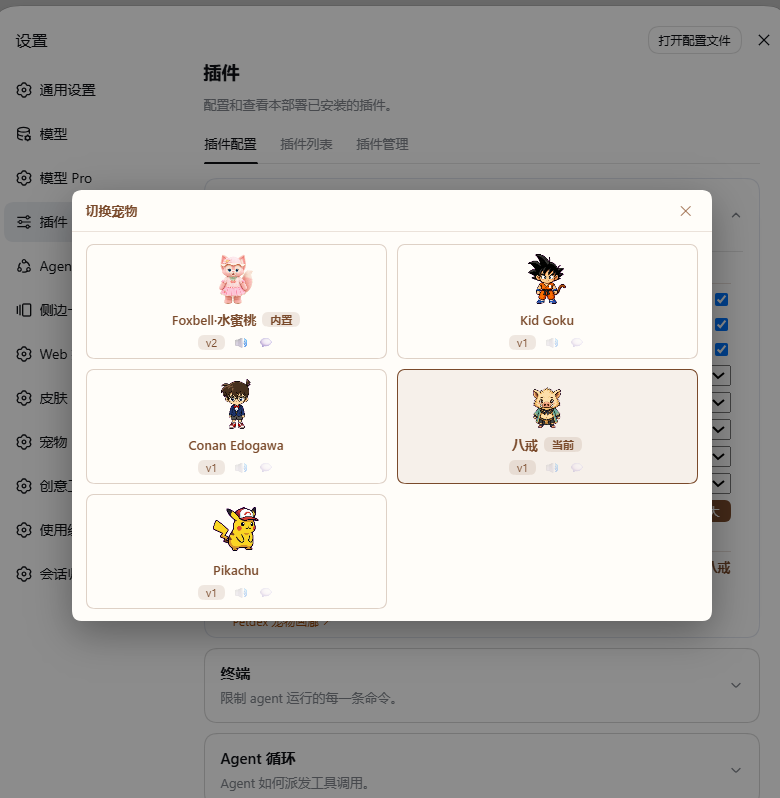
Hot swap — the built-in pet and imported pets are managed side by side; click to switch, effective instantly:
Right-click menu — toggles / size / five action bindings (live preview) / switch pet / hide / about:

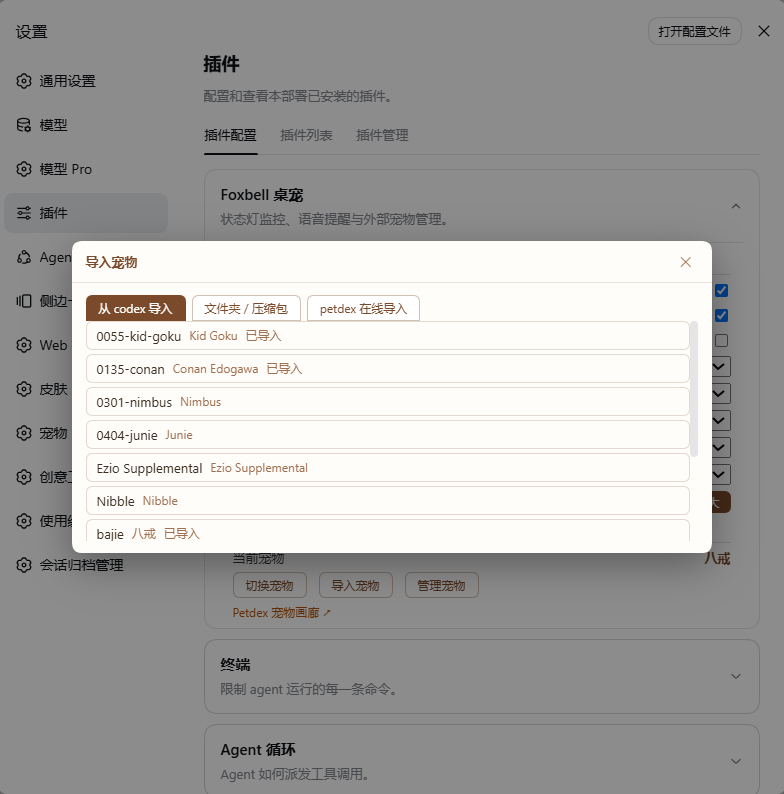
Four import sources — local folder / zip / Codex pet dir / Petdex online registry:
Features
- Multi-project status monitor — one card per active project above the pet's head (MAM color semantics):
- 🔴
approval— waiting for your approval (red) - 🟡
running— in progress (yellow) - 🟢
done— finished, unread (green; click = confirm & dismiss) - 🟥
error— turn failed / disconnected (dark red + ⚠ badge, clearly distinct from approval red)
- 🔴
- Click a card to switch sessions — opens that conversation (
sessions.open) and marks it read; error/done cards disappear once opened and relight on recurrence. - Voice alerts — completion plays the
donegroup, new approval playsapproval(10s throttle), errors playerror; subtitle = voice filename, timed to the audio. - Voice interactions — single-click: waves only (silent); double-click: speaks + the configured "double-click action"; card click: switches only (silent).
- State-driven animations (all 11 Codex V2 atlas rows; external v1 9-row sheets adapt at runtime) — priority chain: drag > transient action > task pose > look-around > idle; drag-direction run/jump, task poses (approval→waiting, running→working), idle 6s triggers a 16-direction look sweep.
- Drag physics — gravity fall on release (1400 px/s²), horizontal throw inertia (150ms sampling window), squash-and-bounce landing + a hop (toggleable); the viewport is the work area, with position memory and edge clamping.
- Right-click menu — 🔊 sound / 💬 subtitle / 🧲 physics toggles (auto-disabled with tooltips for pets lacking the capability), 📏 three size steps, five action-binding submenus (double-click / red / yellow / dark-red / green) with live preview, 🔁 switch pet (current pet checkmarked, click = hot-swap), 🦊 hide, ℹ️ about.
- External pet system (ported from MAM v0.3.0) —
- on-disk store
~/.dsh/foxbell-pet/pets/<id>/; manifest v2 (atomic write + one.bak); - 4 import sources: local folder / zip (host-side safe extraction: ≤100MB total, ≤200 files, path-traversal defense) / Codex pet dir
~/.codex/pets// Petdex online registry (petdex.dev — both listing and download proxied by the host half: domain allowlist, response size caps, 8s timeout); - unified import wizard: live pet-id validation (charset / length / reserved
foxbell/ duplicates / Windows reserved device names, enforced both client- and server-side), display name & description, subtitle toggle, voice-group editor (parallel duration probing; 1s < duration < 20s and ≤10MB per file; all four groups complete ⇒ "has voice"); - manage dialog: rename (id synced across folder & manifest), edit display name/description, per-group voice add/remove, subtitle toggle, safe delete (after confirmation the folder moves to
~/.dsh/foxbell-pet/.trash/— never hard-deleted), view folder path; editing the active pet triggers flash-switch protection; - hot swap: card-style list (built-in foxbell + all external pets) → activation takes effect instantly (sprite/voice/manifest hot-replaced, no page reload);
- activation guard: integrity check on plugin activation and every switch (sheet missing/changed, voices missing/changed/extra, manifest missing); issues ride the state snapshot and open a repair dialog (update manifest / switch back to foxbell / ignore / hide pet); never pops while the pet body is mid-interaction;
- voiceless pets: completion plays animation only, sound toggle disabled with tooltip; subtitle-less pets: no speech bubble.
- on-disk store
- Three scale steps (0.75 / 1 / 1.25) — applied to sprite, cards and menu as a whole (settings card and menu share the same config).
- Settings card (one card, two sections) — "Configuration" (sound/subtitle/physics, five action bindings, size) + "Pet management" (current pet, switch/import/manage buttons, Petdex entry); shares one config store with the right-click menu (localStorage + settings scope dual backend, persisted by the host to
~/.dsh/settings.yaml). - 🦊 show/hide switch — sidebar footer (same semantics as v1), persisted in localStorage.
- Error-code system — aligned with the MAM PetError table (50 host codes + 8 client-local codes); route errors are uniform
{code, params, detail}JSON, mapped to zh/en text by the plugin's internal dictionary and rendered inline in dialogs (browser language auto-detected; no harness locale dependency, no toasts).
Efficiency Dashboard (ported in v2.1.0)
The v1.4.0 efficiency-dashboard phase one, ported wholesale onto the v2 architecture: aggregated by the host half and delivered with the /state snapshot, zero always-on UI (the mini bar exists only while hovering). Usage is always pure tokens — never converted to money — presented in five metrics: request input / cache hit / hit rate / output / your input (est.) (plus a "incl. subagents" tag).
- Pace dial (duration-posture engine) — the pet's pose follows the event timeline through tiers: intense / active / long-run (turn open but silent ≥3 min — guards against babysitting a hanging task) / idle / four loafing stages (turn closed but silent ≥15 min: resting → lounging → idling → dried-fish, progressively suppressing the idle look-around). Swapping animation variants does not change speed; a tier transition plays one short animation, and any new event resets immediately.
- Five-metric mini bar — hover the pet ≈0.5s and it appears: pace dial (current tier readout) + "today × · this session ×" five-metric usage + an "N awaiting approval / N running / N done" status line; its only clickable element is the trailing "Details »" drill button (the container still never intercepts clicks); it vanishes when the pointer leaves (right-click "🏷 Today's usage" summons it manually; close via outside click / ESC).
- Alert placards + dashboard sound chain — daily threshold
dayLimitTokensraises a placard "spent X today" once each at 80% / 100%; crossing amilestoneUnittoken milestone speaks one bubble line. Since v2.2.0 alert sounds follow the MAM four-group mechanism + built-in defaults: with all four pet voice groups present thegeneralgroup plays, otherwise a built-in synthesized chime (3 rotating) plays; TTS no longer takes part in dashboard alerts (ttsEnabledremains for spoken lines only). - Blackboard + 📖 limited-time entry — after a task completes, a "📖 Summary" entry appears next to the pet for a limited time (default 15s; 10/15/20 configurable) → clicking opens the summary board (sessions / turns / five-metric token ledger / top-3 tools / longest single turn / error count); it auto-dismisses after
boardTtlSec, and ✕ / outside click / ESC all close it; right-click "📊 Last summary" reopens it anytime. - Farewell on hide — hiding the pet dispatches a "Wrapping up today" board once, so the day ends with a report.
Two small enhancements: title blink — when an approval waits ≥N minutes (approvalFlickerMin) and the page is hidden, the tab title alternates with "🦊 approval waiting…", restored on approval or on returning to the page; age annotation — a gray "×s/×m" tail on each status-card line distinguishes "just happened" from "stuck for 5 minutes". Plus a right-click "🗂 Session overview" listing all conversations (status dots + click to jump).
All of this adds 12 new settings (paceEnabled / usageEnabled / summaryEnabled / ttsEnabled / dayLimitTokens / milestoneUnit / paceIntenseEvents / paceLongrunMin / paceLoafStartMin / approvalFlickerMin / summaryEntrySec / boardTtlSec), edited in the settings card as a draft with unified save (edits stage into a draft; save/discard applies them together; the card collapses on save).
Efficiency-dashboard interaction quick reference (one target, one action)
| Click / gesture target | The one behavior |
|---|---|
| Status card (single click) | Smart jump: with a pending approval → approval anchor; otherwise → session + mark read |
| 📖 summary limited-time entry | Open the blackboard; the entry then disappears |
| New right-click menu items | Today's usage → open mini bar manually; Last summary → open blackboard; session-overview item → smart jump |
| Hover ≈0.5s | Mini bar appears (only clickable element = the "Details »" drill button; gone when the pointer leaves) |
| Drag | Pure physics animation, carries no command (mini bar hides and hover detection suspends while dragging) |
| Mouse wheel | Never hijacked over the pet body or mini bar — scrolls the page through; the blackboard / menu scroll their own content |
| Right-click | Pet body only opens the menu (status card and floating layers have no custom right-click behavior) |
| ESC | Peels one layer at a time, topmost first (manual mini bar → blackboard → menu) |
| Blackboard vs mini bar | Mutually exclusive: while the blackboard is open the mini bar is replaced; it comes back once the blackboard closes |
Usage Dashboard (v2.2.0, three-level disclosure)
One data core, three levels of disclosure, each click going deeper: L1 mini bar → L2 blackboard → L3 main-column dashboard (plus a right-click “📈 Usage dashboard” shortcut). The host aggregates session-event usage once (by day / hour / route / tool) and serves it via the /state snapshot and an on-demand route; pure tokens, never money; performance-wise it uses last-event-fingerprint incremental caching + /state short-circuit + reduced polling when hidden, so idle overhead is near zero.
- L2 blackboard extras: after the five-metric rows it appends a 7-day sparkline, top-3 models, and an “Open full dashboard →” entry row; the blackboard anchors beside the pet (left first, flipping right on overflow) and replaces the mini bar while open.
- L3 dashboard (Codex++-style layout, occupying the main column): tabs [Last 5 hours | Last 7 days | Last 30 days | Custom ≤31 days] + “Copy text” / “Export image”; a range hero number plus this-week/last-week hit-rate comparison; five-metric grid; blue→purple gradient trend chart (hover tooltip / data points / peak / axis labels); model distribution progress bars (≤6 rows); 2×2 tool grid + top-5 tools; a caliber footnote at the bottom.
- Model / provider distribution (F05 settled): usage is booked per settled (turn, step) sample by
provider/model(same-slot replacements roll back, no cross-day pollution); the aggregation reconciles byte-for-byte with the session’s official tokenUsage totals across all four metrics. - Share & export: a 1200×675 PNG — title / hero / trend line / metric grid / model rows + the current pet sprite at the bottom (random or picked pose) + a smart quote bubble (rule pool with zh/en priority matching, or a custom template
{range}{tokens}{hitPct}{models}in settings); “Copy text” is the same data as plain text. - Dashboard sounds: alerts (daily threshold / milestone) play the
generalvoice group when all four groups are present, otherwise a built-in synthesized chime (served via/sounds/). - Three new settings: “Sidebar dashboard entry” (off by default; shows a dashboard icon in the sidebar when enabled), “Export quote”, “Export pose”. Note: on rc.2 the sidebar entry icon may not project (upstream child-slot lifecycle under investigation); the right-click menu and the blackboard chain are the verified entrances.
Requirements (compatibility)
| Component | Requirement |
|---|---|
| DeepSeek Harness (DSH) | ≥ 0.1.2-rc.1 (Web profile, dsh web) |
| rc.1 surfaces used | session.snapshotEvents() (B1), ctx.settings.installSection (B2), package-edge dsh.client.inject semantics (B3 — declared empty: only platform seed modules like react are required) |
| master (0.1.3-alpha.1) | static-diff assessment found no breaking surface (IMPLEMENTATION_NOTES §9) |
| 0.1.5-rc.2 | protocol surface (events/routes/settings) verified compatible item-by-item (regressed before the v2.1.0 release) |
| v1.x (rc.7/rc.8 era) | unsupported (legacy session.events / installSettingsSection / dsh-client-runtime were removed in rc.1; use plugin v1.3.0 there) |
Built-in assets ship with the package; external pet assets are user-imported.
Install (one click)
dsh plugin --profile web add github:jarvislee90s-dot/dsh-foxbell-pet
> Build-script note: since v2 the install runs `prepare` (esbuild). When the dsh
> profile uses pnpm, allow this plugin's build scripts via the profile allowBuilds
> list (pnpm approve-builds or profile config) on first install — otherwise the
> `lib/` artifacts won't be generated.
Then restart dsh web and hard-refresh the browser (Cmd/Ctrl+Shift+R). The pet appears bottom-right, the 🦊 toggle beside Settings, and a "foxbell-pet" card in the settings page.
The pet reads built-in sprite/voices from the package's own
assets/directory; the external pet store lives in~/.dsh/foxbell-pet/(plugin-private, auto-created on first launch).
Usage
| Interaction | Effect |
|---|---|
| Drag | Move the pet anywhere (direction animations: run left/right, jump when lifted) |
| Release after drag | Gravity fall / throw inertia / squash-and-bounce + hop (disable via "Drop physics") |
| Right-click pet | Menu: toggles / size / five action bindings (live preview) / switch pet / hide / about |
| Single-click pet | Waves (silent) |
| Double-click pet | Speaks a random line + the "double-click action" (subtitle = voice filename) |
| Click a project card | Switch session + mark read (green card confirms & dismisses on click) |
| 🦊 button (sidebar footer) | Show / hide the pet |
| Settings card "Pet management" | Switch / import / manage pets, Petdex gallery entry |
Lights (MAM semantics): red approval · yellow running · green done-unread · dark red + ⚠ error/disconnected.
Voice groups
Four fixed groups under voice/ (built-in: assets/voice/ in the package; external: ~/.dsh/foxbell-pet/pets/<id>/voice/). The filename (minus extension) becomes the subtitle:
| Folder | Trigger | Notes |
|---|---|---|
general/ |
double-click | small talk (random, no immediate repeat) |
approval/ |
approval appears (red) | nagging lines, 10s throttle |
error/ |
turn error (dark red) | sulky lines |
done/ |
completion (green) | praise-me lines |
Running (yellow) is silent. Empty groups skip silently; a pet counts as "voiced" only when all four groups are complete.
Customization (external pets)
- Import: settings card → "Import pet" → pick one of four sources (folder / zip / codex / petdex link or search) → configure in the wizard (id / display name / description / subtitles / voice groups) → import → activate now.
- Asset spec: Codex V2 sheet
spritesheet.webp(8 columns; 11 rows 1536×2288 = v2, 9 rows 1536×1872 = v1, auto-detected at runtime), see docs/SPRITESHEET-CONTRACT.md; audio.m4a/.mp3/.wav/.ogg/.opus/.flac/.aac, 1–20s and ≤10MB each. - Keep the sprite, change voices: add/remove per group in the manage dialog, then "Save changes" (manifest backed up & updated automatically).
Development
npm install
npm run build      # esbuild: src/host → lib/index.js (ESM), src/client → lib/client.js (single-file iife)
npm run validate   # static checks (legacy checks + bundle purity / declaration parity / route prefix / versions / error-code table / built-in manifest)
npm run typecheck  # tsc --noEmit (client TSX)
npm test           # vitest (pure logic + real-tempdir pipelines + mocked fetch)
dsh-foxbell-pet/
├── assets/         built-in foxbell assets (sheet + 31 voices + v2 manifest pet.json)
├── lib/            published artifacts (main & ./client entries; esbuild output, committed)
├── src/host/       host half (plain JS: status aggregation/store/import/guard/route family)
├── src/client/     client half (TSX: pet body/menu/settings card/dialogs/error dictionary)
├── test/           vitest suites (real temp dirs, mocked fetch)
├── scripts/        build + validate + built-in manifest generator
├── docs/           sprite contract / QA checklist / screenshots / legacy design docs
├── demo/           standalone offline preview page
├── package.json  dsh.plugin.json  cordis.patch.yml
├── IMPLEMENTATION_NOTES.md   decisions / MAM alignment index / forward-risk assessment
└── README.md  README.en.md  LICENSE  CHANGELOG.md
Local dev install: dsh plugin --profile web add <repo path> symlinks the repo; after editing src/, run npm run build, restart dsh web and hard-refresh.
License
Links
More in this category
zhu1090093659/dsh-web-ui#packages/dsh-pet★ 7488
A whale-girl companion for the dsh web GUI: animations follow the agent state, with pat interactions and a feeding mechanic that raises intimacy from a calf to deep-sea bonds.
Nagi-ovo/dsh-ads★ 620
Parody ads in 2005-Chinese-web style: sidebar banners, in-chat feeds, corner popups, and a close button whose hit area is smaller than it looks. All fictional.
PC2005-cloud/dsh-pet#dsh-pet★ 613
Desktop pet for the DSH Web UI with 25 transparent animations, screen wandering, click reactions and drag, plus a reproducible asset-generation pipeline.
vlln/whale-girl★ 323
Desktop pet (QQ-pet style): floats in the corner, draggable, feedable, playable.
yyh-001/dsh-meme★ 84
Chat meme stickers: text-only send, mood auto-send, QQ/WeChat-style picker, auto-learn, custom packs.
Awu12277/dsh-stock-watch★ 79
A-share watchlist real-time market monitoring plugin: a collapsible popup in the top-right corner of the DeepSeek Harness (DSH) web interface for real-time quote monitoring, group switching, intraday and candlestick (K-line) charts, and buy/sell target price settings.
Community comments
Comments are public GitHub Discussions. Loading them connects to GitHub and Giscus; a GitHub account is required to post.