During long agent thinking, posts a hot-news or reminder message directly into the conversation stream.
Install
# from npm (prebuilt)
dsh plugin --profile web add dsh-gap-feed
# from GitHub (first run asks for allowBuilds approval — follow the hint, retry)
dsh plugin --profile web add github:faukwaa/dsh-gap-feed
Any plugin you install runs third-party code with your own permissions — it can read your files, use your credentials, and reach the network, and tool approvals don’t sandbox it. GitHub-sourced plugins also run build scripts at install time — pnpm blocks those until you allow them, so an install can stop with ERR_PNPM_GIT_DEP_PREPARE_NOT_ALLOWED or ERR_PNPM_IGNORED_BUILDS; dsh prints the exact key to add under allowBuilds in your profile’s pnpm-workspace.yaml, and the install works on the next run. Allowing a build is a trust decision: only install sources you trust, and pin a commit (github:owner/repo#sha).
README
A DeepSeek Harness (dsh) plugin that posts a hot-news or reminder card directly into the conversation stream while the agent is thinking for a long time. Low-frequency, never intrusive.
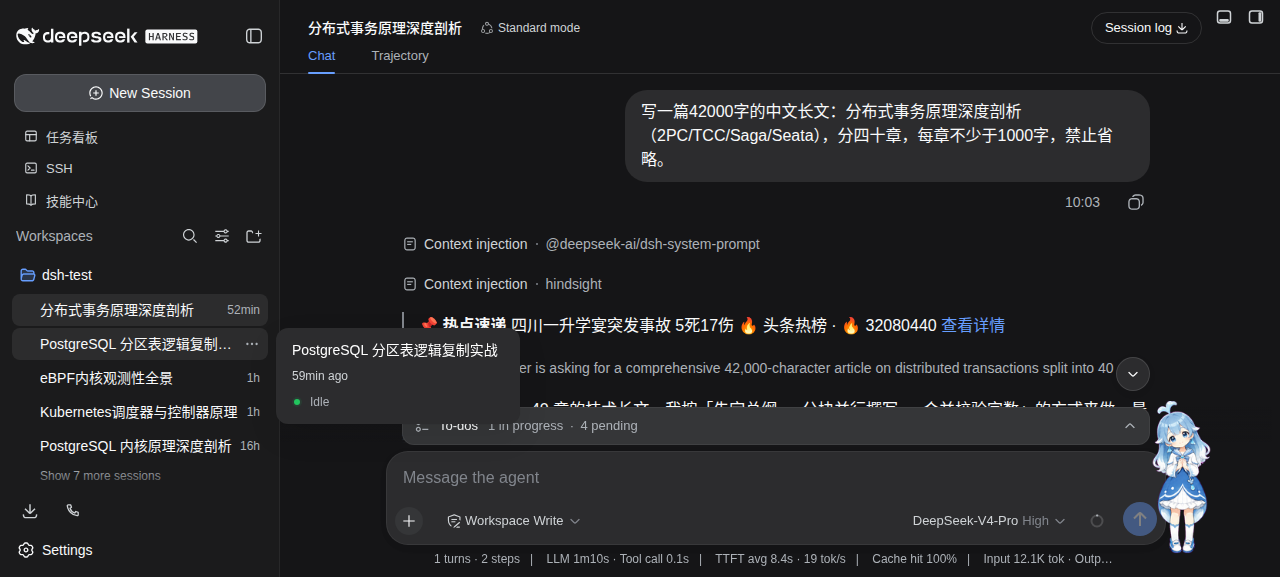
Features
- In-stream injection — when the agent thinks longer than a threshold, the plugin appends an
assistant/messagedirectly into the session log (session.append+surfaceOp:'append'), rendered as a card in the conversation stream with a clickable link. If a source fails, it silently degrades — never blocks the conversation. - Multiple sources — today's hot news from Toutiao (公开 API, no login), trending GitHub repositories (created this week, sorted by stars), and Bilibili's hot ranking. Sources are fetched in parallel; one failing never affects the others.
- In-chat reminders — just say "remind me to have a meeting at 18:00" in the conversation; the model calls the
gap_feed_reminder_addtool to save it. Due reminders are prioritized over news. - Settings page — the dsh settings page renders the
gap-feedform automatically from a schema: configure limits, manage reminders (CRUD / enable / done). - Rate limiting — configurable thinking threshold + cooldown + per-hour cap, so it stays rare and never spams.
- Priority — due reminder > upcoming reminder > news; the same content is never injected twice.
- Persistence-safe — injected messages inherit a valid
model source(kind/provider/model) from existing session messages, so the session loads fine after a restart (a forged source is rejected by SessionPersistence validation).
Install
dsh plugin --profile web add dsh-gap-feed
Restart dsh web (or just refresh the page).
Published on npm as
dsh-gap-feed— the market prefers prebuilt npm tarballs (noallowBuildsapproval needed).
Usage
When does it inject?
All of the following must hold:
enabledis true;- the agent has been thinking for more than
minThinkSeconds(default 20s) without idling — detected by polling the agent registry, so it's robust to event timing; - more than
cooldownMinutes(default 15) since the last injection; - fewer than
maxPerHour(default 4) injections in the last hour.
Otherwise it stays silent and does nothing.
In-chat reminders
Say something with a time + a task, for example:
- "提醒我 18:00 开会" / "remind me to have a meeting at 18:00"
- "半小时后提醒我回邮件" / "remind me to reply to emails in half an hour"
The model parses it into text (the task) + dueAt (unix ms timestamp, default = now + 1h) and saves it. Parse failures return a friendly error without blocking the conversation. Due reminders are shown before news on the next injection.
Settings
The dsh settings page automatically renders the gap-feed namespace form. Changes take effect immediately and survive restarts.
Configuration
| Key | Type | Default | Description |
|---|---|---|---|
enabled |
boolean | true |
Master switch |
minThinkSeconds |
number | 20 |
Only inject after this many seconds of continuous thinking |
cooldownMinutes |
number | 15 |
Minimum gap between injections (minutes) — the core rate limiter |
maxPerHour |
number | 4 |
Per-hour injection cap (safety net) |
blacklist |
string[] | [] |
Title blacklist words; a matching title is filtered out |
Defaults live in DEFAULT_CONFIG in src/types.ts.
Reminder storage
$DSH_HOME/profiles/<profile>/data/gap-feed/reminders.json
DSH_HOMEdefaults to~/.dsh;- JSON array of
id / text / dueAt / done / enabled / createdAt; missing dirs are created, and read/write failures or corrupt JSON silently fall back to in-memory state — never throws.
Development
npm install        # dev deps
npm test           # vitest: 67 unit + contract tests
npm run typecheck  # tsc --noEmit
npm run build      # tsc -> dist/ (prepack runs it automatically)
Layering discipline: pure-function layers (decision.ts, picker.ts) have zero dsh dependency and full branch coverage; side-effect layers (news.ts network, reminders.ts file I/O) are mockable via the Source interface; the wiring layer (index.ts) only connects the runtime.
Known limitations
- Bilibili source may be rate-limited (
-352) on datacenter IPs; it degrades silently — other sources are unaffected. - Reminder cards show via the same in-stream card; reminder UI is in the settings page.
- In-session dedup is per-plugin-lifetime (no cross-restart dedup).
License
MIT
Links
More in this category
xmanrui/dsh-im★ 1597
Connect IM bots to DeepSeek Harness via QR codes or bot credentials (9 channels: Feishu, WeChat, DingTalk, WeCom, QQ, Slack, Telegram, Discord, and WhatsApp).
shaobeichen/dsh-pocket★ 1521
Remote phone access to the DSH Web UI: scan a QR code for LAN or public (cloudflared tunnel) access with real-time sync, a mobile-adaptive layout, and a settings tab.
inclusionAI/Avernet#deepseek-harness-channel-bcn★ 658
Connects DeepSeek Harness to Avernet's Bot Collaboration Network over WebSocket V2, with automatic onboarding, isolated agent sessions, tool-call events, and multi-bot routing tools.
omdsh-dev/dsh-notification★ 85
Desktop notifications for turn completions, with per-outcome controls and keyword rules.
whyihaveyou/dsh-suite#plugin-notify★ 56
IM webhook and local notifications on turn completion, errors, or approval (Feishu/WeCom/DingTalk/Slack/Discord/custom).
omdsh-dev/dsh-lark★ 55
Lark/Feishu bot channel for DeepSeek Harness: each chat drives its own agent, and tool approvals, model questions, and plan reviews return as cards answered by a button or a reply. Switch workspace and model from the chat (`/cd`, `/model`, `/new`), and run several bots that keep separate sessions and can hand turns to each other in one group.
Community comments
Comments are public GitHub Discussions. Loading them connects to GitHub and Giscus; a GitHub account is required to post.