Automated unit-test generation: a /testgen command and generate_tests tool that scaffold, run, and fix tests until they pass (LLM + offline template generators; vitest/jest/mocha/node:test).
Install
# from GitHub (first run asks for allowBuilds approval — follow the hint, retry)
dsh plugin --profile web add github:bujue600-arch/dsh-testgen
Any plugin you install runs third-party code with your own permissions — it can read your files, use your credentials, and reach the network, and tool approvals don’t sandbox it. GitHub-sourced plugins also run build scripts at install time — pnpm blocks those until you allow them, so an install can stop with ERR_PNPM_GIT_DEP_PREPARE_NOT_ALLOWED or ERR_PNPM_IGNORED_BUILDS; dsh prints the exact key to add under allowBuilds in your profile’s pnpm-workspace.yaml, and the install works on the next run. Allowing a build is a trust decision: only install sources you trust, and pin a commit (github:owner/repo#sha).
README
Automated unit-test generation for DeepSeek Harness: a
/testgencommand and agenerate_teststool that scaffold tests, run your project's test runner, and fix failures until they pass — bounded, observable, and honest about what it changed.

English | 中文
Why this plugin
DeepSeek Harness agents write code constantly — and leave it untested. dsh-testgen closes that loop inside the harness:
- One command for humans —
/testgen src/utils/math.tsgenerates, runs, and fixes in a single step. - One tool for agents — the agent itself can call
generate_testsafter writing code, keeping the loop in the session. - Two generators, no dead ends — behavioral tests through your composed LLM when available; deterministic structural smoke tests (zero LLM, works offline) otherwise.
- A real fix loop — failures are parsed from vitest / jest / mocha / node:test output and fed back to the LLM, up to a bounded number of iterations, only ever rewriting the test files it generated.
No duplicated wheels: the ecosystem has git tools and eval harnesses, but no plugin that generates, runs, and fixes unit tests as a first-class harness surface.
Features
⚡ /testgen slash command |
[options] <file-or-glob>, --json, --help; rendered directly in the Web UI |
🛠️ generate_tests model tool |
structured JSON input/output, cooperative cancellation, never runs in parallel |
| 🧠 LLM generator | streams through ctx.llm, honors your provider/model, bounded source truncation |
| 🧩 Template generator | zero-dependency smoke tests scaffolded from exported symbols — no API key needed |
| 🔁 Generate → run → fix loop | per-framework failure parsing, bounded by maxIterations |
| 🧪 Runner autodetect | vitest / jest / mocha detected from the project; node --test as the universal fallback |
| 🔥 Hot-reloaded config | testgen: section in settings.yaml; edits apply on the next invocation, no restart |
| 🧰 Lifecycle-clean | registrations and in-flight runs unwind with the plugin fiber; refuses to overwrite user tests |
| 📐 Typed end to end | TypeScript, schemastery config, stable error codes, 78 unit tests including a real end-to-end run |
Demo
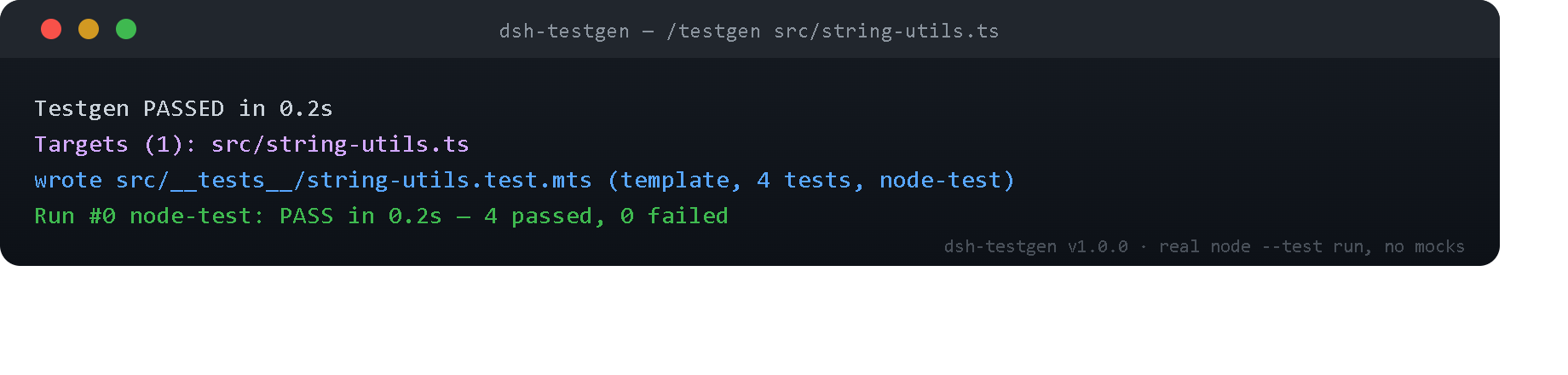
Terminal-style demo (deterministic template generator + real node --test run):
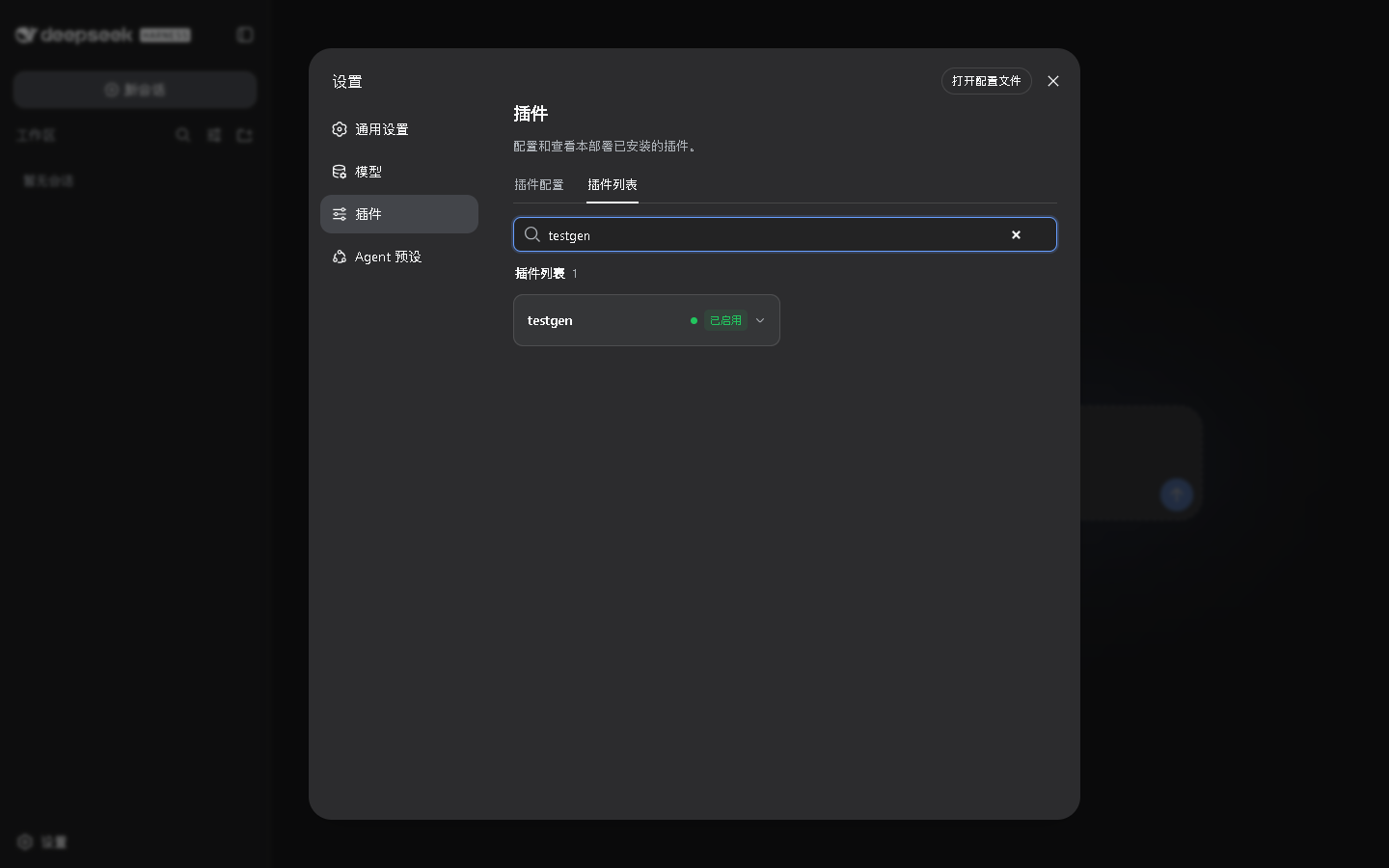
In the Web UI, the plugin shows up in Settings → Plugins → Plugin list with an active status (real dsh web boot, 134 plugins loaded):
Installation
Requires Node ≥ 22 and dsh (DeepSeek Harness CLI).
# Install straight from GitHub
dsh plugin --profile web add github:bujue600-arch/dsh-testgen
dsh plugin add installs the package into the profile and reconciles the bundle layer stack — the plugin declares a dsh.bundle manifest ("dsh": { "bundle": { "patch": "./cordis.patch.yml" } }), so no hand-editing is required. It works for any profile: web, headless, or your own. (An npm package will be published with the first stable dsh release it targets; pinning to a release tag is recommended once available.)
Note for git/file installs: pnpm exits non-zero on missing peers for linked dependencies; that is expected — the harness resolves the peer packages (
@deepseek-ai/dsh-*, cordis) from the profile's own module fallback at boot. The plugin loads normally.
Verify it loaded (Web): Settings → Plugins → Plugin list shows the testgen entry with an active status dot.
Usage
Slash command
/testgen [options] <file-or-glob> [more targets…]

Options:
  --runner <vitest|jest|node-test|mocha|auto>  framework (default: auto)
  --generator <llm|template|auto>              generator (default: auto)
  --iterations <n>                             fix-loop bound (default: 3)
  --model <provider/model>                     generation model override
  --no-run                                     generate only, do not run
  --json                                       machine-readable report
  -h, --help                                   show this help
/testgen src/utils/math.ts
/testgen --runner vitest "src/**/*.ts"
/testgen --generator template --no-run src/app.ts
/testgen --model deepseek-official/deepseek-chat src/parser.ts
Model tool
The agent can call it directly — same pipeline, structured result:
generate_tests({ target: "src/utils/math.ts", runner: "vitest", maxIterations: 3 })
What gets written
For src/utils/math.ts, tests land in src/utils/__tests__/math.test.ts (framework-dependent; node:test uses .test.mts). Existing test files are never overwritten — a target that already has a test file is skipped with a warning.
Configuration
All settings live under the testgen: key of your harness settings document ($DSH_HOME/settings.yaml) and are hot-reloaded — edit, save, done. Layering: schema defaults → composition entry (cordis.patch.yml) → your settings section.
testgen:
  runner: auto            # auto | vitest | jest | node-test | mocha
  generator: auto         # auto | llm | template
  maxIterations: 3        # generate → run → fix loop bound (0 disables fixing)
  timeoutSec: 120         # per-run wall-clock timeout
  autoRun: true           # run the suite after generation
  includeGlobs:
    - '**/*.{ts,tsx,js,jsx}'
  excludeGlobs:
    - '**/node_modules/**'
    - '**/dist/**'
    - '**/*.test.*'
    - '**/*.spec.*'
    - '**/__tests__/**'
  testDir: __tests__      # generated tests land here, next to the target
  model:                  # optional provider/model override
    provider: deepseek-official
    model: deepseek-chat
  maxSourceChars: 60000   # source characters fed to the LLM per target
You can also override any of these per profile by patching the testgen row in the profile's cordis.patch.yml (a patch replaces the row's whole config). See docs/config.md for the full reference.
Input / output specification
Every surface — command, tool, engine — speaks the same contract. The tool's canonical output schema is the JSON projection of TestgenReport; docs/io-spec.md documents it in full.
interface TestgenReport {
  status: 'passed' | 'fixed' | 'generated' | 'failed' | 'skipped'
  targets: { path: string; language: string }[]
  generated: GeneratedTest[]        // path, framework, generator, testCount
  runs: TestRun[]                   // per-iteration exit code, summary, failures
  warnings: string[]
  stats: { generatedFiles: number; passed: number; failed: number; iterations: number }
  elapsedMs: number
}
Architecture
Everything is a plugin, and this plugin stays inside its box:
dsh-testgen
├── src/
│   ├── index.ts            # cordis entry: name / inject / Config / apply
│   ├── schema.ts           # schemastery config + settings namespace schema
│   ├── settings.ts         # hot-reload aware effective-config resolution
│   ├── command.ts          # /testgen grammar + handler
│   ├── tool.ts             # generate_tests definition (input/output schemas)
│   ├── report.ts           # plain / markdown / JSON rendering
│   ├── errors.ts           # stable TESTGEN_* error codes (HarnessError)
│   └── engine/             # pure, framework-free core (fully unit-tested)
│       ├── resolve.ts      # path/glob → SourceTarget[], language detection
│       ├── template.ts     # deterministic smoke-test generator
│       ├── generate-llm.ts # ctx.llm streaming, prompt assembly, extraction
│       ├── runner.ts       # framework detect, spawn, output parsing
│       └── pipeline.ts     # generate → run → fix orchestration
├── cordis.patch.yml        # bundle patch: one `testgen` insert row
├── docs/                   # io-spec, config reference
├── examples/fixture/       # demo project
└── test/                   # 78 unit tests (vitest)
- Non-invasive: one insert row in the composition; no core patches, no monkey-patching. Removable with
dsh plugin --profile web remove dsh-testgen. - Composable: hard-injects only
commandsandtools(present in every shipped profile);settings,llm, and the agent session are consumed opportunistically, so a profile without a settings provider or LLM adapter still works. - Honest side effects: writes test files only, refuses to overwrite existing ones, and fixes only files it generated. Test processes run with your project's runner, from the workspace root, with a tree-killing timeout and abort wiring.
Development
pnpm install
pnpm run typecheck     # tsc --noEmit
pnpm run lint          # eslint
pnpm test              # vitest (78 tests)
pnpm run build         # tsdown → lib/
pnpm run verify:manifest  # dsh.bundle / exports / files contract
pnpm run demo          # end-to-end demo against examples/fixture
Contributions welcome — see CONTRIBUTING.md and the Code of Conduct. Report bugs or propose features through the issue templates.
FAQ
Does it need an API key? No. Without an LLM adapter, generator: auto uses the deterministic template generator — structural smoke tests that prove imports resolve and exports exist. With an LLM composed, auto prefers behavioral tests.
Which projects work with node --test? TypeScript targets need an ESM project ("type": "module" in package.json — the normal case) because Node strips types only from ESM files; JSX targets need vitest or jest (pin runner).
Will it modify my source code? Never. It writes test files only, and skips targets that already have a test file.
What if the fix loop can't make it green? It stops at maxIterations and reports failed with the last failures and warnings — no infinite retries.
Changelog & versioning
CHANGELOG.md — versions follow SemVer.
License
MIT © bujue600-arch and dsh-testgen contributors. This is a community project, not affiliated with DeepSeek.
Links
More in this category
yjh051108/dsh-routing-suite★ 7000
One repository, three parts: a runtime injector for DSH plugin packages (inject, hot-reload, unload, promote a dev staging tool to the front, route self-heal, plus a settings-page plugin manager that lists, unloads and drags folders in to internalize), a task-aware reasoning-mode router agent preset (router-standard / router-spec / router-react), and a graded two-level task protocol whose six tools (commit_star, lock_stage, revise_do, edit_plan, mark_task, redteam_verdict) pin task state to disk. The injector implementation ships in-tree, so the install carries its own behaviour rather than a dependency list.
strukto-ai/mirage#dsh★ 3663
Swaps the filesystem and bash providers for a mirage virtual workspace: file tools and shell commands run over mounted resources (RAM, S3, Redis, Slack, Gmail, Notion, Postgres) instead of the host disk, with per-mount read/write/exec modes, per-command sandbox routing (monty, pyodide, quickjs in process; docker, e2b, daytona remote), and installed CLIs (git, gh, slack, linear, ntn, gws, or one you register) as head words in the virtual terminal.
hust-open-atom-club/oh-dsh★ 325
Community distribution: TUI, desktop, and Web UI as one bundle with layered installation.
weijiafu14/pi2dsh★ 206
Pi Host ABI compatibility engine: after one install, unmodified Pi extensions from npm mount as native DSH plugins with `dsh plugin add <pi-package>`. Verified end to end on stock DSH with pi-mcp-adapter (full MCP manager: OAuth, resources, prompts, MCP Apps, elicitation, sampling), @tintinweb/pi-subagents, pi-code, pi-hermes-memory and pi-background-tasks; `pi2dsh inspect` reports a package's compatibility before installing.
lire1131/dsh-undo-savepoint★ 165
Undo/redo & rollback system for DSH: every config change is auto-snapshotted; undo/redo/restore to any version from the WebUI or the offline CLI/GUI tools (works even when DSH fails to boot).
Fishquito7/dsh-skill-mcp-panel★ 152
Manages DSH skills and MCP servers from the web settings: skill cards with hot enable/disable, workspace scopes, groups, batch migration and drag-and-drop import, plus stdio/HTTP MCP CRUD with connection tests, secret redaction and the unified dsh-panel CLI.
Community comments
Comments are public GitHub Discussions. Loading them connects to GitHub and Giscus; a GitHub account is required to post.