Keeps long DSH sessions alive when a model channel starts failing: daruma takes over after the in-box retry gives up, trips a self-healing circuit breaker on repeated 429/5xx or a terminal error, and moves the next request to another channel in your chain. A panel beside the composer picks the backup by hand, switches show up as rows in the conversation, and every decision lands in a durable JSONL audit log.
Install
# from npm (prebuilt)
dsh plugin --profile web add dsh-daruma
# from GitHub (first run asks for allowBuilds approval — follow the hint, retry)
dsh plugin --profile web add github:SISCHOI/daruma#path:/packages/dsh-daruma
Any plugin you install runs third-party code with your own permissions — it can read your files, use your credentials, and reach the network, and tool approvals don’t sandbox it. GitHub-sourced plugins also run build scripts at install time — pnpm blocks those until you allow them, so an install can stop with ERR_PNPM_GIT_DEP_PREPARE_NOT_ALLOWED or ERR_PNPM_IGNORED_BUILDS; dsh prints the exact key to add under allowBuilds in your profile’s pnpm-workspace.yaml, and the install works on the next run. Allowing a build is a trust decision: only install sources you trust, and pin a commit (github:owner/repo#sha).
README
Daruma resilience plugin for DeepSeek Harness — detects model-request failures and fails over to another channel to keep long tasks alive.
How it works
dsh-daruma is a native Cordis plugin. It sits downstream of the in-box
dsh-llm-retry on the agent/request-error waterfall: retry owns the
same-channel retry budget, and when it gives up it delegates (via next()) to
daruma. daruma then:
- records the failure against the current channel's circuit-breaker state;
- when the channel trips (
failureBudgetconsecutive failures, or a terminal code likeQUOTA/INVALID_CREDENTIAL/CONTEXT_WINDOW_EXCEEDED), it arms the next routable channel (the user-chosen backup first, then the configured chain) and returns{ kind: 'retry' }; - on the retry turn, the
agent/requestwaterfall swaps the request config onto the armed channel — dropping the caller'sreasoningEffortwhen that target does not advertise the level (see below); - appends one JSON line per decision to the audit log (see below).
A failover target has to accept the request. DSH validates an explicit
reasoningEffort against the target's own capability and refuses the
request before any provider I/O; that refusal is raised outside
agent/request-error, so a swapped request carrying an effort the target
cannot take kills the turn without ever reaching the provider — the failover
channel never dispatches, and the channel that is actually broken keeps looking
healthy. daruma therefore reads the target's model metadata on every swap: a
supported effort is kept, an unsupported (or unresolvable) one is dropped so
the target can use its own default, and the drop is logged —
dsh-daruma: mt::glm-5.3 does not accept reasoning effort "high" …. Every
other field (maxTokens, temperature, stop sequences) is passed through
untouched.
Self-healing: the host exposes no request-success event, so success is
inferred — an agent whose previous model request never tripped
agent/request-error earns its channel a success record at the next
agent/pre-step or agent/turn-stopping. The circuit closes and the failure
counter resets; tripped channels never linger as zombie COOLDOWN entries.
Channel health persists to ~/.dsh/daruma/channel-health.json, so a tripped
channel stays cooled-down across restarts.
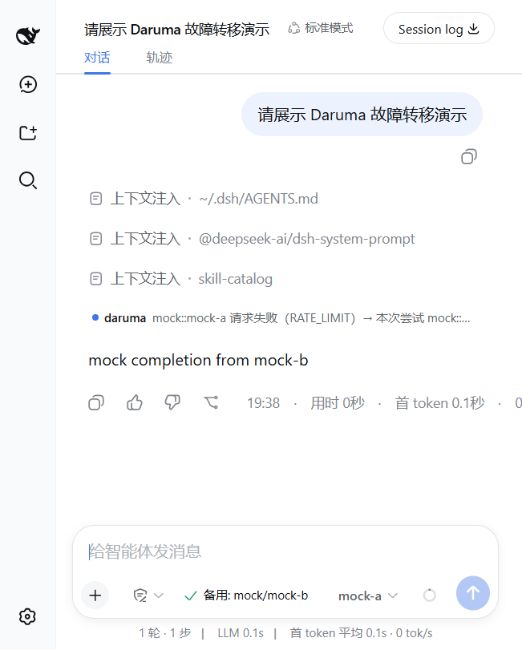
Visible failover notices in the conversation
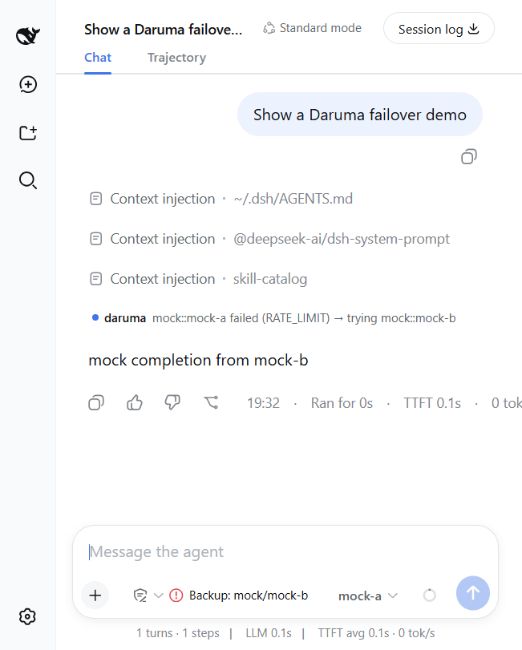
When a channel switch happens mid-turn, the web client renders a small
daruma row inside the conversation flow (anchored at the failover event,
right where it occurred): mt::glm-5.3 failed (RATE_LIMIT) → trying mt::deepseek-v4-flash, with the budget usage
(failover 2/3 · turn 3 step 1) on hover. When recovery is exhausted, a
red-dotted give-up row (mt::glm-5.3 failed (RATE_LIMIT) → recovery budget exhausted, giving up) renders instead of failing silently.
This works through the host's plugin-extensible conversation engine: the
client registers definitions claiming daruma/failover / daruma/give-up
session events plus a keyed renderer for its node kind, mirroring how
in-repo retries render. The notices are live-only — out-of-repo session
events are not yet persisted by the harness, so rows do not survive a page
reload or a resumed session.
Usage screenshots / 使用截图
Captured from live DSH Web sessions: the composer and the channel picker on a
real mt provider, the failover row from the mock-a → mock-b demo flow.
The images are linked by absolute URL on purpose: npm's web UI does not resolve
relative README image paths, so a ./assets/… link renders broken on the
package page (it still works on GitHub). The copies shipped in the tarball
(files) are for readers of the package itself.
English
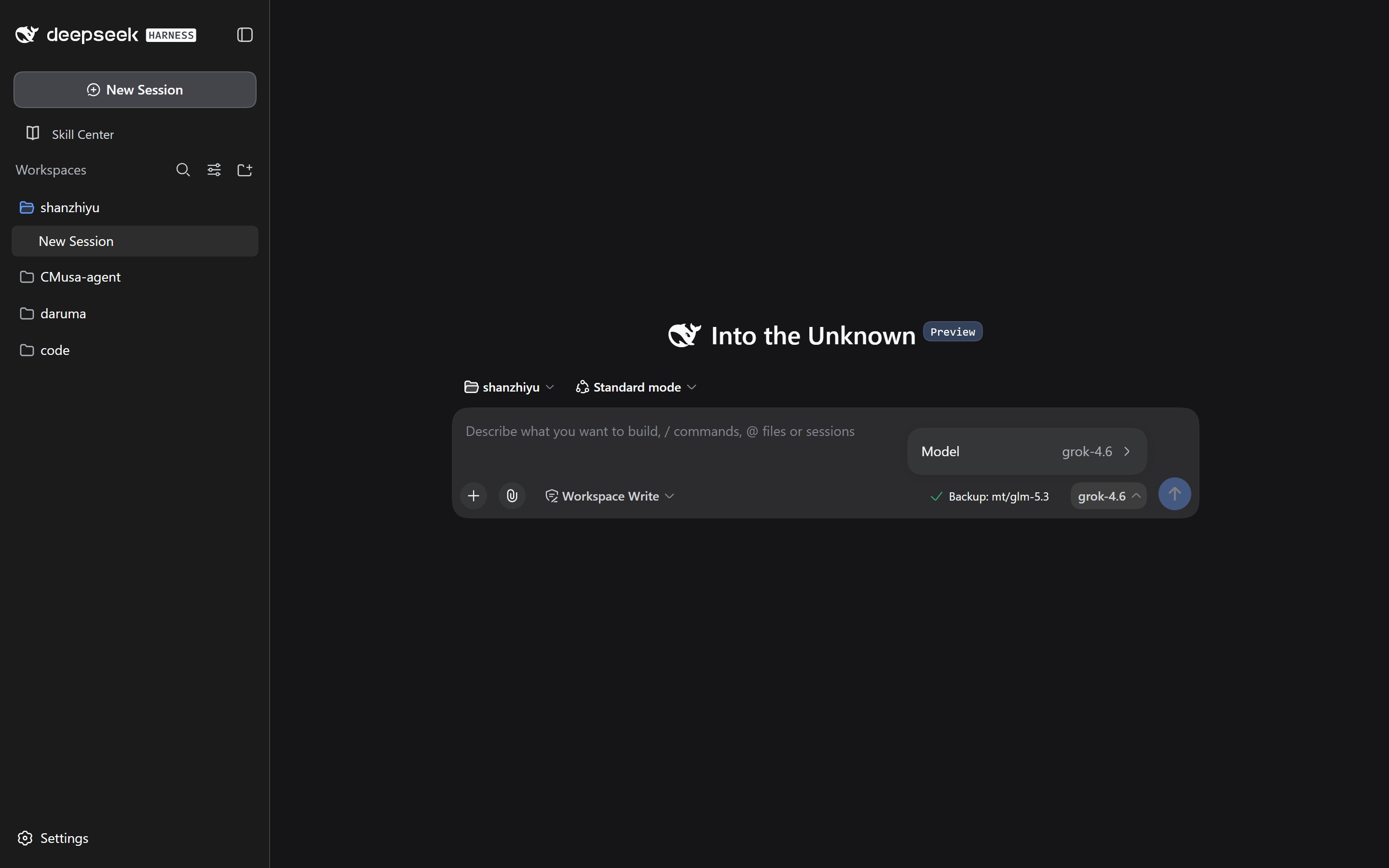
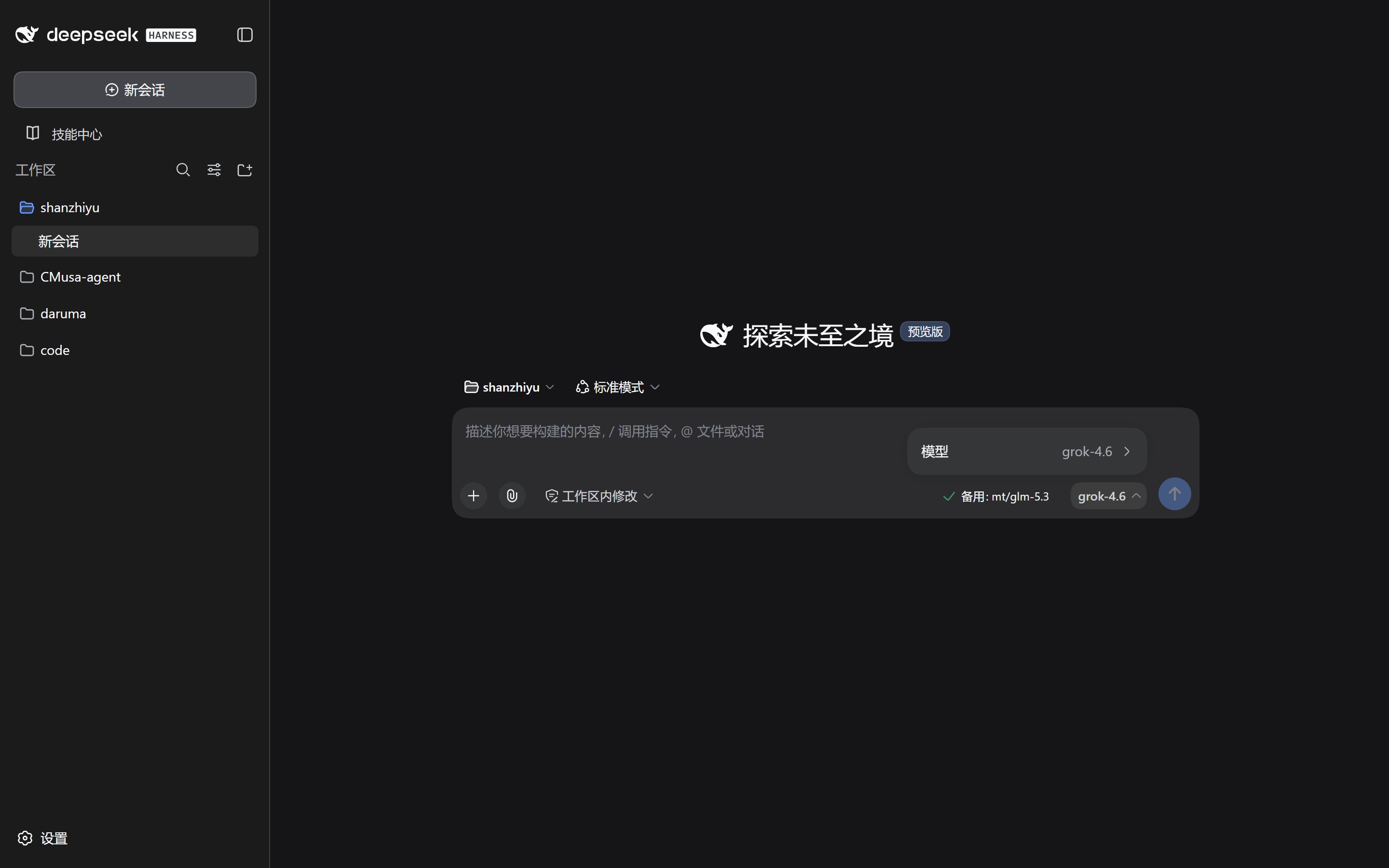
The composer. The daruma control sits at the right end of the tool row, next
to the model selector, and shows the armed backup channel (Backup: mt/glm-5.3):

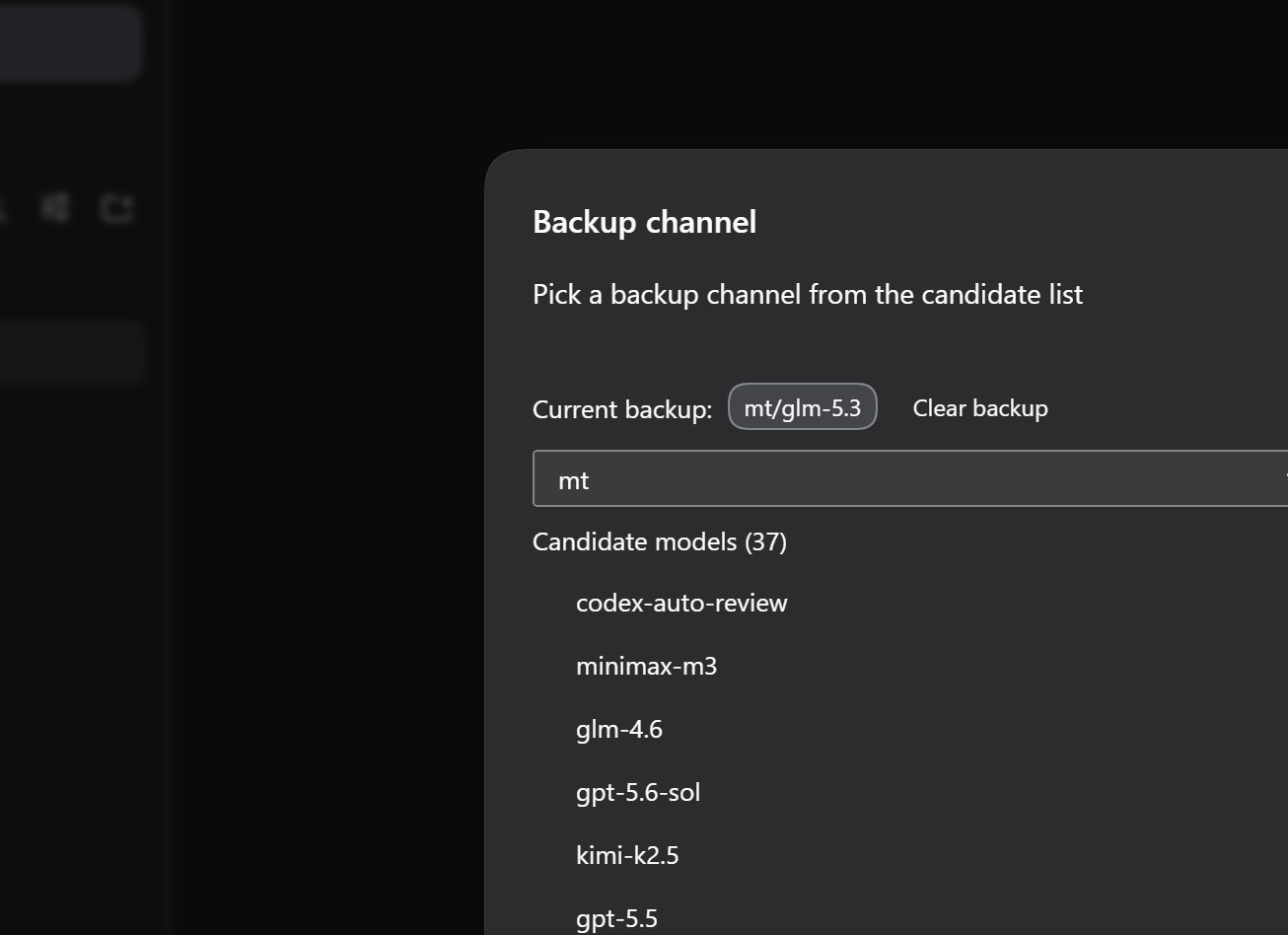
Picking a backup channel. Clicking the control opens the picker: the current backup, a provider box, and the candidates discovered from that provider's adapter:
The model selector the control sits next to:
A failover notice rendered inline in the conversation, right where the switch happened:
中文
输入框。 daruma 控件在工具行最右端、模型选择器旁边,显示当前已设置的备用渠道
(备用: mt/glm-5.3):

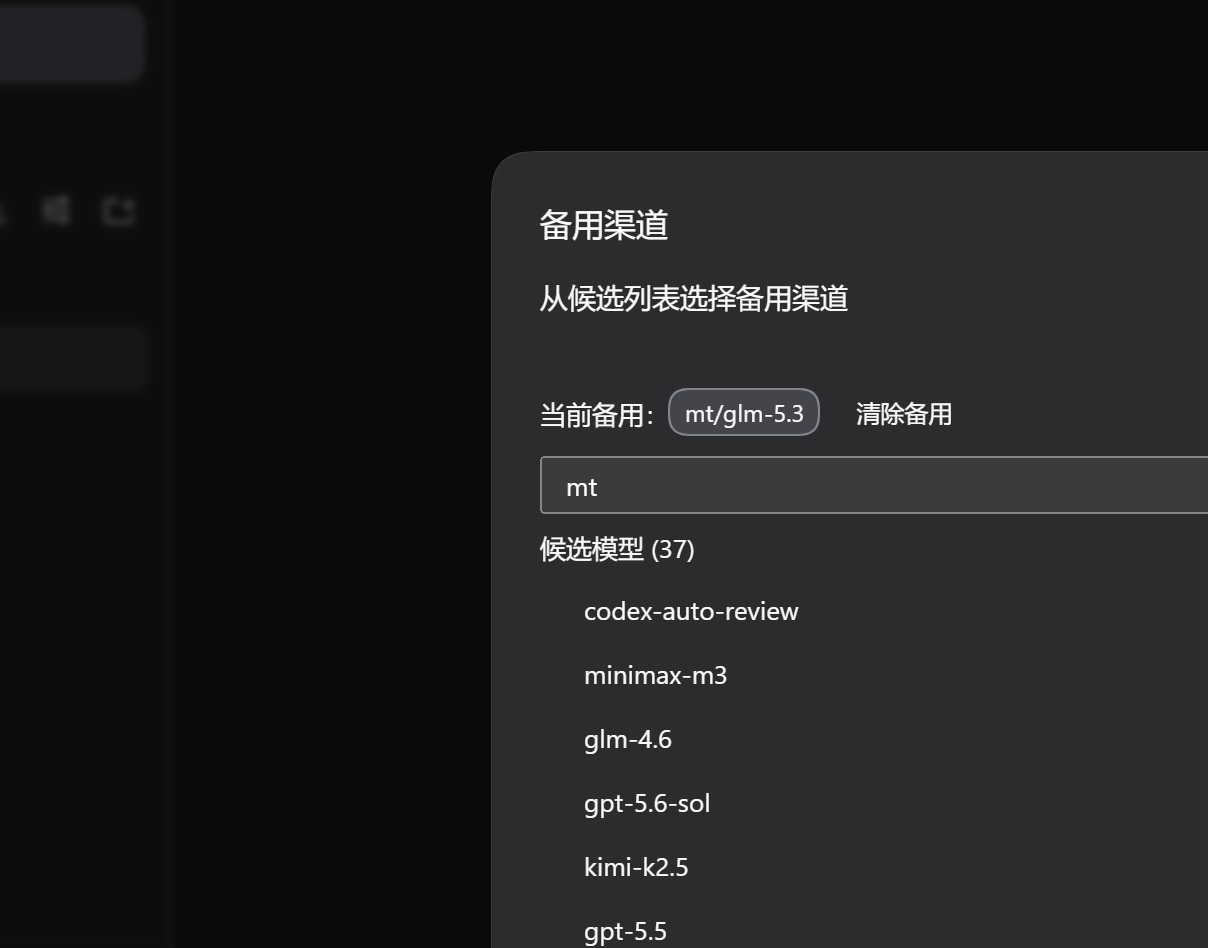
选择备用渠道。 点开控件即出现选择面板:当前备用、provider 输入框,以及从该 provider 适配器发现的候选模型:
模型选择器(控件就在它旁边):
切换提示,直接渲染在会话流里发生切换的位置:
Audit log
Every failover / give-up / boot decision is appended to
~/.dsh/daruma/failover-log.jsonl (rotates at 2 MiB to one .1 generation;
write failures are swallowed — a lost line never breaks recovery):
{"kind":"boot","t":1788860215489,"pid":38660,"channels":["mt::glm-5.3","mt::deepseek-v4-flash","mt-cc::claude-3-5-haiku-latest"],"failureBudget":3,"cooldownMs":30000,"giveUpBudget":8}
{"kind":"failover","t":1788850743199,"agentId":"session-2c50…","from":"mt::glm-5.3","to":"mt::deepseek-v4-flash","reason":"RATE_LIMIT","turn":1,"step":1,"failoverCount":1,"giveUpBudget":8}
{"kind":"give-up","t":1788850876140,"agentId":"session-295a…","from":"mt::deepseek-v4-flash","reason":"no-routable-fallback","turn":1,"step":1,"failoverCount":1,"giveUpBudget":8}
reason is the failure code for failovers (RATE_LIMIT, QUOTA, …) or the
give-up cause (give-up-budget-exhausted / no-routable-fallback);
failoverCount / giveUpBudget capture the budget state at the decision.
Install
dsh plugin --profile web add dsh-daruma   # from npm
# or from a checkout:
dsh plugin --profile web add link:./packages/daruma-core link:./packages/dsh-daruma
Configure
Add a dsh-daruma entry to your profile's cordis.patch.yml (or rely on the
bundle defaults) with an ordered failover chain:
- id: dsh-daruma
  name: dsh-daruma
  config:
    channels:
      - provider: mt
        model: glm-5.3
      - provider: mt
        model: deepseek-v4-flash
      - provider: mt-cc
        model: claude-3-5-haiku-latest
    failureBudget: 3     # consecutive failures before a channel trips
    cooldownMs: 30000    # how long a tripped channel stays unroutable
    giveUpBudget: 8      # per-agent failover budget before giving up
    # stateFile: /path/to/isolated/health.json   # REQUIRED for test profiles
    # logFile: /path/to/isolated/failover-log.jsonl
Each channel is a { provider, model } pair reachable by the LLM adapter
registry (same names you use in the settings model selector).
⚠️ Every chain channel must exist in your
settings.yamlproviders — a channel whose provider is missing gets armed on failover, burns one budget slot, and fails again. And test/mock profiles must isolatestateFile, or mock channels pollute the production health records.
Development
pnpm --filter dsh-daruma build
pnpm --filter dsh-daruma test
Host compatibility boundary
The recovery engine is independent of DSH runtime objects. Host-facing session
writes go through src/event-sink.ts; a Session API change or an unavailable
custom event surface is logged and degraded without interrupting failover.
src/host-capabilities.ts records optional host surfaces (RPC and conversation
event registry) so client integrations can remain capability-driven as DSH
releases evolve.
The web transport is bound late, from an injection callback
(src/host-mount.ts): the host's dsh-client-connection provides its
connection service synchronously through 0.1.0-rc.x, but awaits browser-auth
setup first on 0.1.5-rc.1/0.1.5-rc.2, so the service may not exist yet when
this plugin's apply runs. Reading it with a synchronous ctx.get('connection')
skipped the /dsh-daruma RPC channel — and with it the status dock and backup
picker — on those hosts, so the mount waits for the service and records the
capability snapshot at that point. Hosts without a web transport (headless)
simply never fire the callback.
Known host limitation: on
0.1.5-rc.1/0.1.5-rc.2the channel still cannot register — those hosts droppedwebServerfrom the connection plugin's own inject list whilerpc.handle()registers its route through the service context, so every caller getscannot get property "webServer" without inject. daruma logs that failure loudly and keeps failover working; the panel needs the host fix. Seedocs/aegis/evidence/2026-09-11-latest-harness-compat.md.
DSH 0.2.x is supported alongside 0.1.x. The backup can also be chosen from
Settings → Backup channel, and the control beside the composer updates as soon
as that change is saved. On 0.2.x the selection is stored in
backup-channel.json next to the channel-health file.
Links
More in this category
corrinehu/dsh-workbuddy-connect★ 970
Brings the models in the WorkBuddy desktop app straight into DeepSeek Harness — zero configuration in the DSH chat.
V1ki/dsh-plugin-subscriptions★ 469
Use ChatGPT (Codex), Claude, and Grok subscriptions as DeepSeek Harness LLM providers, with Settings login, model catalogs, usage, plus image_generate, video_generate, and x_search tools.
Mars-Sea/dsh-commandcode-provider★ 393
Unofficial Command Code LLM provider: registers a `commandcode` route with a live model catalog and reasoning-effort support.
cv-superding/dsh-deepseek-web-login★ 274
Adds a deepseek-web provider that uses chat.deepseek.com web models in DSH, with browser login capture, PoW request signing, SSE streaming, and prompting-based tool calls.
FishBottle7/opencode2dsh★ 212
Exposes OpenCode Zen free models to DeepSeek Harness, with no API key.
WSL043/dsh-codex-subscription★ 179
ChatGPT OAuth provider for Codex models with subscription web search, quota and safe reset, image tools, Fast mode, and model-aware context; no API key or Codex CLI.
Community comments
Comments are public GitHub Discussions. Loading them connects to GitHub and Giscus; a GitHub account is required to post.