Tool-output repair layer for DeepSeek Harness — JSON schema enforcement, parameter mapping, and JSON repair for tool calls.
Install
# from npm (prebuilt)
dsh plugin --profile web add dsh-translate
# from GitHub (first run asks for allowBuilds approval — follow the hint, retry)
dsh plugin --profile web add github:PerryLink/dsh-translate
Any plugin you install runs third-party code with your own permissions — it can read your files, use your credentials, and reach the network, and tool approvals don’t sandbox it. GitHub-sourced plugins also run build scripts at install time — pnpm blocks those until you allow them, so an install can stop with ERR_PNPM_GIT_DEP_PREPARE_NOT_ALLOWED or ERR_PNPM_IGNORED_BUILDS; dsh prints the exact key to add under allowBuilds in your profile’s pnpm-workspace.yaml, and the install works on the next run. Allowing a build is a trust decision: only install sources you trust, and pin a commit (github:owner/repo#sha).
README
dsh-translate
Current version 0.3.8.
Translate the whole interface into your language — with your own DSH model route, and without touching code, paths, commands or product names.
An end-to-end translator for DeepSeek Harness. The browser half walks the page's text, masks every span that must stay verbatim (code blocks and inline code, file paths, shell commands, URLs, identifiers, versions, hashes, numbers, product names) into, ⟦n⟧ placeholders, and sends the remaining prose to the host half. The host translates with the model route your current session already uses, the browser restores the placeholders and writes the result back into the same text nodes. Originals stay in memory; one click on Original restores the page.
Display-only by design: the session log, the workspace and the DSH config are never written. The transcript keeps exactly what the model said.
Since 0.3.0,
dsh-translateis the full-page translator. The former "vendor parameter mapping + deterministic JSON repair" plugin is nowdsh-param-repair(1.0.0). If you upgraded from 0.2.x and need that behaviour, installdsh-param-repairand remove this row; old config keys (repair.*,rosettaDataPath) are ignored by the new plugin and do not fail the profile.
Last verified on DeepSeek Harness dsh-v0.2.3-alpha.1 (2026-11-22).
English · 简体中文 · Español · Português · हिन्दी
What is translated
| Translated | Kept verbatim |
|---|---|
| Assistant prose, reasoning summaries, tool output prose | Fenced and inline code (code / pre) |
| Markdown headings, lists, tables, link labels | File paths, globs, commands and flags, URLs, emails |
| Buttons, labels, settings copy | JSON keys, env vars, dsh-* / snake_case / camelCase identifiers |
| Copy from other plugins (hidden popovers included) | Versions, hashes, plain numbers, and the ⟦n⟧ placeholders |
| — | Product terms: DeepSeek Harness, Cordis, npm, GitHub, Gitee, GitCode, Phocinae, PerryLink, … |
A text node with no prose left (for example a path or a code span) is skipped. If the model loses, renumbers or invents a placeholder, that segment keeps its original text instead of writing a half-masked string into the page.
Structure: mask → translate → restore; translatePage/translate returns translations[], failed[] and the provider and model actually used, while status only reports whether a route is resolvable. The token labels inside the diagram are the real method, field and config names, so the same picture serves all five languages.
Install
dsh plugin --profile <name> add dsh-translate
Reload the Web GUI: a Translate pill appears at the bottom-right. Click once to translate the page (it becomes Original); click again to restore.
Requirements
Translation uses your own model, with no bundled key and no bundled provider:
- The profile needs an
llmservice and a working provider (a normal chat already proves it); - The route defaults to the newest
request/headerrecorded by a live session, so send one message first — or pinprovider/modelin the config.
Without a route the control shows the reason (for example no model route: …) and the page is left untouched.
Configuration
Every key is a Schemastery field; an invalid value fails the profile load loudly.
| Key | Default | Meaning |
|---|---|---|
enabled |
true |
Master switch; false mounts nothing |
targetLang |
'' |
Target language; empty follows the Web GUI locale (browser language when the UI is English) |
provider / model |
'' |
Optional explicit route; both or neither; empty inherits the newest session route |
maxSegments |
40 |
Segments per model call (1–200) |
maxChars |
6000 |
Characters per model call (200–40000) |
timeoutMs |
60000 |
Per-call deadline (1000–600000) |
reasoningEffort |
off |
Thinking effort per call: off, low, high, max; off disables thinking so a translation batch never pays for chain-of-thought |
glossary |
[] |
Extra terms to keep verbatim |
Example: force Japanese and protect internal product names:
- id: dsh-translate
  name: dsh-translate
  config:
    enabled: true
    targetLang: ja
    glossary: [Acme Ledger, Internal Ticketing]
Cost and privacy
- On demand, page text only (hidden popovers are translated before they open): nothing runs in the background until the control is clicked; turning it off stops the work.
- Cache: the same source segment (same target language) is translated once and cached in browser
localStorage(600 entries max); clearing site data clears it. - What leaves the machine: only prose with protected spans masked, sent to the provider you configured; paths, code, commands and key-shaped identifiers are not sent as translatable text.
- No persistence: translations live in the DOM and the browser cache; the session log, workspace and DSH config are untouched.
- No credentials: the plugin never reads or stores an API key; authentication stays with the host provider configuration.
Known limitations
- Translation happens at the render layer. When React re-renders a node it writes the original back; the MutationObserver re-applies the cached translation without another model call. A brief flicker is possible.
- Streaming text keeps changing, so the plugin translates after a 350 ms quiet period; long streaming replies get their translation a little later.
- No OCR for images, Canvas or PDF previews.
- Hidden elements (
display:nonepopovers) are walked too, so a popover opens already translated without another model call. - The GUI itself already ships eight locales (en / zh / ja / es / fr / de / ru / pt); this plugin translates content and English copy from third-party plugins, and does not replace the built-in locale system.
Development
pnpm install
pnpm test        # 21 cases: masking/restore, placeholder checks, batching, route resolution, jsdom DOM behaviour, descriptor parity
pnpm run lint
Layout:
index.mjs— host entry (Config + service mount)lib/service.mjs— thetranslatePageTypert service (status / translate)lib/engine.mjs— prompt, batching, parsing, placeholder verification (no cordis, no DOM; unit-tested)lib/wire.mjs— the invocation descriptors shared by both facestypert.host.mjs— host Typert manifestclient/index.js— hand-written client bundle: DOM walk, masking, cache, floating control
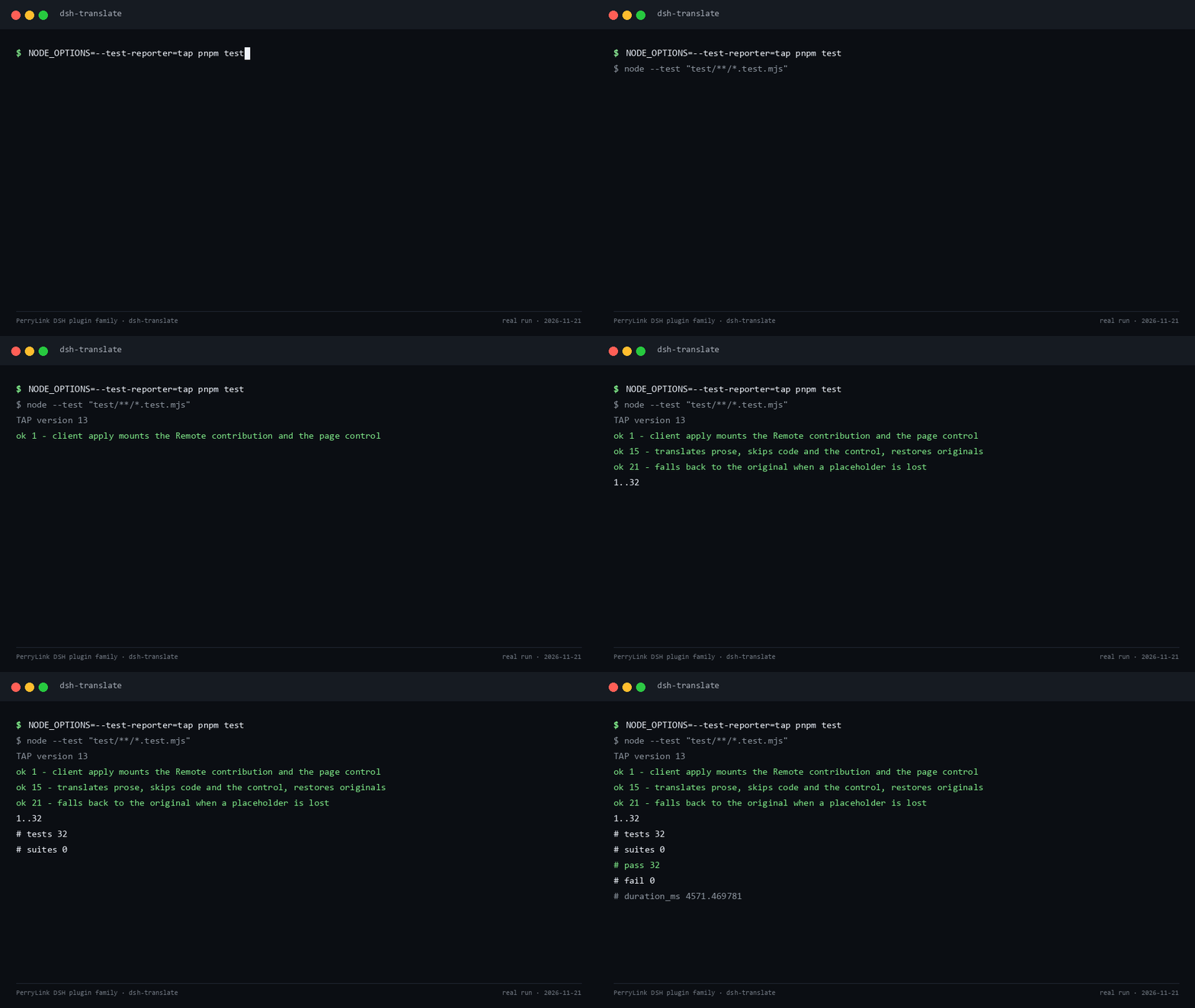
Animated: the real pnpm test run in this checkout on 2026-11-21, replayed through Node's TAP reporter — 32 tests, 0 failures, 4.6 s, no network. The count in the Development snippet above is the suite as it stood when that line was written; this replay is the current output.
License
Apache-2.0. A community plugin; not affiliated with DeepSeek.
Links
More in this category
Tencent/WeKnora#dsh-weknora★ 38385
Four read-only tools over a WeKnora knowledge base: list knowledge bases, hybrid passage search, reassemble one document's chunks in order, and WeKnora's own cited RAG or ReAct-agent answer with a resumable session id.
DayuanJiang/next-ai-draw-io#dsh-plugin★ 37218
Draws draw.io diagrams in DeepSeek Harness through the next-ai-drawio MCP server: the link in the reply opens a live preview in the right sidebar, you can edit the diagram by hand, and each AI change is a version you can restore. Node.js 18+; npx downloads the MCP server on first use.
yikart/AiToEarn#dsh-plugin-aitoearn★ 28812
Generate copy, images and short videos, and publish with one click to Douyin, Kuaishou, Xiaohongshu, WeChat Official, Bilibili, Facebook, TikTok and more, covering the full content lifecycle from creation to publishing and monetization.
superdesigndev/treg★ 9804
Tool catalog for agents: search ~2,600 external endpoints (SEO and SERP, backlinks, social, people and company enrichment, ad libraries, scraping) by the task you want done, read each one's parameters and per-call price, then call it with the credential injected server-side. Ships the skill plus an MCP row that stays disabled until TREG_TOKEN is set.
T-Auto/dsh-ops★ 6039
Provides bash, PowerShell 7, and high-performance Rust tools for DSH on Windows to reduce token usage.
Hithink-Tech-Org/Financial-API#hithink-finance★ 4659
Query Hithink Finance data in DeepSeek Harness, view charts in chat, and save refreshable dashboards.
Community comments
Comments are public GitHub Discussions. Loading them connects to GitHub and Giscus; a GitHub account is required to post.