Deterministic industry research reports for DeepSeek Harness — company and industry research flows produce structured, verifiable reports from staged evidence.
Install
# from npm (prebuilt)
dsh plugin --profile web add dsh-industry-research
# from GitHub (first run asks for allowBuilds approval — follow the hint, retry)
dsh plugin --profile web add github:PerryLink/dsh-industry-research
Any plugin you install runs third-party code with your own permissions — it can read your files, use your credentials, and reach the network, and tool approvals don’t sandbox it. GitHub-sourced plugins also run build scripts at install time — pnpm blocks those until you allow them, so an install can stop with ERR_PNPM_GIT_DEP_PREPARE_NOT_ALLOWED or ERR_PNPM_IGNORED_BUILDS; dsh prints the exact key to add under allowBuilds in your profile’s pnpm-workspace.yaml, and the install works on the next run. Allowing a build is a trust decision: only install sources you trust, and pin a commit (github:owner/repo#sha).
README
dsh-industry-research
Current version 0.3.29.
Turn industry research into a checkable evidence chain — every number carries a source and a date, every gap is declared.
An industry and company research domain pack for DeepSeek Harness: four workspace-bound tools plus two methodology skills, public sources only, research support only.
Last verified on DeepSeek Harness dsh-v0.2.3-alpha.1 (2026-11-22).
Install · Configuration · FAQ · 简体中文 · English · Español · Português · हिन्दी
dsh plugin --profile <name> add dsh-industry-research
A community plugin, not affiliated with DeepSeek. Sole repository: https://github.com/PerryLink/dsh-industry-research (Gitee is a mirror).
What it is
dsh-industry-research splits industry research into a replayable pipeline: build the industry-chain map, track public-source policy and news, scan companies into cards, then assemble an auditable report. Every metric with a value must carry a sourceRef; every gap is an explicit slot rather than a fabricated number; a report either goes to the sealing engine or takes the builtin fallback path and says so honestly. Research support only: no trading, no price prediction, no paid or login-walled sources.
Three-step setup
Install (pick one; both channels install the bundle row into the profile's
dsh.profile.bundlesstack and take effect on restart):# git channel (pins the commit; the first add writes an allowBuilds entry into the profile's pnpm-workspace.yaml) dsh plugin --profile demo add "github:PerryLink/dsh-industry-research#<sha>" # npm channel (published 0.3.25) dsh plugin --profile demo add dsh-industry-researchMinimal config (defaults are usable; override only when you need a different artifact root or offline mode):
- insert:
    - id: dsh-industry-research
      name: dsh-industry-research
      config:
        industryRoot: industry-research
        offline: false
Verify it mounted:
dsh --profile demo --dump-config | grep dsh-industry-researchThen, in a session, call the tools in order:
Load the industry-research-method skill, then research the baijiu industry:
build the chain with industry_map, track policy with industry_track, and finish with industry_report.
Uninstall: dsh plugin --profile demo remove dsh-industry-research (or delete the row from the profile patch).
Every PerryLink plugin is browsable in the DSH Desktop built-in market: Market → Sources → Add source → paste https://perrylink-dsh-catalog.perrylink.workers.dev/catalog-source.json → select it. Installation still goes through the market's npm identity check and your confirmation.
Core capabilities
industry_map— build or update an industry chain map (chain.json): upstream/midstream/downstream nodes, edges, and metric slots. A metric with avaluemust carry asourceRef; a value-less slot is an explicit gap. Nodestatusassertions carry astatusAsOf, and an optionaltaxonomyCodemust hit the built-in national economy industry classification table. WithrenderSvg: trueit also writes a deterministic, tier-layeredchain.svgnetwork diagram with funnel/hub bottleneck highlighting. Adepthargument scales the web assist. Seed notes/files and an optionalctx.webdigest are registered as citable sources (S1,S2, …).industry_track— public-source policy/news tracking over the officialctx.webseam: per-topic search, host allow/block lists,sincefiltering, bounded snapshot fetches with SHA-256 provenance hashes, and append + dedupe intotimeline.jsonlwith a retention cap. Entries may carry a validatedevidenceCategory; adepthargument scales source counts. Fails loud when the web capability is unreachable.company_scan— company cards (card.json+card.md) from your workspace data files (SHA-256-hashed, with Markdown outlines and figure-candidate lines so every number cites a file and a line), plus an optionalctx.webcitation complement. Cards carry a listingstatus(withstatusAsOf), a format-checkedticker, and sourced price/valuemetrics(each withsource+asOf). Batch mode (companies) isolates one bad company without aborting the batch;depthscales the web complement. Text formats only in v1 (no PDF).industry_report— one auditable report from the map + timeline + cards. Before producing, a deterministic delivery contract checks blocks, status/price assertions, and placeholder residue (fail loud, no half-assembled report). Timeline entries are grouped byevidenceCategory. A deterministic bull/bear synthesis lists sourced, dated values against declared gaps and data-quality findings, is embedded as the report's multi-perspective section, and is forked as a subagent job writingperspectives-note.mdinto the version ledger. With a mountedctx.researchReportengine the evidence/sections/claims are sealed by itsassembleand per-claim verdicts come back; without one, the builtin fallback writes versionedreports/<YYYYMMDD-HHmmss>/report.md+manifest.jsonwith a SHA-256 source-traceability table and honestly labelsengine: 'builtin-fallback'.- Artifact version ledger —
industry_map/company_scan/industry_reportappend toversions.jsonl(root-relative path + SHA-256 + timestamp + change type) on every artifact write; reads verify the hash and fail loud on mismatch. - Two methodology skills —
industry-research-method(chain decomposition, supply/demand framework, sourcing discipline, gap-declaration discipline) andcompany-research-method(company framework, public-source list, compliance wording). - Typed Cordis events —
industry-research/map,industry-research/track,industry-research/reportemitted after each committed artifact.
Both methodology skills load on demand through the standard skill tool (load the industry-research-method skill).
Tool surfaces
industry_map({ industry, seed?, seedFiles?, web?, chain?, renderSvg?, depth? })
Called with chain: validates (dangling edges, unsourced values, illegal tiers, duplicate ids, status/statusAsOf, unknown taxonomyCode — loud failure with the full issue list) and persists chain.json, then lists the explicit gap slots and bottleneck nodes. Called without chain: returns the current map, the registered sources, and an optional ctx.web chain-structure digest so the model can iterate. With renderSvg: true it also writes a deterministic chain.svg. depth (quick/standard/comprehensive) scales the web assist. Returns a delta summary vs the previous research-state.json. Emits industry-research/map.
industry_track({ industry, topics?, since?, depth?, evidenceCategory? })
Searches each topic through ctx.web, filters by the allow/block lists and since, fetches page snapshots (SHA-256) within the call budget, and merges into timeline.jsonl (dedupe by normalized URL, capped). depth scales the source/fetch budget; evidenceCategory labels every appended entry and is validated against the six-category enum. Sources whose snapshot failed are kept as citation-only entries with the reason in note. Returns a delta summary vs the previous research-state.json. Fails loud naming the missing capability when ctx.web is unmounted or offline: true. Emits industry-research/track.
company_scan({ name | companies, dataFiles?, web?, status?, statusAsOf?, ticker?, metrics?, depth?, parallel? })
Reads the workspace data files (.md/.txt/.csv/.tsv/.json; v1 does not parse PDF), hashes them, extracts Markdown outlines and figure-candidate lines, optionally attaches ctx.web citations, and persists the card. A status requires a non-future statusAsOf; a ticker must match a built-in format unless scan.strictTicker: false; every metrics value must carry source + asOf. companies (batch) isolates one bad company without aborting the batch; parallel: true fans each company into an independent job when ctx.jobs is mounted (otherwise it falls back to sequential, reported in the result mode). Rejected files come back with reasons; everything the card cannot establish is an explicit gap.
industry_report({ industry, sections?, companies?, draft? })
Assembles evidence (E-chain, E-timeline, E-company-<slug>), verifies the read artifacts against versions.jsonl (hash mismatch fails loud), and either validates your draft (sections + claims; every claim's evidenceIds must reference registered evidence) or builds the mechanical auto-draft (sourced metrics and recent timeline entries become claims, grouped by evidenceCategory). A deterministic delivery contract runs before production and fails loud on any missing block, placeholder, or unsourced/undated assertion. A deterministic adversarial machine-check always runs, and a red-team review job (red-review-note.md) is spawned when ctx.jobs is mounted (else review: skipped(jobs unavailable)). A deterministic bull/bear synthesis embeds a multi-perspective section in the report and forks a debate job (perspectives-note.md) when ctx.jobs is mounted. Engine path: sealed directory + sealHash + per-claim verdicts. Fallback path: versioned Markdown + manifest, claims honestly marked unverified. Emits industry-research/report.
Examples
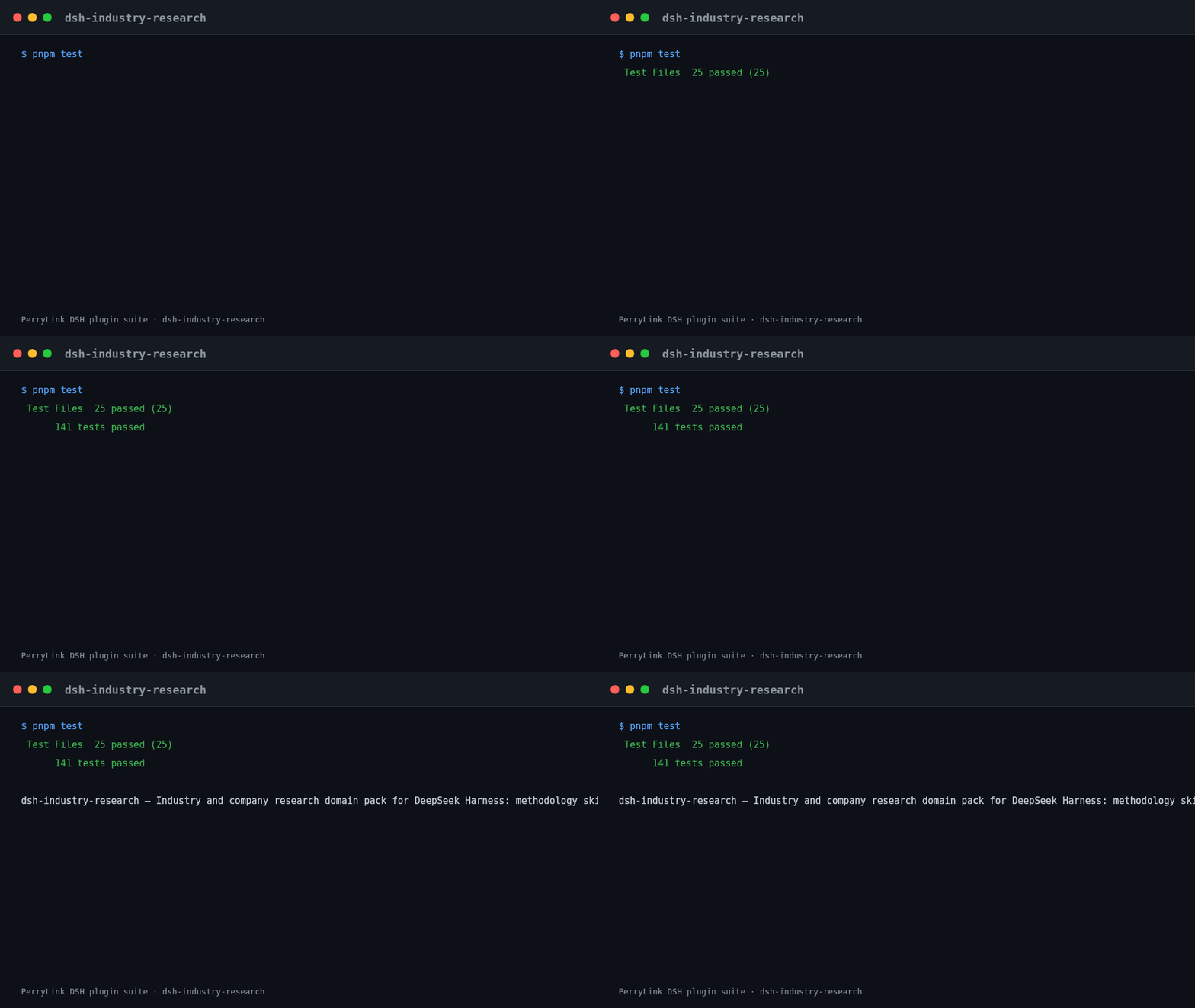
Animated replay of a real run recorded in this repository.
These are the plugin's real entry points; install once, then call one.
Detailed example — command industry_map, input:
industry_map({
  industry: "示例",
  web: false,
  chain: {
    nodes: [
      { id: "up", name: "上游原料", tier: "upstream", metrics: [{ key: "价格", value: 10, unit: "元", asOf: "2026-01-01", sourceRef: "S1" }] },
      { id: "down", name: "下游渠道", tier: "downstream", metrics: [{ key: "占比" }] }
    ],
    edges: [{ from: "up", to: "down" }]
  }
})
Output:
行业「示例」产业链图:已校验并写入 /tmp/dsh-industry-research-test-Pxf1l8/industry-research/示例/chain.json
节点 2 / 边 1;缺口 2 项。
与上次相比:新增源 0,移除源 0,未变化证据 0。
缺口清单:节点「下游渠道」(down) 的指标「占比」待补(无来源数值);产业链缺少 midstream 层节点
web 辅助未执行:调用方指定 web: false
Observed from README.md:151-153; test/map.spec.ts:44-51; src/tools/map.ts:157-163; src/chain.ts:177-194
Failure branch — input:
{"industry":"白酒","web":false,"chain":{"industry":"白酒","nodes":[{"id":"upstream-1","name":"高粱种植","tier":"upstream","metrics":[{"key":"市场规模","value":120,"unit":"亿元"}]}],"edges":[]}}
Output:
isError=true; error.message=chain 校验失败(1 项):node "upstream-1" metric "市场规模" carries a value without a sourceRef — register the source or mark the slot 待补 (omit value)
Observed from plugins/dsh-industry-research/src/chain.ts:158-159 (rule); plugins/dsh-industry-research/src/tools/map.ts:232-234 (throw); plugins/dsh-industry-research/README.md:179 (unsourced values fail loud); exercised through plugins/dsh-industry-research/test/harness.ts
Brief examples: industry_track · company_scan · industry_report
Data layout
<workspace>/<industryRoot>/versions.jsonl              artifact version ledger (SHA-256 + timestamp + change)
<workspace>/<industryRoot>/<industry>/research-state.json  research-state memory
<workspace>/<industryRoot>/<industry>/chain.json      industry_map
<workspace>/<industryRoot>/<industry>/chain.svg       industry_map (renderSvg: true)
<workspace>/<industryRoot>/<industry>/timeline.jsonl  industry_track
<workspace>/<industryRoot>/<industry>/sources.json    citable source registry (S1, S2, …)
<workspace>/<industryRoot>/<industry>/notes/          seed notes
<workspace>/<industryRoot>/<industry>/red-review-note.md  industry_report (red-team review, jobs)
<workspace>/<industryRoot>/<industry>/perspectives-note.md  industry_report (bull/bear debate, jobs)
<workspace>/<industryRoot>/<industry>/reports/<ts>/   industry_report (report.md + manifest.json)
<workspace>/<industryRoot>/companies/<name>/card.*    company_scan
Configuration
All tunables are Schemastery Config fields (overridable from cordis.yml); invalid values fail the profile load loudly. Overriding by id replaces the whole row — restate every key you need. cordis.patch.yml documents every key inline.
Most-used keys:
| Key | Default | Description |
|---|---|---|
enabled |
true |
Master switch; false mounts nothing. |
industryRoot |
industry-research |
Artifact root, relative to the session workspace (or absolute). |
fetchTimeoutMs |
20000 |
Per-request timeout (ms) for ctx.web search/fetch calls. |
timelineMaxEntries |
500 |
Entries retained per industry timeline.jsonl (oldest dropped). |
sourceAllowlist |
[] |
Host allowlist for tracked sources (empty = all hosts). |
sourceBlocklist |
[] |
Host blocklist for tracked sources (wins over the allowlist). |
offline |
false |
Offline mode: never touch ctx.web; local workspace data only. |
skillsDir |
(unset) | Explicit skills root override; defaults to the packaged skills/. |
track.maxResultsPerTopic |
10 |
web_search maxResults per topic. |
track.maxFetchesPerCall |
10 |
Snapshot-fetch budget per industry_track call. |
scan.maxFileBytes |
1048576 |
Per-file read cap for company data files. |
scan.maxFigureCandidates |
100 |
Figure-candidate budget per company scan. |
scan.strictTicker |
true |
Company-card tickers must match a built-in format (A-share 6 digits, US 1–5 letters, HK 1–5 digits); false exempts the format check. |
Profile patch override example:
- insert:
    - id: dsh-industry-research
      name: dsh-industry-research
      config:
        industryRoot: industry-research
        offline: false
        track:
          maxFetchesPerCall: 5
        scan:
          strictTicker: false
FAQ
Every artifact lands under <industryRoot>/ in the session workspace (default industry-research/): chain.json, timeline.jsonl, sources.json, reports/<ts>/, company cards, and the versions.jsonl ledger. The plugin makes no network requests of its own and stores no credentials; all retrieval goes through ctx.web, with provider selection and timeouts owned by the deployment and your config. Paid or login-walled sources are out of scope — export them yourself and pass them in as dataFiles.
Never silent. Without ctx.web, industry_track fails loud naming the missing capability; without ctx.researchReport, industry_report takes the builtin fallback and writes a versioned report.md + manifest.json honestly labelled engine: 'builtin-fallback' with claims marked unverified. Without ctx.jobs, parallel: true degrades to sequential and the red-team review and bull/bear debate are reported as skipped(jobs unavailable).
No. It injects only skills and tools; it registers no waterfall listener, command, client slot, or webServer route, and looks up ctx.web / ctx.researchReport / ctx.jobs with ctx.get(...) at execution time instead of injecting them, so a missing sibling never parks the plugin tree in PENDING. See "Interoperability" for the per-item evidence.
All of it is local deterministic work: reading and writing Markdown/JSON, hashing with SHA-256, validating structures — no model calls. Network activity happens only in industry_track (and the web assist of industry_map / company_scan) and is bounded as a foreground budget by track.maxFetchesPerCall, track.maxResultsPerTopic, and fetchTimeoutMs; offline: true turns networking off entirely.
No. v1 reads text formats only (.md/.txt/.csv/.tsv/.json) and does not parse PDF. Convert the PDF to text or Markdown first, then pass it as dataFiles.
Security boundaries
- Workspace containment — industry/company names are validated path segments; data files are containment-checked against the session cwd (both sides resolved).
- Provenance by construction — sources carry SHA-256 hashes; unsourced numbers are validation errors; corrupt timeline lines are skipped with a surfaced count, never silently.
- Honest degradation — missing
ctx.web/ctx.researchReportproduce loud failures or honestly labeled fallback artifacts, never silent fabrication. - Reversible registrations — everything goes through
ctx.effect()/ctx.on()/register(). - Research-only compliance — tool descriptions, cards, and reports carry "research only, not investment advice"; data points carry asOf and sources.
Known limitations
- Cordis events, not session-log events —
industry-research/*events are typed Cordis observability events and are never appended to the session log; the durable record is the workspace artifacts themselves, and model-visible tool results ride the durabletool/resultsession event. - No
ctx.attachmentwrites — the rc2 attachment seam accepts images only (PNG/JPEG/WebP/GIF); Markdown reports therefore stay versioned workspace files, referenced by absolute path in the tool result. - v1 reads text formats only — no PDF parsing; ask users to convert PDFs to text/Markdown first.
- Chinese-edition skills — the packaged methodology skills ship in Chinese; an English edition is future work.
- Foreground tools —
industry_trackis bounded bytrack.maxFetchesPerCallandfetchTimeoutMsand runs in the foreground; a background-jobs mode is future work. - The auto-draft is mechanical — it summarizes artifacts and turns sourced data points into claims; narrative quality comes from model-authored
drafts.
Interoperability
The plugin consumes public seams only and takes over no shared resource:
- Two injected services only —
inject = ['skills', 'tools'];ctx.web,ctx.researchReport, andctx.jobsare all execution-timectx.get(...)structural lookups (with shape guards), so a missing one never leaves the plugin in PENDING. - No listeners — there is no waterfall listener and no subscription to shared events such as
agent/pre-steportools/post-execute, so it cannot short-circuit or starve another plugin. - No shared-name grabs — it registers no command, client slot, or
webServerprefix; the four tool names (industry_map,industry_track,company_scan,industry_report) are namespaced and take no bare name. - Skills use a dedicated provider — mounted as
industry-researchwithincludeDefaultRoots: false, so it neither takes over nor replaces the global skills root; an invalidskillsDirfails loud at load. - The patch only inserts itself — the bundle patch inserts its own row and never overwrites a built-in row's
config. - The
dsh-research-reportcontract is type-side —AssembleReportRequestand friends come in as type-only devDependency imports erased at build time; at runtime onlyctx.get('researchReport')is looked up, and without it the builtin fallback runs — sealed results are never invented. - With
dsh-base—ctx.webis composed by the base bundle; when missing,industry_trackfails loud with mount guidance. - Continuous check-ups —
.github/workflows/plugin-doctor.ymlruns the plugin doctor; the verdicts are whatever that workflow reports.
Permissions & data
dsh-industry-research consumes only public seams: ctx.tools, ctx.skills, and — looked up optionally — ctx.web and ctx.researchReport. It performs no network access of its own (all retrieval goes through ctx.web with the deployment's provider selection and your configured timeouts), stores no credentials, and writes only inside the session workspace under industryRoot. Only public sources are used; paid or login-walled sources are out of scope — pass your own exports in as dataFiles.
Compatibility
| Dimension | Status |
|---|---|
| Harness | DeepSeek Harness dsh-v0.2.2-rc.4 (published npm line, verified 2026-11-18); package.json declares engine.dsh >=0.2.1-0 <0.3.0 || >=0.2.2-0 <0.3.0. 0.1.2-rc.1 (adapted 2026-11-18): the session envelope keeps its ignorable field for stored-log read compatibility only — Session.append still cannot stamp it, so audit-gate behavior is unchanged. Verified 2026-11-18 against the 0.1.7-rc.2 published peers (full gate chain; the real profile install smoke runs in the weekly and per-PR compat.yml job). |
| Node | ^22.19.0 || >=24.9.0, ESM only ("type": "module"). |
| Peer dependencies | @deepseek-ai/cordis ^4.0.5-alpha.1, @deepseek-ai/schemastery ^3.18.5-alpha.1, and @deepseek-ai/dsh-tools, @deepseek-ai/dsh-skill, @deepseek-ai/dsh-skill-filesystem (peer range >=0.1.2-rc.1 <0.2.0 || >=0.1.5-alpha.1 <0.2.0 || >=0.1.6-0 <0.2.0 || >=0.1.7-0 <0.2.0 || >=0.2.0-0 <0.3.0 || >=0.2.1-0 <0.3.0 || >=0.2.2-0 <0.3.0; all composed by the official dsh-base bundle). |
| Platform | Anywhere DSH runs; the tools are pure host-side TypeScript with no browser half. |
| Optional capabilities | Looked up at execution time (never injected): ctx.web (public-source retrieval — composed by dsh-base) and ctx.researchReport (the sibling dsh-research-report sealing engine). |
Ecosystem & quality
- Gitee mirror (synced mirror; GitHub is canonical)
- dshfind plugin page (installs and ranking)
- OpenSSF Scorecard report (driven by .github/workflows/scorecard.yml)
- dsh-plugin-doctor verification report
- DSH Market (listed)
- 1024 store channel: run
npm i -g dsh1024once, thendsh1024 plugin --profile web add dsh-industry-research(counts toward the deepseek1024.com install ranking) - Ecosystem knowledge base (measured data, not marketing): plugin development guide · plugin-selection data · maintenance criteria
Development
pnpm install
pnpm run typecheck && pnpm run typecheck:ci     # published-peer face + the published line with skipLibCheck cleared
pnpm test                                       # vitest
pnpm run build                                  # scripts/prepare.mjs → lib/
pnpm run verify:self-contained && pnpm run verify:artifacts
pnpm run verify:readme-sync                     # five-language README structure and config-key parity
pnpm run verify:skills                          # skills frontmatter gate
pnpm run pack:check
Images are generated by scripts/gen-readme-assets.py (Python + Pillow) and can be re-run: python scripts/gen-readme-assets.py. Both light and dark SVGs live in docs/assets/; the visible text is command/artifact tokens only, so all five languages share them.
| Path | Contents |
|---|---|
src/ |
Function-plugin entry (index.ts), config.ts, the four tools, and the pure data models |
skills/ |
The two Chinese-edition methodology skills (SKILL.md bundles) |
cordis.patch.yml |
Bundle row declaration with every key documented inline |
test/ |
vitest suite (real Context / ToolRuntime / SkillRegistry / WebRuntime) |
fixtures/ |
Baijiu teaching fixtures (fictional, clearly marked) |
scripts/ |
Build and gates: prepare.mjs, verify-*, check-readme-sync.mjs, check-skills.mjs |
docs/assets/ |
README images (generated by this script) |
.github/workflows/ |
CI, compat, plugin-doctor, release, scorecard |
Topics: dsh, dsh-plugin, deepseek-harness, cordis, industry-research, company-research, research, report
Family & acknowledgements
This project is part of the DeepSeek Harness plugin family maintained by PerryLink (all Apache-2.0). If it is useful, a star helps the next person find it — nothing is gated behind it.
- Initial design and implementation by the
dsh-v0.2.2-rc.4(2026-11-18);dsh-industry-researchdevelopment session (DeepSeek Harness). - External contributions are welcome — open an issue or a pull request.
License
Apache-2.0 — see LICENSE.
Links
More in this category
tt-a1i/archify#integrations/deepseek-harness★ 101004
Generate validated, self-contained interactive architecture, workflow, sequence, data-flow, and lifecycle diagrams from repositories or system descriptions.
dream-num/dsh-univer-office★ 766
Give DeepSeek Harness a real office environment. Univer Office Plugin brings spreadsheets, docs, slides, canvases, relational tables, and more into one runtime — with connected data, validation, versioned changes, and isolated worktrees for multi-agent collaboration.
ECNU/EduWork#dsh-knowledge-studio★ 429
A workspace-based Studio for source-grounded reports, slides, tables, mind maps, quizzes, flashcards, audio and video, using DSH models and shared artifact services. Office generation requires Python 3.12+ with its dependencies and DSH_OFFICE_PYTHON configured; media rendering requires Chromium, and local ASR additionally requires whisper.cpp and a model.
Roland0511/dsh-marktext★ 388
WYSIWYG Markdown editor in the DSH right sidebar, built on MarkText's muya engine: open a .md file, edit it as a rendered document, and save back through ctx.fs with a version guard.
joeseesun/qiaomu-ui-learn-dsh★ 89
Browse UI design references and interaction examples, take design quizzes, and export learning notes as Markdown.
GGboya/dsh-paper-reader★ 64
Paper reading workbench: library + PDF reader + tutor-style companion. Answers cite clickable page numbers that jump back and flash the exact passage; select-to-ask without leaving the paper; bundled strict-tutor preset (reading plan, section coaching, graded quizzes tracked across sessions). With MinerU configured (self-hosted, no signup / mineru.net cloud token): scanned PDFs become readable, formulas become click-citable (one click sends the LaTeX source into the chat) and searchable (QK^T hits directly), plus a per-page formula panel; optional embeddings endpoint adds semantic recall for plain-language questions. Rename/delete topics and papers — deletes go to a recoverable .trash with a batch-clear flow for non-empty topics; reader with scroll/single-page modes, rightbar-fullscreen safe, one-click path copy and translated-PDF export; in-place original ↔ Chinese toggle (babeldoc, zero preinstall). Transcription and search run locally by default — documents never leave your machine; only when cloud MinerU, an embeddings endpoint, or a translation endpoint is enabled does the corresponding text go to the service you configure.
Community comments
Comments are public GitHub Discussions. Loading them connects to GitHub and Giscus; a GitHub account is required to post.