Data quality checking for DeepSeek Harness — profiling, cleaning, and verification pipelines with structured reports.
Install
# from npm (prebuilt)
dsh plugin --profile web add dsh-data-quality
# from GitHub (first run asks for allowBuilds approval — follow the hint, retry)
dsh plugin --profile web add github:PerryLink/dsh-data-quality
Any plugin you install runs third-party code with your own permissions — it can read your files, use your credentials, and reach the network, and tool approvals don’t sandbox it. GitHub-sourced plugins also run build scripts at install time — pnpm blocks those until you allow them, so an install can stop with ERR_PNPM_GIT_DEP_PREPARE_NOT_ALLOWED or ERR_PNPM_IGNORED_BUILDS; dsh prints the exact key to add under allowBuilds in your profile’s pnpm-workspace.yaml, and the install works on the next run. Allowing a build is a trust decision: only install sources you trust, and pin a commit (github:owner/repo#sha).
README
dsh-data-quality
Current version 0.3.30.
Stop making the model do the math — hand it a CSV and get back a profile, a clean dataset, and a report you can re-open.
A deterministic data-quality plugin for DeepSeek Harness: row and column counts, missing rates, duplicate rows, inferred types, a six-dimension DAMA scorecard, and seven verification rule kinds — all computed in pure TypeScript inside the harness process, with reports persisted to the, data_quality storage domain.
Last verified on DeepSeek Harness dsh-v0.2.3-alpha.1 (2026-11-22).
Install · Configuration · FAQ · 简体中文 · English · Español · Português · हिन्दी
dsh plugin --profile <name> add dsh-data-quality
Community plugin, not affiliated with DeepSeek. Canonical repository: https://github.com/PerryLink/dsh-data-quality (Gitee is a mirror).
What it is
Give the model a CSV and dsh-data-quality reads it into a structured dataset, then computes everything you should know with pure functions: rows and columns, which columns are mixed-type, what is missing, what is duplicated, what the numeric distributions and IQR outliers look like — and finally a six-dimension DAMA scorecard. Cleaning and verification are expressed as declarative rules; every run persists its report to the data_quality storage domain and returns a reportKey, so every number the model shows you can be re-opened rather than "felt". All computation is TypeScript inside the harness process: no network, no credentials, no external processes, no model calls.
Three-step setup
Install (pick one channel):
# git channel (latest main; equivalent to git+https://github.com/PerryLink/dsh-data-quality.git)
dsh plugin --profile web add github:PerryLink/dsh-data-quality
# npm channel (published releases)
dsh plugin --profile web add dsh-data-quality
# tarball channel: pnpm pack in this repo, then
dsh plugin --profile web add ./dsh-data-quality-<version>.tgz
The first
addon the git channel fails because pnpm blocks the package'spreparebuild. Copy the exact key pnpm prints into the profile'spnpm-workspace.yamland re-run:allowBuilds: 'dsh-data-quality': trueRestart the profile after installing (bundles activate on restart).
Minimal config (sane defaults; raise the guards as needed):
- insert:
    - id: dsh-data-quality
      name: dsh-data-quality
      config:
        maxRows: 200000
        maxFileSizeMB: 64
Verify it mounts:
dsh --profile web --dump-config | grep -A2 'id: dsh-data-quality'Then, in a workspace containing a CSV, ask the agent:
Profile
holdings.csv, then clean it by trimming whitespace, deduplicating onfund_code, and normalizing theholding_valuecolumn's unit suffixes to base units; finally verifyfund_codeis unique and not null.
Uninstall: dsh plugin --profile web remove dsh-data-quality (or remove the row from the profile patch).
Core capabilities
ctx.dataQualityservice — a Cordis service other plugins may optionally consume (inject = ['dataQuality']). Besides the three dataset operations behind the tools, it implements the frozenverifyCitations(request)contract: verify that numbers/strings cited in a document match a dataset snapshot, with relative-tolerance numeric comparison andverified/mismatch/not-found/unverifiablestatuses.data_profiletool — row/column counts, inferred column types (number/date/boolean/string/empty/mixed), missing rates, unique counts, numeric distributions (min/max/mean/median/p25/p75), IQR outlier counts, mixed-type suspicion notes, and full-table sha256 content-hash duplicate detection (duplicate rate plus a bounded sample of duplicate row indexes). Adds a deterministic DAMA six-dimension scorecard (completeness, uniqueness, validity, consistency, timeliness, accuracy — accuracy is reported undetermined without a declared schema, never fabricated). Optional deterministic systematic sampling for large files.data_cleantool — ordered declarative cleaning rules:dedupe(by column group),fill-missing(constant/mean/median/forward),coerce-type(number/date/boolean; failures counted and set to missing),normalize-unit(Chinese ten-thousand/hundred-million suffixes to base units, see the factors example below),trim,map-values(enum mapping). Returns a per-rule audit log, a pre-delivery contract validation summary (dedupe before/after, uniqueness, non-null and type regressions), and a bounded preview; writes the cleaned dataset only whenoutputPathis given, and never overwrites the source.data_verifytool — declarative verification rules:not-null,unique,range,regex,enum,cross-column(e.g.startDate < endDate),freshness(date column within N days of a reference date). Per-rule pass/fail with capped failing-row evidence; an overall failure is a normalpassed: falseresult, not a tool error.data_reporttool — read persisted reports back from thedata_qualitystorage domain: by exactreportKey(path-safe validation, missing keys fail loud) or bykind(chronological listing).format: htmlrenders one profile/clean report as a self-contained offline HTML document (inline CSS/JS, no external requests) with the DAMA six-dimension scorecard and the profile/cleaning summary tables.- Durable reports — every profile/clean/verify/citation run persists to the
data_qualitystorage domain (JSON backend), keyed by run timestamp plus a dataset-path fingerprint; the key is returned asreportKeyin tool results. Clean reports also persist the bounded preview and the contract summary, so every model-visible result is reconstructable from itsreportKey; each clean run additionally persists aclean-diffbefore/after profile report. - Session events — on hosts that can carry them safely, runs append
data-quality/profile/data-quality/clean/data-quality/verifyevents (with theignorablemarker where supported). On the published0.1.7-rc.2line (as on earlier rc lines) the append is skipped by design — the storage-domain report is always the durable copy (see "Known limitations").
holdings.csv ──data_profile──▶ report ──data_clean──▶ outputPath
                   │                                  │
                   └──── data_quality domain · reportKey ──┴──data_verify──▶ passed / evidence rows
Tools & surfaces
data_profile({ path, sample?, industryPreset? })
Profiles a workspace dataset. path is workspace-relative (.csv/.tsv/.json/.jsonl; JSON must be an array of flat objects). sample takes every ceil(N/sample)-th row for the column cards (deterministic; row counts stay exact). industryPreset (retail/saas/fund/real-estate/e-commerce/healthcare/logistics/manufacturing/energy) injects that industry's expected columns so the scorecard accuracy dimension becomes determinable; unknown ids fail loud. Returns the structured report — the duplicate rate, bounded duplicate-row indexes, numeric count/distinct distributions, file encoding (UTF-8 BOM + validity), and the weighted six-dimension DAMA scorecard — and renders a human-readable per-column summary plus scorecard.
data_clean({ path, rules, outputPath?, dryRun? })
Applies rules in array order, each seeing the previous rule's output. Rule reference:
| Rule | Extra fields | Semantics |
|---|---|---|
dedupe |
columns? |
Remove rows whose key-column values duplicate an earlier row (first kept; all columns when omitted). |
fill-missing |
column, strategy, value? |
Fill missing cells: constant (needs value), mean/median (numeric columns), forward (previous non-missing). |
coerce-type |
column, to |
Coerce to number/date (ISO)/boolean; failures become missing and are counted in the log. |
normalize-unit |
column, factors |
Strip a unit suffix and multiply by the matching factor; plain numerics convert too. |
trim |
columns? |
Trim whitespace of string cells (all columns when omitted). |
map-values |
column, map, else? |
Exact-match mapping; unmapped values stay (keep, default) or become missing. |
The unit map is a plain suffix-to-multiplier object — the fixture's example:
{"万": 10000, "亿": 100000000}
The source file is never overwritten. With outputPath the cleaned dataset is written there (workspace-confined, format by extension); without it the run is preview-only. With dryRun: true no file is written and nothing is persisted — the result returns the per-column cleaning plan and the expected contract/diffPreview. The result also carries a pre-delivery contract summary (dedupe before/after rows, uniqueness over the dedupe key or full rows, non-null regression for fill-missing columns, type regression for coerce-type columns, and the per-column decision trace), and a clean-diff before/after profile report is persisted to the storage domain.
data_report({ key?, kind?, format? })
Reads persisted reports back from the storage domain. Pass key (the exact reportKey a prior run returned) to fetch one report, or kind (profile/clean/clean-diff/verify/citations) to list every report of that kind chronologically; exactly one of key/kind is required. Malformed or missing keys fail loud. format: html (with key) renders the report as a self-contained offline HTML document — inline CSS/JS, no external requests, the DAMA six-dimension scorecard, and the profile/cleaning summary tables (profile/clean reports only).
data_verify({ path, rules, expectations? })
Evaluates verification rules. Rule reference:
| Rule | Extra fields | Semantics |
|---|---|---|
not-null |
column |
Fail missing cells (null/empty/whitespace). |
unique |
columns |
Fail every row whose key combination repeats (missing participates). |
range |
column, min?, max? |
Fail missing/unparseable cells and values outside the inclusive bounds (at least one bound required). |
regex |
column, pattern, flags? |
Fail missing or non-matching cells (full JS regex). |
enum |
column, values |
Fail cells whose trimmed text is not listed. |
cross-column |
left, op, rightColumn?, value? |
Compare per row: numeric when both sides parse, dates compare as epochs, strings only for ==/!= (exactly one of rightColumn/value). |
freshness |
column, maxAgeDays, asOf? |
Fail dates older than maxAgeDays before asOf (default: now); unparseable/missing fails. |
expectations reconciles deterministic metrics against expected values: rowCount, columnSum, columnMean, uniqueCount, nullCount (each with column except rowCount, plus expected and an optional relative tolerance in [0, 1]). Each expectation yields passed plus actual/expected/tolerance; a mismatch is a normal passed: false verdict, never a tool error. Invalid metrics, missing columns, and out-of-range tolerances fail loud.
A missing cell fails every rule that reads it. Evidence is capped at evidenceRowLimit failing rows per rule.
ctx.dataQuality (for other plugins)
const result = await ctx.dataQuality.verifyCitations({
  dataset: 'holdings.csv',          // resolved against workspaceRoot
  citations: [
    { id: 'c1', path: 'rows[3].nav', value: 1.234, tolerance: 0.01 },
    { id: 'c2', path: 'summary.annualReturn', value: '12.34%' },
  ],
})
// result.results[i] = { id, status: 'verified' | 'mismatch' | 'not-found' | 'unverifiable', actual?, note? }
Locators walk the dataset document: CSV/TSV load as { columns, rows } (so rows[3].nav resolves), JSON is the parsed value, JSONL the array of parsed lines. Numbers compare with relative tolerance (|a-b| <= tolerance * max(|a|, |b|)); a CSV string cell that parses numerically compares as a number; strings compare exactly; incomparable type pairs are unverifiable. The service also exposes profileDataset / cleanDataset / verifyDataset (the same operations the tools call).
Examples
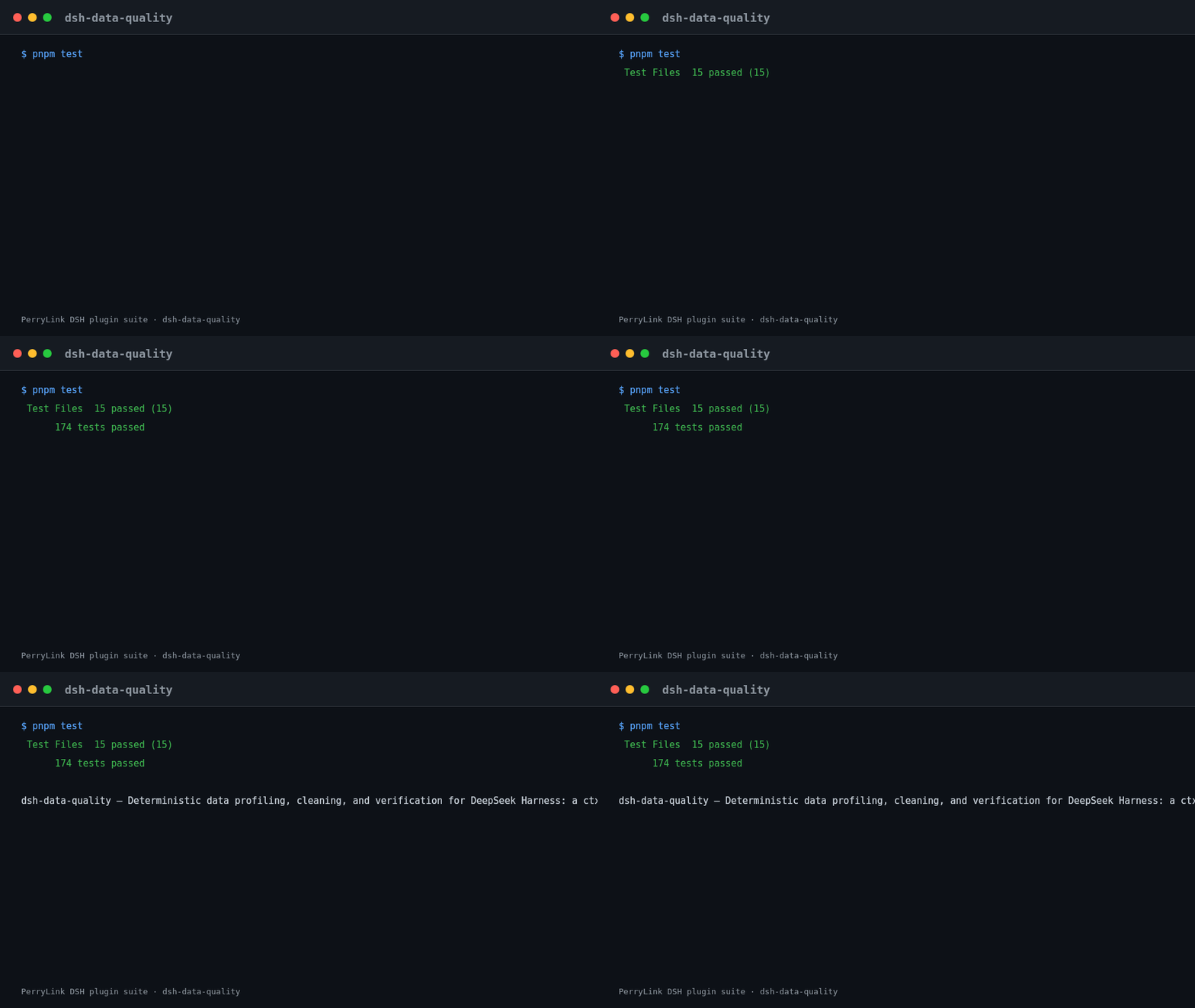
Animated replay of a real run recorded in this repository.
These are the plugin's real entry points; install once, then call one.
Detailed example — command data_profile, input:
data_profile({ path: "dirty-fund-holdings.csv" })
Output:
Profile of dirty-fund-holdings.csv: 10 rows x 6 columns
Duplicate rows: 1 (10.0%); sample row indexes: 8
- nav: mixed; missing 1 (10.0%); unique 7; note: mixed types among 9 present values: 8 numeric, 1 string
Scorecard (overall 93.2%, weighted 93.2%):
Observed from README.md:147-149; test/profile.spec.ts:130-132; test/loader.spec.ts:98-99; src/profile.ts:311-315
Failure branch — input:
{"path":"dirty-fund-holdings.csv","rules":[{"rule":"dedupe","columns":["nope"]}]}
Output:
isError=true; error.message=rule 0: unknown column "nope" (columns: fund_code, fund_name, nav, nav_date, holding_value, currency)
Observed from plugins/dsh-data-quality/src/clean.ts:66-68; plugins/dsh-data-quality/fixtures/dirty-fund-holdings.csv; exercised through plugins/dsh-data-quality/test/harness.ts
Brief examples: data_clean · data_verify
Measured data
Measured on the repo's own fixture fixtures/dirty-fund-holdings.csv (10 rows x 6 columns): completeness 96.7% · uniqueness 90.0% · validity 91.4% · consistency 87.9% · timeliness 100.0%, weighted overall 93.2%; the sixth dimension, accuracy, is reported undetermined without a declared schema (it becomes determinable only with an industryPreset). This is not an accuracy benchmark — it is a deterministic, recomputable reading on the same dirty data. The data comes from the measured run recorded in docs/assets/dsh-data-quality-evidence.png (the repo's own engine over its own fixture, generatedAt 2026-10-09 UTC) and can be reproduced with node scripts/loader-runner.mjs (no API key required).
Configuration
All keys are optional (defaults shown); invalid values fail loudly at load. Every key is settable from cordis.yml (the bundle ships cordis.patch.yml with the same defaults). An id-targeted override replaces the whole row — restate every key you need.
Most-used keys:
| Key | Default | Description |
|---|---|---|
enabled |
true |
Master switch; false mounts nothing at all. |
maxRows |
200000 |
Hard row cap per dataset load; larger inputs reject loudly (use the tool's sample parameter). |
maxFileSizeMB |
64 |
Hard file-size cap in MiB per dataset load. |
evidenceRowLimit |
20 |
Cap on failing-row evidence (verify) and preview rows (clean) in one result. |
allowedExtensions |
['.csv', '.tsv', '.json', '.jsonl'] |
Extensions accepted as datasets. |
workspaceRoot |
"" |
Absolute root for SERVICE-level calls (e.g. verifyCitations) that carry no session workspace; empty = the harness process launch directory. Tool calls always use the session's workspace cwd. |
storeReports |
true |
Persist run reports to the data_quality storage domain and return reportKey. |
| Key | Default | Description |
|---|---|---|
enabled |
true |
Master switch; false mounts nothing at all. |
maxRows |
200000 |
Hard row cap per dataset load; larger inputs reject loudly (use the tool's sample parameter). |
maxFileSizeMB |
64 |
Hard file-size cap in MiB per dataset load. |
defaultTolerance |
1e-9 |
Default relative tolerance for numeric citation comparison when a citation omits tolerance. |
evidenceRowLimit |
20 |
Cap on failing-row evidence (verify) and preview rows (clean) in one result. |
allowedExtensions |
['.csv', '.tsv', '.json', '.jsonl'] |
Extensions accepted as datasets. |
workspaceRoot |
"" |
Absolute root for SERVICE-level calls (e.g. verifyCitations) that carry no session workspace; empty = the harness process launch directory. Tool calls always use the session's workspace cwd. |
storeReports |
true |
Persist run reports to the data_quality storage domain and return reportKey. |
scorecardWeights |
all 1 (equal) | Per-dimension weights (completeness/uniqueness/validity/consistency/timeliness/accuracy) for the scorecard's weighted overall total; each weight must be a non-negative number. |
Example override in your profile patch:
- insert:
    - id: dsh-data-quality
      name: dsh-data-quality
      config:
        maxRows: 50000
        evidenceRowLimit: 10
        scorecardWeights:
          completeness: 2
          uniqueness: 1
FAQ
It reads workspace dataset files (allowlisted extensions only) and writes exactly two things: the data_clean output file when an explicit outputPath is given (workspace-confined, never the input), and reports in the data_quality storage domain under the harness data directory. No network, no credentials, no external processes — all parsing and statistics are in-process TypeScript. Reports may contain sample cell values from your datasets (bounded by evidenceRowLimit and display truncation); the session log records tool arguments and results as usual.
The plugin hard-injects tools and storageDomain: the shipped profiles (web/headless/sdk/acp) compose the storage stack (dsh-storage + dsh-storage-json + dsh-storage-domain) through dsh-base, so a bare profile must compose it itself or the plugin will not mount. Session events are adaptive — when the host does not know the data-quality/* vocabulary and Session.append cannot stamp ignorable, the append is skipped (it never corrupts the session log), and the data_quality storage-domain report remains the durable copy.
No. It registers no waterfall listener, publishes a single namespaced service key (dataQuality), names all four tools with a data_ prefix, registers no client slot and no webServer prefix, and mutates no globals; the bundle patch only inserts its own row. The point-by-point argument is in "Interoperability with other DSH plugins".
Parsing and statistics are zero-dependency in-process TypeScript — no inference, no network, no model calls, so a typical CSV costs one file read plus one linear scan. The guards are hard: maxRows (default 200000) and maxFileSizeMB (default 64) reject oversized inputs loudly, data_profile's sample parameter provides deterministic systematic sampling, and abort signals cancel long loads mid-stream.
No — the model does not do arithmetic here. Row counts, missing rates, quantiles, IQR outliers, duplicate rates, the scorecard, and verification verdicts are all produced by deterministic functions; same input, same output, and the only clock is the one injected for freshness defaults and report timestamps. The model chooses the tool and the rules, and narrates the result.
Security boundaries
- Path confinement — dataset and output paths must resolve inside the session workspace (
verifyCitationsusesworkspaceRoot);..escapes and outside absolute paths reject, and both sides are normalized before comparison (Windows slash-safe). - Bounded work —
maxRows/maxFileSizeMBguards reject oversized inputs loudly; abort signals cancel long loads mid-stream. - No overwrite —
data_cleanrefuses anoutputPathequal to the input path. - Deterministic computation — same input, same output; the only clock is the one injected for
freshnessdefaults and report timestamps. - Registrations are effects — tool registration and the storage-domain close are Cordis effects, removed on stop/hot-reload.
Permissions & data
- Reads workspace dataset files (allowlisted extensions only).
- Writes only: the
data_cleanoutput file (explicitoutputPath, workspace-confined, never the input) and reports in thedata_qualitystorage domain under the harness data directory. - No network, no credentials, no external processes — all parsing and statistics are in-process TypeScript.
- Reports may contain sample cell values from your datasets (bounded by
evidenceRowLimitand display truncation); the session log records tool arguments and results as usual.
Known limitations
- Session events are adaptive. The published
0.1.7-rc.2line (like the earlier rc lines) has no plugin session-event registration surface and itsSession.appendcannot stamp theignorablemarker, so appending an unknowndata-quality/*type would make the session log unreadable on restore. The plugin therefore appends only when the host knows the vocabulary or supports theignorableappend flag; on the published line the storage-domain report is the durable record. - CSV dialect — comma/tab with RFC-4180 quoting, header row required, blank lines skipped, no delimiter auto-detection or comment lines.
- Type parsing is strict — numbers have no thousands separators; dates are
YYYY-MM-DD/YYYY/MM/DD/ ISO-like datetimes (UTC); booleans aretrue/false/yes/no/1/0. Everything else profiles asstring/mixed— clean it withcoerce-typewhen intended. - JSON must be tabular for the tools (array of flat objects);
verifyCitationswalks arbitrary JSON documents. - No ML anomaly detection, no PII masking, no databases, no SQL — rule-based suspicion notes only.
Interoperability with other DSH plugins
Verified against the host corridor this repository declares (>=0.2.1-0 <0.3.0 || >=0.2.2-0 <0.3.0) and the plugin contract in dsh-plugin-guide.
This plugin does not interfere with other plugins:
- No listener contention. It registers no waterfall listener at all (neither
agent/pre-stepnortools/post-execute), so it can neither starve nor short-circuit another plugin's chain. - Namespaced service key. It publishes exactly one service key,
dataQuality, and occupies no built-in or third-party key; consumers declare the dependency explicitly withinject = ['dataQuality']. - No tool-name collision. The four tool names
data_profile/data_clean/data_verify/data_reportall carry thedata_prefix and take no bare name owned by a shipped tool or another plugin. - No slot / HTTP route collision. It is a pure host plugin (no browser half): it registers no client slot key and no
webServerprefix. - No patch-layer collision. The bundle patch only
inserts its own row; it never overrides a built-in row'sconfig. - Storage-domain isolation. It writes only its own
data_qualitydomain (JSON backend) and touches no other plugin's domain. - No global mutation. It does not patch prototypes, rewrite
process.env, or replace the global fetch dispatcher; no network requests, no external processes.
Static evidence: this repository's historical dsh-plugin-doctor verification badge (report).
Compatibility
| Surface | Status |
|---|---|
| Harness | DeepSeek Harness dsh-v0.2.2-rc.4 (adapted 2026-11-18): the peer range now admits the alpha.2 line; there Session.append's third parameter exists only for surface-eligible types and is a SurfaceIntent, so the audit gate still skips and the storage-domain report stays the durable copy. Verified 2026-11-18 (three typecheck rulers + full test suite green). |
| Node | ^22.19.0 || >=24.9.0 |
| Package manager | pnpm@11.7.0 |
| Platform | Windows / macOS / Linux (host-only plugin) |
| Model | Text models fully supported; no extra model capability required |
Ecosystem & quality
- Gitee mirror (sync mirror; GitHub is canonical)
- dshfind plugin page (installs and ranking)
- OpenSSF Scorecard report (driven by .github/workflows/scorecard.yml)
- dsh-plugin-doctor verification badge (historical)
- DSH Market (listed)
- 1024 store channel:
npm i -g dsh1024once, thendsh1024 plugin --profile web add dsh-data-quality(counts toward the deepseek1024.com install ranking) - Ecosystem knowledge base — measured data, not marketing: plugin development guide · plugin-selection data · maintenance criteria
Development
pnpm install                                                     # node ^22.19 || >=24.9
pnpm run typecheck && pnpm run typecheck:ci && pnpm run typecheck:checkout
pnpm test                                                        # vitest
pnpm run build                                                   # tsdown output + d.ts fixups
pnpm run verify:self-contained && pnpm run verify:artifacts     # dependency specs + shipped files
node scripts/check-readme-sync.mjs                               # five-language README consistency
pnpm pack
- Tests run vitest against the REAL
Context/Session/ToolRuntime/storage domain (no hand-written service mocks) plus pure engine specs; every clean/verify rule has positive and negative cases, andverifyCitationscovers all four statuses. scripts/loader-runner.mjsboots the real Loader composition and executes the profile → clean → verify chain againstfixtures/without an API key.- Release:
node scripts/release.mjs <x.y.z>(never pushes; the tag triggersrelease.yml). - The README images are generated programmatically by
scripts/gen-readme-assets.py(Python + Pillow): light/dark webp heroes (the six-axis DAMA radar), a hand-written two-skin SVG structure diagram, and light/dark webp for the measured chart; safe to re-run.
Topics: dsh, dsh-plugin, deepseek-harness, cordis, data-quality, data-cleaning, data-profiling, data-verification
Family & thanks
This project is part of the DeepSeek Harness plugin family from PerryLink (all Apache-2.0). If it is useful, a star helps the next person find it — nothing is gated behind it.
- @PerryLink — maintenance and releases (
0.1.2/0.1.3), peer-dependency upgrades, the npm version/downloads/CI badges, and recent fixes. - dsh-data-quality contributors — the initial scaffold, the
ctx.dataQualityseam and frozenverifyCitationscontract, the deterministic dataset layer and pure engines, thedata_qualitystorage-domain reports, the real-service vitest suite, the CI/compat/release workflows, and the five-language READMEs.
License
LICENSE (Apache License 2.0) © 2026 dsh-data-quality contributors
Links
More in this category
Tencent/WeKnora#dsh-weknora★ 38385
Four read-only tools over a WeKnora knowledge base: list knowledge bases, hybrid passage search, reassemble one document's chunks in order, and WeKnora's own cited RAG or ReAct-agent answer with a resumable session id.
DayuanJiang/next-ai-draw-io#dsh-plugin★ 37218
Draws draw.io diagrams in DeepSeek Harness through the next-ai-drawio MCP server: the link in the reply opens a live preview in the right sidebar, you can edit the diagram by hand, and each AI change is a version you can restore. Node.js 18+; npx downloads the MCP server on first use.
yikart/AiToEarn#dsh-plugin-aitoearn★ 28812
Generate copy, images and short videos, and publish with one click to Douyin, Kuaishou, Xiaohongshu, WeChat Official, Bilibili, Facebook, TikTok and more, covering the full content lifecycle from creation to publishing and monetization.
superdesigndev/treg★ 9804
Tool catalog for agents: search ~2,600 external endpoints (SEO and SERP, backlinks, social, people and company enrichment, ad libraries, scraping) by the task you want done, read each one's parameters and per-call price, then call it with the credential injected server-side. Ships the skill plus an MCP row that stays disabled until TREG_TOKEN is set.
T-Auto/dsh-ops★ 6039
Provides bash, PowerShell 7, and high-performance Rust tools for DSH on Windows to reduce token usage.
Hithink-Tech-Org/Financial-API#hithink-finance★ 4659
Query Hithink Finance data in DeepSeek Harness, view charts in chat, and save refreshable dashboards.
Community comments
Comments are public GitHub Discussions. Loading them connects to GitHub and Giscus; a GitHub account is required to post.