ChatGPT Codex subscription chat: official OAuth, a Sol/Terra/Luna catalog with Fast rows, live usage limits, and optional search and view_image tools.
Install
# from GitHub (first run asks for allowBuilds approval — follow the hint, retry)
dsh plugin --profile web add github:NOirBRight/dsh-llm-codex
Any plugin you install runs third-party code with your own permissions — it can read your files, use your credentials, and reach the network, and tool approvals don’t sandbox it. GitHub-sourced plugins also run build scripts at install time — pnpm blocks those until you allow them, so an install can stop with ERR_PNPM_GIT_DEP_PREPARE_NOT_ALLOWED or ERR_PNPM_IGNORED_BUILDS; dsh prints the exact key to add under allowBuilds in your profile’s pnpm-workspace.yaml, and the install works on the next run. Allowing a build is a trust decision: only install sources you trust, and pin a commit (github:owner/repo#sha).
README
English | 中文
ChatGPT Codex integration for DeepSeek Harness. This plugin is a separate provider route (codex) and settings namespace (llm-codex). It does not declare apiKeyEnv, does not read or write ~/.codex/auth.json, and does not share a credential file with dsh-codex-connect.
The package root exposes the Cordis plugin contract. The same artifact exports ./client, which contributes the Codex card under Settings → LLM Providers.
Compatibility
DSH peer and development dependency ranges accept 0.1.7-alpha.2 and later releases. Cordis peers accept >=4.0.4 <5.0.0.
Verified Hosts in package.json#dsh.compatibility.dshReleases are evidence, not an allowlist. Unknown newer Hosts warn once and keep the normal mount path. Only a reproduced failure is blocklisted.
catalogId and the unresolved unknown account state are attached at runtime. Published dsh-llm-providers-ui 0.2.8 omits those fields and treats unknown as unconnected; they only take effect on a newer Owner.
Installation
Install directly from GitHub:
dsh plugin --profile web add --force \
  https://github.com/NOirBRight/dsh-llm-providers-ui/releases/download/v0.2.13/dsh-llm-providers-ui-0.2.13.tgz
dsh plugin --profile web add --force \
  https://github.com/NOirBRight/dsh-llm-codex/releases/download/v0.3.26/dsh-llm-codex-0.3.26.tgz
dsh web
The repository tracks release-ready lib artifacts, so GitHub installation needs no build-script allowlist. A source checkout can use a link installation after running pnpm run build.
Management RPC
Settings and authentication management use the authenticated /api/plugin-rpc/codex fetch route. The Host /api carrier applies its Host/Origin checks, cookie authentication, and body limit before dispatch; this plugin has no separate remote-management switch.
Web configuration
Open Settings → LLM Providers → Codex. Sign in with ChatGPT starts the official ChatGPT OAuth flow, opens the system browser, and stores the session only on the Host at $DSH_HOME/codex-oauth.json (mode 0600). The card then shows usage limits. Sign out deletes that file. The browser never receives tokens.
The collapsed header first-paints the last successful quota from the shared browser cache; error, unsupported, and signed-out states paint no cached meter. Signing in, signing out, or an authoritative signed-out status purges the cache in every bundle copy, even without providerDirectory.
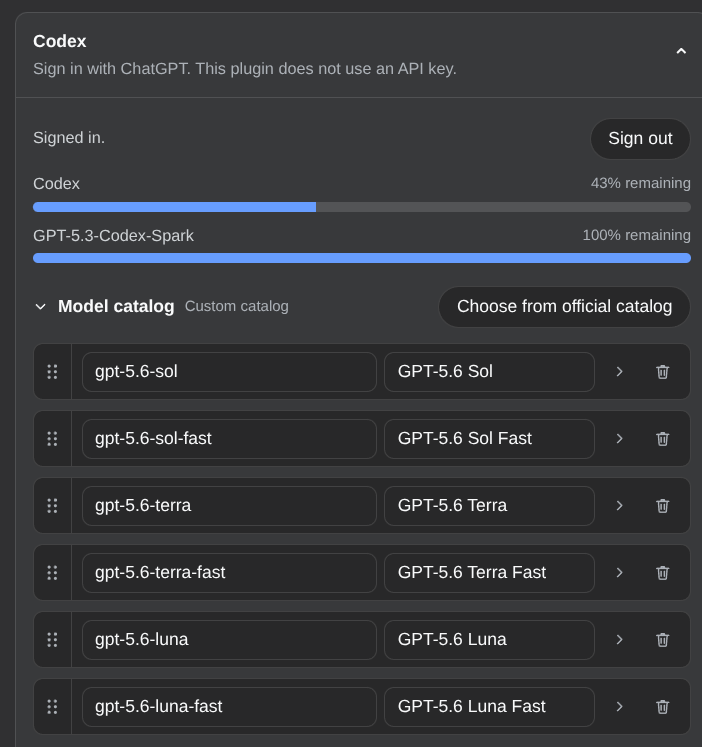
Model catalog
The conversation picker uses the displayed catalog stored as settings.models. The default is six rows:
gpt-5.6-sol/gpt-5.6-sol-fastgpt-5.6-terra/gpt-5.6-terra-fastgpt-5.6-luna/gpt-5.6-luna-fast
Fast and 1M are first-class picker rows, not checkboxes. Chat still uses the official wire id; Fast rows send service_tier: "priority". 1M rows (gpt-5.6-sol-1m, gpt-5.6-sol-1m-fast, and the Terra/Luna equivalents) set contextWindow to 1,000,000 so DSH compaction waits until 80% of that budget (800k). They are not in the default six-row catalog; add them from the official picker. The overlay can also add gpt-5.5, gpt-5.4, gpt-5.4-mini, gpt-5.3-codex-spark, and Fast variants. Custom ids can be added manually.
The official picker fetches the live account catalog using an unfiltered discovery client version; newer models (including gpt-6-sol and gpt-6-luna) appear without updating the static defaults. Choosing rows does not add them to conversations until saved. Offline, the last successful catalog is reused; discovery alone does not guarantee chat compatibility with future models.
Picker ids may also use a generic context suffix -<n>k or -<n>m (for example gpt-5.6-sol-272k or gpt-5.6-sol-272k-fast). The plugin peels that suffix before talking to ChatGPT and uses n×1000 / n×1,000,000 as the DSH compaction budget, so a 272K row starts compacting earlier than a 1M row. Product names such as kimi-k3-max are not treated as a context tier. The composer picker groups sibling rows that share a base id.
Default reasoning effort is per model and editable on the row: Luna uses max, Terra xhigh, Sol high, and every other official Codex model xhigh. Fast and 1M rows use their base model's default. A reasoning effort explicitly selected in a conversation takes precedence.
Chat goes through pi-ai openai-codex-responses against https://chatgpt.com/backend-api. Chat without a session fails MISSING_CREDENTIAL. A stored session whose refresh fails is reported as AUTH. A later content-less AUTH (HTTP 401) force-refreshes the session and retries the request once; remaining AUTH failures are eligible for the bundle's eight normal retries.
Remote compaction (not enabled)
The ChatGPT Codex Responses endpoint supports native V2 compaction: append compaction_trigger to a streaming request and replay the returned opaque compaction item in later requests. This is not the standalone /responses/compact API. DSH currently persists only a text summary as a user checkpoint through @deepseek-ai/dsh-compaction-basic; @deepseek-ai/dsh-llm-pi-ai does not pass opaque user-message metadata through to the Codex request. Calling V2 from this adapter alone would lose the item on the next turn or after a restart/branch. The plugin leaves remote compaction off and continues using DSH's existing local compaction.
Upstream seam needed: let a provider-specific compaction handler return an opaque, provider-scoped replacement history; persist it atomically with the compaction checkpoint and pass it back to the same provider on subsequent requests, including resume and branch. The Host must retain ownership of history trimming, cancellation, and fallback to text summarization when the provider/model does not support V2. The pi-ai bridge must serialize the opaque item unchanged rather than converting it to user text. Until this is available in an official DSH release, the plugin must not advertise or enable remote compaction.
Acceptance requires checking the next wire request for the encrypted item and retained user turns (and the discarded turns' absence), then repeating after resume/branch; a mocked usage value or prompt_cache_key alone does not prove cache reuse. With a stable session/routing identity and a shared prefix of at least 1,024 tokens, check the provider's usage.input_tokens_details.cached_tokens on repeated post-compaction requests. Compare that count to the measured token position before the opaque item: a hit confined to instructions does not demonstrate reuse of the compressed history. A lab-only Codex protocol probe completed V2 and replay; the pre-item request used 3,318 input tokens, while repeated continuation requests reported 3,328, 3,200, and 0 cached tokens. Cache hits are provider-dependent, and plugin-level 3082 acceptance remains blocked on the upstream seam. See OpenAI prompt caching and compaction.
Model Switch integration
When dsh-model-switch v0.2+ is present, Codex registers optional Search and Image adapters that reuse this plugin's authenticated clients. Model Switch keeps official web_search ownership and leaves view_image / codex_generate_image unchanged. No Vision adapter is registered.
Optional capabilities
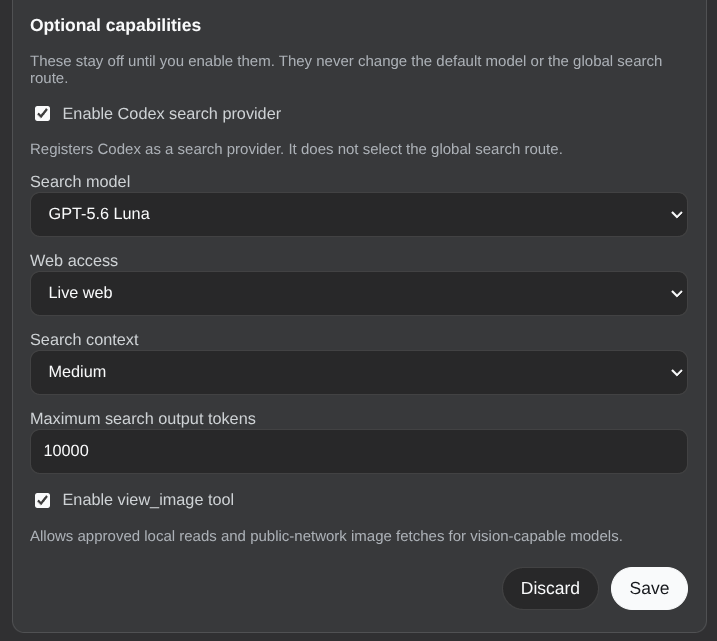
Search, view_image, and codex_generate_image are implemented but default off. Enabling any of them and clicking Save registers or unregisters it immediately; no restart is required. Search registers a standalone Codex WebSearchProvider (POST /codex/alpha/search). It does not write web.searchProvider or agent-default-model. The search-model dropdown lists official non-Fast models and defaults to gpt-5.6-luna. The plugin also registers web/openai-codex-search-llm-request so session logs written by dsh-codex-connect remain readable after that plugin is uninstalled. Search modes match official Codex:
cached(default): OpenAI-maintained index, no live fetchindexed: live fetch only when the search index gates the requestlive: unrestricted live retrieval
view_image is a model-invoked tool for local files and public-network HTTP(S) images. Spark is text-only.
codex_generate_image is a separate model-invoked tool. Any conversation model can call it; it uses this plugin's ChatGPT login and Codex usage (typically 3–5× a text turn) and draws with backend gpt-image-2. The routing-model dropdown lists official vision models and defaults to gpt-5.6-luna. The name is intentionally not generate_image, so it does not collide with other provider plugins. Generated files land under generated-images/ unless path is set.
Config
- id: llm-codex
  name: 'dsh-llm-codex'
  config:
    enableSearch: false
    enableImageTool: false
    enableImageGeneration: false
    streamIdleTimeoutMs: 300000
    retryPolicy:
      mode: normal
      maxRetries: 8
      backoff:
        initialDelayMs: 500
        maxDelayMs: 10000
        jitterRatio: 0.1
The bundle retries eligible model-request failures up to eight times by default, including AUTH. ChatGPT WebSocket closures, including code-and-reason variants other than message-too-large code 1009, connection limits, and overload responses use retryable DSH failure codes. Ambiguous usage limits remain non-retryable.
There is no apiKeyEnv and no user-editable base URL. models is the displayed conversation catalog.
LLM Providers UI ownership
The LLM Providers Settings page (settings.section id: providers with child settings.provider.item) and the shared llm-providers order store are owned solely by dsh-llm-providers-ui.
- This plugin contributes only its keyed card (
key: llm-codex) and its Hostllmroute; it does not install the page or the sharedllm-providersnamespace. Load order with the owner does not matter. - Without the owner (Headless or Web without
dsh-llm-providers-ui): the Host model routecodexstill works; in Web the owner controls whether the Providers page and this card are mounted. A Web release composition test rejects a bundle graph that ships provider cards without the owner. - The nav globe glyph is a temporary Alpha.4 DOM adapter owned only by
dsh-llm-providers-ui(src/client/nav-icon.ts); this plugin does not ship that adapter.
Install dsh-llm-providers-ui explicitly in the profile alongside provider plugins (see that package's cordis.patch.yml).
License
MIT
Release installation (Latest)
ChatGPT Codex login, model catalog, usage, and optional search/image capabilities. This release targets official DeepSeek Harness 0.1.7-rc.1 and contains built Host/Client files only; it has no sibling-repository source, workstation path, link:, or workspace: dependency.
The dsh-llm-providers-ui package owns the LLM Providers page, navigation, and shared order store. This package owns only its provider card, models, credentials, and Host route. Install the Owner first for Web; headless Host routing works without the Owner.
Latest (Owner + this plugin; required together on Web):
dsh plugin --profile web add --force \
  https://github.com/NOirBRight/dsh-llm-providers-ui/releases/latest/download/dsh-llm-providers-ui-0.2.13.tgz
dsh plugin --profile web add --force \
  https://github.com/NOirBRight/dsh-llm-codex/releases/latest/download/dsh-llm-codex-0.3.26.tgz
Fixed versions (reproducible):
dsh plugin --profile web add --force \
  https://github.com/NOirBRight/dsh-llm-providers-ui/releases/download/v0.2.13/dsh-llm-providers-ui-0.2.13.tgz
dsh plugin --profile web add --force \
  https://github.com/NOirBRight/dsh-llm-codex/releases/download/v0.3.26/dsh-llm-codex-0.3.26.tgz
Update, uninstall, and verify:
# Update Owner + this plugin to Latest
dsh plugin --profile web add --force \
  https://github.com/NOirBRight/dsh-llm-providers-ui/releases/latest/download/dsh-llm-providers-ui-0.2.13.tgz
dsh plugin --profile web add --force \
  https://github.com/NOirBRight/dsh-llm-codex/releases/latest/download/dsh-llm-codex-0.3.26.tgz
# Verify the loaded version
dsh plugin --profile web list
dsh plugin --profile web doctor
# Uninstall only this plugin
dsh plugin --profile web remove dsh-llm-codex
Configuration: use the plugin section in Settings for Web UI plugins, or the profile dsh.profile.bundles entry for Host-only plugins. Start with this README's minimal YAML/JSON example and provide credentials/backend addresses explicitly.
Rollback: reinstall the prior stable v0.3.22, verify the profile list, then restart the Web service once. Inspect journalctl --user -u dsh-web.service and dsh plugin --profile web doctor; never put a source checkout in the production profile.
Release and integrity: v0.3.26 · SHA256SUMS.
Independent Model Switch search
Since 0.3.14, the Host adapter self-declares its current search model catalog (tools !== false) through the existing Model Switch adapter registry: display label Codex plus a live serializable models list ({id, name}) reflecting current provider settings. Search uses the existing ChatGPT credential store and Codex search implementation; no credentials or executable functions are sent to the browser. Unsupported models and missing credentials fail explicitly.
The coordinated search UI that reads this metadata is available from Model Switch 0.4.7; the optional dsh-model-switch peer accepts versions from 0.4.5 onward. Older releases ignore the extra fields. Registration does not select global Web routing: explicitly configure web.searchProvider: model-switch while preserving the complete existing Web config, then select the adapter/model in Model Switch Settings. web_fetch is unchanged. ProviderDirectory role/usage registration remains deferred through ctx.inject.
Validation: pnpm run check, pnpm run build; live acceptance through 3082 official Web selection succeeded with gpt-5.6-luna. See the Model Switch integration audit for exact lab composition and evidence.
Links
More in this category
V1ki/dsh-plugin-subscriptions★ 415
Use ChatGPT (Codex), Claude, and Grok subscriptions as DeepSeek Harness LLM providers, with Settings login, model catalogs, usage, plus image_generate, video_generate, and x_search tools.
Mars-Sea/dsh-commandcode-provider★ 355
Unofficial Command Code LLM provider: registers a `commandcode` route with a live model catalog and reasoning-effort support.
corrinehu/dsh-workbuddy-connect★ 262
Brings the models in the WorkBuddy desktop app straight into DeepSeek Harness — zero configuration in the DSH chat.
cv-superding/dsh-deepseek-web-login★ 206
Adds a deepseek-web provider that uses chat.deepseek.com web models in DSH, with browser login capture, PoW request signing, SSE streaming, and prompting-based tool calls.
volcengine/ark-cli#ark-plan-api★ 140
Registers Ark Agent Plan, Coding Plan and postpaid model routes in the native DSH model picker.
franksong2702/dsh-codex-connect★ 131
Connect ChatGPT OAuth and OpenAI Codex models to DeepSeek Harness, with opt-in search and image tools.
Community comments
Comments are public GitHub Discussions. Loading them connects to GitHub and Giscus; a GitHub account is required to post.