Runs scheduled coding tasks in isolated DeepSeek Harness sessions, managed from Settings or the agent.
Install
# from npm (prebuilt)
dsh plugin --profile web add @michengai/dsh-automation
# from GitHub (first run asks for allowBuilds approval — follow the hint, retry)
dsh plugin --profile web add github:MichengAI/dsh-automation
Any plugin you install runs third-party code with your own permissions — it can read your files, use your credentials, and reach the network, and tool approvals don’t sandbox it. GitHub-sourced plugins also run build scripts at install time — pnpm blocks those until you allow them, so an install can stop with ERR_PNPM_GIT_DEP_PREPARE_NOT_ALLOWED or ERR_PNPM_IGNORED_BUILDS; dsh prints the exact key to add under allowBuilds in your profile’s pnpm-workspace.yaml, and the install works on the next run. Allowing a build is a trust decision: only install sources you trust, and pin a commit (github:owner/repo#sha).
README
DSH Automation
Run standalone coding tasks on a schedule in DeepSeek Harness
简体中文 · Changelog · Apache-2.0
DSH Automation is a community-maintained DeepSeek Harness (DSH) plugin, not an official DeepSeek AI product.
Features
Let DSH handle work on a schedule. Set up tasks in Settings or describe the timing and requirements in a conversation, then review each run.
- Run once or repeat: choose intervals, hourly, daily, weekly, monthly, or every N days.
- Choose the working environment: set the directory, model, skills, and permissions.
- Adjust the schedule anytime: create, pause, resume, run immediately, or delete tasks.
- Review results: browse task conversations by name and run time in the Scheduled tab, or filter run history in Settings.
- Keep each run independent: each run uses the saved task instructions and does not inherit the conversation that created it.
Interface
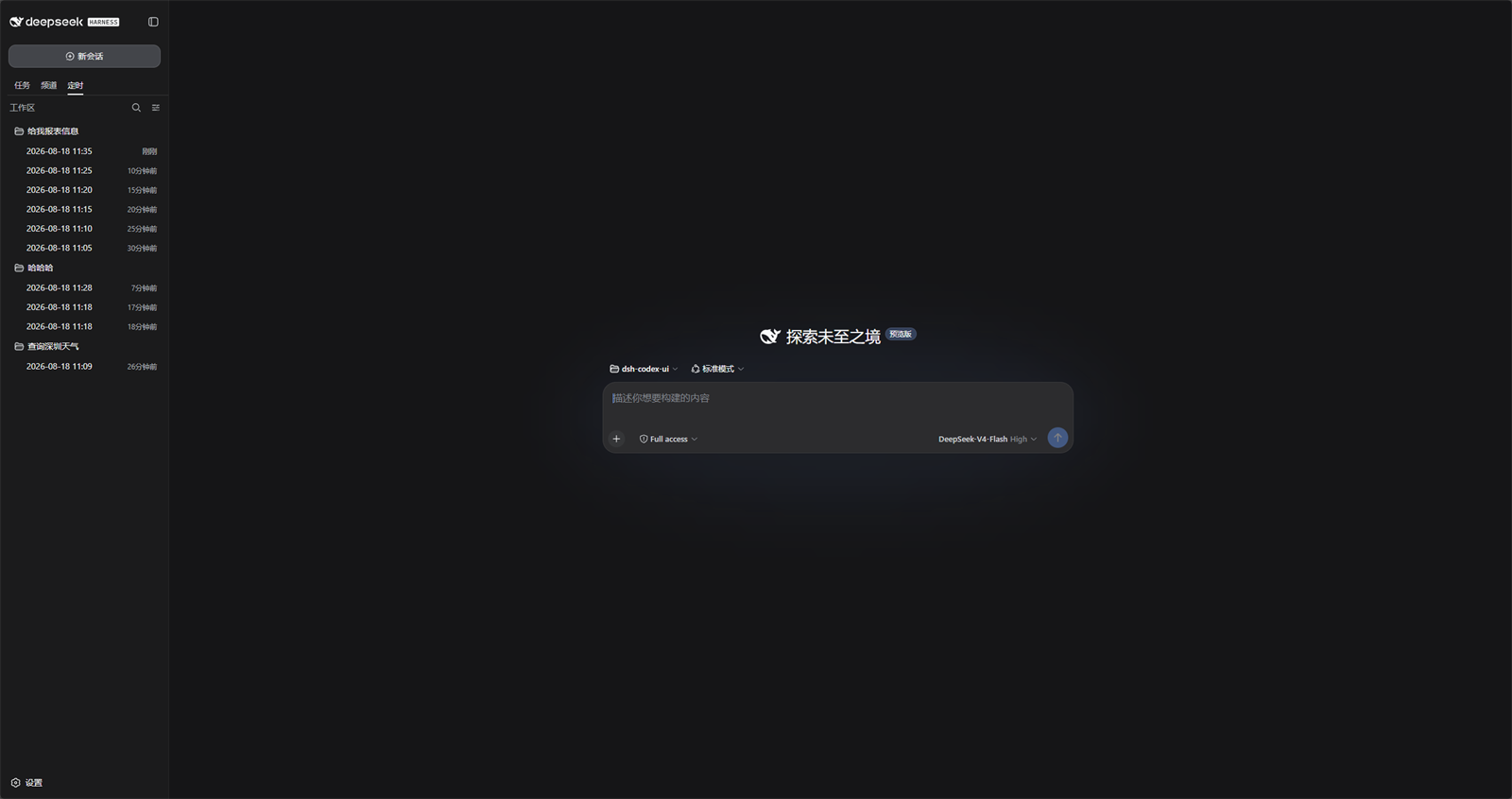
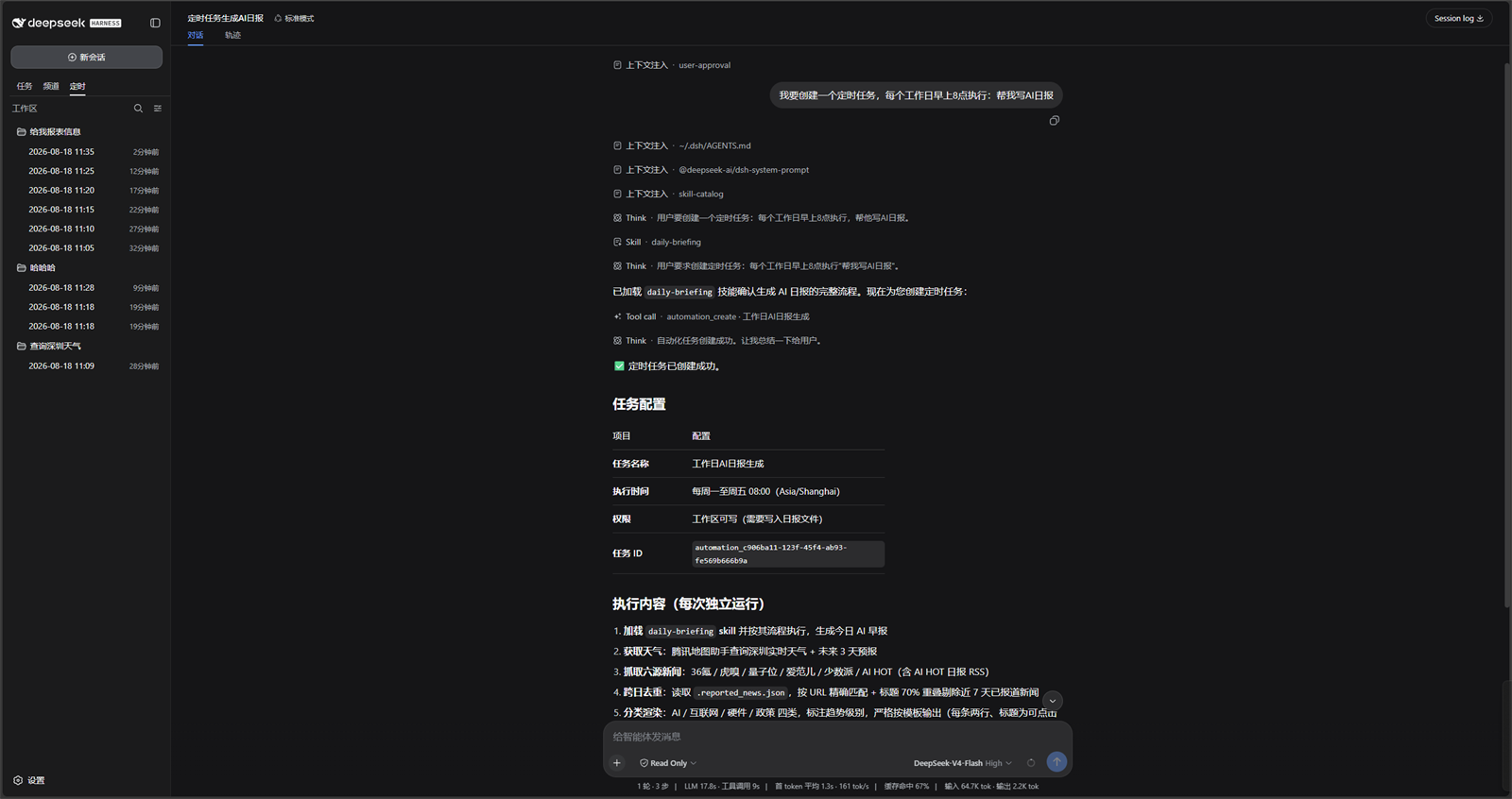
Scheduled tasks live in the workspace Scheduled tab, next to Tasks and Channels:
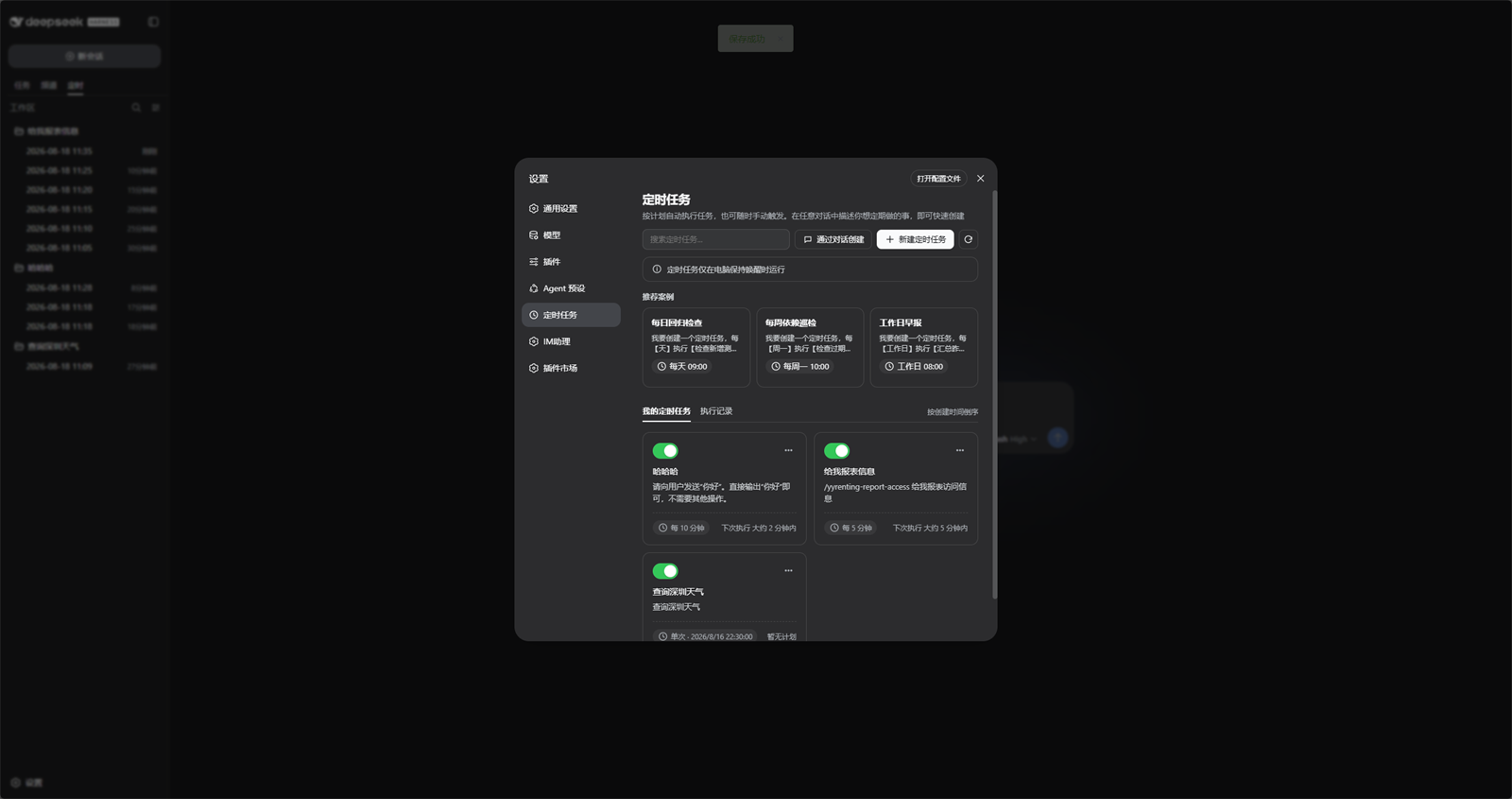
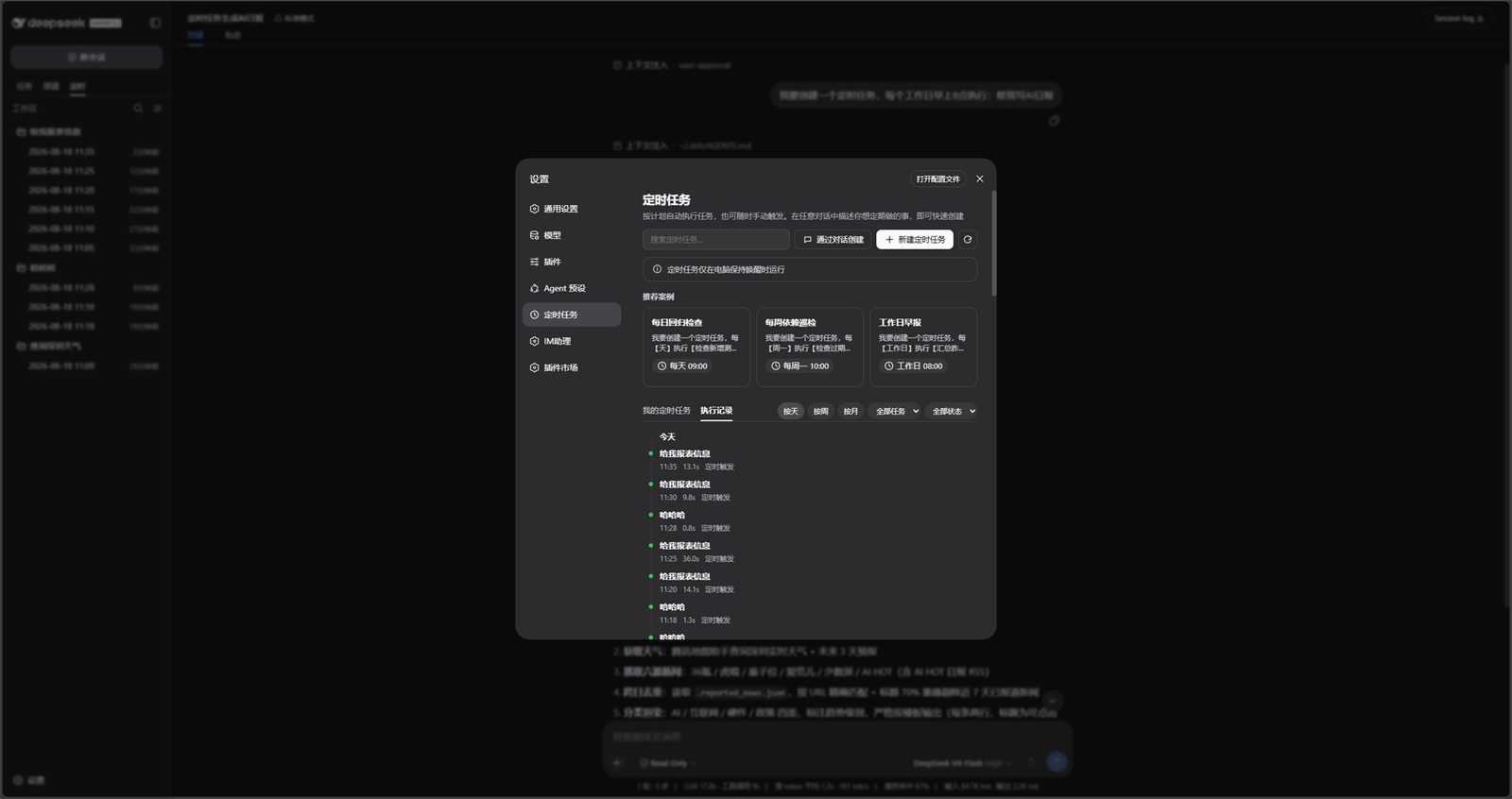
Open Settings → Scheduled Tasks to search, create, pause, and inspect rules:
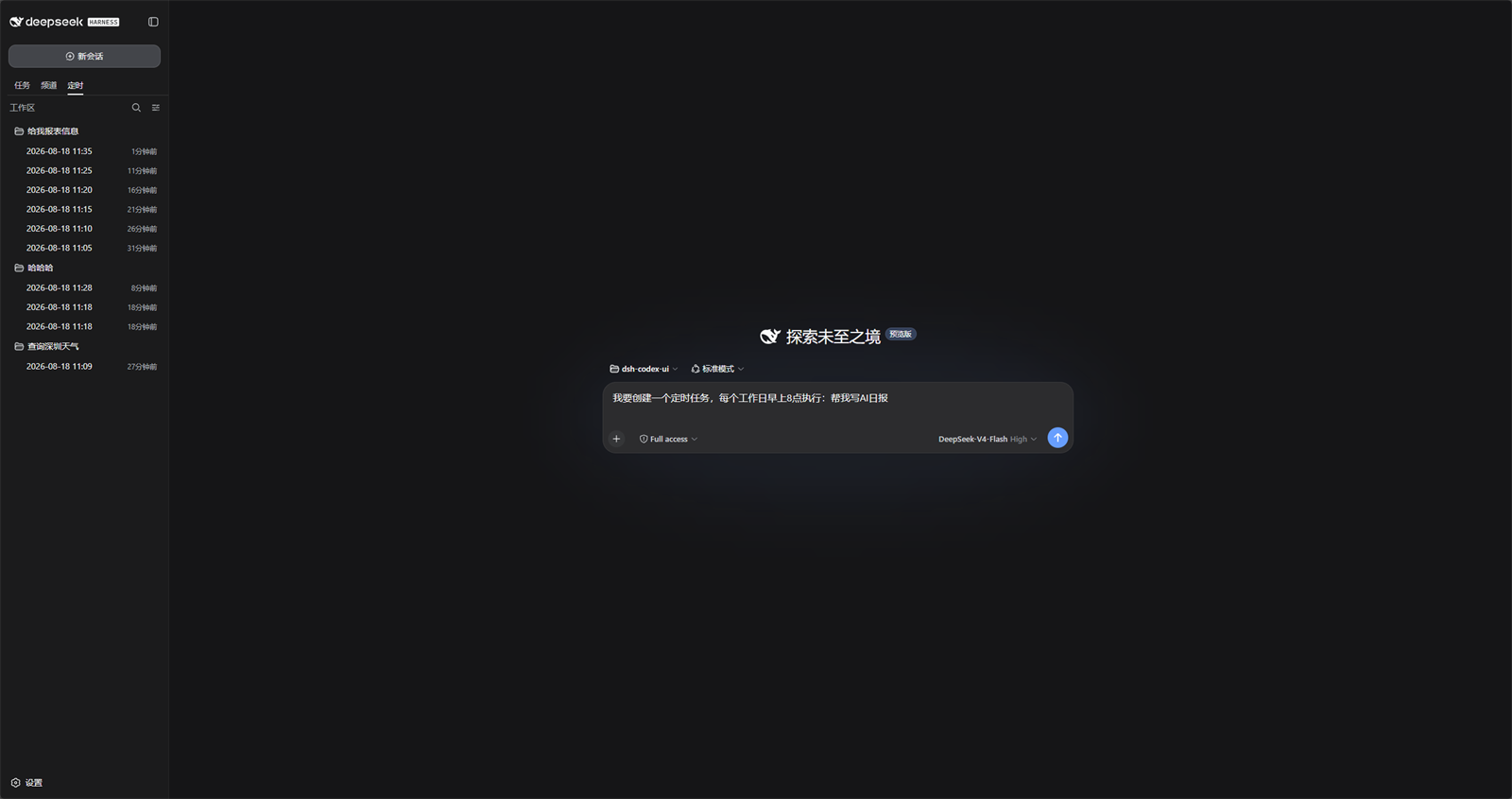
Describe the job in chat. DSH handles approval according to the selected permission mode:
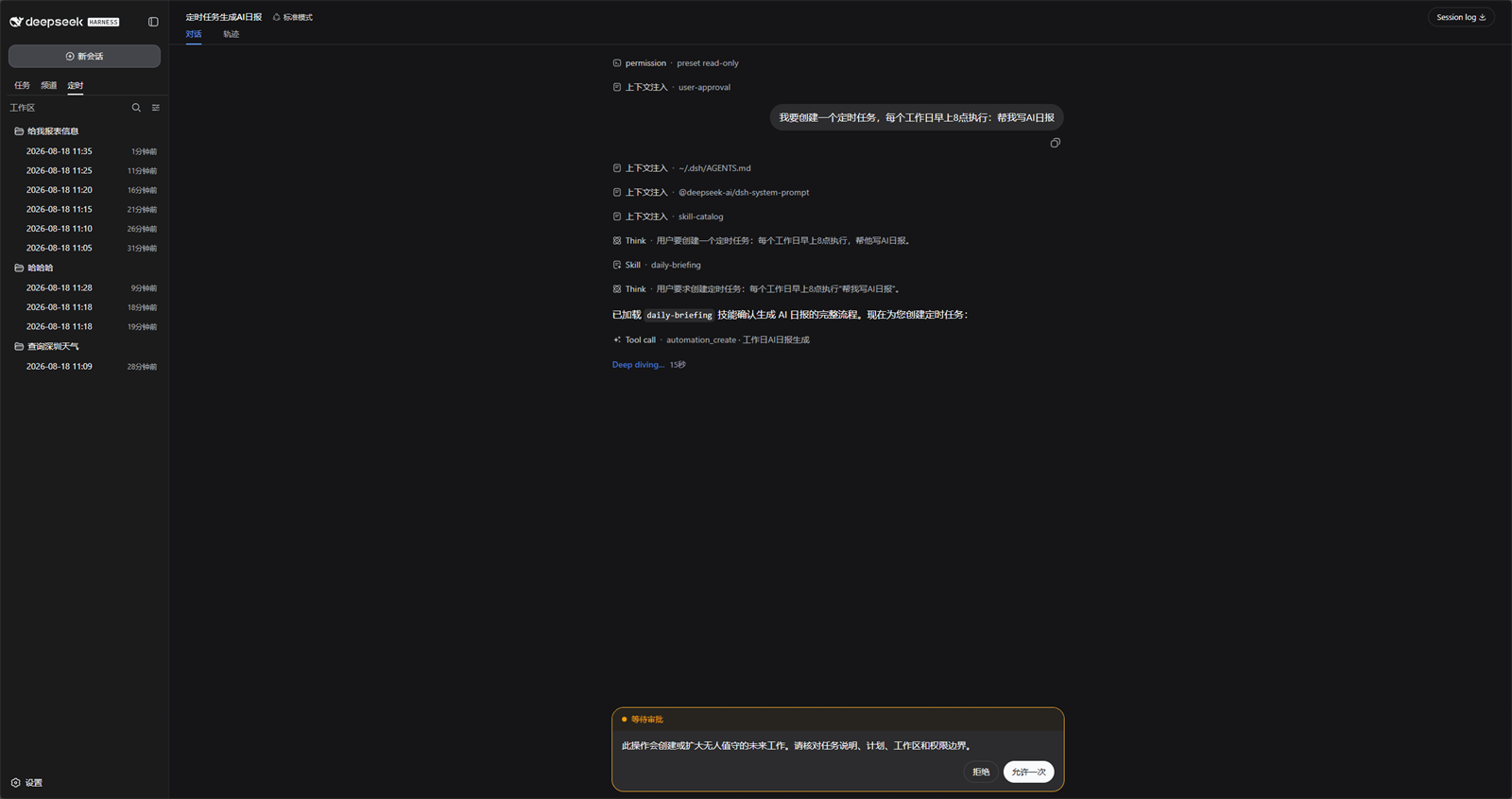
After approval, the rule is saved and summarized in the conversation:
Run history stays in Settings and can be filtered by day, week, month, task, or status:
DSH product ecosystem
For a desktop workbench, download DSH Codex Desktop. Existing DeepSeek Harness installations can add plugins as needed by following each project's README. Below are 11 first-party plugins; consult the corresponding desktop release notes and bundled catalog for what that version includes.
| Plugin | What you can do |
|---|---|
| Codex UI | Organize projects and conversations, search tasks, and navigate chat turns |
| Agency Agents | Choose and summon specialists for your task |
| Skills Manager | Find, enable, create, and import local skills |
| Archive Manager | Search, restore, or clean up archived conversations |
| IM Connect | Send tasks and receive replies through messaging platforms |
| Automation | Schedule tasks and review each run |
| BTW | Ask side questions without interrupting the main task |
| Simplify | Use /simplify to improve code within your Git changes |
| PUA | Guide the Agent to try new approaches after failures, investigate causes, and verify results before completion |
| Code Review | Use /review to request an independent Agent code review and receive the report in the current conversation |
| Codex Pet | View conversation notifications and respond to tool approvals and questions through a desktop pet |
Prerequisites
- The current source uses DSH
0.2.0-rc.2for development and real Host compatibility tests, and declares support through0.2.0-rc.2. Back up automation storage and sessions in the Profile before upgrading the Host.0.1.7and0.2.0write V4 sessions, and V4 sessions cannot be read after downgrading. - Official DSH peerDependencies are exactly
0.1.2-rc.1 || 0.1.5-rc.1 || 0.1.5-rc.2 || 0.1.5-rc.3 || 0.1.7-rc.1 || 0.1.7-rc.2 || 0.2.0-rc.1 || 0.2.0-rc.2. The0.1.6line is absent because it will not get a release candidate; hosts still on0.1.6-alpha.1or0.1.6-alpha.2need0.1.7-rc.1or later for the next plugin release.@deepseek-ai/dsh-agent-presetsand@deepseek-ai/dsh-agent-preset-registryare not peers: the host install gate checks every@deepseek-ai/dsh-*peer against the running version and ignoresoptional. The old package has no0.1.7or0.2.0release, and the renamed package does not exist on older hosts. Scheduled tasks still use the hostagentPresetsservice. Development dependencies are pinned to0.2.0-rc.2. Use one consistent official package version within each Host. - Other versions are outside the declared compatibility range. Installers may warn, and strict peer validation rejects them. Extend and pass the version matrix before adding a new rc.
- The Connection patch replaces the Web bundle's configured injection list with
[webServer, webRuntime]; Loader still merges dependencies declared by the plugin source. Custom Hosts with additional configured injections must retain these two entries and their extra dependencies in a later Profile patch. This patch does not automatically merge other bundles' lists. - A working DeepSeek Harness Web installation with
dshavailable in PowerShell. - Examples use the
webprofile; replace it with the target profile. - Source installation and development require Node.js 22.19+. npm installation does not require running
npm installin an arbitrary directory.
Installation
The installation commands below use the official npm registry.
Ask an agent to install it (recommended)
Send the prompt below to any agent that can run terminal commands on your computer. Replace web with your actual profile. Once installed, use the plugin in DSH.
Install the DSH plugin @michengai/dsh-automation into my local web profile by running: dsh plugin --profile web add @michengai/dsh-automation@latest --registry=https://registry.npmjs.org/. Then run dsh --profile web --dump-config, confirm the configuration includes dsh-automation, and explain how to reload DSH and start using the plugin.
Install from npm
[Console]::OutputEncoding = [System.Text.Encoding]::UTF8
$OutputEncoding = [System.Text.Encoding]::UTF8
dsh plugin --profile web add @michengai/dsh-automation@latest --registry=https://registry.npmjs.org/
dsh --profile web --dump-config
Restart DSH Web and hard-refresh the browser. Pin a version with @0.1.5 instead of @latest when needed.
Updates
The settings title shows the installed version and a Check for updates button. When a newer release is available, Update automatically runs only when the DSH CLI or Desktop update service is available; otherwise, the dialog provides a profile-specific manual command to copy and run.
Usage
Open Settings → Scheduled Tasks, then use the panel as follows:
| Goal | Action | Scope |
|---|---|---|
| Create a rule | Select New scheduled task, then set name, schedule, prompt, workspace, model, skills, and permission. | Host-wide |
| Create from chat | Describe the schedule in any conversation, or select Create in chat. | Current conversation |
| Pause or resume | Use the switch on a task card. | One rule |
| Run now | Open the card menu and select Run now. | One rule |
| Delete | Open the card menu and select Delete task. Run history is kept. | Definition only |
| Inspect runs | Open Run history, then filter by day, week, month, task, or status. | Host-wide |
Each dispatched run uses the saved prompt, workspace, model, and permission boundary. It does not reuse approvals from the source chat.
Safety boundary
| Item | Behavior |
|---|---|
| Permission | Options and the default come directly from the Host permissionPresets service, including custom presets. |
| Tool calls | Follow Host tool availability, permission, and approval checks without an additional fixed tool allowlist or a background-shell ban. The Host manages background processes. |
| Full access | The official danger-full-access option uses the same risk confirmation and orange warning as Chat. |
| Approval | Chat create follows the session policy. Full access (never) proceeds; Workspace Write / Read Only (ask) shows the official card. Unattended runs stay fail-closed never. |
| Retry | No automatic retry after a started run. |
| Host restart | Leftover queued / running records become failed(host_interrupted). |
| Concurrency | Different automations have no plugin-level global concurrency cap, including those in the same directory. The legacy plugin-level global concurrency setting (maxConcurrentRuns in plugin config) no longer takes effect; it is separate from the per-task field below. |
| Minimum interval | Since 0.1.40, interval schedules accept whole minutes starting at 1. Missed triggers are not replayed individually; only the latest due occurrence is considered within the recovery window. |
| Per-task concurrency | Available since 0.1.40. Set Concurrency in the create/edit dialog (positive integer, default 1). Queued and running executions share this limit. When full, scheduled triggers become skipped(overlap) and manual runs return a limit error. Lowering the limit does not cancel existing runs. Agent create/update tools accept max_concurrent_runs; Web RPC accepts maxConcurrentRuns. Existing tasks default to 1. |
A schedule stores future intent. It is not a cached permission grant.
Development
Install from source
Use this for debugging or unpublished changes. The cloned directory becomes the plugin source path:
[Console]::OutputEncoding = [System.Text.Encoding]::UTF8
$OutputEncoding = [System.Text.Encoding]::UTF8
Set-Location D:\Repository\deepseek-harness-plugin
git clone https://github.com/MichengAI/dsh-automation.git
Set-Location .\dsh-automation
pnpm install
pnpm test
pnpm build
dsh plugin --profile web add .
dsh --profile web --dump-config
Restart DSH Web and hard-refresh the browser. Local installation reads and applies cordis.patch.yml; do not copy lib files manually.
Current sources live in src and build into lib:
- src\index.ts: Host plugin, tools, and RPC.
- src\service.ts: Durable definitions, clock, and run admission.
- src\client\index.ts: Settings page and chat prefill.
tests\*.test.ts: Domain, recurrence, service, client, and package-contract tests.
After changing files, run tests, rebuild, and reinstall from the local directory:
[Console]::OutputEncoding = [System.Text.Encoding]::UTF8
$OutputEncoding = [System.Text.Encoding]::UTF8
pnpm check
dsh plugin --profile web add .
Keep the at-most-once dispatch policy, workspace scoping for Agent tools, and fail-closed unattended approval when changing execution code.
Verification
[Console]::OutputEncoding = [System.Text.Encoding]::UTF8
$OutputEncoding = [System.Text.Encoding]::UTF8
pnpm test
pnpm build
pnpm check runs typecheck, unit tests, real Host compatibility tests, and build. pnpm test:host bypasses runtime stubs and uses the official AgentLoop, Session V3, and permission service with a fixed local model adapter; it makes no external model calls. Browser interactions and real model calls require separate acceptance testing.
Cross-plugin sidebar regressions run with pnpm test:composition <dsh-im-connect checkout>. Build the IM checkout first; the script reads its lib/client.js. It executes the composition logic and tab registries of both repositories, covering registration order, delayed notifications, and uninstall handover across the archive, IM, scheduled, and Codex UI plugins; slots and timers use a simulated environment, so it does not install any plugin or replace Desktop rendering acceptance testing. This separate check requires an external checkout and is not included in pnpm check; use a fixed IM revision for reproducible results.
pnpm test:matrix builds the package, then creates separate temporary npm environments for every declared Host version using network access. It checks strict peer installation, every official dependency version, the packaged entry point, real AgentLoop execution, and service regressions. All declared versions pass. Persistence enumeration in service regressions uses in-memory fixtures for both cold-session formats; it does not validate on-disk migration of a real Profile. The printed evidence directory retains installation lockfiles, test logs, and results.json. The matrix does not modify development dependencies or connect to the user's Profile.
License
Additional notices are in NOTICE.
This project uses Apache License 2.0.
Links
More in this category
Q00/ouroboros#integrations/dsh-plugin★ 6166
Config-only bundle that mounts Ouroboros through the DSH MCP client, exposing 36 interview, Seed, execution, evaluation, and evolution workflow tools in DSH.
loopx-project/loopx#dsh-loopx-plugin★ 6125
LoopX, a provider-neutral, local-first state kernel and control plane for long-horizon agents: keeps Goal, Todo, gate, evidence, quota, recovery, and handoff state above DeepSeek Harness, while the plugin bootstraps the CLI and skills, admits bounded same-session continuation, and adds a loopback GoalBar for the exact bound loop.
chuspeeism/dashi-taskboard#deepseek-harness★ 3273
Embeds the active installed Codex Taskboard runtime in the DeepSeek Harness sidebar, using its launcher runtime descriptor instead of a fixed port.
NanmiCoder/dsh-agent-teams★ 1883
AgentTeams multi-agent teams.
EthanYoQ/AI-Novel-Writer#dsh-ai-novel-writer★ 1241
Installs a dedicated AI novel-writing preset and workbench: revisioned local project assets, a compact side drawer, and native approval-gated single-file changes.
tong-io/tongflow#dsh-tongflow★ 1032
TongFlow film-crew studio for image, voice, music and video production: the agent writes per-asset TongFlow workflow files (.tongflow.json) that run through TongFlow plugins, with an embedded workflow canvas, a shot/character/take project layout and a manga-drama template; sessions starting with @tongflow open the Studio view.
Community comments
Comments are public GitHub Discussions. Loading them connects to GitHub and Giscus; a GitHub account is required to post.