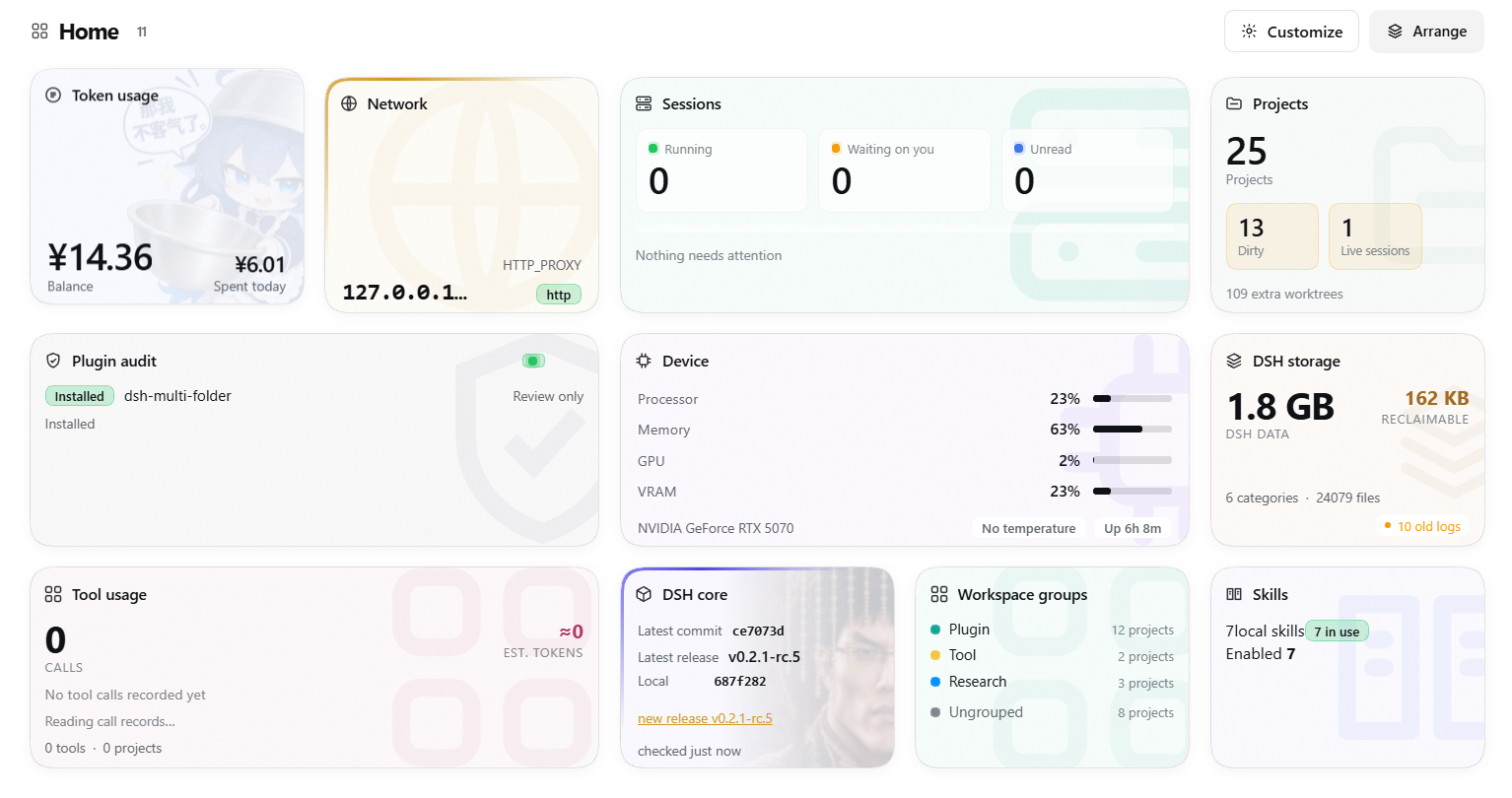
A personal home page for DSH that gathers feature entry points and readings into a card wall: one-click DSH core updates, security review of a plugin before install, local Skill management, session status and more. The page is customizable, and any other plugin can add its own cards through the interface.
Install
# from npm (prebuilt)
dsh plugin --profile web add dsh-homepage
# from GitHub (first run asks for allowBuilds approval — follow the hint, retry)
dsh plugin --profile web add github:AngelosZou/dsh-homepage
Any plugin you install runs third-party code with your own permissions — it can read your files, use your credentials, and reach the network, and tool approvals don’t sandbox it. GitHub-sourced plugins also run build scripts at install time — pnpm blocks those until you allow them, so an install can stop with ERR_PNPM_GIT_DEP_PREPARE_NOT_ALLOWED or ERR_PNPM_IGNORED_BUILDS; dsh prints the exact key to add under allowBuilds in your profile’s pnpm-workspace.yaml, and the install works on the next run. Allowing a build is a trust decision: only install sources you trust, and pin a commit (github:owner/repo#sha).
README
dsh-homepage gives DSH one place to browse and enter its auxiliary features. It adds an
extra surface to DSH that presents different content as cards, and a card expands to offer
entry points to those features — reviewing and installing an external plugin through a
delegated session, checking the DSH core version and updating it in one click, seeing
whether sessions are running, managing local Skills, and more. The cards are modular by
design, so any external plugin can register its own; their artwork, layout and motion can
all be customized into a personal home page.
Install
Installing through npm is recommended:
dsh plugin --profile web add dsh-homepage
You can also give a DSH session the address of this repository and ask the agent to complete the installation.
Requirements
- Node.js >= 22.19
- DSH 0.2.x
Cards
Eleven cards ship: the preview shows the readings, expanding opens the full view. Click a card to float it over the wall, drag its title to reorder, and use Customize for artwork, visibility and motion.
| Card | What it does |
|---|---|
| Plugin audit | Runs a session to review a given plugin for security. It can be asked to install automatically after a passing review, or to return the review report only. |
| Sessions | How many sessions are running, waiting on you or unread, each with a shortcut into it. |
| Projects | Every workspace's branch, dirty count, ahead/behind, last commit, session count and extra worktrees. |
| Tool usage | Tool call counts, error rate, argument and output volume, estimated tokens and time, filterable by project. |
| Token usage | Balance and today's spend, with history, wallets, bonus credit and account links. |
| Network | A quick view of the DSH core's network environment variables. |
| Device | CPU, memory, GPU/VRAM and disk. |
| DSH storage | The DSH home's size, what is reclaimable, the largest categories and old-log cleanup. |
| DSH core | The latest version in the DSH repository against the installed core, with a one-click update. |
| Workspace groups | Manage the sidebar groups. |
| Skills | Browse and manage installed Skills, and discover and install community Skills. |
Extending the cards
Any other plugin can add cards through the interface. The full interface documentation is in docs/card-api.md.
Model-facing tool
The plugin provides a model-callable homepage tool that reads the same data as the cards.
It is off by default and has to be turned on manually in the plugin's settings on the
Plugins page. Enabling the tool injects its context into a session: the tool can reach the
information of every card, including cards implemented by external plugins, and depending
on a card's implementation that may hand the agent information it did not expect.
Storage
The plugin stores its data under <DSH_HOME>/storages/dsh-homepage. <DSH_HOME> prefers
the DSH_HOME environment variable; when that variable is absent, ~/.dsh is used.
Contributing
Issues and pull requests are welcome. The development loop, the repository layout and the checks a change has to pass are in CONTRIBUTING.md.
License
MIT — see LICENSE. Copyright (c) 2026 Yutong Zou.
Links
More in this category
yjh051108/dsh-routing-suite★ 6994
One repository, three parts: a runtime injector for DSH plugin packages (inject, hot-reload, unload, promote a dev staging tool to the front, route self-heal, plus a settings-page plugin manager that lists, unloads and drags folders in to internalize), a task-aware reasoning-mode router agent preset (router-standard / router-spec / router-react), and a graded two-level task protocol whose six tools (commit_star, lock_stage, revise_do, edit_plan, mark_task, redteam_verdict) pin task state to disk. The injector implementation ships in-tree, so the install carries its own behaviour rather than a dependency list.
strukto-ai/mirage#dsh★ 3762
Swaps the filesystem and bash providers for a mirage virtual workspace: file tools and shell commands run over mounted resources (RAM, S3, Redis, Slack, Gmail, Notion, Postgres) instead of the host disk, with per-mount read/write/exec modes, per-command sandbox routing (monty, pyodide, quickjs in process; docker, e2b, daytona remote), and installed CLIs (git, gh, slack, linear, ntn, gws, or one you register) as head words in the virtual terminal.
first-fluke/oh-my-agent#dsh★ 1357
Runs project OMA checks before and after tool execution and when a turn tries to finish. Installs its OMA CLI dependency and initializes unconfigured projects on first use. Requires Node.js 22+; initial setup needs network access and project write access.
MichengAI/dsh-skills-manager★ 444
Manages local DeepSeek Harness skills in Settings and shows shared Agent skills as read-only.
hust-open-atom-club/oh-dsh★ 324
Community distribution: TUI, desktop, and Web UI as one bundle with layered installation.
Fishquito7/dsh-skill-mcp-panel★ 248
Manages DSH skills and MCP servers from the web settings: skill cards with hot enable/disable, workspace scopes, groups, batch migration and drag-and-drop import, plus stdio/HTTP MCP CRUD with connection tests, secret redaction and the unified dsh-panel CLI.
Community comments
Comments are public GitHub Discussions. Loading them connects to GitHub and Giscus; a GitHub account is required to post.