面向 DSH profile 内插件的只提醒更新检查器:按依赖写法(specifier)分类,只列出当前 DSH 内核能加载的版本;提供 plugin_updates 工具和 Updates 侧栏页(侧栏页需装 dsh-better-sidebar,不装时工具与设置仍可用)。
安装
# npm 包(预构建)
dsh plugin --profile web add @lucagiftzek/dsh-plugin-updates
# GitHub 源码(首次需按提示配置 allowBuilds 构建授权后重试)
dsh plugin --profile web add github:lucagiftzek/dsh-plugin-updates
装任何插件都等于在你的机器上跑第三方代码,权限和你本人一样大——能读你的文件、用你的凭据、访问网络,工具审批管不到它。GitHub 来源的插件还会在安装时执行构建脚本——pnpm 默认拦截,所以安装可能停在 ERR_PNPM_GIT_DEP_PREPARE_NOT_ALLOWED 或 ERR_PNPM_IGNORED_BUILDS;dsh 会打印出需要添加的确切键名,把它加进该 profile 的 pnpm-workspace.yaml 的 allowBuilds 下,重跑一次即可装上。放行构建本身就是一次信任判断:请只安装可信来源,并尽量锁定 commit(github:owner/repo#sha)。
README
该插件的 README 只有英文版本。
An update checker that only offers plugin releases your running DSH core can actually load.
dsh plugin --profile web add dsh-better-sidebar   # the tab host, skip if installed
dsh plugin --profile web add @lucagiftzek/dsh-plugin-updates
# or from GitHub: dsh plugin --profile web add github:lucagiftzek/dsh-plugin-updates
# restart dsh web, then open the Updates tab
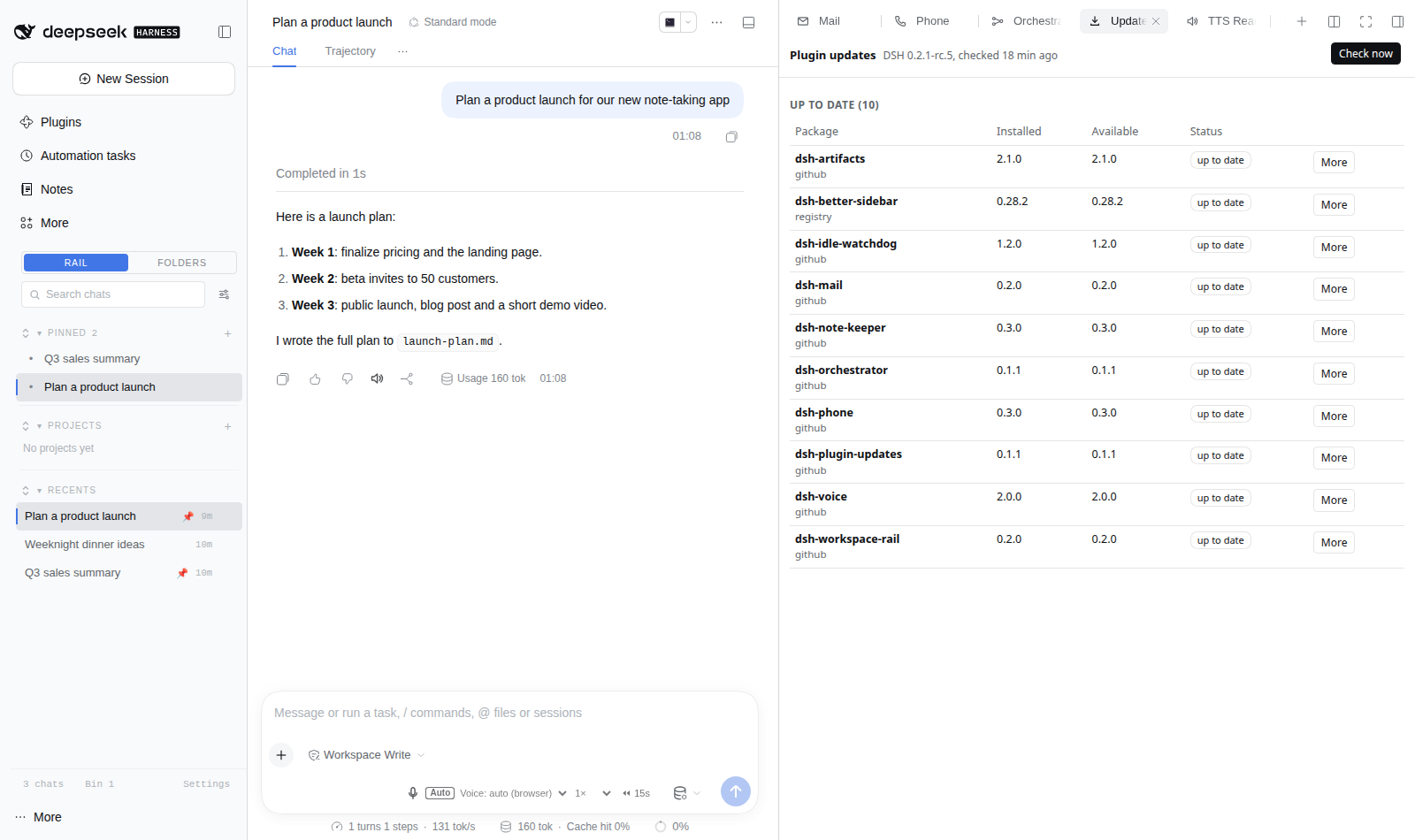
Screenshot from a demo DSH instance with sample data.
A DeepSeek Harness (DSH) web-profile plugin that tells you which of your installed plugins have a newer release that your running DSH can actually take. It only notifies. It never installs, never edits your profile, never runs a child process.
npm name. The bare name
dsh-plugin-updatesis already taken on npm by an unrelated data package, so this plugin is published as@lucagiftzek/dsh-plugin-updates. The loader row id staysplugin-updateseither way.
Why
Updating DSH plugins blind is risky. Two things go wrong in practice:
- Name collisions. Many local plugins are
link:folders or GitHub installs whose names also exist on npm as unrelated projects. A checker that looks packages up by name reports false "updates" and, if you approve, installs somebody else's package. This plugin classifies every dependency by its specifier (^1.2.0,link:,github:, a release tarball URL), never by its bare name. - Wrong-core builds. The newest release of a plugin often needs a newer DSH core than the one you run. Installing it can blank the whole web UI. This plugin applies the same compatibility rule as the DSH 0.2.1 loader against the running core version, so a 0.2.x-only build is never offered to a 0.1.5 host.
It also keeps a list of holds (versions you know to avoid), per package notes, and gives you a memory-capped apply command to copy, because a bare pnpm add on a busy machine can exhaust memory.
What you get
- An Updates tab in the sidebar (needs
dsh-better-sidebar, optional) with a live count badge, grouped results, links (npm, releases, changelog, compare), Check now, Ignore this version, Snooze and Copy command. - A Settings section for the options below.
- A read-only agent tool
plugin_updates(andplugin_updates_doctor). GET /dsh-plugin-updates/api/doctorand a bundled doctor skill.- Zero configuration: defaults work as installed.
Install (DSH web profile)
Install from npm: dsh plugin --profile web add @lucagiftzek/dsh-plugin-updates, or from GitHub: dsh plugin --profile web add github:lucagiftzek/dsh-plugin-updates.
dsh plugin --profile web add @lucagiftzek/dsh-plugin-updates
# or from GitHub: dsh plugin --profile web add github:lucagiftzek/dsh-plugin-updates
# then restart dsh web: the server half loads at start only
The package declares dsh.bundle, so dsh plugin add lists it in dsh.profile.bundles. A local checkout works too: clone it, run npm install --omit=dev in it, then dsh plugin --profile web add link:/absolute/path/to/dsh-plugin-updates. Requires Node 22.5 or newer and DSH 0.1.5-rc.1 up to (not including) 0.3.0. The browser half hot-reloads; only the server half needs the restart.
Kill switch without uninstalling: add - id: plugin-updates with disabled: true to the profile cordis.patch.yml, or set DSH_PLUGIN_UPDATES_DISABLE=1.
Settings
Settings live in the dsh-plugin-updates namespace on DSH 0.1.5 (Settings page, stored in settings.yaml) and in the plugin-updates row of the profile cordis.patch.yml on DSH 0.2.x (settings forms). The plugin imports an old settings.yaml section once.
| Key | Default | Meaning |
|---|---|---|
enabled |
true |
Master switch. |
intervalHours |
12 |
Hours between automatic checks (minimum 1). |
initialDelaySeconds |
60 |
Delay of the first check after start. After a restart the next check respects the last one, so restarts do not cause extra requests. |
registry |
https://registry.npmjs.org |
Registry base URL. Must be on the host allowlist. |
allowHosts |
[] |
Extra hosts, explicit opt-in only. |
githubTokenEnv |
"" |
The name of an environment variable that holds a GitHub token. Never the token. It is sent only to api.github.com and never stored or logged. |
channels |
["latest"] |
Extra dist-tags to show (for example next). Never counted in the badge. |
holds |
seeded | Package name to a semver range to avoid. A value may end in when dsh <range> to apply only on some cores, for example ">=0.3.2 when dsh <0.2.0-0". |
upstream |
seeded | Local plugin (folder or package name) to owner/repo, or owner/repo@<base> to record the base version. Used for link: and file: plugins that are forks or clones. |
notes |
seeded | Per package notes shown next to the result. A note ending in when dsh <range> (the hold syntax) is shown only while the running DSH matches that range. |
afterInstall |
{} |
Per package reminder printed with the apply command (for example a patch script to re-run). |
checkOwnRemotes |
false |
Compare plain local plugins with their github.com origin. |
snoozeDays |
7 |
Default snooze length. |
badge |
true |
Show the count badge. |
badgeCountsIncompatible |
false |
Also count updates that need a newer core. |
chatNotice |
false |
Post one short notice per new finding set, at most once a day. Best effort; it never starts a model turn. |
runningDshVersion |
"" |
Test override of the detected DSH version. Leave empty. |
Seeded holds and upstream come from a manual audit of real plugins: they encode knowledge that registry metadata cannot carry (a desktop-only 0.2.x line, stepping-stone builds, an archived upstream). Replace them freely.
How it decides compatibility
- Classify by specifier.
registry(semver range, tag,npm:alias) is checked on npm.github:andgit+https://github.com/...are checked against GitHub tags and the default branch HEAD, with the pinned commit read frompnpm-lock.yaml. Ahttps://github.com/<owner>/<repo>/releases/download/<tag>/<file>.tgzURL is checked against GitHub releases.link:,file:,workspace:are local: they are compared with an upstream only when theupstreammap names them, or with their own github.com origin whencheckOwnRemotesis on. Anything else (another git host, another tarball host) is shown asmanual. - Gate against the running core. For each candidate version: if its
engines.dshis declared, that range decides alone; otherwise every@deepseek-ai/dshand@deepseek-ai/dsh-*peer range must match. Matching usessemver.satisfies(running, range, { includePrerelease: true }), so>=0.2.1refuses an rc and>=0.2.1-0accepts it. The DSH 0.1.5 core has no gate of its own, so there the result is "declared compatible", not "verified". Nesteddsh.engines.dshranges are shown as a hint only. - Pick the newest stable version that passes the gate and is not on a hold. A newer version that fails the gate is reported next to it ("0.28.2 needs a newer core"), never offered.
- Status per package:
up-to-date,update-compatible,update-needs-newer-core,update-needs-older-core,no-declared-range(the new version declares nothing, verify by hand),held,snoozed,ignored,unreachable,manual,local,unknown. A failed lookup isunreachable, neverup-to-date. - Caret traps. If a fresh resolve of your declared range (
^0.7.4) would pick a version your core cannot take, the package is flagged so you do not run a barepnpm update.
The badge counts update-compatible only.
Applying an update (you do it, not the plugin)
For a safe update the result carries applyHint, for example:
XDG_RUNTIME_DIR=/run/user/$(id -u) systemd-run --user --scope -p MemoryMax=1500M -p MemorySwapMax=0 \
  pnpm --dir "${DSH_HOME:-$HOME/.dsh}/profiles/web" add --save-exact --ignore-scripts <package>@<version>
The cap makes a runaway install kill only itself. Check free -m first. Git and release tarball dependencies get the matching pnpm add 'name@github:owner/repo#ref' or release URL form. Local forks get a manual hint (rebase onto the upstream tag), because no package manager command applies. Add afterInstall reminders for packages that need a follow-up step. The agent tool says the same: do not run pnpm add, pnpm update or dsh plugin add on your own; present the list and let the human decide.
Agent tool and routes
plugin_updates { scope?, package?, refresh? } with scope one of actionable (default), outdated, safe, held, local, all. Read-only. refresh: true runs a new check (60 second cooldown).
Routes under /dsh-plugin-updates/api: GET status, GET list?scope=, GET detail?pkg=, GET doctor, GET health, GET settings, POST refresh, POST ignore {pkg,version?}, POST unignore {pkg}, POST snooze {pkg,days?}, POST settings {patch}. POSTs require the header X-Requested-With: dsh-plugin-updates, a JSON body, a matching Origin and a loopback connection (or the host connection admission when it offers one). None of them touches anything except the plugin's own state file.
Privacy
- Only two hosts are ever contacted: registry.npmjs.org and api.github.com. Redirects to any other host are refused.
allowHostsis an explicit opt-in that is empty by default. - No telemetry, no catalog download, no mirrors, no analytics.
- The only data sent is package names, versions and repository names from your own profile, the same data
npm viewwould send. - Responses are cached with ETags in
$DSH_HOME/dsh-plugin-updates/state.json(mode 0600), never in the profile. Registry and GitHub text is never shown or given to the model: only validated version strings and links the plugin builds itself. - Unauthenticated GitHub access allows 60 requests per hour. A sweep of a large profile needs roughly 30 requests with ETags. The plugin stops below 10 remaining and reports the rest as
unreachableuntil the reset.
When something goes wrong
- Ask your agent to load the
plugin-updates-doctorskill (bundled; see docs/TROUBLESHOOTING.md if it is not listed). - Run the self-check:
GET /dsh-plugin-updates/api/doctor(no secrets in the output). - Every error carries a stable
code: docs/ERRORS.md.
The skill is registered automatically at the next dsh web start. Manual fallback:
P=$(node -p "require('path').dirname(require.resolve('dsh-plugin-updates/package.json',{paths:[(process.env.DSH_HOME||require('os').homedir()+'/.dsh')+'/profiles/web']}))")
mkdir -p "${DSH_HOME:-$HOME/.dsh}/skills" && cp -r "$P/skills/plugin-updates-doctor" "${DSH_HOME:-$HOME/.dsh}/skills/"
Development
npm install          # dev dependencies: esbuild, react, react-dom, jsdom
npm run build        # bundles src/client.jsx to lib/client.js, verifies it loads like the browser loader does
npm test             # unit tests with mocked HTTP, fake 0.1.5 and 0.2.1 contexts, jsdom client boot
DSH_GLOBAL_PREFIX=/path/to/a/dsh-0.2.x/prefix npm test   # same suite against another DSH line
test/dry-eval.mjs evaluates a read-only copy of a real profile against the live registry. Release history: CHANGELOG.md. License: MIT.
More plugins by the same author
All of them are open source and run on DeepSeek Harness 0.2.x (several on 0.1.5 too).
| Plugin | What it does |
|---|---|
| dsh-artifacts | An Artifacts tab that lists the files an agent produced and previews them in place, plus a template library agents can use and extend |
| dsh-mail | Mail client and agent mail tools: IMAP, POP3, SMTP and OAuth2 accounts, scheduled and bulk sends with unsubscribe handling |
| dsh-note-keeper | Obsidian-compatible Markdown notes in the sidebar with search, graph, audio notes and transcription, OCR and client-side encryption |
| dsh-phone | SMS and calls (Twilio, SIP via Asterisk) with call audio through your own server, live voicemail and Telegram |
| dsh-voice | Read-aloud, dictation and language-aware speech with 23 TTS and STT providers, per-language routing and word highlighting |
| dsh-orchestrator | Agent swarm and task orchestration: an Orchestrate tab, orch_* tools, runners, provider cards and a machine API |
| dsh-workspace-rail | A workspace-first sidebar rail: pinned chats, projects as folders, live Recents, search and unread markers |
| DSH-Idle-Watchdog | Idle-chat nudges and an authenticated HTTP API that posts a prompt into any chat |
| dsh-plugin-updates (this one) | Update checker that only offers releases your running DSH core can load |
| dsh-subagent-tiering | Subagents default to a cheaper sibling of the parent model unless the agent names a route |
| dsh-fs-reobserve | Ends self-inflicted stale-file errors after an agent's own shell commands |
| dsh-request-image-cap | Clamps every image sent to the model to a pixel cap, fixing many-image request errors |
| dsh-seal | An encrypted channel in front of DSH: a Go reverse proxy plus a service worker that seal all DSH browser traffic |
Built by Luca Tzekos, who also makes Job Opportunities API: employer-direct job data with per-field provenance you can verify yourself, free to read and available as an API. If this plugin is useful to you, a star on this repo or a look at jobopportunitiesapi.org is the best thanks.
链接
同类插件
DayuanJiang/next-ai-draw-io#dsh-plugin★ 36548
dsh 的 draw.io 绘图插件:通过 next-ai-drawio MCP 服务器作图,点回复里的链接在右侧栏打开实时预览,可以手动修改图,AI 的每次修改都是可以恢复的版本。需 Node.js 18+,首次使用由 npx 下载 MCP 服务器。
Tencent/WeKnora#dsh-weknora★ 36201
把 WeKnora 知识库接入 dsh 的四个只读工具:列出知识库、混合检索原文片段、按顺序还原单篇文档,以及直接取用 WeKnora 自己带引用的 RAG 或 ReAct agent 回答(含可续聊的 session id)。
superdesigndev/treg★ 6962
给 Agent 的工具目录:按「要做的事」检索约 2,600 个外部接口(SEO 与 SERP、外链、社交、人物与公司信息补全、广告库、抓取),查看参数与单次调用价格后直接调用,凭据由服务端注入。附带技能,MCP 行在未设置 TREG_TOKEN 前保持禁用。
T-Auto/dsh-ops★ 5011
为 Windows 的 DSH 提供 bash、PowerShell 7 及 Rust 高性能工具,减少 token 消耗。
sixtysevenlf/dsh-blender-plugin★ 1536
让 DSH agent 通过直连 TCP 通道驱动本地 Blender,提供 15 个工具:视口帧、自定义视角渲染、Python 执行、无头与作业卸载、事务回滚,以及 34 个 family / 228 个 op 的规划层。
TencentCloudBase/CloudBase-AI-Toolkit#dsh-plugin★ 1153
把腾讯云 CloudBase 后端接入 DeepSeek Harness——在对话里搭好并部署全栈应用,查询结果渲染为表格卡片(分页、排序、导出 CSV),部署后可预览真实域名,并提供 CloudBase MCP 工具集(`mcp__cloudbase__*`),登录走 device-code 流程。
社区评论
评论公开保存在 GitHub Discussions。加载评论会连接 GitHub 和 Giscus;发表内容需要 GitHub 账号。