把跑着的会话排成一张报纸式头版,作为 Chat 与 Trajectory 旁的 Conversation View 标签页:逐轮时间线(耗时、步数、工具、token、结果)、按文件统计的改动热度、墙钟时间去向以及其中多少是模型而非工具、哪一轮吃掉了花费、无人重试的失败(附失败命令),以及对照该路由模型自报容量的上下文压力仪表。简报由持久会话日志折算而成、从不调用模型:零 token、不会编造、同一份日志与时钟下字节一致;不向会话追加任何内容、也不触达模型,只报告待批准项而绝不代为应答。仅在某一页有内容时才提供该页;标签页在轮次结束时自刷新,并用只读日志尾部的探针做两档轮询。
安装
# npm 包(预构建)
dsh plugin --profile web add dsh-morning-paper
# GitHub 源码(首次需按提示配置 allowBuilds 构建授权后重试)
dsh plugin --profile web add github:damlys99/dsh-morning-paper
装任何插件都等于在你的机器上跑第三方代码,权限和你本人一样大——能读你的文件、用你的凭据、访问网络,工具审批管不到它。GitHub 来源的插件还会在安装时执行构建脚本——pnpm 默认拦截,所以安装可能停在 ERR_PNPM_GIT_DEP_PREPARE_NOT_ALLOWED 或 ERR_PNPM_IGNORED_BUILDS;dsh 会打印出需要添加的确切键名,把它加进该 profile 的 pnpm-workspace.yaml 的 allowBuilds 下,重跑一次即可装上。放行构建本身就是一次信任判断:请只安装可信来源,并尽量锁定 commit(github:owner/repo#sha)。
README
该插件的 README 只有英文版本。
The front page for a session you left running: what happened, what broke, and what is waiting on you — computed from the durable event log, never written by a model.
It is a real Conversation View tab labelled Morning Paper, sitting next to Chat and Trajectory, and it is set like a newspaper: a masthead, a dateline, a boxed bulletin for anything waiting on you, a lede with a drop cap, columns, and small print.
$ dsh --profile web # …you leave the tab open and come back 42 minutes later
============================================================================
THE MORNING PAPER - refactor auth
away 42m | 751 event(s) | 28m of wall clock | turn 18 | 0 action(s) required
============================================================================

LEAD: Turn 17 completed.

WHAT IT DID
  9 turn(s): 8 finished, 0 blocked, 0 failed, 0 cancelled, 0 interrupted
  140 tool call(s), 12 file(s) touched, 79 command(s) run (0 failed)

TURNS
  turn   took    steps  tools        tokens  outcome
    10   57s         8      8     3,079,044  completed
    11   4m         35     42    13,573,537  completed
    13   9m         56     58    25,512,399  completed
    18   24s         2      1     1,131,559  open

FILES (12 touched)
   12x src/auth/session.ts
    9x src/auth/token.ts
    4x src/auth/__tests__/session.test.ts
  ... and 9 more file(s)

WHERE THE TIME WENT
  ##########......  60.6%  bash                1m   (79 calls)
  ######..........  37.8%  ask_user_question  42s   (1 calls)
  #...............   0.6%  edit                1s   (25 calls)
  longest single call: ask_user_question 42s
  tool execution was 6.5% of the window; the rest was model time

WHERE THE MONEY WENT
  turn  13    25,512,399 tokens   41% of the window  58 tools  completed
  turn  11    13,573,537 tokens   22% of the window  42 tools  completed
  turn  14     7,787,236 tokens   13% of the window  14 tools  completed

BUSINESS
  61,938,602 tokens | cache hit 99.9% | 11 message(s) from you
  delivered:
  - docs/refactor-plan.md

CORRECTIONS
  3 tool failure(s): edit/FS_STALE_VERSION x2, read/FS_NOT_OBSERVED x1
  1 model retry(ies)

UNRESOLVED (1)
  18:24  edit failed: FS_STALE_VERSION  (never retried)

YOU ASKED
  - split the session token into its own module, keep it backward compatible

WEATHER
  ########................   34%  340,115 of 1,000,000 tokens
  route: deepseek-official/deepseek-flash
(Illustrative output — the shape is exactly what /briefing prints.)
The tab renders that same document as a three-page newspaper; /briefing prints
it as plain text in the transcript. One computed briefing, two renderings.
What it says that the chat does not
A chat is a linear list of messages. It cannot tell you:
- which files took the churn —
22x selftest.mjsis a fact no single message contains; - where the wall clock went — per-tool execution time, the longest single call, and the split between tool execution and model time (6.5% of the window above — the rest was the model thinking, which no transcript shows);
- which single turn ate the spend — turn 13 was 41% of a 62M-token window;
- what failed and was never retried — a failure followed by a later success of the same tool is treated as handled; one with no later success is listed with the exact failing command;
- what you asked for an hour ago, filtered to your own messages.
It deliberately does not quote the agent's reply. That is readable in the chat, and restating it is what makes a briefing worthless. The lead is one line of outcome; everything else is aggregation.
Three pages
The tab is paginated like a paper, and a page only exists when it has something to say — a quiet session is a single sheet, not three pages of nothing.
| Page | Carries |
|---|---|
| 1 · Front | the action bulletin, the lead outcome, the what-it-did summary, what you asked, and context weather |
| 2 · The Log | the per-turn timeline, unresolved failures with their commands, and the corrections line |
| 3 · The Ledger | file churn, delivered files, where the time went, where the money went |
Page one gets the full nameplate; inner pages get a running head and a folio
(Page 2 of 3), with section links at the top and one footer row holding
previous/next beside the read controls. Switching sessions returns you to page one.
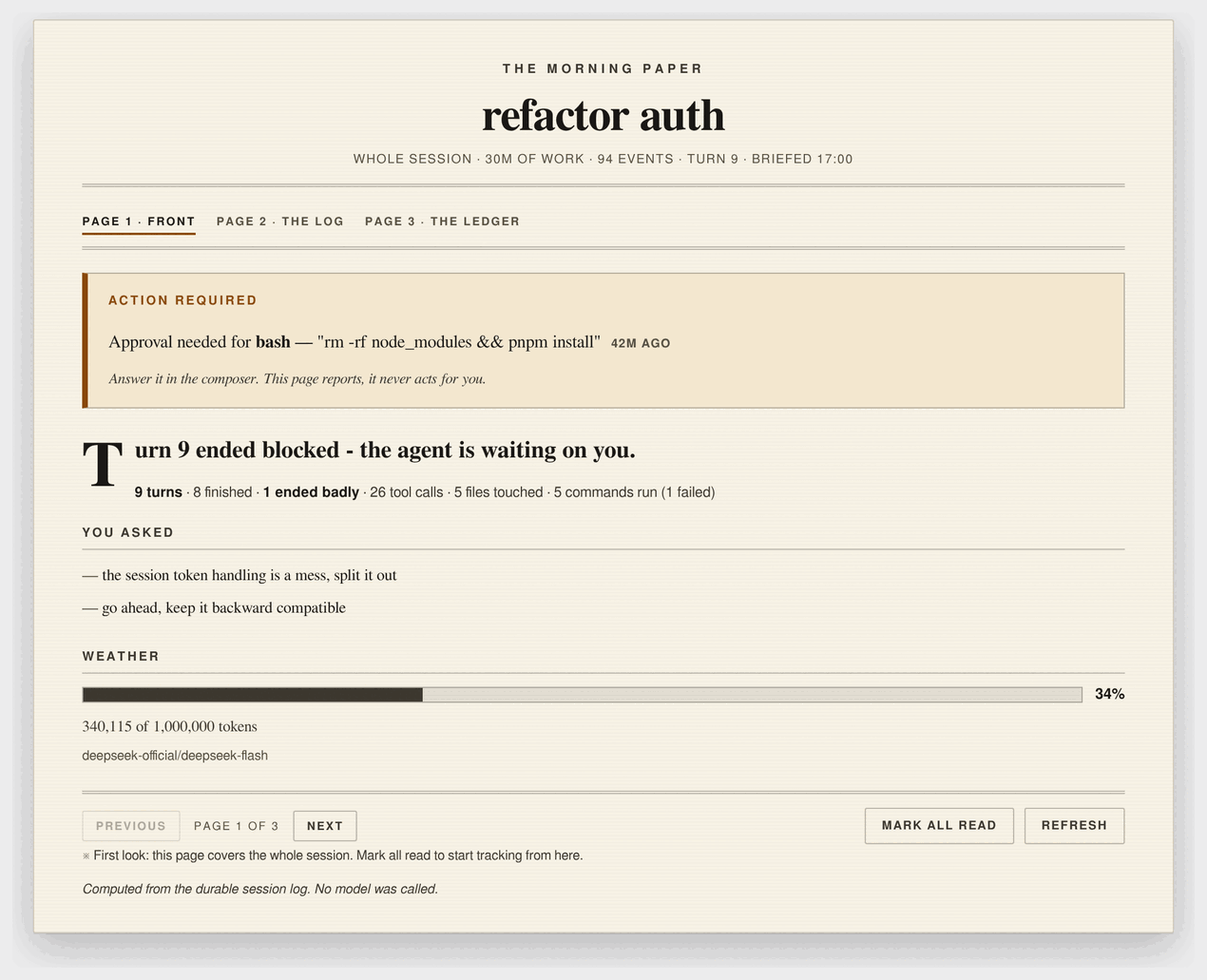
Page 1 · Front — the bulletin, a one-line outcome instead of a quoted reply, the
activity summary, what you asked, and the context gauge. The lead says
Turn 9 ended blocked - the agent is waiting on you, which is the whole point of
opening this tab.
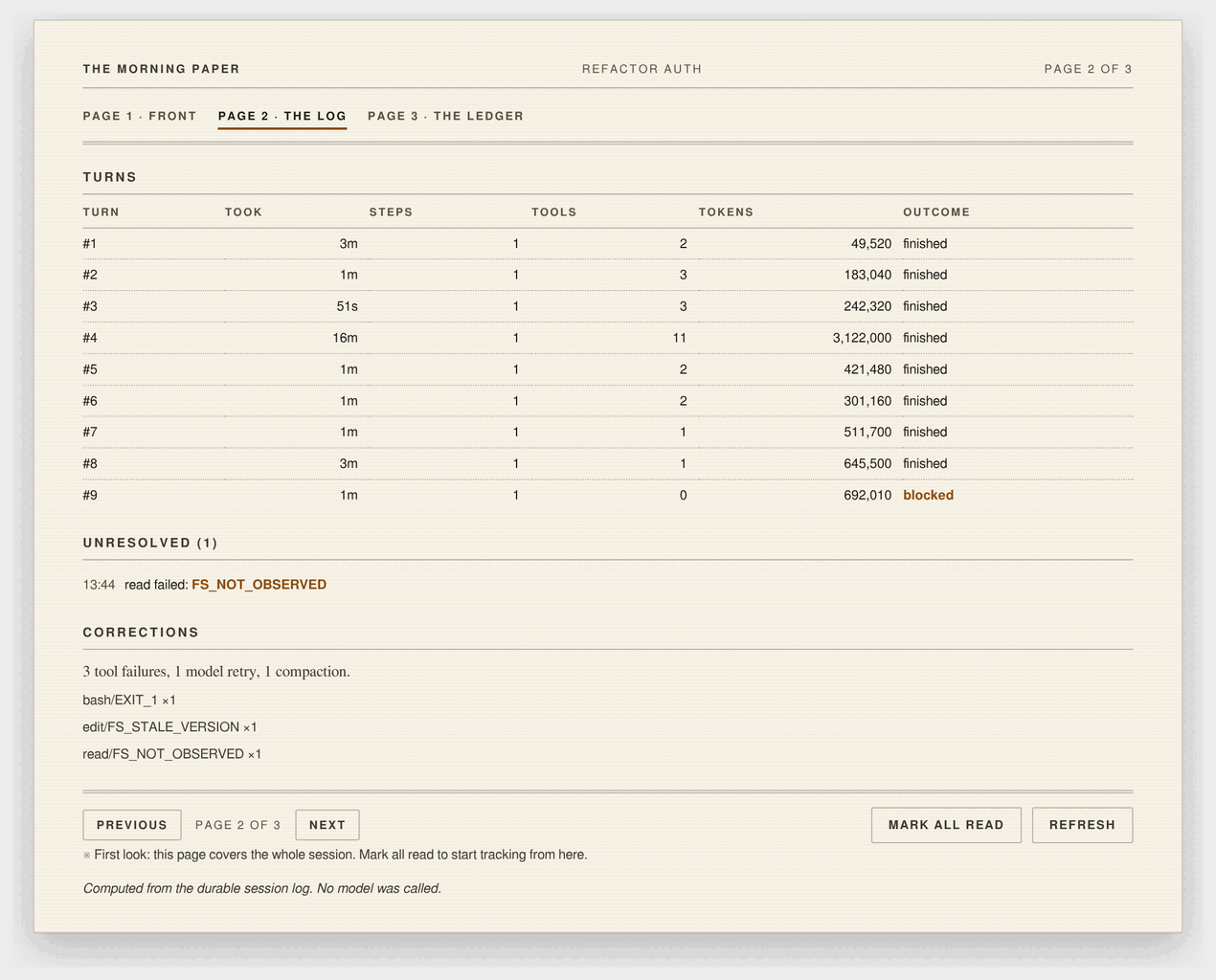
Page 2 · The Log — the timeline that shows a single turn taking 16 minutes and 3.1M tokens, the failures nobody retried with the command that failed, and the corrections line.
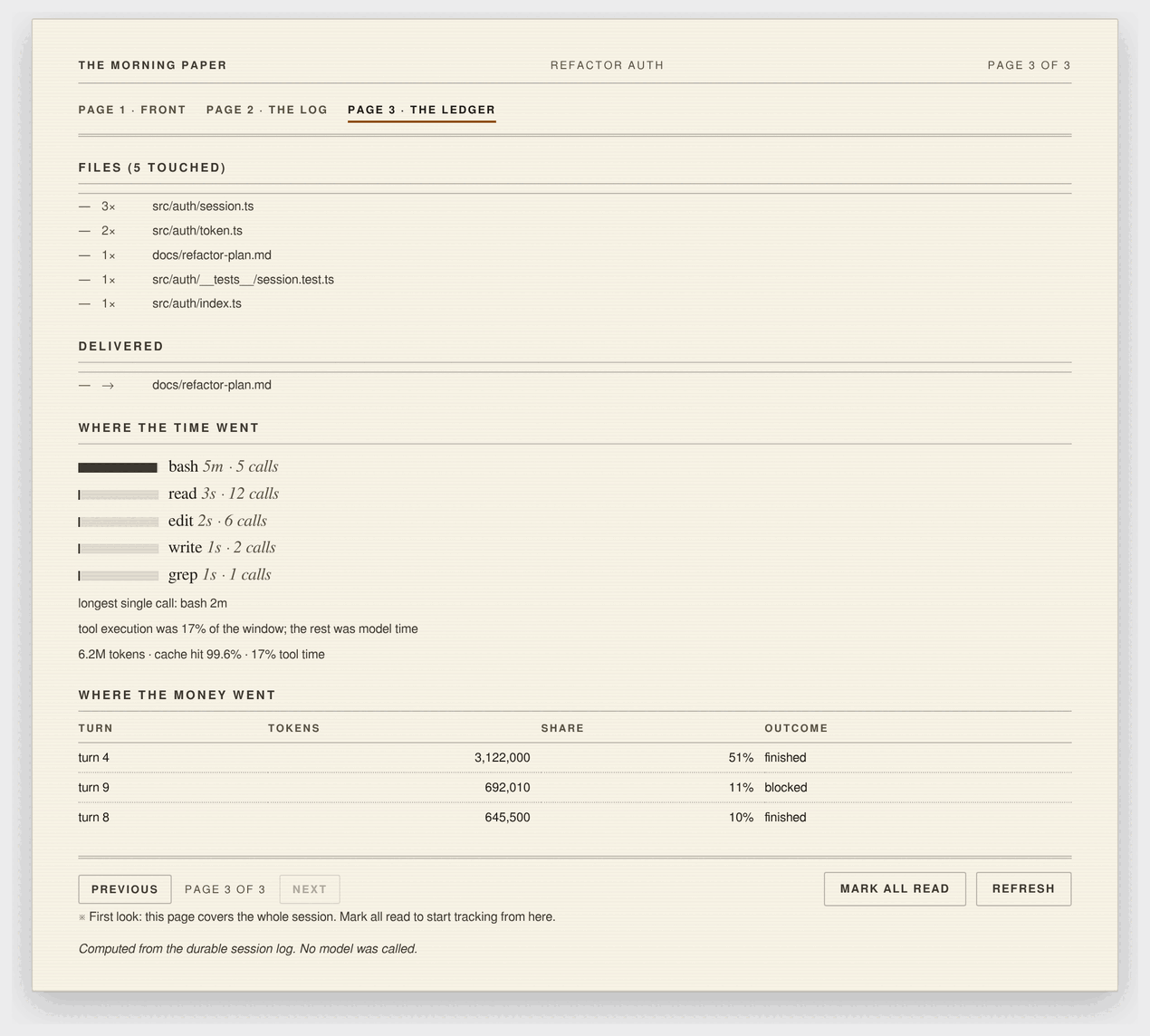
Page 3 · The Ledger — file churn counted per file, what was delivered, where the wall clock went (and how little of it was tool execution), and which turns ate the spend.
Screenshots are generated by node tools/screenshot.mjs from the shipped
stylesheet and render tree, so they cannot drift from the code.
/briefing prints the same document as one continuous column, because a
transcript cannot be flipped. Pagination is presentation, not data, so the text
rendering and the tab share one computed briefing.
Why it is trustworthy
The briefing is computed, never generated. Zero tokens, no hallucination,
byte-identical for the same log and clock. If you want prose about a session,
/briefing plus the agent can produce it — this plugin deliberately does not.
It never enters your context. The page is derived state. Nothing here calls
inject(), appends a session event, or sends anything to a model. The one path
that touches the transcript is the /briefing command, which you invoke. The
selftest asserts this.
Two scope rules
A front page answers two different questions, so two different reads:
| Question | Source |
|---|---|
| What happened while I was away? | only events after the seq your browser last showed you |
| What needs me right now? | the whole log — an approval asked before you left is still waiting, and a turn that ended blocked an hour ago is still blocked |
Fork-inherited events are excluded from the "what happened" counts and named in
a notes line. If you forked a session, its inherited prefix did not happen
here; readSession reports the exact prefix length, so the page cannot inflate
your agent's work with someone else's.
Install
dsh plugin --profile web add -w dsh-morning-paper
# restart dsh web, then reload the page
From a checkout, if you are working on the plugin itself:
git clone https://github.com/damlys99/dsh-morning-paper
dsh plugin --profile web add -w link:/absolute/path/to/dsh-morning-paper
Requires DSH >=0.1.2-alpha.1 <0.2.0-0. The row is added to the profile
automatically; a restart is required because both the host module and the client
bundle are composed at boot, and patchReload: live only watches patch files.
Uninstall:
dsh plugin --profile web remove dsh-morning-paper
The context ceiling
WEATHER is a gauge: a filled bar, the percentage beside it, the raw figures, and
the route it measured — because a percentage buried in a sentence is the one
thing you cannot read at a glance. It compares the session's current request
pressure against the routed model's own declared capacity. DeepSeek's adapter declares one — every model in
its catalog carries a contextWindow, 1,000,000 tokens on the current routes —
and the plugin reads it through ctx.llm.resolveModelInfo(), the same call
automatic compaction uses to decide when to compact. So the percentage is the
number DSH itself is working from, not an estimate.
The route is read from the newest request/header event in the log rather than
from the agent's options, because a session on the default model never sets a
provider explicitly, and the ceiling belongs to the route that actually ran.
A plugin-config ceiling is a fallback for adapters that declare nothing:
# ~/.dsh/profiles/web/cordis.patch.yml
- id: morning-paper
  config:
    contextWindow: 128000
A model-declared capacity always wins over it, and a configured one is labelled wherever it is shown because it is an assumption rather than a fact. An invalid value is ignored. With neither, the page reports the token count and says the ceiling is unknown rather than inventing a percentage.
The command
/briefing                 # the whole session, as text in the transcript
/briefing --since 812     # only what happened after seq 812
What reads what
| Need | Seam |
|---|---|
| The log | ctx.sessionQuery.readSession() — concrete, so no search backend is required |
| The log tail | ctx.sessionQuery.listEvents() — metadata only; the cheap half of the auto-refresh poll |
| The title | ctx.sessionQuery.readTitle() |
| Pending approvals | durable approval/asked minus approval/decided — survives a host restart |
| Turn outcome | turn/end reasons: completed, blocked, error, aborted, max-tokens, interrupted |
| Failures, retries, compactions | tool/result.error, llm/retry*, compaction/* |
| Cost | assistant/message.usage — disjoint input / cache-read / cache-write / output buckets |
| Context pressure | ctx.tokenMeter.measure() + ctx.llm.resolveModel() for the model's declared window |
| Pending questions | the live user-questions/request waterfall (in memory only — see limits) |
| The route | ctx.webServer.register({ kind: 'exact', path: '/morning-paper' }) |
| The page | conversation.view, one tab labelled Morning Paper, next to Chat and Trajectory. No DOM decoration, no MutationObserver |
Optional services (agents, tokenMeter, llm, commands) are resolved with
ctx.get at use time. A composition without them still mounts and still serves
the durable half of the page; a headless profile loses only the weather line.
Refusals
Every guard runs before any work, so a refused request changes nothing.
| Code | Status | When |
|---|---|---|
BAD_REQUEST |
400 | Missing or malformed sessionId / sinceSeq / format |
SESSION_NOT_FOUND |
404 | No live or persisted session with that id |
MARKER_AHEAD |
409 | Your reading marker is past the log tail. The browser forgets the marker and shows the whole session rather than a stale page |
LOG_TOO_LARGE |
413 | Above 20,000 events, which is more than this plugin will read in one request |
SUBAGENT_OWNED |
409 | A subagent session's briefing belongs to its parent |
BRIEFING_FAILED |
502 | The log could not be read |
Deliberate limits
- Pending questions are live-only.
dsh-user-questionsdeclares no durable session event, so a pending question cannot be found in a cold log after a host restart. The watermark is set when the waterfall opens and cleared when it settles, so it can never nag about a question you already answered — but it is also absent after a restart. Approvals have no such limitation. - No full-text search.
dsh-session-query-sqliteships mounted withopenAt: never, so this plugin uses only the concrete reads and depends on no search backend. - Windows are truncated, not refused. Above 5,000 new events the page summarises the newest 5,000 and says so in a note.
readSessionclones the whole log. That is the ceiling that producesLOG_TOO_LARGE; if it bites on real sessions, the fallback is a tail read of the JSONL, which would couple this plugin to the on-disk format.
Page behaviour
- A first visit shows the whole session. A page that greets you with silence
reads as broken, so the first render is the full history and the small print
says so.
Mark all readstarts the tracking window from that point. - After that, the window is yours. The dateline reads
since 18:12 · away 3h 12mand covers only what happened since you last read it; a whole-session read sayswhole session · 45m of workand never claims an away duration it did not measure. - It refreshes itself. A turn that just ended is read a beat after the run state flips; while the agent is working the tab polls every 5s, every 20s when idle, and immediately when you come back to it. The recurring poll asks the host for the log tail only — the expensive log read happens only when the tail actually moved — and nothing is polled while the tab is in the background.
Mark all readnever blanks the page. It advances the reading marker and leaves what you just read on screen, with a line saying when you marked it; the next new events appear on the following refresh. The previous behaviour — clearing the page on the click — read as "my paper just vanished".Show whole sessionforgets the marker to re-read everything.- The footer is one row, like a paper's folio line: page navigation on the left, the read/refresh controls on the right, with the small print beneath it. A single-sheet paper shows no navigation at all.
- A quiet session still renders a page saying there is no news, rather than an empty tab that looks broken.
- It never acts for you. An approval item tells you what is waiting and where to answer it; the page does not re-implement the approval surface.
- The palette is fixed, not themed. A newspaper is cream paper with dark ink
in every theme, so the sheet and the ink are literal values rather than theme
tokens. Every text tier is contrast-checked in the selftest: body ink 15.7:1,
secondary 10.4:1, the faint tier 7.2:1 on the sheet, and the accent
heading 5.6:1 on the bulletin tint.
This is a deliberate correction: the first version mixed the sheet from
--dsw-alias-*variables whose names I had guessed, and--dsw-alias-bg-elevated/--dsw-alias-border-secondarydo not exist, so the sheet fell back to cream while the label token resolved light — unreadable. The selftest now fails if the palette ever depends on a theme token again.
Tests
node selftest.mjs         # 131 assertions, no network, no browser, no build
node verify-real-log.mjs  # build briefings from the session logs on this machine
node tools/screenshot.mjs # regenerate the images on this page (repo tool)
tools/screenshot.mjs renders the three pages with the shipped PAPER_CSS and
paperTree, photographs them with headless chromium, and rewrites
screenshots.json. It needs a chromium binary and ImageMagick, so it is a repo
tool rather than runtime code, and it is excluded from the published package.
selftest.mjs covers the pure core, every refusal, the request decoder, the HTTP
surface, the live watermark, the command, the text renderer, and the real
client bundle evaluated in a node:vm sandbox — including its render tree,
built with a test element factory, and the stylesheet, so page content and
styling are covered without React.
verify-real-log.mjs reads the logs DSH actually wrote under
$DSH_HOME/sessions/ and builds a briefing from each, checking determinism,
non-mutation and renderability on real event payloads. It is a dev tool: session
logs are concatenated zstd frames, so it shells out to the zstd CLI, which the
plugin itself never does — the plugin reads through ctx.sessionQuery.
Real-log verification has already earned its keep twice:
- it caught the page emitting a non-ASCII truncation marker and unsanitized model text, so quoted content is now stripped of control characters and clipped with an ASCII marker;
- it caught the tool-call id being read from the wrong place. The id lives at
tool/result.message.source.callId; without it there was no pairing, no per-tool timing, no command counting, and failure groups had no tool name. The entire Where the time went section exists because real data found that.
Caveats
- The route discloses session content to any caller on the loopback
interface.
GET /morning-paper?sessionId=…returns a session title, file paths, failing commands, failure codes and token counts without the GUI's session cookie — the same posture as the rest of the plugin HTTP surface, but the payload here is conversation content, so it is worth stating plainly. Session ids are unguessable UUIDs, the response is derived and capped, and a cross-site browser request is blocked because the response carries no CORS headers. If you bind this port beyond loopback, treat the whole plugin HTTP surface as trusted-network-only, not just this plugin. - The page is a
conversation.viewentry. That slot id and itslabeloption are published contracts indocs/subsystems/slots.md, not private markup — unlike a DOM-decorating plugin, a restructured composer or dock cannot break this one. - The stylesheet is injected, not bundled. One
<style>element with admp-class prefix is appended todocument.headon first render. There is no CSS file and no build step, so there is no CSS-module contract to depend on. - Verified against DSH
0.1.5-rc.1contracts, in a browser-less harness and against real session logs, and then used in a live browser — that pass is what produced the footer, read-state and dateline corrections above. - Published as
dsh-morning-paper. The images ship inside the tarball so npm's README render resolves them.
License
MIT
链接
同类插件
zhu1090093659/dsh-web#packages/dsh-task-board★ 8405
侧边栏多列任务看板:卡片交给真实 DSH 智能体会话执行,支持 cron 定时(Host 侧到点执行,关浏览器也生效)。
zhu1090093659/dsh-web#packages/dsh-web-all★ 8405
DSH Web UI 插件与皮肤合集:任务看板、git 图、右侧面板、远程移动端 UI、桌宠、实时 token 统计与皮肤中心。
ccch1mneyyy/dsh-TUI★ 4088
Claude Code 风格全屏终端 UI:像素鲸鱼顶栏、实时工作状态行、思考流式展开。
MeteorNOX/DeepSeek-Balance-Whale-Widget★ 4076
右下角常驻的小鲸鱼挂件:余额、今日已用与每轮对话消耗(含峰谷价),余额预警与今日预算的泡泡内容都可编辑;泡泡点击序列模块化自定义,支持并列加权 A/B、随机台词与随机图片;内置 30+ 厂商模板(OpenAI / OpenRouter / Kimi / 硅基流动 / 方舟 / 智谱 / MiniMax 等),按模型查余额与订阅额度;另有任务结束音效、导入音频、自定义角色与资源管理。数据全在本机,无遥测。
omdsh-dev/DSH-better-sidebar★ 4009
侧边栏完整工作台:内置文件渲染编辑、终端、Git 与子代理,支持三方插件注册新 Tab。
Devin-AXIS/deepseek-design#deepseek-idesign★ 1423
可视化设计工作室,支持网站、App 原型、海报、信息卡、报告和杂志的模板创建、元素编辑、选区级 AI 草稿衔接与导出。
社区评论
评论公开保存在 GitHub Discussions。加载评论会连接 GitHub 和 Giscus;发表内容需要 GitHub 账号。