Local-first persistent memory for DeepSeek Harness: bounded pre-step hot-memory injection, exact and Chinese-bigram BM25 cold recall, six agent tools, approval-gated lease-lock writes with recovery receipts, and read-only governance and trajectory-review candidates.
Install
# from npm (prebuilt)
dsh plugin --profile web add @zhujunpeng12/dsh-memory-system
# from a prebuilt release tarball
dsh plugin --profile web add "https://github.com/zhujunpeng12/dsh-memory-system/releases/download/v0.1.1/zhujunpeng12-dsh-memory-system-0.1.1.tgz"
# from GitHub (first run asks for allowBuilds approval — follow the hint, retry)
dsh plugin --profile web add github:zhujunpeng12/dsh-memory-system
Any plugin you install runs third-party code with your own permissions — it can read your files, use your credentials, and reach the network, and tool approvals don’t sandbox it. GitHub-sourced plugins also run build scripts at install time — pnpm blocks those until you allow them, so an install can stop with ERR_PNPM_GIT_DEP_PREPARE_NOT_ALLOWED or ERR_PNPM_IGNORED_BUILDS; dsh prints the exact key to add under allowBuilds in your profile’s pnpm-workspace.yaml, and the install works on the next run. Allowing a build is a trust decision: only install sources you trust, and pin a commit (github:owner/repo#sha).
README
dsh-memory-system
Give DeepSeek Harness cross-session memory while keeping every fact in local Markdown.

中文 · How it works · Safety boundaries · Contributing
This is not another opaque vector store. It injects a bounded hot packet at session start, opens historical details only through explainable Chinese-aware BM25 recall, and previews every write before a lease-locked recoverable transaction. The default store is ~/.dsh-memory/; Obsidian, a database, vector service, and external APIs are all optional—not requirements.
Privacy boundary: this repository ships mechanisms, never personal data. Profiles, rules, events, and project notes remain on your machine. Set
MEMORY_VAULTonly when you want to use your own Obsidian Vault.
Install in 30 seconds
Prerequisites: DeepSeek Harness 0.1.0-rc.7, Node.js 22/24, and Python 3.10+.
npx @deepseek-ai/dsh plugin --profile web add github:zhujunpeng12/dsh-memory-system
Restart Harness, then ask the agent to run memory_gate in a new session. A healthy install returns the gate result and injects [vault-bootstrap]; the first run creates the ~/.dsh-memory/ skeleton automatically.
For Cannot find package, ctx.agents, Python, or missing-bootstrap errors, see Installation troubleshooting.
Install github:zhujunpeng12/dsh-memory-system into the DeepSeek Harness web profile, restart it, run memory_gate, and verify that a new session receives [vault-bootstrap]. Do not read or upload any private memory content.
Why this one
| What you care about | Design choice |
|---|---|
| Can I inspect my data? | Local Markdown is the source of truth; review it in any editor or Obsidian |
| Does Chinese recall work? | Exact + CJK bigram BM25 + title/path/project rerank, with sources and trace |
| Can the agent silently rewrite memory? | Writes are dry-run by default and require user confirmation |
| Can concurrent sessions corrupt files? | Single-writer lease, heartbeat, crash recovery, before-images, and receipts |
| Do I need a model/database service? | No background LLM, vector service, or database is required |
| Will memory consume the whole context? | Hot packet ≤14KB, cold packet ≤4.2KB, details on demand |
Best for: individuals and small teams that value auditability, local ownership, Chinese recall, and safe writes.
Not for: server-side multi-tenancy, high-frequency multi-writer workloads, vector-first semantic retrieval, or fully autonomous unapproved memory writes.
Why
Agent sessions are amnesic by default. This system turns "memory" into an engineering loop with six layers:
- Hot-memory bootstrap — one ≤14KB packet injected per new session (gate status + instruction budget + user profile + active core rules + project summary + recent event headings)
- Working path — follow global/project
AGENTS.mdrules to complete tasks - Cold recall — two-gate trigger (history reference + concrete topic), exact + Chinese bigram BM25 + metadata rerank, ≤4.2KB packet, vector retrieval off by default (zero deps)
- Authorized writes — lease lock (30s lease / 5s heartbeat / stale-lock recovery) + multi-file transactions (before-image / SHA-256 precondition / manifest / receipt); raw entries are append-only; corrections require
supersedes - Slow governance —
govern.pyread-only scan for duplicates, conflicts, staleness, size, rule lifecycle; never writes - Trajectory review — read-only scan of session traces using user corrections as the hard signal
Highlights
| Capability | Description |
|---|---|
| Write safety | Single-writer lease lock + recoverable transactions, atomic multi-file changes, append-only raw |
| Chinese recall | Bigram BM25 + exact/title/path match + metadata rerank, fully explainable trace |
| Byte budgets | 14KB hot / 4.2KB cold hard budgets, UTF-8-safe clipping |
| Read-only governance | L0-L3 boundaries; collects evidence, never auto-deletes |
| Local-first | Zero database / vector service / external service; Python stdlib + Markdown (DSH plugin host, JS/TS wrapper build) |
System architecture (six-layer closed loop)
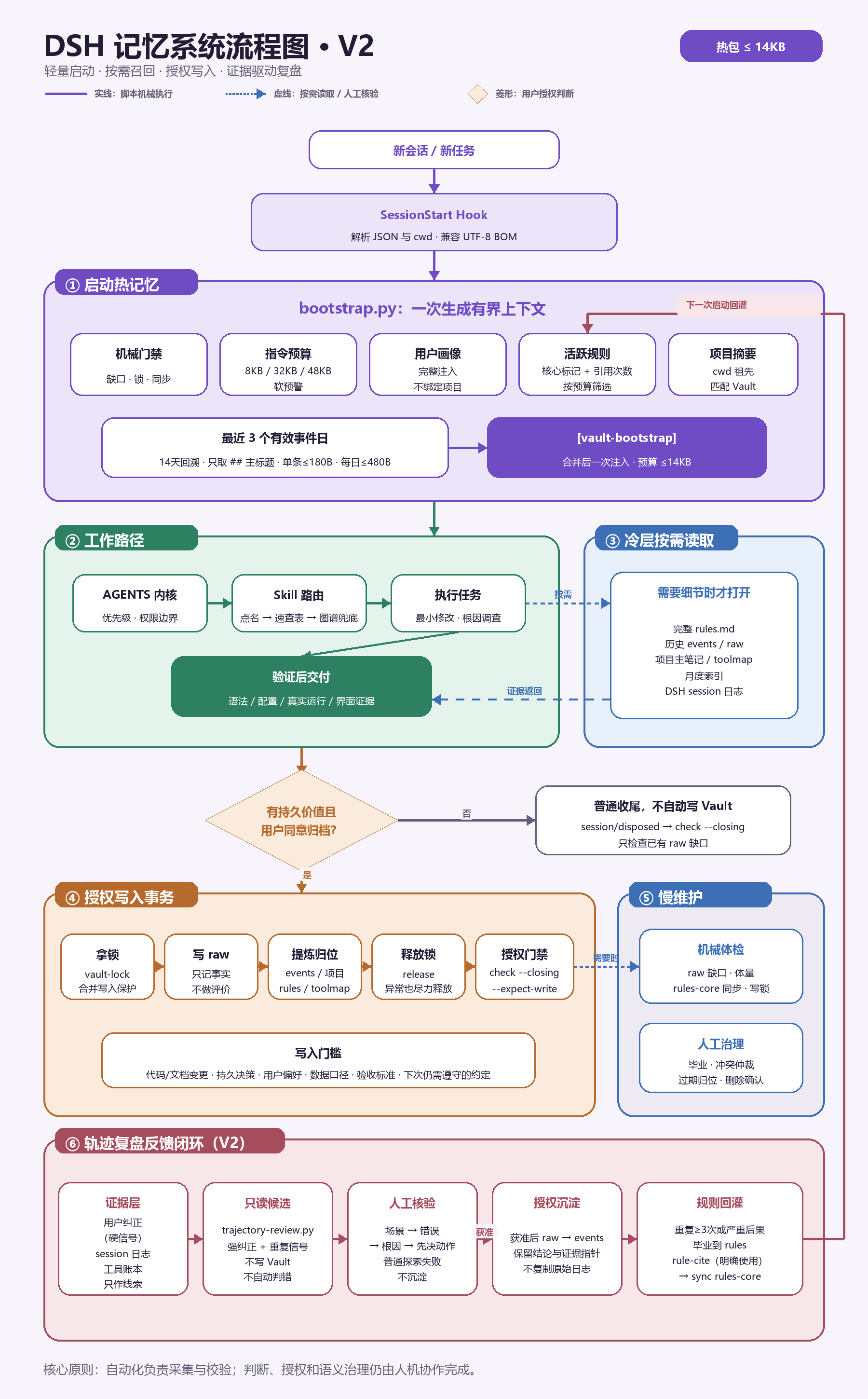
Maintainable source: HTML/CSS V3 diagram.
flowchart TD
    Start([New session / task]) --> Bundle["@zhujunpeng12/dsh-memory-system<br/>scoped bundle · inject tools + agents"]
    Bundle --> Roots[Register 6 tools per root agent<br/>bootstrap · recall · gate · govern · trajectory · write]

    subgraph L1[① Native hot-memory startup]
      Roots --> Pre[First agent/pre-step · session-id dedupe]
      Pre --> Boot[bootstrap.py<br/>section budgets · UTF-8-safe clipping · fail-open]
      Boot --> Hot["[vault-bootstrap] · one inject ≤14KB"]
      Boot --> HotParts[gate · instruction budget · user profile<br/>active rules · cwd project · 3 recent active event days]
    end

    subgraph L2[② Working path]
      Hot --> Work[AGENTS core → skill routing → minimal/root-cause work]
      Work --> Deliver[Verified delivery<br/>syntax · config · real run · UI evidence]
    end

    subgraph L3[③ On-demand cold recall]
      Work -.history/correction signal + concrete topic.-> Recall[exact + Chinese bigram BM25<br/>title/path match]
      Recall --> Rerank[metadata rerank · dedupe · per-file quota]
      Rerank --> Cold[source-cited packet + trace ≤4.2KB]
      Cold -.evidence back.-> Work
    end

    Deliver --> Decision{Persistent value and<br/>explicit archive approval?}
    Decision -->|no| Close[Plain closing · no auto write<br/>memory_gate closing=true]

    subgraph L4[④ Authorized write transaction]
      Decision -->|yes| Preview[memory_write dry-run preview]
      Preview --> Approve[tools/pre-execute human approval]
      Approve --> Lock[30s single-writer lease · 5s heartbeat]
      Lock --> Tx[lock-scoped reread · SHA precondition<br/>before-image + manifest]
      Tx --> SafeWrite[raw EOF append / non-raw replace]
      SafeWrite --> Receipt[validate · receipt · release<br/>rollback / recover on next writer]
    end

    subgraph L5[⑤ Slow maintenance and governance]
      Receipt --> Gate[memory_gate mechanical health]
      Gate --> Govern[memory_govern read-only candidates<br/>duplicate/conflict/stale/size/lifecycle]
      Govern --> Human[human promotion · arbitration · archive · delete approval]
    end

    subgraph L6[⑥ Trajectory-review feedback loop]
      Work -.session trace.-> Evidence[user correction = hard signal<br/>session log + tool ledger as clues]
      Evidence --> Review[memory_trajectory_review<br/>scenario → error → root cause → precondition]
      Review --> Verify{Human verification}
      Verify -->|ordinary exploration| Skip[No distillation]
      Verify -->|approved| Distill[events / rules<br/>keep conclusion + evidence pointer]
      Verify -->|stable pattern ≥3x| Graduate[graduate into rules-core]
    end

    Human --> Distill
    Distill --> Next[next session reselects under byte budgets]
    Graduate --> Next
    Next --> Pre
Legend: solid = scripted execution; dashed = on-demand read / human review; diamond = user authorization decision. The feedback loop distills rules and events back into the next session's hot memory.
Install as a DSH plugin (recommended, one command)
The plugin form registers memory capabilities directly as agent tools:
# Install straight from GitHub (no manual env/hooks/vault setup)
npx @deepseek-ai/dsh plugin --profile web add github:zhujunpeng12/dsh-memory-system

# or local development:
npm pack && npx @deepseek-ai/dsh plugin --profile web add ./zhujunpeng12-dsh-memory-system-0.1.1.tgz
Restart the Harness. The agent gains 6 tools, and every new session gets the hot-memory packet injected automatically (native pre-step listener in index.js — zero manual hooks configuration; disable with DSH_MEMORY_AUTO_INJECT=false):
| Tool | Purpose | Writes |
|---|---|---|
memory_bootstrap |
≤14KB hot-memory packet | read-only |
memory_recall |
cold recall (exact + Chinese BM25) | read-only |
memory_gate |
mechanical gate checks | read-only |
memory_govern |
governance candidate scan | read-only |
memory_trajectory_review |
trajectory review candidates (user corrections = hard signal) | read-only |
memory_write |
authorized transactional write (dry-run default) | confirmed |
memory_write only previews by default; it applies only with apply=true after explicit user confirmation (enforced via the tools/pre-execute hook). All tools locate your vault via MEMORY_VAULT / DSH_HOME.
Trajectory review evidence layer (optional companion): memory_trajectory_review reads the tool-call ledger (${DSH_HOME}/storages/tool-telemetry.json). Install the companion plugin plugins/evidence-ledger/ (zero inject) to accumulate per-session tool calls and errors automatically. Without it, the review still scans session logs for user-correction signals.
Optional manual hooks (standalone script usage only): see
hooks.example.jsonto attachhook-first-prompt.pytoUserPromptSubmit. The plugin form injects automatically — this step is not needed.
Six layers in detail (what each layer does)
① Hot-memory bootstrap — one bounded context per session
What: at session start, compress "what the agent most needs to know right now" into one ≤14KB packet and inject it once. No full-vault reads to get started.
Contents: mechanical gate status (gaps/lock/sync), instruction-budget audit, user profile, active core rules (star + citation filtered), current project summary (cwd-ancestor match), recent event headings (14-day lookback, ≤180B each).
How: memory_bootstrap tool, or python vault-guard/bootstrap.py --cwd <dir> --max-bytes 14000. The recommended plugin uses native agent/pre-step on the first turn of every session; manual hooks are only for standalone compatibility.
② Working path — rules-driven execution (methodology, no script)
What: how the agent works, not a script: priority & permission boundaries (system/user > project AGENTS.md > global rules > cold docs), skill routing (named → index table → graph fallback), minimal edits, root-cause investigation, verified delivery (syntax/config/real-run/UI evidence).
Why no script: this layer is behavioral policy carried by AGENTS.md. The repo ships templates/ with example rules as a starting point.
③ Cold layer on demand — open details only when needed
What: when a task needs evidence or details, cold recall opens full sources (complete rules, historical events/raw, project notes, monthly index, session logs).
Trigger: two gates — a recall signal (history/last time/correction) and a concrete searchable topic, both required. Plain acknowledgements or meta-only follow-ups do not open cold memory.
How: memory_recall tool, or python vault-guard/recall.py --query "<q>" --cwd <dir> --force. Exact + Chinese bigram BM25 + metadata rerank, ≤4.2KB packet with sources and trace.
④ Authorized writes — write only when persistent value + user consent
What: only "substantive output" (code/doc changes, persistent decisions, user preferences, data conventions, acceptance criteria, standing agreements) with explicit user consent goes through the transactional writer: acquire lease lock → append raw (facts only) → distill into events/projects/rules → release lock.
Safety: 30s lease + 5s heartbeat single-writer lock; before-image + SHA-256 precondition + manifest + receipt multi-file transactions; raw append-only (corrections require supersedes); dry-run by default; tools/pre-execute confirmation enforced.
How: memory_write tool (op=raw/replace/recover, applies only with apply=true).
⑤ Slow maintenance — mechanical health checks + human governance
What: periodically (or when the vault feels unhealthy): mechanical checks (raw gaps, size limits, rules-core sync, lock state) and human governance (rule graduation, conflict arbitration, expiry archiving, deletion confirmation).
Boundary: govern.py collects evidence and suggestions only (duplicates/conflicts/staleness/size/lifecycle candidates), never auto-deletes. Promotion/archive/deletion always requires a human.
How: memory_govern tool, or python vault-guard/govern.py --json --max-items 100. Pair with check.py closing gates (--closing / --closing --expect-write).
⑥ Trajectory review — evidence-driven quality feedback loop
What: at wrap-up, scan the session trace for three kinds of items: errors (user corrections = hard signal; AI self-review is self-serving), repeated tool errors (only when frequent), and reusable lessons. Output candidates in the four-field template: scenario → error → root cause → precondition.
Four required parts (a review is incomplete without all four): ① ledger review (quantitative first — per-tool call counts / error rates / weighted cost from tool-telemetry.json, diffed against the previous snapshot); ② error review (qualitative — user corrections as hard signal / errors / reusable lessons, four-field template); ③ improvement plan + dispatch question; ④ session temp-file cleanup.
Dual-scope ledger snapshot: snapshots must record both global and per-workspace scopes — the workspace scope must include its unknown share; an abnormally high unknown share signals broken attribution, in which case fall back to the global scope for comparisons.
Evidence: user-correction signals from session logs + the tool-call ledger from the evidence-ledger plugin (which tools fail most). The ledger is a clue, never an automatic verdict.
Loop: review produces candidates → propose a plan to lower tool error rates → dispatch the fix (single task → independent sub-agent; multiple improvements → a multi-agent team split by role, using the dependency triple-check / file ownership / accept-on-delivery discipline) → after the fixes land, distill the session trace into events; if the user says "next time", skip the fix and distill directly. After human review, ordinary exploration failures are not distilled; patterns repeating ≥3 times graduate into rules-core — rules and events feed back into the next session's hot memory.
How: memory_trajectory_review tool, or python vault-guard/trajectory-review.py --cwd <dir>. Install plugins/evidence-ledger/ for ledger data.
Quick start (3 steps, works out of the box)
1. Install
npx @deepseek-ai/dsh plugin --profile web add github:zhujunpeng12/dsh-memory-system
Restart the Harness.
2. First run auto-initializes (no manual setup)
The first session automatically:
- creates the memory skeleton at
~/.dsh-memory/(memory/{events,index}+projects/+ emptyuser_profile.md/rules.md), printing已初始化记忆库于 ...; - injects the hot-memory packet on the first prompt (profile/rules/project summary/recent events) — usable memory from the very first session.
No Obsidian needed. The vault is a plain local directory (Python stdlib + Markdown, zero external deps).
3. Verify
Ask the agent to run memory_gate (mechanical gate checks) to confirm the pipeline. Afterwards every session carries the hot packet automatically; memory_recall is used on demand for details.
Vault mode (optional)
To use Obsidian for visualization, point MEMORY_VAULT at your vault and restart:
| Variable | Default | Meaning |
|---|---|---|
MEMORY_VAULT |
~/.dsh-memory |
Vault root (must contain memory/ and projects/) |
DSH_HOME |
~/.dsh |
DSH home (hooks config, storages) |
$env:MEMORY_VAULT = "C:\Users\you\Documents\Obsidian Vault"
Copy the templates/vault/ skeleton into your vault (see templates/README.md).
Standalone script usage (without the plugin)
python vault-guard/bootstrap.py --cwd /path/to/project --max-bytes 14000   # hot packet
python vault-guard/recall.py --query "continue the previous X" --cwd /path/to/project --force  # cold recall
Repository layout
├── index.js                    # DSH host plugin: 6 memory tools + hot-packet auto-inject + write guard
├── package.json                # npm package (dsh-memory-system)
├── dsh.plugin.json             # DSH plugin manifest
├── cordis.patch.yml            # DSH bundle patch
├── vault-guard/                # Python core (bootstrap/recall/gate/govern/write/...)
├── templates/                  # sanitized memory-vault skeleton
├── hooks.example.json          # DSH hooks example
├── .env.example
└── LICENSE                     # MIT
Run tests
# Python engine tests
cd vault-guard && python -m unittest discover -p "test_*.py" -v

# JS contract tests (tool args → CLI argv mapping; run from repo root)
node --test test_plugin_bridge.test.mjs
# or everything at once (CI-equivalent):
npm run check
All tests use temporary directories; they never touch a real vault.
Known limitations (expectation management)
memory_writeis dry-run by default: nothing is written unlessapply=trueis explicitly set and the user confirms. "The agent said it remembered" does not mean it was persisted — verify withmemory_gateor by checking the events files.- Cold recall is BM25 keyword retrieval, not semantic vectors: best for exact/near-exact matches (proper nouns, code, dates, concrete topics); weak on paraphrases, long-tail phrasing, and cross-language recall. Vector retrieval is off by default (the cost of zero dependencies).
- Single-writer lease lock: only one writer at a time per memory vault; concurrent multi-agent writes serialize (queue for the lock). Not suited for many agents writing the same vault at high frequency — split vaults or stagger writes.
- Project isolation is cwd-ancestor matching only, no git-branch awareness: different git branches of the same directory share the same memory; branch-specific memory is not separated. Branch-level isolation is on the roadmap (below).
- Hot packet is injected once per session: mid-session memory writes do not auto-refresh the current session's packet; call
memory_recall/memory_bootstrapexplicitly when needed. - The quantitative dimension of trajectory review depends on the companion plugin: without
plugins/evidence-ledger/, the review scans session logs for user-correction signals (qualitative) only — no tool-ledger data.
Roadmap
- Git-branch awareness: memory bound to "only effective on a given branch" (aligning with dsh-memory-evolve's branch isolation)
- Semantic recall as an optional channel (keeping zero-dependency BM25 as default)
- Multi-writer concurrency improvements (the single-writer lock is a correctness-first design choice today)
Methodology (the philosophy)
- Single source of truth: one fact, one home (runtime params → AGENTS.md; decisions → project notes; daily flow → events; cross-project lessons → rules). Everywhere else holds pointers only.
- Write authorization: preview first,
--applyonly with explicit consent; raw append-only; corrections viasupersedes. - Governance is read-only:
govern.pycollects evidence and suggestions; promotion/archive/deletion always requires a human.
Contributing
See CONTRIBUTING.md. Security issues: see SECURITY.md.
License
MIT — see LICENSE. Copyright © 2026 zhujunpeng12.
Attribution
This project is created and maintained by zhujunpeng12. If it helps you — whether you use it in a product, build on it, or reference the six-layer memory loop in an article or talk — you are warmly invited to:
- Credit the project in your README, about page, or public material
- Tell the author how you use it via email 312076183@qq.com — it is genuinely appreciated to see it in real environments
MIT does not require any of this, but your acknowledgement is the most tangible return for open source.
Upstream acknowledgement: the "trajectory review → multi-agent dispatch" methodology in this repository builds on NanmiCoder/dsh-agent-teams (MIT) — a multi-agent team orchestration plugin for DeepSeek Harness. Enhancements practiced and distilled on top of it here: demand-brief gating (brief submission + panel confirmation + dispatch blocking), orchestration correction (editable dependencies / captain self-claim), captain protocol (progressive acceptance / dependency triple-check / file ownership / new-demand-as-task), and UI state machines (ripple phases / queued amber state). Thanks to the original author.
Disclaimer
- This repository contains no personal data; memory content stays on the user's machine.
- Review your vault layout, hooks wiring, and security boundaries before deploying.
Links
More in this category
vectorize-io/hindsight#coding-agents★ 45535
Hindsight, agent memory that learns: long-term project memory with auto recall and retain, knowledge pages, deep reflection, and per-repo memory banks.
volcengine/OpenViking#examples/dsh-memory-plugin★ 39213
OpenViking memory and context bundle for DeepSeek Harness: pre-step auto-recall and profile injection, session capture, `viking://` URI guarding, and recall/write memory tools backed by an OpenViking server.
agentscope-ai/ReMe#dsh★ 3551
Connects DeepSeek Harness to ReMe's local-first, self-evolving personal knowledge base: automatically captures completed main-agent conversations as user-owned Markdown memory, searches conversations and source material through reme_search with BM25, optional embeddings, and wikilink expansion, and schedules daily memory consolidation.
zilliztech/memsearch#MemSearch★ 2714
Shared Markdown memory for DSH and other coding agents, with automatic capture, pre-step context injection, searchable recall, and memory-to-skill self-evolution through a review panel.
vshulcz/deja-vu#extensions/dsh★ 1131
Reads the session files thirty-three other coding agents on this machine already wrote — Claude Code, Codex, Cursor, VS Code Copilot Chat, opencode, OpenClaw, Hermes, Kimi, Cline, Zed and more — including sessions from before it was installed: six tools (deja_recall, deja_session, deja_blame, deja_fix, deja_how, deja_remember), a /deja command, and optional automatic recall added to the runtime context. Local BM25 index, no LLM, no embeddings, no network (dsh plugin --profile web add dsh-deja).
adoresever/graph-memory★ 636
Traceable, searchable cross-session memory for DeepSeek Harness — conversation knowledge as typed graph nodes (TASK/SKILL/EVENT) and typed edges.
Community comments
Comments are public GitHub Discussions. Loading them connects to GitHub and Giscus; a GitHub account is required to post.