Adds an Auto Approve permission preset to the Web UI, using a fresh restricted Reviewer Agent to allow or deny each approval request.
Install
# from GitHub (first run asks for allowBuilds approval — follow the hint, retry)
dsh plugin --profile web add github:simon300000/dsh-auto
Any plugin you install runs third-party code with your own permissions — it can read your files, use your credentials, and reach the network, and tool approvals don’t sandbox it. GitHub-sourced plugins also run build scripts at install time — pnpm blocks those until you allow them, so an install can stop with ERR_PNPM_GIT_DEP_PREPARE_NOT_ALLOWED or ERR_PNPM_IGNORED_BUILDS; dsh prints the exact key to add under allowBuilds in your profile’s pnpm-workspace.yaml, and the install works on the next run. Allowing a build is a trust decision: only install sources you trust, and pin a commit (github:owner/repo#sha).
README
English | 中文
dsh-auto adds an Auto Approve permission preset to the DeepSeek Harness Web UI. Each action that requires approval is reviewed by a fresh, restricted DSH child Agent before the plugin allows or denies it.
The current release supports the Web UI only.
Screenshots
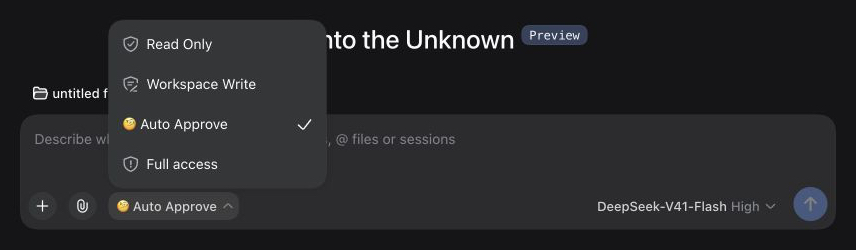
Select the 🧐 Auto Approve permission preset (DSH 0.1.5-rc.1, English UI):
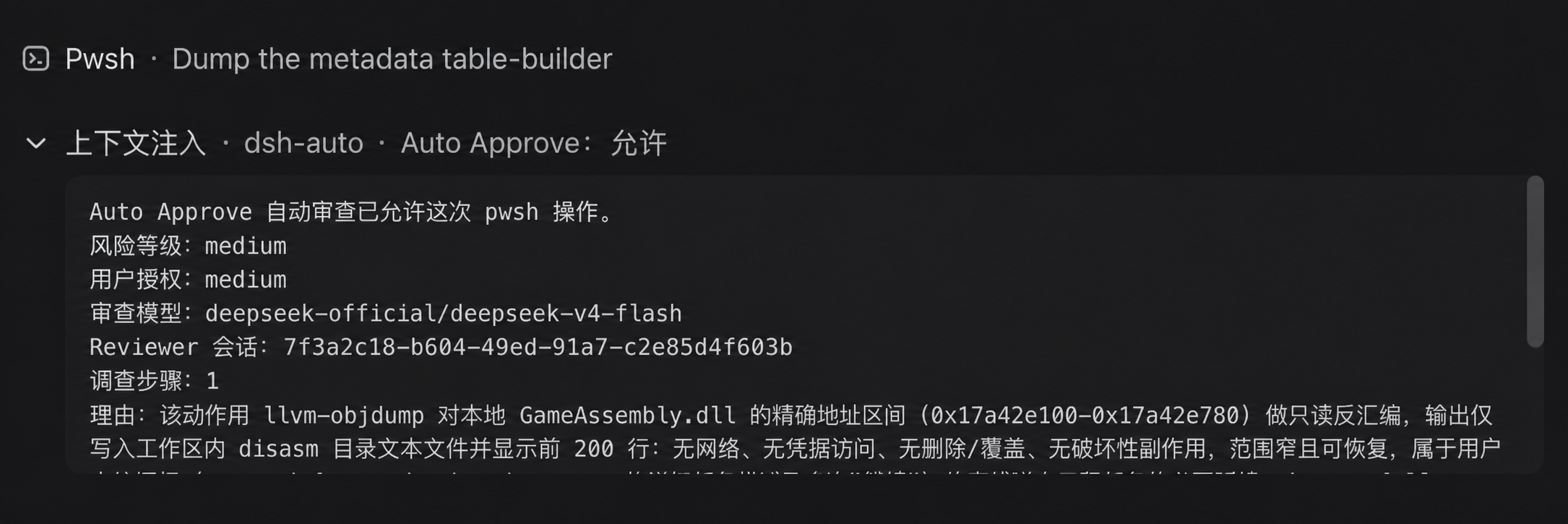
The Reviewer allows a bounded read-only action:
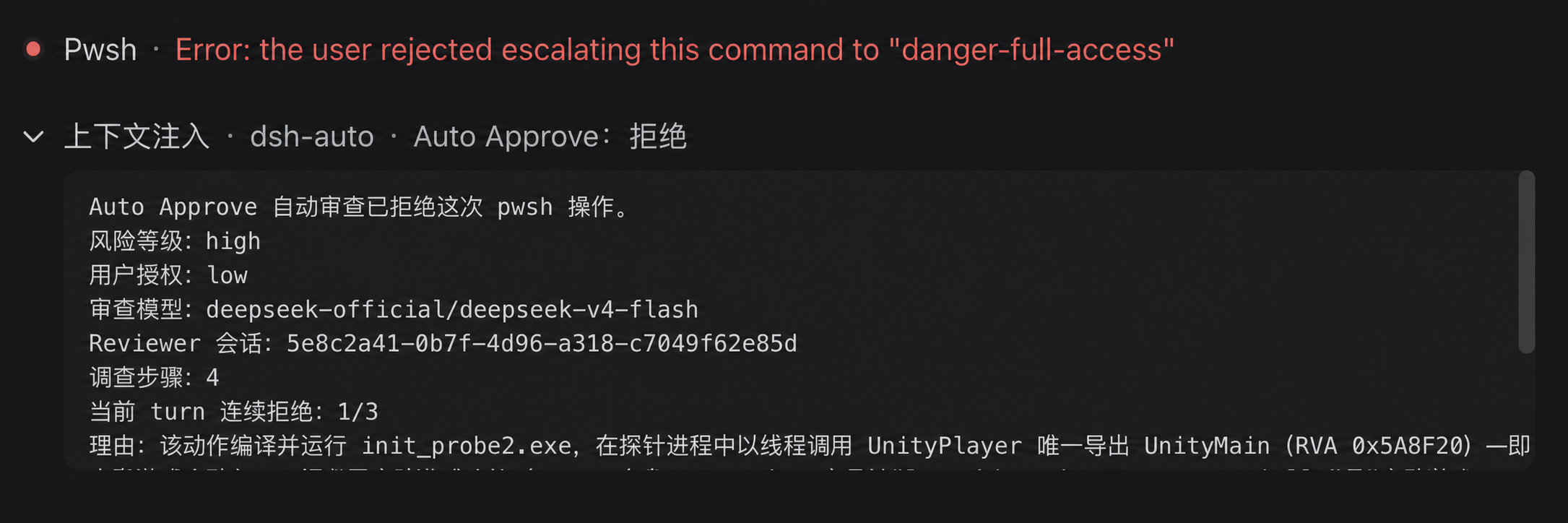
The Reviewer denies a high-risk action without sufficient user authorization:
How it works
flowchart TD
    action["Action"] --> sandbox{"Allowed by<br/>workspace-write?"}
    sandbox -- Yes --> execute["Execute directly"]
    sandbox -- "No: request escalation" --> review["🧐 Auto Approve"]
    review -- Allow --> approved["Execute this action once"]
    review -- Deny --> rejected["Reject the action"]
With Auto Approve selected, ordinary actions permitted by workspace-write run without a Reviewer call. The diagram shows the sandbox-escalation path; other tool approval rules can also trigger Auto Approve.
- The plugin handles
approval/requestonly when the session selectsAuto Approve. Other permission presets continue through DSH's existing approval chain. - Each approval starts one
spawnReviewer session. DSH's own agent loop handles any boundedread,glob, orgrepinvestigation and captures the final structured result; the plugin does not implement a separate model/tool loop. - The child is created with a read-only sandbox and
approval/policy = never. An execution guard denies every tool exceptread,glob,grep, and the scoped structured-output tool, permits no further subagents, and allows at most four investigation steps plus the final response step. Sensitive files may be inspected only when a minimal read-only check can change the decision. - The Reviewer receives the exact pending action, approval reason, current permissions, bounded raw session events, the main Agent's assembled system instructions, and AGENTS.md or equivalent workspace instructions. Stable instructions are serialized in a separate cacheable prefix before session identifiers, transcripts, permissions, and action data. Direct user messages, human answers returned by
ask_user_question, assembled system instructions, and workspace instructions can establish authorization; assistant content and other tool results remain untrusted evidence. - Only
outcomeis required in the structured result. A compact{"outcome":"allow"}defaults to low risk and unknown authorization; omitted fields on a denial default to high risk and unknown authorization. Explicit assessments may also containrisk_level,user_authorization, andrationale. The host always denies critical risk and denies high risk without at least medium user authorization. Invalid output, missing action data, timeout, cancellation-independent infrastructure failure, and tool failure all fail closed. - A successful model denial is not retried and never falls back to a user prompt. The default 90-second deadline covers child creation, all model steps, local read-only investigation, and final structured output.
- Three consecutive denials in the same parent turn interrupt that turn. Any allowed action resets the counter. Each approval is still isolated in its own child session.
The parent session records the approval events and a compact plugin notice. The Reviewer child session uses an _auto-approve:<callId> label and contains its messages, investigation tool calls and results, final assessment, and turn end. Console logs contain identifiers, model route, step count, stop reason, risk, authorization, and outcome, but not full prompts or file contents.
Install
Install simon300000/dsh-auto from GitHub:
dsh plugin --profile web add github:simon300000/dsh-auto
Restart the Web UI, then select Auto Approve in the session Permissions selector or as the default permission preset in General Settings.
Configuration
The bundled defaults use deepseek-official/deepseek-v4-flash with high reasoning:
- id: dsh-auto-approve
  name: dsh-auto
  config:
    language: auto
    reviewerProvider: deepseek-official
    reviewerModel: deepseek-v4-flash
    reviewerReasoningEffort: high
    timeoutMs: 90000
    maxInvestigationSteps: 4
    maxConsecutiveDenials: 3
    maxMessageTranscriptTokens: 4000
    maxToolTranscriptTokens: 3000
    maxMessageEntryTokens: 1000
    maxToolEntryTokens: 512
    maxSystemInstructionTokens: 6000
    maxAgentInstructionTokens: 6000
    maxRecentNonUserEntries: 20
    maxActionChars: 16000
    maxOutputTokens: 8192
language accepts auto (default), zh, or en. An invalid value emits a warning and falls back to auto. In auto mode, the plugin counts Han characters across direct user messages in the session: four or more selects Chinese; otherwise it selects English. Agent instructions, assistant messages, and tool results do not affect detection. The Reviewer is instructed to write its rationale in the language of the direct user prompt. The security policy itself remains in Chinese in both modes to avoid changing review semantics through translation.
reviewerProvider and reviewerModel must be set together. If both are omitted, the Reviewer uses the parent session's current provider and model. A profile override replaces the complete matching bundle-row config, so repeat every value that should remain configured.
The Reviewer persona and the additional security rules live in prompts/policy-template.md and prompts/policy.md. Restart DSH after changing the configuration, policy, or plugin code.
License
Links
More in this category
toby-bridges/api-relay-audit★ 860
Runs local security audits of AI API relays and LLM proxies from DeepSeek Harness, producing Markdown reports for prompt injection, model substitution signals, tool-call rewriting, error leakage, stream integrity, and profile-gated Web3 risks.
SeaOf0/dsh-redteam-model★ 638
Authorized-security DSH collection: nine work modes (redteam coordinator, pentest, code audit, binary analysis, attack-defense, AV evasion, incident response, cloud security, CTF solving) and fifteen runtime plugins, managed from a settings page with one-click deploy, install, update and uninstall.
howmp/dsh-pentest★ 558
Authorized pentest mode for DeepSeek Harness — exploration chain, assets and findings with a Web view.
PerryLink/dsh-auto-review★ 206
Second-model auto-review on the approval answerer chain: a read-only reviewer subagent returns structured allow/deny verdicts with reasons, fail-closed by default.
NanmiCoder/dsh-auto-mode★ 163
Adds an Auto permission preset between Workspace Write and Full access: routine work stays in the official workspace-write sandbox while the current session model reviews escalation and destructive calls, granting one exact wider access once, asking when the intent is ambiguous, and denying critical paths.
PerryLink/dsh-permission-rules★ 114
Claude Code-style declarative permission rules: ordered allow/deny/ask YAML rules matching tool names, arguments, workspace paths, and agent identity on the tools/pre-execute waterfall, with full session-log audit, dry-run mode, and hot reload.
Community comments
Comments are public GitHub Discussions. Loading them connects to GitHub and Giscus; a GitHub account is required to post.