Injects your own saved context entries as a Remember row after each user message, per turn or once per session, with a Settings editor and a manager page.
Install
# from GitHub (first run asks for allowBuilds approval — follow the hint, retry)
dsh plugin --profile web add github:polohot/dsh-adrian-inject-context
Any plugin you install runs third-party code with your own permissions — it can read your files, use your credentials, and reach the network, and tool approvals don’t sandbox it. GitHub-sourced plugins also run build scripts at install time — pnpm blocks those until you allow them, so an install can stop with ERR_PNPM_GIT_DEP_PREPARE_NOT_ALLOWED or ERR_PNPM_IGNORED_BUILDS; dsh prints the exact key to add under allowBuilds in your profile’s pnpm-workspace.yaml, and the install works on the next run. Allowing a build is a trust decision: only install sources you trust, and pin a commit (github:owner/repo#sha).
README
Inject Context for DeepSeek Harness (DSH): persist your own context entries and have them injected as a standalone Remember: row — right after your message — on every turn or once per session, per entry.
Features
- Standalone sourced row — never touches the initial system prompt or the shared runtime-context snapshot
- Simple / Advanced datasets — two independent context lists; the active mode's dataset is what gets injected (exclusive)
- Per-entry checkboxes — toggle any entry on/off, applies from the next request
- Per-entry frequency (v0.3.0) — each entry has an Every turn switch: ticked (default) the entry is injected right after every message; unticked it is injected only at the start of a session and never again — restart-safe, detected from the session's persisted sourced-message surface plus in-memory per-session tracking
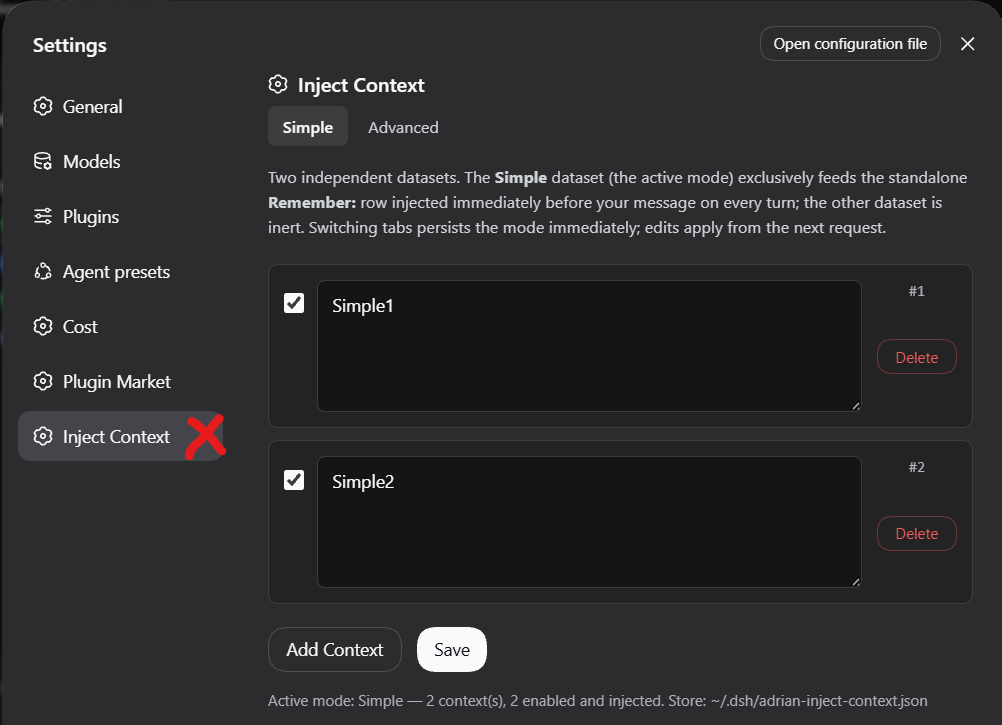
- Native Settings UI — Settings → Inject Context: add, edit, delete, toggle, save
- Persistent — datasets and active mode survive sessions and restarts
- Standalone manager page — also available at
/adrian-inject-context
Screenshots
Settings → Inject Context — manage your datasets
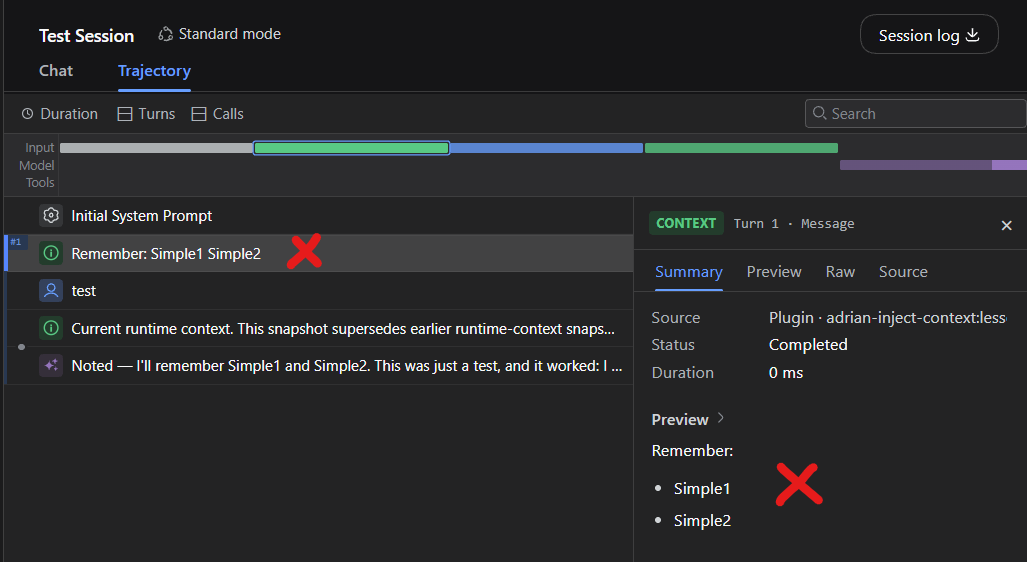
Remember: row in the Trajectory
Install
dsh plugin --profile web add polohot/dsh-adrian-inject-context
Usage
- Open Settings → Inject Context
- Add context entries; per row, two switches:
- Enabled — off = never injected
- Every turn (ticked by default) — ticked = injected right after every message; unticked = only the first message of a session
- Pick the active tab (Simple/Advanced) — its dataset feeds the injection
- Send any message and check the Trajectory: your message sits above the
Remember:block (order: SYSTEM → your message →Remember:)
Per-entry frequency (v0.3.0)
| Enabled | Every turn | Behavior |
|---|---|---|
| off | — | never injected |
| on | ticked | injected right after every message of every session (the default, and the migration default for existing entries) |
| on | unticked | injected only at the start of a session (its first turn), never again in that session |
Once-per-session entries are restart-safe: a process restart never re-injects a once-entry into a session that already carries it. Prior injection is detected from the session's persisted sourced-message surface (the adrian-inject-context:lessons rows) plus in-memory per-session tracking while the process lives. Unticking an entry mid-session lets it appear on the next message exactly once more, then never again — per dataset, so Simple and Advanced stay fully independent.
Configuration
Store: ~/.dsh/adrian-inject-context.json (schema v2, auto-migrated from v1):
{
  "version": 2,
  "mode": "simple",
  "simple":   { "lessons": [{ "id": 1, "text": "…", "enabled": true, "everyTurn": true }] },
  "advanced": { "lessons": [] }
}
everyTurn was added in v0.3.0 without a schema bump — entries missing the field default to true (the previous every-turn behavior).
Requirements
- DeepSeek Harness
dsh≥ 0.2.0-rc.2 (tested on the web profile) - Not compatible with
dsh0.1.x — see Session format v4 below
How it works
Host-side: an agent/pre-step waterfall listener composes the block per step — all enabled every-turn entries plus enabled once-entries not yet delivered to that session — and splices the plugin's own independently-sourced user-role message right after the turn's user message (the same pattern as dsh-agent-instructions), freshly read from the store on every step. It never injects into an empty entering batch (the agent loop's turn-close signal). Client-side: a settings-section module renders the manager against two host routes. Zero system-prompt modification.
Session format v4 (v0.4.0)
DSH 0.2.0 ships Session format v4, which retired the catch-all
{ kind: 'plugin', plugin: '…' } message source. That kind is now refused at
admission: emitting it raises SessionFormatError and aborts the whole turn
with format v4 message requires a producer-owned source kind.
This plugin emits the v4 producer-owned form of its own identity:
source: { kind: 'plugin:adrian-inject-context:lessons' }
That is the same kind the shipped v3→v4 migration derives for a third-party plugin, so live rows and rows migrated from older sessions share one identity and the once-per-session surface scan recognises both.
The row's position is decided by a positive test — a user-role row counts as
the turn's message only when source.kind === 'user'. Every other producer (the
runtime-context snapshot, agent instructions, tool and model rows) declares its
own kind and is skipped. v0.3.2 blocklisted the kinds it knew about, so the
runtime-context snapshot was mistaken for the user message and the row landed
after the snapshot instead of after the message it answers.
License
MIT
Links
More in this category
kingcharleslzy-ai/dsh-purge★ 3067
Community-maintained dsh-purge fork with host-policy patches, prompt and rule settings, diagnostics, separate update-check and install controls, and local backup/rollback.
techflag/workdsh#enterprise-connection★ 274
Enterprise login, colleague mentions, shared text and files, and authenticated business requests for WorkDSH Desktop 2.0.6-alpha.3+ with WorkDSH Admin; distributed as a release archive.
ECNU/EduWork#dsh-oidc★ 250
Configurable OIDC login and token-authorized model access, including LiteLLM and opt-in oidc-llm integration, with a standalone DSH Web backend.
Yuuyuko-uu/dsh-feiyu-mood★ 159
Gives the companion a mood judged each turn and shown as a short context note, with a panel for mood, emotion dimensions and timeline.
accomplish07zrh-eng/dsh-aurabot-qq★ 81
Puts the agent on QQ as a persona character through SnowLuma (OneBot v11): private and group chat, voice notes, stickers, Qzone diary, Bilibili browsing, song covers, image generation, long-term memory and mood. Every feature is a module you can switch off, replace or extend locally — hot-reloaded modules can also rewrite group-reply decisions, prompts, outgoing messages and per-chat model choice. Safe by default (master switch off, dry run on).
huaizhuanghub/dsh-persona-dafeiyu★ 64
Persona library for DeepSeek Harness: injects the selected persona into the system prompt, offering three built-ins plus import from a file or pasted text, applied either profile-wide or per session from a switcher above the composer.
Community comments
Comments are public GitHub Discussions. Loading them connects to GitHub and Giscus; a GitHub account is required to post.