DeepSeek Harness Plugin

p2coder/dsh-task-control

Stars ★ 0 Category Sessions & Messages Added 2026-08-16

Pause / resume / cancel the in-flight conversation task from the composer area: forced pause interrupts immediately and remembers the interrupted tool, safe pause lands after the tool or reasoning finishes, resume asks for confirmation, and the default pause granularity is configurable in the settings.

Install

# from GitHub (first run asks for allowBuilds approval — follow the hint, retry)

dsh plugin --profile web add github:p2coder/dsh-task-control

Any plugin you install runs third-party code with your own permissions — it can read your files, use your credentials, and reach the network, and tool approvals don’t sandbox it. GitHub-sourced plugins also run build scripts at install time. Only install sources you trust, and pin a commit (github:owner/repo#sha).

README

English | 中文

Task control plugin for DSH Web: in addition to the built-in "stop/cancel", provides pause and resume controls for the conversation task, implemented as a dual-face Cordis plugin (host + browser).

Features

Action Behavior
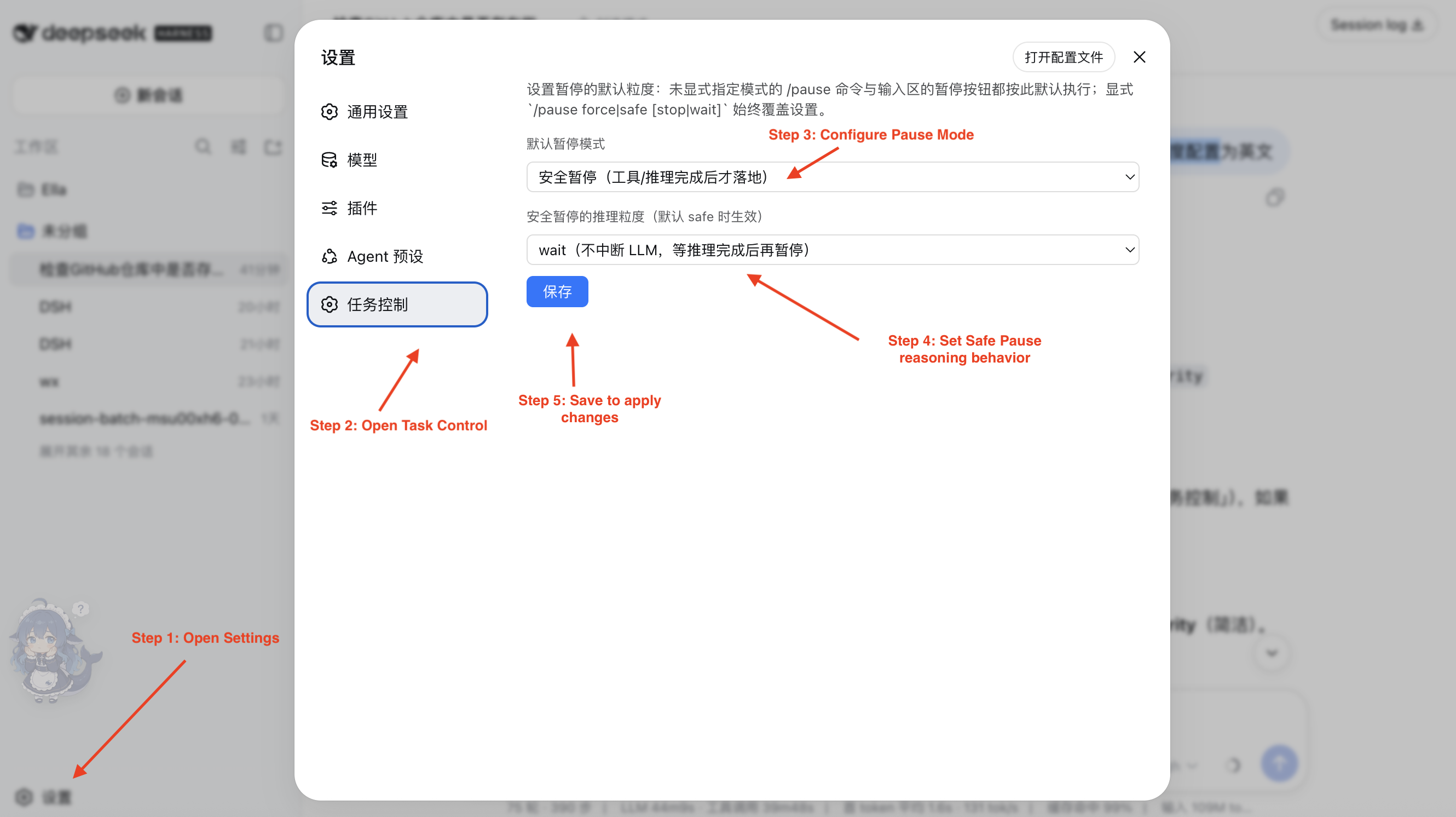
Pause Two modes: force and safe. When no mode is explicitly specified, the default granularity from Settings → "Task control" applies (shipped default: safe wait).
· Safe pause Never interrupts work: a running tool defers to the safe boundary (the tool finishes, tool/result lands, and no more in-flight tools remain) before the pause actually lands; a running reasoning follows the configured granularity: wait (default — does not interrupt the LLM; pauses after reasoning completes) or stop (terminates the current LLM output; the model re-reasons on resume). The trace keeps recording during the pause.
· Force pause Immediately cancels the running tool and interrupts the reasoning output; the paused state remembers the interrupted tool (interruptedTool). On resume the tool's actual outcome is looked up in the session log: if it completed → continue without re-running it; if aborted/state unknown (possibly partially executed) → the user is told "tool X did not finish before the pause; it will be re-run" and chooses re-run the tool / skip the tool / stay paused.
Resume Clears the paused marker and continues from the pause point (the session log IS the trace — nothing is re-sent from scratch and completed work is not re-run). Safe pause: continue from the pause point; if the task is still actually running when resumed (the pause never truly landed) → just clear the marker, tool/model results keep flowing normally. Force pause (with an interrupted tool): confirmation is required first, then it continues per the user's rerun/skip choice.
Cancel Immediately interrupts the current turn (queue preserved) and clears the paused marker; if a tool is running it is terminated immediately, and the reply states the tool's intended purpose and reminds to check for side effects (files/processes/network etc.).

Default pause granularity: configure it in Web Settings → "Task control" (shipped default safe + wait). A bare /pause (and the composer pause button) follows this default; /pause force, /pause safe [stop|wait] explicitly override it. taskControl service: pause(sessionId, { mode, reason }) (omitted fields also resolve from the settings), resume(sessionId, { confirm, choice: 'rerun'|'skip' }). After a force pause, clicking resume shows a three-choice menu (re-run the tool / skip the tool / stay paused).

State model (Route A): pause/resume state is not written into the session log (task-control/paused / task-control/resumed are custom event types; the harness's persistence reader only accepts its built-in event-type set or events flagged ignorable, and writing them makes the session unloadable after a restart). State lives in the plugin's own durable store (~/.dsh/task-control/<sessionId>.json, atomic writes; tests can override the root with DSH_TASK_CONTROL_STATE_DIR), and every consumer reads through this single source:

  • Browser dock: polls the host route /task-control/state?session=<id> (every 2 seconds);
  • Browser settings page: the /task-control/settings route reads/writes the default pause granularity (default safe + wait), effective immediately;
  • taskControl service state(): reads the store directly — offline sessions (not loaded) still report their pause state, and the paused state survives restarts;
  • dsh-trace-repeat: reconciles its pause gate from the taskControl service on every session event.

Other plugins (e.g. dsh-task-batch) keep using the taskControl service unchanged.

Installation

The package ships a dsh.bundle manifest — it activates automatically on install (no manual configuration):

# Install from GitHub
dsh plugin --profile web add github:p2coder/dsh-task-control
# Once published to npm: dsh plugin --profile web add dsh-task-control

After install, fully restart dsh web (host plugins do not hot-reload) and refresh the browser.

Usage

  1. Refresh the browser page.
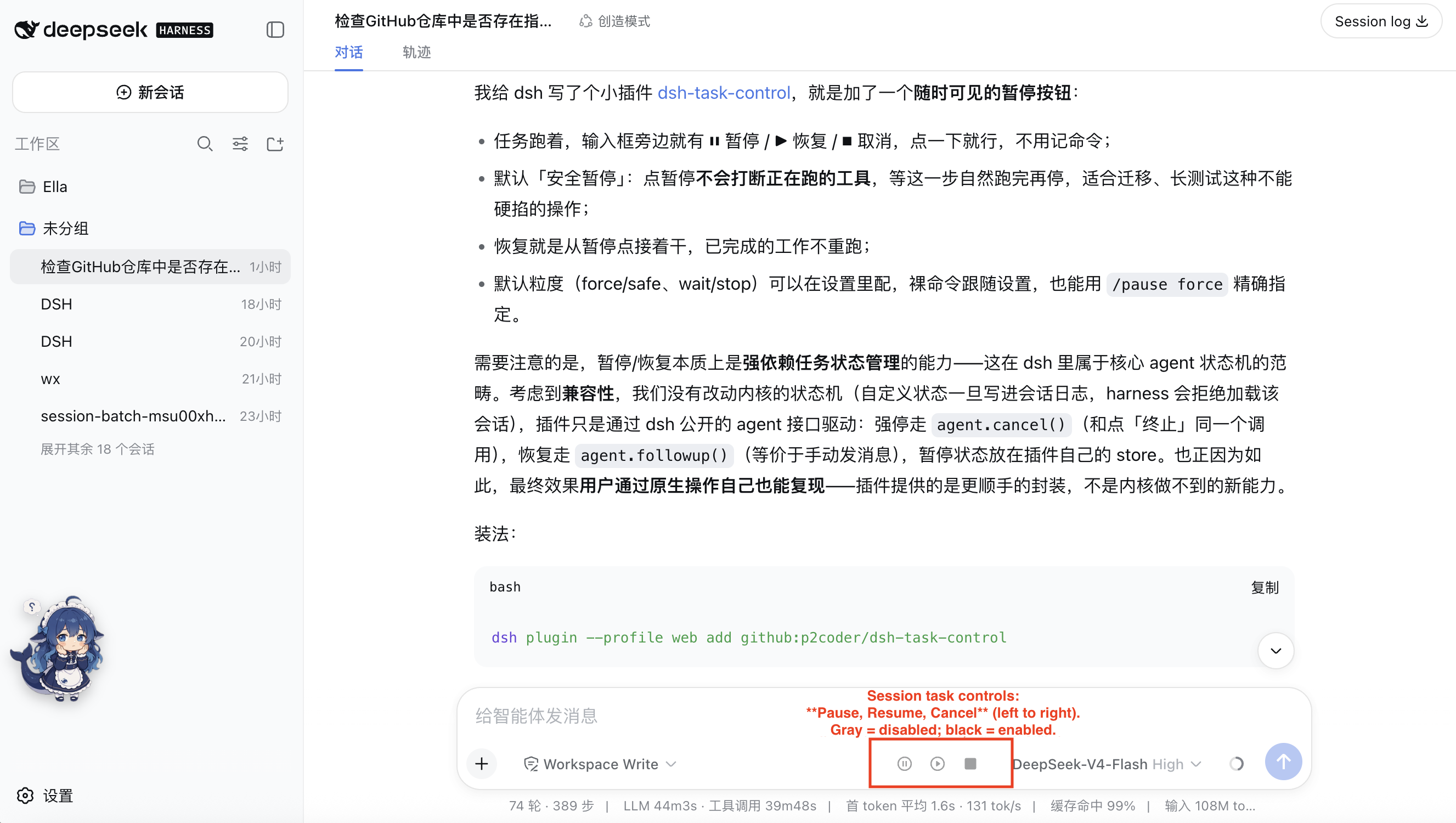
  2. Submit a task; while the agent is running, three icon buttons appear to the left of the send button:
    • ⏸ Pause (available while running)
    • ▶ Resume (available while paused)
    • ⏹ Cancel (available while running or paused)
  3. The button group is always visible (it does not hide when idle); buttons disable per state: Pause/Resume gray out when idle/not paused, Cancel grays out when neither running nor paused.
  4. Settings → "Task control": configure the default pause granularity (default safe + wait); bare /pause and the pause button follow it.

Slash commands also work in the input box: /pause, /resume, /cancel (results appear as ordinary command lines in the conversation).

Pause semantics (follows the settings; shipped default safe wait): a bare /pause (and the dock pause button) without an explicit mode uses the default granularity from Settings → "Task control" (default safe wait: lands after reasoning/tools finish, never interrupts work). An explicit /pause force interrupts the current turn immediately: in-flight tools are cancelled and the LLM output is cut; the pause snapshot records the interrupted tool (interruptedTool); resume needs confirmation first: /resume confirm rerun (re-run the interrupted tool) / /resume confirm skip (skip it); tools that actually completed are auto-skipped, never re-run. /pause safe [stop|wait] explicitly selects a safe pause: safe wait lands after reasoning completes and before tool dispatch; the undispatched tools are recorded as deferredTools, and resume also asks for confirmation.

Structure

dsh-task-control/
├── package.json          # declares dsh.bundle.patch + dsh.client (platform: web)
├── cordis.patch.yml      # one dual-face row: - id: task-control / name: dsh-task-control
├── lib/
│   ├── index.js          # host: /pause /resume /cancel commands + taskControl service + durable state/settings store + /task-control/state, /task-control/settings routes
│   └── client.js         # browser: composer tool-row buttons + state polling + Settings "Task control" page (__ModuleLoader__ format)
└── test/
    └── host-smoke.mjs    # host logic smoke test (node test/host-smoke.mjs)

Host service (for other plugins)

The host publishes the taskControl service; other plugins call the same implementation by sessionId (the commands and buttons go through it too):

taskControl.pause(sessionId)  → { ok, text } | { ok: false, error }   // pauses per the default granularity (default safe wait) + marks paused
taskControl.resume(sessionId) → { ok, text } | { ok: false, error }   // clears the marker + continues from the pause point (does not re-send the original prompt)
taskControl.cancel(sessionId) → { ok, text } | { ok: false, error }   // interrupts the turn + clears the marker
taskControl.state(sessionId)  → { status, paused, forced, interruptedTool, deferredTools, resumeContent }  // status: idle|running|offline (offline sessions still report pause state)

Consumers (e.g. dsh-task-batch's "pause/resume/cancel all") read it via ctx.get("taskControl") — do not duplicate the implementation; this service's semantics are the single source of truth.

Known limitations

  • New input while paused: pause only intercepts the current turn, not new messages — sending is still allowed while paused (a send starts a new turn). A "pause = freeze the session" composer gate is not implemented yet.
  • Scheduled reminders: pause does not intercept dsh-schedule reminder turns (they still wake up); goal auto-rounds are intercepted (see above).
  • Subagents: pausing a parent turn does not interrupt already-dispatched subagents; their reports may arrive after resume.
  • Resume semantics: resume = continue from the pause point (no re-sending of the original prompt, no re-running of completed work); the user chooses whether an interrupted tool is re-run (rerun) or skipped (skip). Tool side-effect state is judged by the actual result in the session log: a completed result → treated as executed; aborted/no result → state unknown, the user is warned and decides.
  • State location (Route A): pause state lives in the plugin's durable store, not the session log — deliberate (custom session events would make the harness refuse to load the session). Cost: the browser dock polls /task-control/state every 2 seconds instead of subscribing to a projection; trace-repeat's pause marker versions are written on the next session event after pause/resume, so a pure pause+resume with no events in between produces no marker version. The default pause granularity lives in settings.json under the same store root (default safe + wait), effective immediately without a restart.
  • safe wait + tool calls emitted by finished reasoning (deferredTools): applies under the default (safe wait) or an explicit /pause safe wait, landing after reasoning completes and before tool dispatch. The tool calls the model just emitted are marked ABORTED_BEFORE_DISPATCH by the kernel (never dispatched, no side effects) and recorded as the pause snapshot's deferredTools. Resume requires confirmation (/resume confirm rerun to re-run / /resume confirm skip to skip; tools that actually completed are auto-skipped, never re-run). If the browser dock's client bundle is not updated with lib/client.js (needs a dsh web restart), the dock's resume button still sends a bare /resume without confirm, and the host rejects with needConfirmation — type /resume confirm rerun manually in that case. Note: the aborted tool calls still land in the session log as failures (the kernel writes them via appendSkippedToolCall) — an inherent shape of the record-and-replay approach; removing the failed look entirely would require "freeze before tool dispatch" in the core agent loop (approach 2, not implemented). A bare /pause follows the default granularity from the settings (shipped safe wait); explicit force/safe take the corresponding path.

Content from the project README on GitHub ↗

Links

More in this category

View the whole category →