Role-based LLM retry & fallback strategies.
Install
# from npm (prebuilt)
dsh plugin --profile web add dsh-llm-fallbacks
# from GitHub (first run asks for allowBuilds approval — follow the hint, retry)
dsh plugin --profile web add github:omdsh-dev/dsh-llm-fallbacks
Any plugin you install runs third-party code with your own permissions — it can read your files, use your credentials, and reach the network, and tool approvals don’t sandbox it. GitHub-sourced plugins also run build scripts at install time — pnpm blocks those until you allow them, so an install can stop with ERR_PNPM_GIT_DEP_PREPARE_NOT_ALLOWED or ERR_PNPM_IGNORED_BUILDS; dsh prints the exact key to add under allowBuilds in your profile’s pnpm-workspace.yaml, and the install works on the next run. Allowing a build is a trust decision: only install sources you trust, and pin a commit (github:owner/repo#sha).
README
dsh-llm-fallbacks
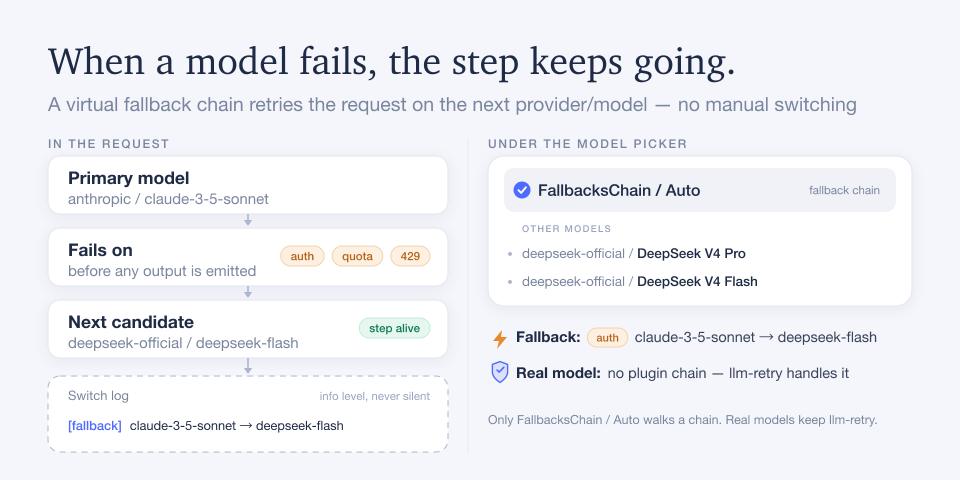
Automatic provider/model fallback chains for dsh (DeepSeek Harness): a session whose model selection routes to the plugin's virtual FallbacksChain / Auto row walks a configured fallback chain — an LLM request that keeps failing on a listed code (auth, quota, rate limiting 429, …) is retried on the next available provider/model, so tasks are not interrupted by model problems. A session on any real provider/model has no plugin fallback: llm-retry alone handles it. Select FallbacksChain / Auto in the model picker to get a chain.
Works in both dsh front ends: the web profile (Settings → Plugins → Fallbacks card) and the dsh-tui terminal profile (/fallbacks session diagnostics, /fallbacks config readback, and the /settings fallbacks section for editing).
Three core capabilities
Automatic model failover
A session routed to FallbacksChain / Auto — the root agent, or an inheriting subagent the dispatch seam mounted on that row — walks its chain: a request that fails on a listed code before emitting any output is retried on the next available provider/model inside the same request, and the step stays alive. Sessions on a real provider/model get no plugin fallback at all. No manual model switching, and nothing happens until you configure content.
- Who gets a chain: only sessions whose model selection routes to
FallbacksChain / Auto. That is the root agent when the row is selected, and a subagent the seam mounted there at dispatch (local backend, no explicit route on the request). A real provider/model selection — root or subagent — is left entirely to llm-retry. - Triggers:
triggerCodes(defaultAUTH/QUOTA/RATE_LIMIT) — any dsh failure code is accepted, includingCONTEXT_WINDOW_EXCEEDED, which fails over to a larger-context candidate. Retryable failures (5xx,TRANSPORT,TIMEOUT, …) stay with llm-retry first; each of its retries re-enters the walk, which starts past the head that just went on cooldown. - Partial output is committed: once an attempt has emitted a chunk, a later failure is not switched inside the request — yielded output cannot be unsent. The failure surfaces to the loop; recovery is llm-retry re-entry (a fresh walk) or the terminal error.
- Recovery: a failed / switched-away model is held out of selection for
cooldownMs, andrevertPolicy: cooldown-expiryreturns to the primary model on expiry. The opt-inrecovery: half-openmode (YAML-only) makes that return evidence-driven instead of timer-based. - Safety valve:
maxSwitchesPerStepcaps switches per request walk (attempts ≤ cap + 1) — chain loops cannot amplify latency. - Visibility: every switch is recorded in an info-level log line (from/to/role/reason/candidates) — no silent model switching.
→ Automatic model failover · Context-window-aware fallback
Peak/valley time slots
Time slots rotate the effective root chain by wall-clock windows: each row carries its own fallback chain, and the first row whose window contains the current moment replaces the all-day chain for the next root request — the all-day chain stays the last resort when no row matches. Rotation is a routing seed, not a failure decision: it consumes no cooldown and leaves the failure walk (fallback switch) untouched.
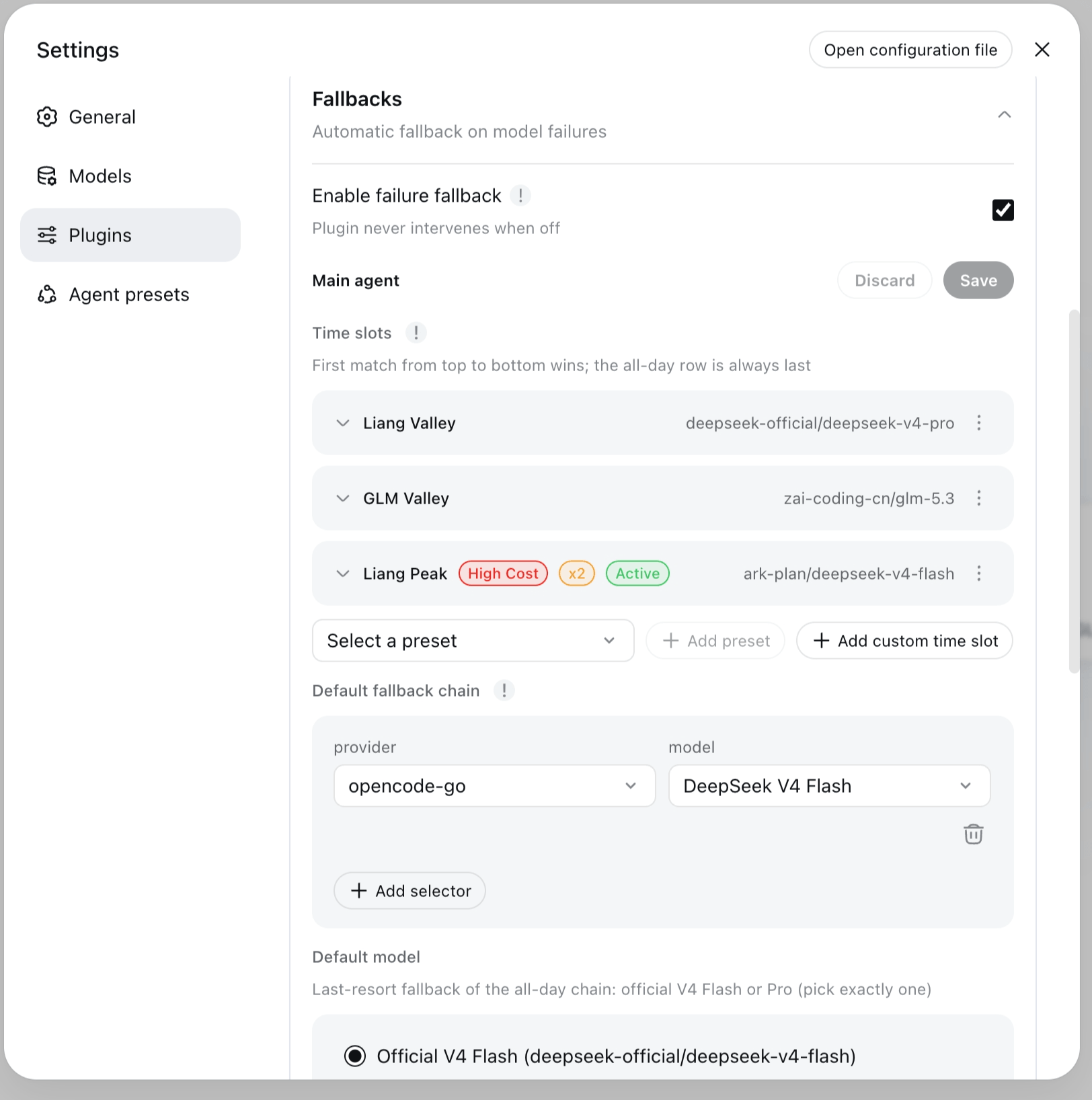
Four frozen UTC+8 presets (windows are code constants; preset rows lock tz to Asia/Shanghai):
| Preset | Window |
|---|---|
liang-peak |
Monday–Friday 09:00–12:00 and 14:00–18:00 |
liang-valley |
every other UTC+8 time (complement of Liang Peak) |
glm-peak |
Monday–Friday 14:00–18:00 |
glm-valley |
every other time (complement of GLM Peak) |
GLM Peak and GLM Valley are offered in the card picker only when zai-coding-cn is configured. Custom rows take start / end (HH:mm, may wrap midnight) and an optional days list.
Role-based subagents
A subagent's role is declared in its dispatch prompt — the Assignment header **Execute as**: <id> — and it is resolved against the role ids declared in roles.list. Only that declared header delivers the child's identity: the role's persona is installed on the child as a system-prompt section, the child's own session gets exactly one [role: <id>] notice row, and its session header shows a role badge.
Role routing is resolved separately, in three ordered stages, first hit winning — explicit agentPreset → dispatch-declared **Execute as**: <id> header → rules. If the child's dispatch prompt declares **Execute as**: <id>, that role's persona, [role: <id>] notice and badge are delivered regardless of which routing stage wins — an earlier explicit agentPreset can route the child as another role while the identity carriers stay the declared header's. A child with no declared dispatch header gets no persona, no notice row and no role half of the badge (the model half still renders when the child has a recorded route), even when rules resolve a role for routing. Routing also decides whether the child gets a fallback chain: at dispatch the seam mounts an inheriting child on the virtual FallbacksChain / Auto row — local backends only, and only when the request carries no explicit provider/model route; a request that does carry one is authorized and never rewritten (card label authorized, a mounted child is labelled injected). A mounted child's candidates are intersected with the host allowlist when subagent-model-selection is enabled, and an external-backend child keeps pure inheritance — which means no chain (host policy).
This covers an ordinary subagent dispatch and an Agent Team teammate (spawn_teammate) alike: both are children dispatched with the same header, which the model writes — the same dispatch seam, no mechanism-specific configuration.
Quick start
Install
Desktop / Web plugin page — in DeepSeek Harness (the Desktop app, or a dsh web session) open the Plugins page in the sidebar, click Add plugin, enter the package name dsh-llm-fallbacks, and click Install; then follow the host's restart prompt. The wizard accepts a package name (= npm package name), a GitHub repo, or a local directory — a registry install needs only the package name. The GUI writes into the web profile, the same profile the --profile web flag below targets.
CLI — for scripted setups, or the terminal front end:
dsh plugin --profile web add dsh-llm-fallbacks      # web profile (Settings → Fallbacks card)
dsh plugin --profile dsh-tui add dsh-llm-fallbacks  # dsh-tui terminal profile
dsh-tui has no plugin page of its own, so it stays CLI-only. Pin a version with @<version>. A registry install fetches the built package (dist/), so nothing builds on the target machine. Registry / git / local-directory variants, uninstall, and --dump-config verification → docs/install.md. The plugin ships localized metadata (title/description for the Plugins-page detail view, English + Simplified Chinese) and an icon — both declared in the package (locale/*.json + icon.svg) and picked up by the host automatically.
Configure
The plugin's settings live in a shared fallbacks: namespace, editable from three surfaces:
| Surface | What it is | Notes |
|---|---|---|
| Web settings card | Settings → Plugins → Fallbacks | Full GUI editor for the fallbacks: namespace; writes the shared settings document |
$DSH_HOME/settings.yaml |
fallbacks: section in the dsh settings document |
The shared source of truth — the same file the web card writes; readable and editable everywhere, including scripted setups |
TUI /settings |
fallbacks section in the dsh-tui settings screen | dsh-tui ≥ v0.8.5; native fields for simple keys, JSON text fields for complex structures |
(/fallbacks and /fallbacks config are diagnostics — read-only views, not edit surfaces.) A minimal section:
fallbacks:
  rootChain:               # all-day chain: leading entries = fallback walk, last = Default model (official)
    - anthropic/claude-3-5-sonnet
    - deepseek-official/deepseek-flash
  timeSlots:               # optional: rotate the effective root chain by wall-clock windows
    - kind: preset
      preset: liang-peak
      chain:
        - anthropic/claude-3-5-sonnet
  roles:                   # optional: declare role entities, then reference them from rules
    list:
      - id: reviewer
        persona: Code-review subagents
        chain:
          - openai/gpt-4o-mini
        fallback: inherit-root
    rules:                 # subagent-only: rules never match root requests
      - role: reviewer
Three rules of thumb:
- There is no feature switch: the plugin intervenes exactly when content is configured — a non-empty
rootChain, at least onetimeSlotsrow, or one declared role. An empty section is a complete no-op, and the Plugins-page row toggle is the master switch. - The all-day
rootChaintail must be exactly one official model —deepseek-official/deepseek-flashordeepseek-official/deepseek-v4-pro(XOR); the leading entries are the fallback walk, walked first. - Slots and roles are optional: the first time-slot row whose window matches replaces the all-day chain for the next root request; rules map subagents to declared roles and never match root requests.
Full reference (keys, entry syntax, selector rules, migration) → docs/configuration.md.
Upgrade note (breaking): the config-level
enabledswitch is removed — a stored section still carryingenabled: true/falseloads cleanly (the key is ignored and stripped on the next save), but the switch no longer gates anything. If you relied onenabled: falseto keep the plugin inert, empty the section (or disable the plugin row on the Plugins page) instead.
Verify
Save the config and restart the session, then type /fallbacks — the read-only in-session diagnostics (origin, resolved role, chain, recent fallback switches, cooldown status). In a dsh-tui profile, /fallbacks config reads back the composed configuration.
Feature highlights
- Automatic failover on the virtual route — a
FallbacksChain / Autosession (root or seam-mounted subagent) walks its chain on a listed failure code and the step continues; real-model sessions have no plugin fallback. → details - Context-window-aware fallback —
CONTEXT_WINDOW_EXCEEDEDfails over to a larger-context candidate; the switch is request-scoped (no cooldown). → details - Peak/valley time slots — four frozen UTC+8 presets or custom windows rotate the effective root chain. → details
- Role-based subagents — a dispatch-declared role brings persona, notice row and badge to the child; inheriting children are mounted on the virtual chain route subject to host policy. → details
- FallbacksChain in the picker — select
FallbacksChain / Autoto make the configured chain the session route; any real model is served by llm-retry alone, with no plugin fallback. → details - Host subagent model policy — the dsh 0.1.2 allowlist is a hard constraint on every plugin-originated subagent route. → details
- Five bundled preset roles —
reviewer/scout/security-reviewer/sonic/task, declared on apply. → details - dsh-tui surfaces —
/fallbacks,/fallbacks config, and a/settingssection with web-card parity. → details
Mount-only
The plugin installs as a pure mount: bundle insert + client inject + its own gateway channel (/api/fallbacks/get|set|reset) — no dsh patches, no postinstall step, and dsh upgrades never require re-patching. Stale leftover patches from an older patched install are harmless.
Documentation
| Doc | Content |
|---|---|
| docs/install.md | desktop/web plugin page / profile install (web + dsh-tui) / registry / git / local variants / uninstall / --dump-config verification |
| docs/configuration.md | full fallbacks namespace reference, selector syntax, example YAML, plugin-config card usage, TUI readback, behavior notes, preset roles |
| docs/features.md | capability reference: failover, context-window fallback, time slots, role-based subagents, picker, host policy, preset roles, agent presets, dsh-tui |
| docs/repair.md | session-log repair: refusal classes, --apply publishing, flags, exit codes, lossy --drop-legacy-events |
| docs/consumer-api.md | developer consumption contract: library API + named llm-fallbacks service + role seeds, export inventory, lifecycle, typing |
| docs/release.md | release process: Trusted Publishing setup, Release prep SOP, fragment format, rollback |
| docs/verification.md | verification records (test matrix, bundle layer order, runtime contracts, QA gate script) |
| CHANGELOG.md | released changes, assembled from .changes/ fragments |
License
Released under the MIT License — see LICENSE. The LICENSE file is authoritative for copyright and license terms.
Links
More in this category
Ebony-Vinyl/dsh-our-free-model★ 64128
Adds free model lanes to DeepSeek Harness — DeepSeek V4.1 Flash, Kimi K3 and others — with no login, sign-up or API key, plus a local OpenAI-compatible gateway, fallback routing and a usage dashboard.
dingminhua/dsh-connect-workbuddy★ 1244
Connects locally signed-in WorkBuddy models, CN and international alike, to DSH, reading each model's credit multiplier from the upstream catalog on every refresh, with per-model image input toggles, account switching backed by an auto-failing-over pool, manual daily check-in, and read-only credit overviews shown as compact pills on the card and in the composer.
Alice-Marx/dsh-model-router★ 859
Routes DeepSeek Harness work across configured model APIs and supported vendor CLIs with dependency-aware packages and cost previews.
V1ki/dsh-plugin-subscriptions★ 568
Use ChatGPT (Codex), Claude, and Grok subscriptions as DeepSeek Harness LLM providers, with Settings login, model catalogs, usage, plus image_generate, video_generate, and x_search tools.
Mars-Sea/dsh-commandcode-provider★ 460
Unofficial Command Code LLM provider: registers a `commandcode` route with a live model catalog and reasoning-effort support.
XDTrees/dsh-workbuddy-xdpool★ 447
Merge every locally signed-in WorkBuddy account into DeepSeek Harness as one auto-failing-over model pool (multi-account rotation, live credits, and a model catalog showing per-model credit multipliers and free/night-discount tags).
Community comments
Comments are public GitHub Discussions. Loading them connects to GitHub and Giscus; a GitHub account is required to post.