RainbowSpeak — a flowing rainbow marquee border around the chat composer card, driven by a conic-gradient ring. Live settings for speed, width, seven color schemes, direction, sides and breathing, plus session-state awareness that reacts to running, attention, error and celebration moments.
Install
# from npm (prebuilt)
dsh plugin --profile web add @kenz1117/dsh-ui-rainbowspeak
# from GitHub (first run asks for allowBuilds approval — follow the hint, retry)
dsh plugin --profile web add github:kenz1117/dsh-ui-rainbowspeak
Any plugin you install runs third-party code with your own permissions — it can read your files, use your credentials, and reach the network, and tool approvals don’t sandbox it. GitHub-sourced plugins also run build scripts at install time — pnpm blocks those until you allow them, so an install can stop with ERR_PNPM_GIT_DEP_PREPARE_NOT_ALLOWED or ERR_PNPM_IGNORED_BUILDS; dsh prints the exact key to add under allowBuilds in your profile’s pnpm-workspace.yaml, and the install works on the next run. Allowing a build is a trust decision: only install sources you trust, and pin a commit (github:owner/repo#sha).
README
dsh-ui-rainbowspeak
✨ Why
Pure decoration, zero intrusion
No slots taken over, no host patches, no tools registered, no system prompts injected. The rainbow ring is pure browser-side decoration: a conic-gradient circle masked down to the card edge, carried by a rotating layer — the gradient paints once, then the compositor spins it; the main thread never repaints per frame.
The pet obeys the same boundary: the host side adds only a read-only turn-boundary stream (session id + turn index + end reason), carrying no chat content, history, or approval details; the browser side mounts one floating entry on shell.overlay and touches nothing else in the host UI.
Five balls, five characters, replicated pixel-by-pixel
The five balls are not one character in five colors — they are five independent characters: Hong-Hong (tsundere, cool), Huang-Huang (lazy, half-lidded), Fen-Fen (derpy, big-eyed), Lan-Lan (rational, bespectacled), Lyu-Lyv (grumpy, cross-eyed). Every face is measured and replicated pixel-by-pixel from the reference art (tools/anim-bench/scan-faces-precise.mjs, connected components + scanlines, part accuracy ≤0.5% of face width): flat-filled bodies, mouths as scanline-derived clip-path polygons, Huang-Huang's two-layer "white eyeball + red lid", Lan-Lan's frames scaling with body size. Every circle carries a longhand + !important hardening contract — host-wide global styles cannot reshape them.
Success and failure follow the host's authoritative turn boundary (via the Typert remote reading session/event turn/end): a cancelled turn never gets celebrated — celebrating a cancel would be lying. Without the remote runtime the pet quietly degrades to client-session-only moods, never inventing conclusions.
A pet that interacts
- Eyes follow the pointer: pupils glide (capped at 5% of body width, further damped per character — the smallest eye-whites get the smallest gain; pupils never slide off the whites), always gliding, never jumping; after a few idle seconds they wander on their own and drift back; the body leans ~1° toward its own gaze;
- Poke: a squash-and-rebound with a "jelly afterquiver" (damped tail, volume-preserving), a spoken line, and two or three candy hearts popping from above the head;
- Rapid pokes (double-click): a full spin, then a dizzy ×_× moment;
- Press and hold: a pat — jelly bulge, happy squint, blush;
- Poke while napping: a startle — it springs up, fully awake;
- Drag: it leans with inertia like hanging from your fingertip, with a landing bounce on release;
- Left idle: it hums a tune, ♪ notes floating out (random 36–60 s cooldown);
- Every entrance: a random intro — pop / airdrop (shadow lands first) / spin / hop;
- Right-click (or
Shift+F10): a small menu — character / scope / size / hide; - Environment-aware: stumbles when the window resizes, stretches on waking, glances at scrolling chat — living in the window, not pasted on it;
- Motion levels: full / gentle / off — gentle keeps every reaction with reduced amplitude; off keeps expressions only (system
prefers-reduced-motionalways wins).
The border is the session state
The ring reflects the conversation in real time: faster while the agent runs (4 s → 1.2 s/turn); amber slow-pulse while a tool approval or question awaits you; red fast-pulse on failures; a one-cycle celebratory flash when a turn completes. Peripheral vision is enough to know where things stand.
Seven palettes, theme-following included
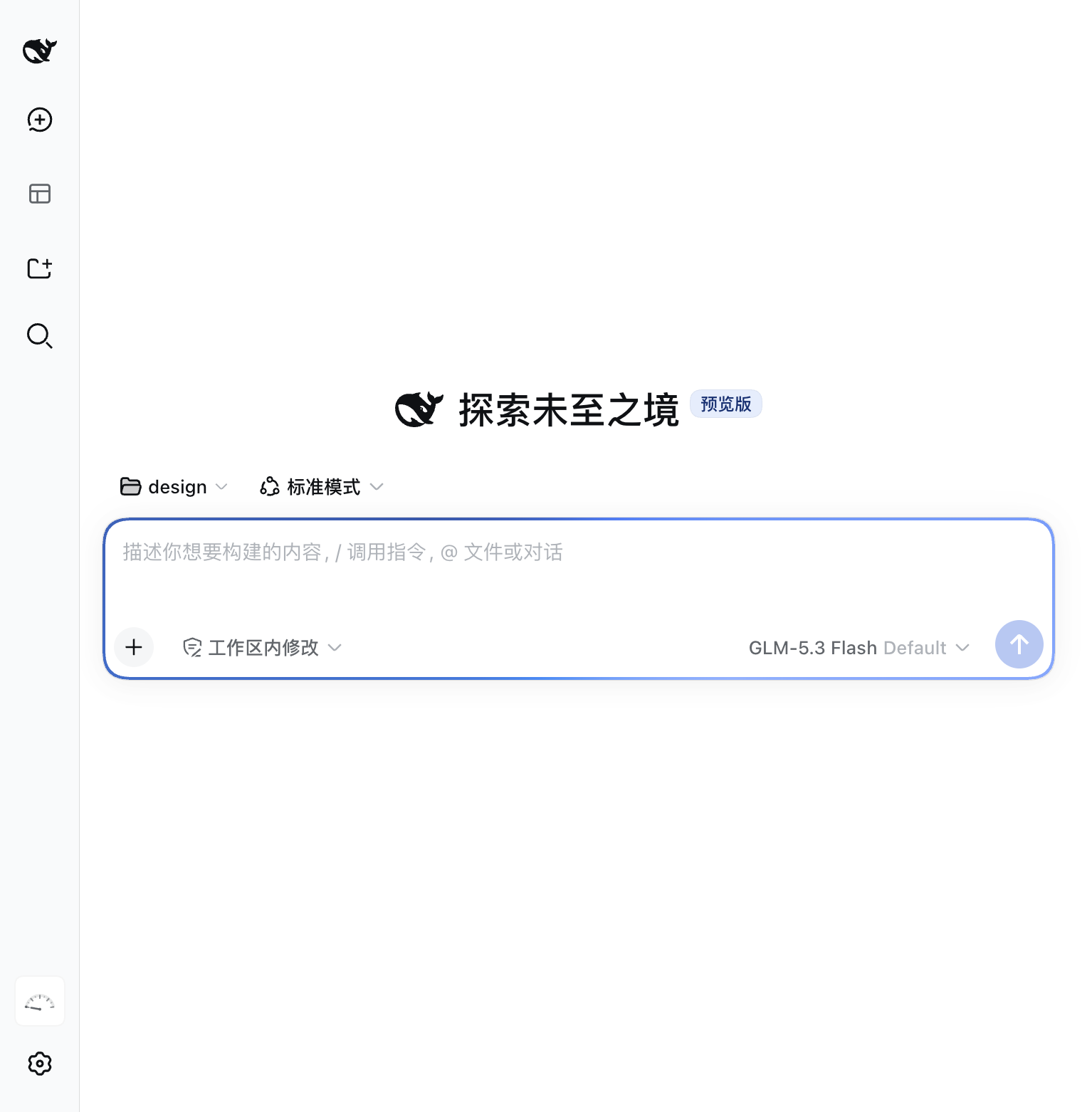
Classic rainbow / aurora / sunset / peach / ocean / cyberpunk — plus follow-theme, derived from the host brand color via color-mix, following light/dark switches instantly.
🎭 The five characters
| Character | Eyes | Mouth | Idle motion | Temper |
|---|---|---|---|---|
| Hong-Hong (red) | Round white eyes, green iris | Solid left-pointing wedge + bar | Sharp nods | Tsundere, cool |
| Huang-Huang (yellow) | White eyeball + red half-lid | White grin + mouth-corner bean | Lazy pendulum | Lazy, aloof |
| Fen-Fen (pink) | Big vertical whites, blue iris (cross-eyed) | Wavy stroke | Bounce (squash & stretch) | Derpy, sweet |
| Lan-Lan (blue) | Yellow square frames (size-scaled), dark pupils | Thick V | Metronome breathing | Rational, earnest |
| Lyu-Lyv (green) | Jammed-together small whites, orange iris (overhanging) | Low-left-to-high-right zigzag | Impatient twitch | Grumpy |
Six states (resting / working / waiting / celebrating / error / sleeping) get a character-specific take on each ball: Huang-Huang's lid presses lower while working and the pupil peeks out while waiting; Lan-Lan's frames keep their shape while sleeping and while blinking. State switches tween via scale / translate — expressions become, they don't snap.
🌈 Features
Rainbow marquee border: flowing ribbon around the composer card, driven by a rotating layer — measured repaints per frame: 360 → 0.
Desktop pet "Prism": lives on
shell.overlay, draggable with persisted position; pure CSS geometry, zero external assets, therefore no third-party-character licensing concerns.Five selectable characters (context menu or settings): ball color is identity, expressions change with state — five base faces + 25 dedicated keyframe sets (five states × five characters), each with its own motion language.
Interaction details: jelly-afterquiver poke rebound, candy hearts from above the head (2–3, auto-throttled when spam-poked), inertial drag sway, pointer-following pupils + random saccades + gaze lean.
Authoritative turn boundary: the host half contributes a read-only event stream (
remote.rainbowPet/watch); the browser half validates every frame with the same Zod schema, requires contiguous sequence numbers, and backs off on gaps.Host-style hardening: every circle (body / eyes / pupils / hit area / aura) is pinned with longhand radii +
!important— host-widebutton spanrules cannot deform them; frame stroke width uses container-query units, scaling with pet size, with a fixed-width fallback on older engines.Settings panel (
Settings→Rainbow border): enable, speed, width, palette, edge, reverse flow, breathing glow; a Desktop pet group: enable, character, scope, motion level, size (0.6–1.6×). All preferences persist inlocalStorage, effective immediately.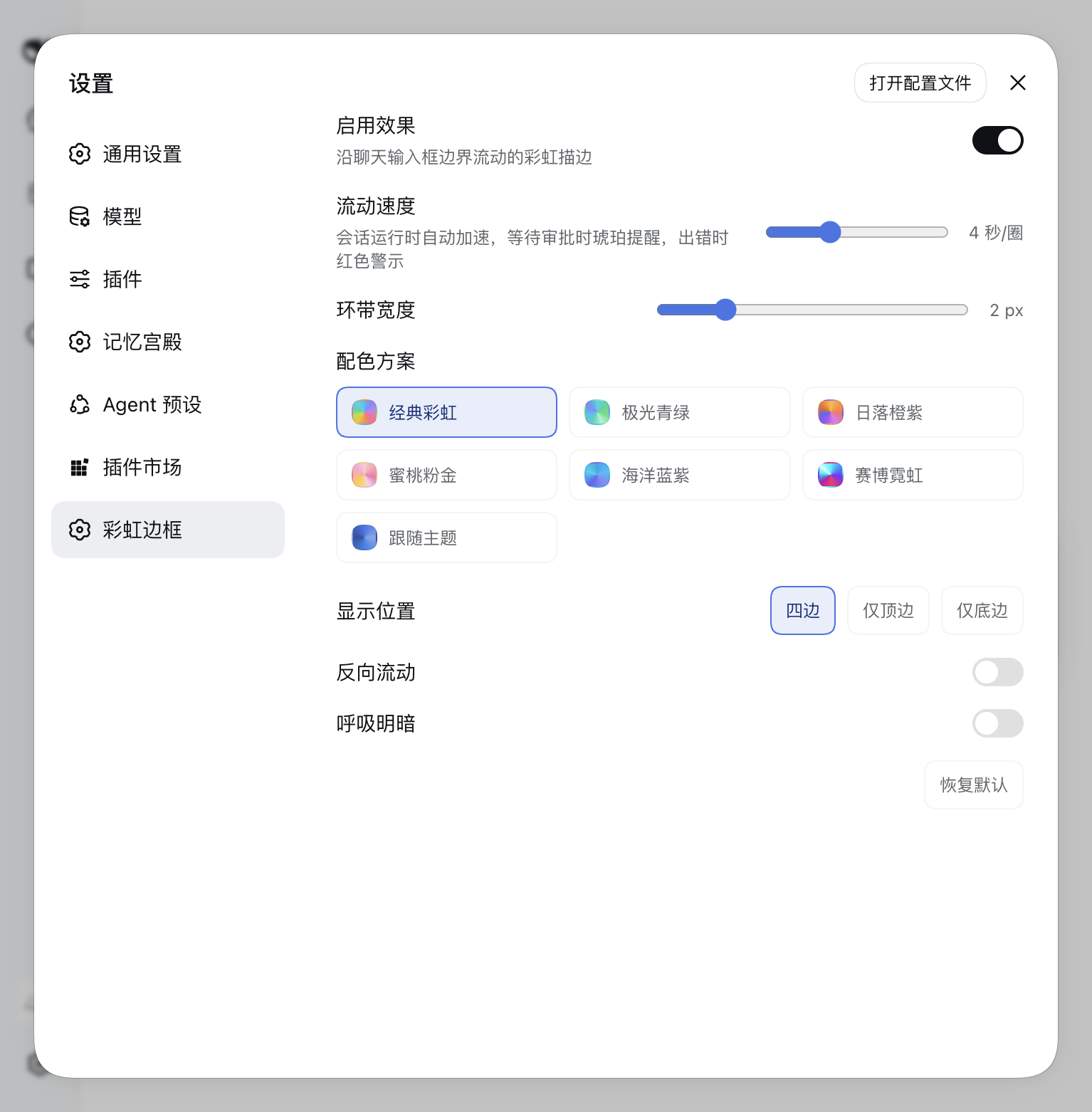
Under simulated host conditions (host-like global rules applied — see
preview/pet-client-sim.html):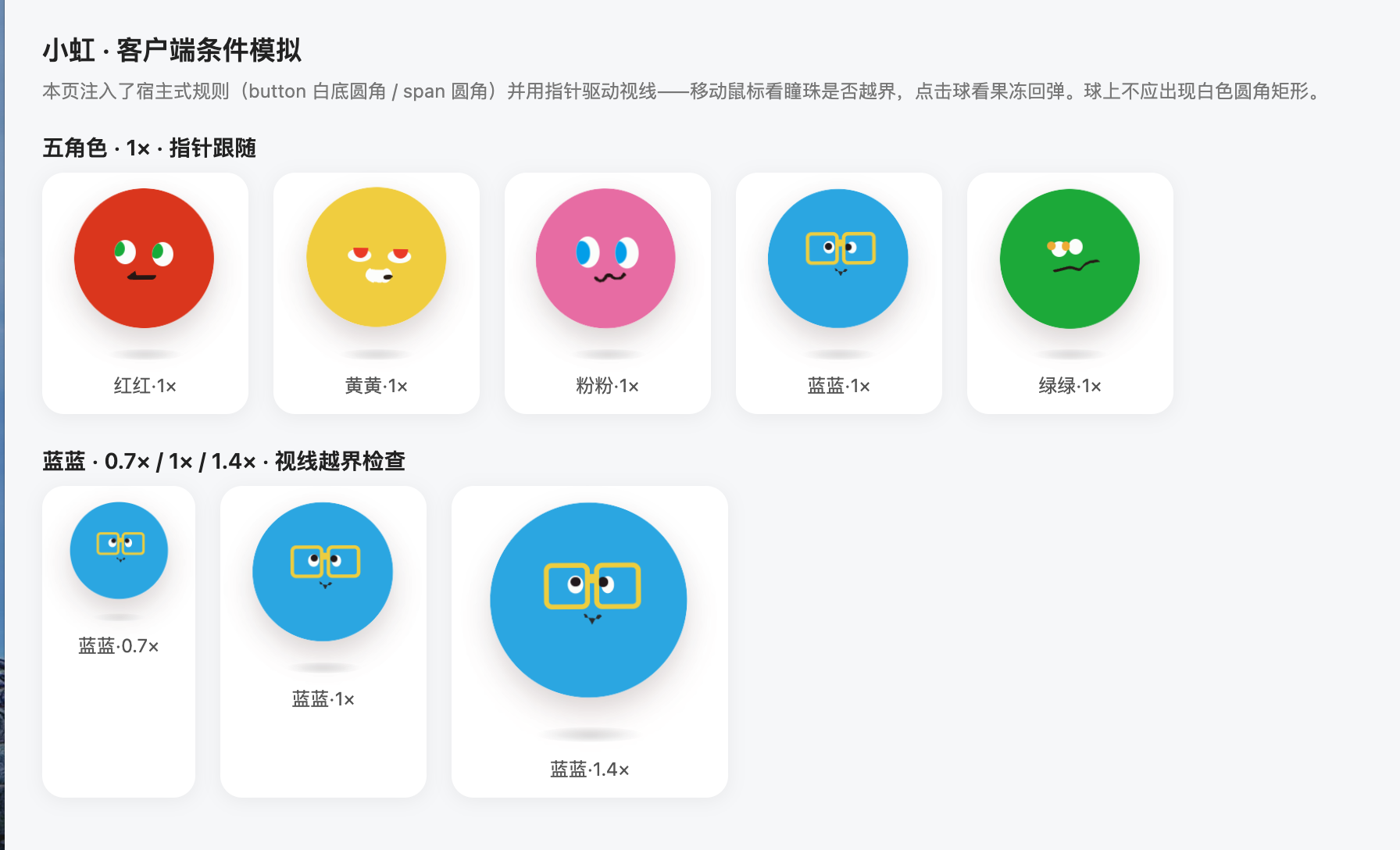
Seven palettes: classic rainbow, aurora, sunset, peach, ocean, cyberpunk, and follow-theme (
color-mixfrom host brand tokens).Cyberpunk Aurora Sunset 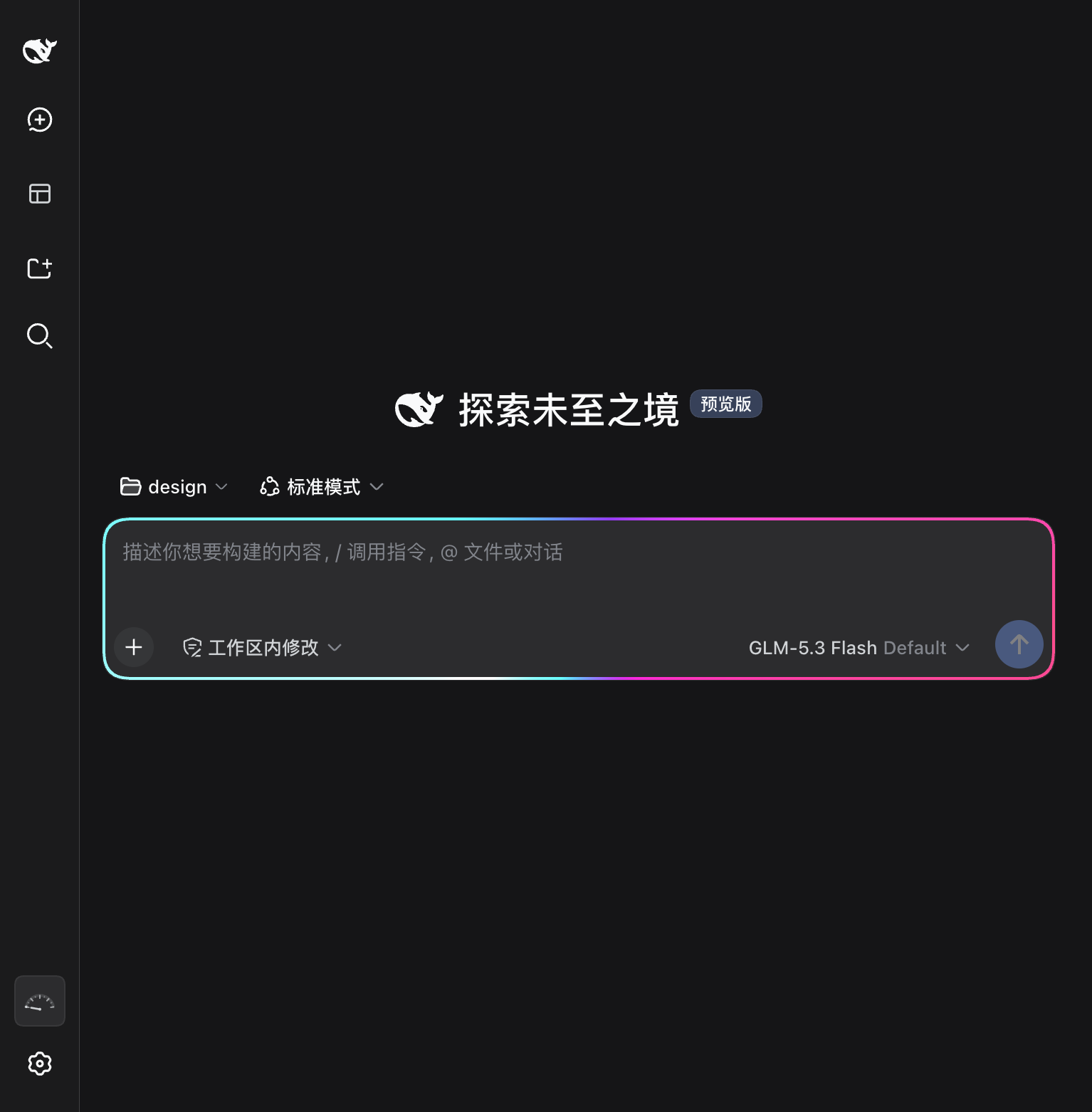
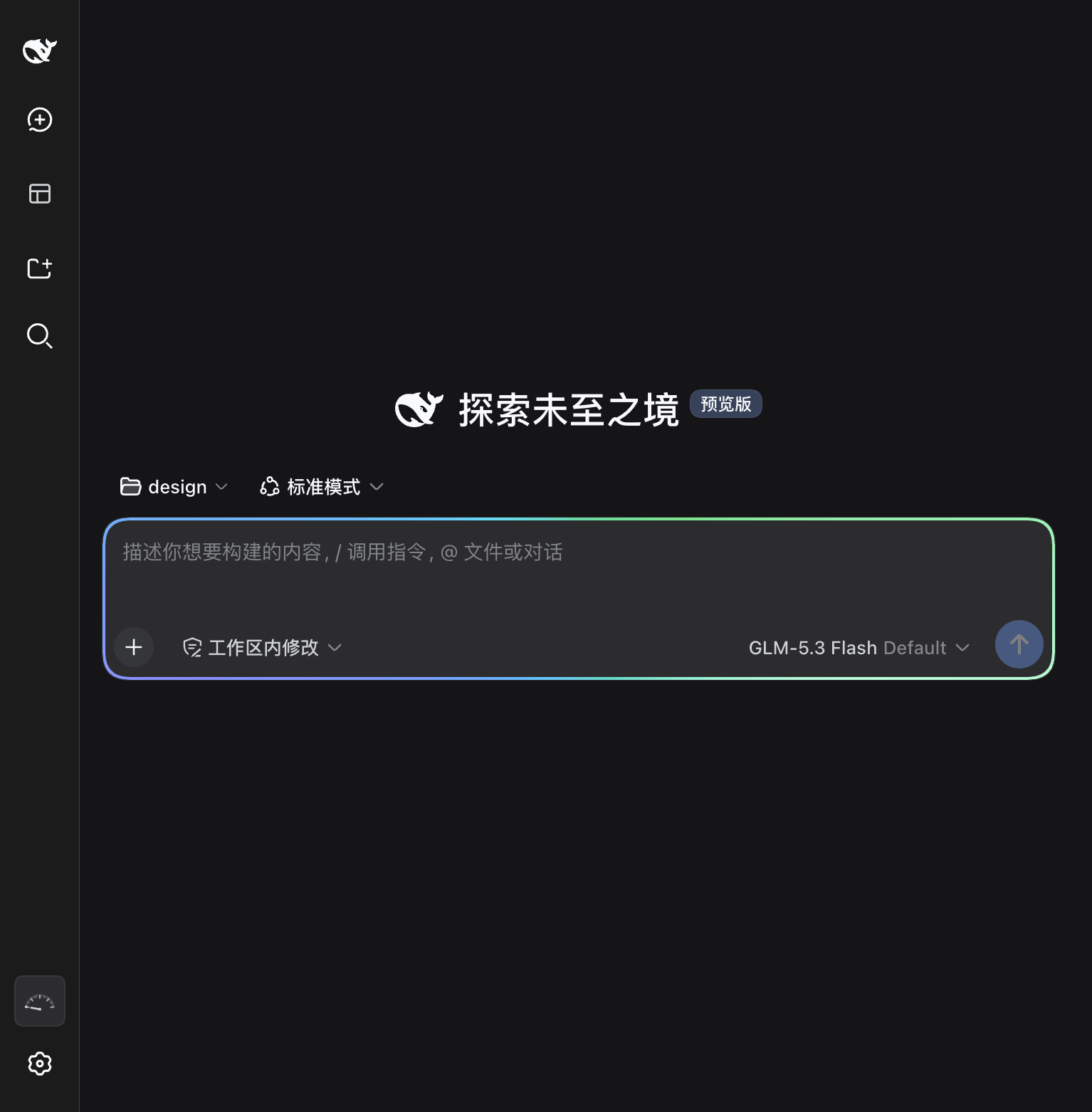
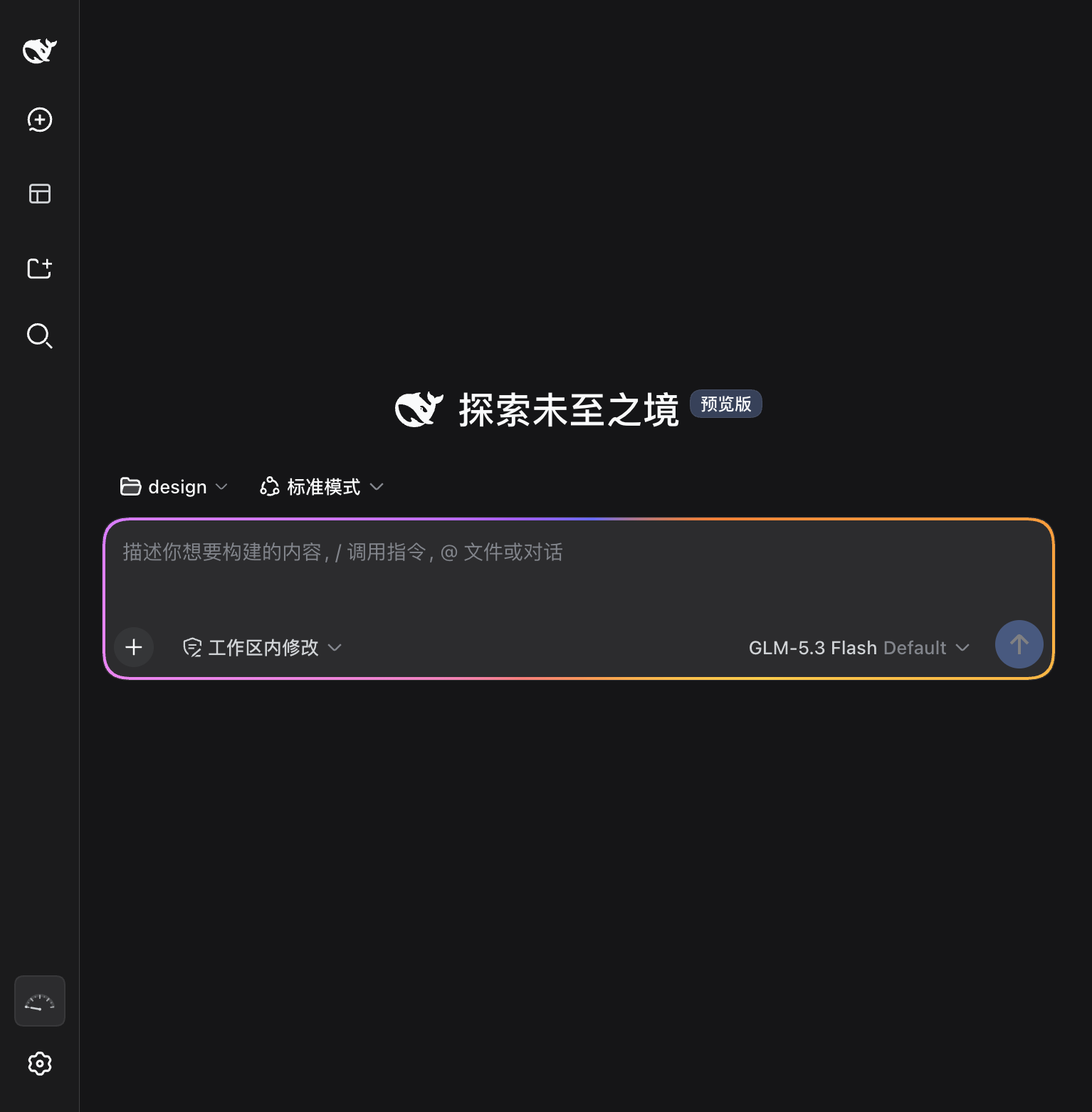
Follow-theme (light mode): the border takes the host brand color and follows theme switches instantly.
Session awareness: the ring speeds up while running; amber slow-pulse while waiting for approvals/questions; red fast-pulse on errors; a celebratory flash on turn completion. Priority: error > attention > running.
Focus glow: the ring brightens while the composer is focused, easing back on blur.
Accessibility: honors
prefers-reduced-motion(animations disabled, static ring and expressions kept); localized labels and aria attributes on all controls.Bilingual: copy is served through the host locale registry and follows the host language.
📦 Install
Via the dsh CLI:
dsh plugin add @kenz1117/dsh-ui-rainbowspeak
Or add it to your profile's package.json:
{
  "dependencies": {
    "@kenz1117/dsh-ui-rainbowspeak": "*"
  }
}
For local development, point the dependency at a checkout:
{
  "dependencies": {
    "@kenz1117/dsh-ui-rainbowspeak": "link:/absolute/path/to/dsh-ui-rainbowspeak"
  }
}
Then run pnpm install in the profile directory and restart the host. With the link: form, running pnpm bundle in the plugin repo is enough — the host picks up changes on its next restart, no reinstall needed.
⚙️ How it works
- The plugin mounts a single
<style data-plugin>stylesheet on apply and removes it on dispose (effect lifecycle). - The composer card's
::beforepaints theconic-gradient;maskcompositing keeps only the edge ring; the color layer is a square conic gradient rotating 360° around the card center — no@propertyangle interpolation needed. - Preferences and session state project onto
<html>data-rainbow-*attributes and inline CSS variables — every switch is immediate, no stylesheet rebuild. - The pet's host half provides a read-only
rainbowPetservice listening toturn/start/turn/end, projecting boundary metadata only; the browser half consumes it viactx.remote.$mount(), validating every frame with the same Zod schema, checking sequence continuity, and backing off on gaps. - The pet itself is pure CSS geometry (no images, no canvas): mouths are
clip-pathpolygons derived from reference-art scanlines; animation uses onlyscale/translate/rotatecompositing-friendly properties — zero repaints per frame; state switches never trigger layout. - The look is fully hardened against host styles and size changes: circles pinned with longhand +
!important, frame stroke incqwscaling with body size (fixed-px fallback on older engines), gaze following proportional to body width and damped per character.
🛠 Development
pnpm install        # deps (peers linked via scripts/link-peers.mjs for monorepo checkouts)
pnpm test           # vitest suite (node half, pref clamping, state projection, pet state machine, bundle smoke)
pnpm typecheck      # tsc --noEmit
pnpm bundle         # tsdown: lib/index.js + lib/remote.js + lib/typert.host.js (node half) + lib/client.js (browser IIFE)
pnpm preview        # generates two previews: pet-states.html (5 characters × 6 states matrix)
                    #                    pet-client-sim.html (host-condition sim: host rules + pointer gaze + 3 sizes)
pnpm bench:anim     # animation bench: Paint / style recalc / layout metrics
pnpm bench:pet-visual      # six-state visual regression (pixel-level)
The replica toolchain (tools/anim-bench/): scan-faces-precise.mjs pixel-precise reference measurement (connected components + scanlines), scan-runs.mjs targeted full-run color segments, mouth-poly.mjs scanlines → clip-path polygons, compare-faces.mjs reference-vs-impl-vs-diff triptychs, measure-grid.mjs gridded reading sheets, measure-implementation.mjs dual-caliber DOM re-measurement. Specs and findings live in docs/character-design.md.
🤝 Compatibility
- Host: dsh desktop/web hosts; tested against 0.2.x (
engines.dsh >= 0.1.2-alpha.1is the floor). Peer:@deepseek-ai/cordis(provided by the host runtime). - Engine: Chromium/Chrome ≥ 105 for the full experience (container-query units,
@property-driven blinking). Older engines degrade gracefully: frame stroke falls back to a fixed 2.1px, blinking falls back to whole-eye squashing — expressions and palettes are unaffected. - Pet remote: needs Typert + client Remote runtime support; without them the plugin still loads and the pet degrades to client-session-only moods.
- Accessibility:
prefers-reduced-motionhonored at all tiers.
📄 License
MIT © 2026 KenZ (kenz1117)
Links
More in this category
zhu1090093659/dsh-web#packages/dsh-task-board★ 10124
Task board for the dsh web GUI: a sidebar multi-column kanban whose cards run in real DSH agent sessions and can also be scheduled with cron expressions, executed host-side even with the browser closed.
zhu1090093659/dsh-web#packages/dsh-web-all★ 10124
Plugin and skin collection for the DSH Web UI: task board, Git graph, right-side panel, remote mobile UI, pet, live token stats, and a skin center.
ccch1mneyyy/dsh-TUI★ 7006
Claude Code-style full-screen terminal UI: pixel-whale header, live status line, and streaming thought expansion.
MeteorNOX/DeepSeek-Balance-Whale-Widget★ 6922
A fixed-corner whale widget for the DSH web GUI — balance, today's usage and per-turn cost with peak/off-peak pricing, editable balance-alert and daily-budget bubbles, a module-based custom bubble queue with A/B weighted choices and random lines or images, 30+ vendor templates (OpenAI, OpenRouter, Kimi, SiliconFlow, Ark, Zhipu, MiniMax and more) with per-model balance and subscription quota, plus task-end sound, imported audio, custom roles and a resource manager. Local-only, no telemetry.
omdsh-dev/DSH-better-sidebar★ 4933
Full sidebar workbench with file rendering and editing, terminal, Git, and subagents; third-party plugins can register new tabs.
Devin-AXIS/deepseek-design#deepseek-idesign★ 1723
Visual design studio for websites, app prototypes, posters, cards, reports, and magazines, with templates, direct element editing, selection-aware AI draft handoff, and export.
Community comments
Comments are public GitHub Discussions. Loading them connects to GitHub and Giscus; a GitHub account is required to post.