Runtime requirement drift guard that keeps long-running DSH agents aligned with the user's approved goal, constraints, and decisions.
Install
# from npm (prebuilt)
dsh plugin --profile web add dsh-requirements-alignment
# from GitHub (first run asks for allowBuilds approval — follow the hint, retry)
dsh plugin --profile web add github:jiezeng2004-design/dsh-requirements-alignment
Any plugin you install runs third-party code with your own permissions — it can read your files, use your credentials, and reach the network, and tool approvals don’t sandbox it. GitHub-sourced plugins also run build scripts at install time — pnpm blocks those until you allow them, so an install can stop with ERR_PNPM_GIT_DEP_PREPARE_NOT_ALLOWED or ERR_PNPM_IGNORED_BUILDS; dsh prints the exact key to add under allowBuilds in your profile’s pnpm-workspace.yaml, and the install works on the next run. Allowing a build is a trust decision: only install sources you trust, and pin a commit (github:owner/repo#sha).
README
Stop long-running agents from quietly changing what you asked for.
让 DSH Agent 自己做工程决策,但别让它在长任务里悄悄改需求、扩范围、换架构。
dsh-requirements-alignment is a lightweight runtime drift guard for DeepSeek Harness (DSH). It turns the user's intent into a durable requirement baseline, stays out of the way while the agent works, and only interrupts when the next step would materially change the direction.
You decide the direction. The agent decides the engineering.
Current release candidate: v0.5.0-rc.1, targeting DeepSeek Harness 0.1.7-rc.2. Requires Node.js >=22.18.0. See the compatibility report for verified behavior and limits.
The problem
Long-running coding agents are good at keeping momentum. That is also how they can drift.
A task may start as:
Fix the result-page filter.
Do not refactor backend logic.
Later the agent discovers that a cleaner solution would require backend changes. Without an explicit guardrail, it may simply expand the scope and continue.
Requirements Alignment changes that behavior:
User intent
   ↓
Durable requirement baseline
   ↓
Agent works normally
   ↓
Direction-changing step detected?
   ├─ No  → keep working silently
   └─ Yes → ask once → record decision → continue
What counts as drift
The plugin is interested in direction-level changes, not implementation trivia.
Typical drift candidates include:
- expanding or shrinking the approved scope;
- violating an explicit constraint;
- changing user-visible behavior;
- switching architecture or product form;
- invalidating a settled assumption;
- changing a previously approved user decision;
- taking a destructive path that changes the intended outcome.
It should not stop the agent to ask about variable names, helper placement, ordinary refactors inside the approved scope, or other routine engineering choices.
Requirements Alignment vs Plan Mode
Plan Mode asks:
"Is this the right implementation plan?"

Requirements Alignment asks:
"Are we still solving the right problem?"
Plan Mode helps before implementation starts. Requirements Alignment protects intent during execution.
They are complementary:
Plan → approve → execute → detect direction drift → re-align only when needed
Quick start
Install this release candidate into your DSH Web profile:
dsh plugin --profile web add dsh-requirements-alignment@0.5.0-rc.1
Then use DSH normally.
Auto mode is the recommended default. Clear tasks continue with zero interruption. When a real direction change appears, the plugin surfaces one decision and records the result.
Use /align any time you want an explicit status check.
Three modes
| Mode | Behavior |
|---|---|
| Auto | Watches for direction-level drift and asks only when necessary |
| Manual | No automatic drift policy; use /align when you want a check |
| Off | Alignment capabilities are disabled for that session; /align-mode remains available so you can switch back |
Common commands:
/align
/align-mode
/align-mode auto
/align-mode manual
/align-mode off
/align-mode reset
Per-session control:
/align-mode session
/align-mode session auto
/align-mode session manual
/align-mode session off
/align-mode session reset
A session override changes only that session. Shared runtime settings remain separate. On DSH 0.1.7, shared mode uses the profile's runtimeMode field; resetting it to null follows the live mode default without erasing other settings.
Example
Stay inside the original scope
User:
Improve the result-page filter. Do not refactor backend logic.

Agent:
[works normally]

Agent discovers:
A complete fix would require backend changes.

Requirements Alignment:
[reports a drift candidate and asks]

User:
Stay within the current scope.

Agent:
[keeps the backend untouched and continues within the approved direction]
Approve a real direction change
User:
The app is single-user and local-only.

Later:
Make it work across devices.

Requirements Alignment:
[detects that accounts/cloud sync may change the architecture]

User:
Approve the direction change: multi-user with accounts and cloud sync.

Agent:
[records the new baseline revision and continues]
How it works
The plugin provides a small set of alignment primitives:
establish_baselinerecords the current goal, explicit constraints, must-preserve behavior, allowed scope and settled user decisions;report_driftsurfaces a material direction change, asks through DSH's native user-question path and records the exact decision;/alignreports current alignment status and requests a fresh inspection;/align-modechanges Auto / Manual / Off behavior without requiring you to uninstall the plugin.
Canonical alignment state is kept in durable sidecar storage instead of being mixed into normal DSH session events. That keeps resume/fork/compaction behavior stable and avoids turning the session log into a plugin-specific state database.
Runtime mode model
Effective mode follows this order:
valid session override
        ↓
valid persisted runtime override
        ↓
valid profile default
        ↓
auto
This means two live sessions can use different alignment modes without leaking state into each other.
Switching modes changes which alignment capabilities are active. It does not delete the requirement baseline or drift history.
Web UI
In supported DSH Web builds, the plugin includes a small floating alignment control that exposes the current session mode and shared mode without requiring manual profile edits.
The UI and /align-mode operate on the same underlying state, so they are intended to stay consistent. Live browser interaction was not verified for this release candidate; the packed CLI/Web HTTP path was.
Long-running tasks can wait and continue
When the agent genuinely needs your decision, the expected behavior is to wait instead of guessing.
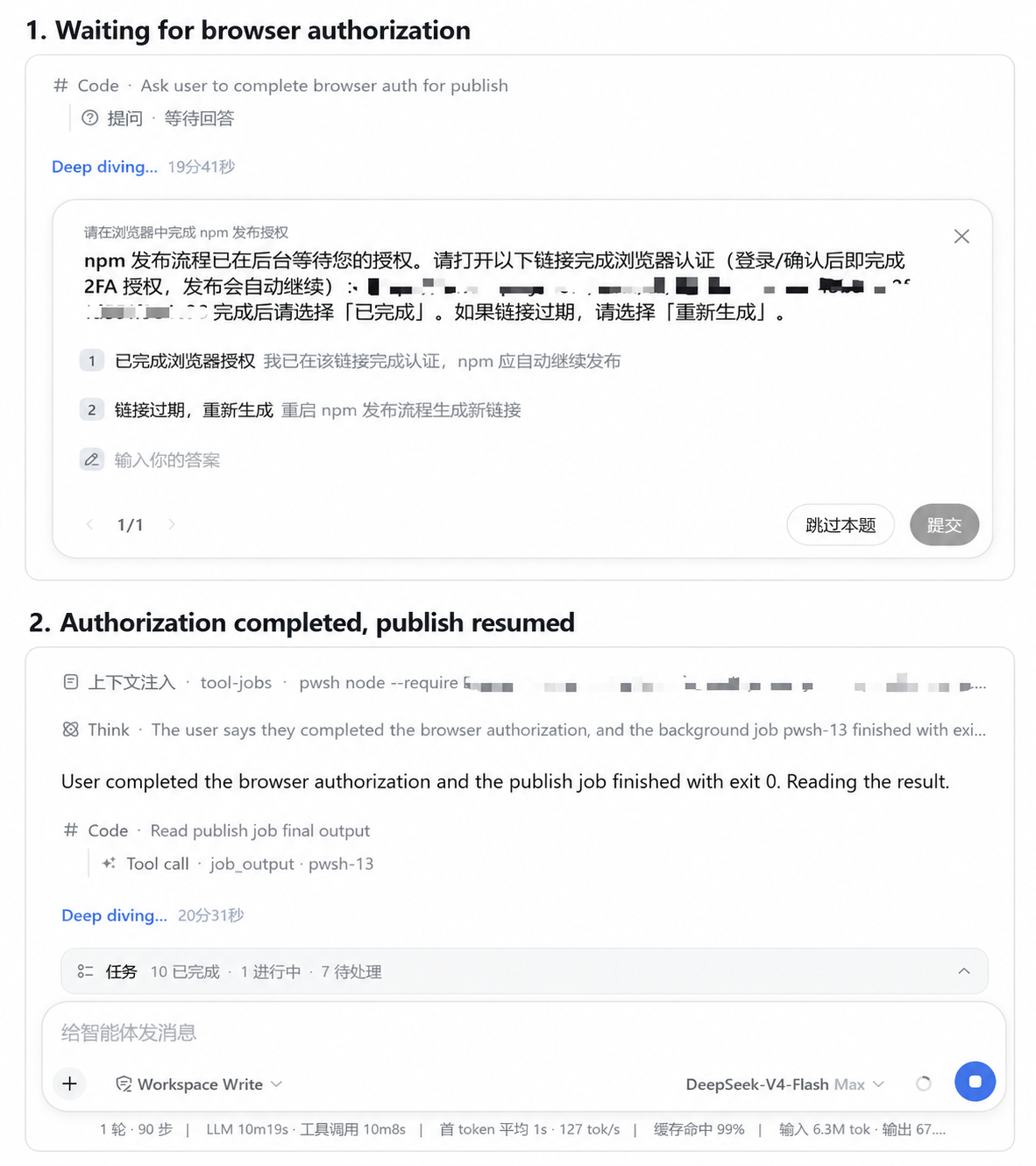
The same design principle applies to requirement drift: pause for the high-impact choice, record it, then continue from the new baseline.
What this plugin does not do
- It does not replace DSH Plan Mode.
- It does not turn every engineering choice into a user question.
- It does not require a full PRD or spec before work can start.
- It does not rewrite DSH core packages.
- It does not continuously interrupt clear tasks.
- It does not delete alignment state when modes change.
Uninstall
dsh plugin --profile web rm dsh-requirements-alignment
Off is not the same as uninstalling: Off keeps the plugin installed so the session can switch back to Auto or Manual at runtime.
Design goal
The project deliberately avoids becoming a full requirements-management system.
Its job is narrower:
Protect the few human decisions that define what is being built, then let the agent work.
Development focus
The implementation is designed around:
- durable baseline and drift state;
- session-scoped mode isolation;
- resume / fork / compaction continuity;
- hot mode switching without duplicate registrations or listener leaks;
- compatibility with normal DSH session semantics;
- minimal interruption when the requested direction is already clear.
Contributing
Found a bug or have an idea? Open an Issue. Pull requests are welcome.
License
MIT. See LICENSE.
Links
More in this category
Q00/ouroboros#integrations/dsh-plugin★ 6144
Config-only bundle that mounts Ouroboros through the DSH MCP client, exposing 36 interview, Seed, execution, evaluation, and evolution workflow tools in DSH.
loopx-project/loopx#dsh-loopx-plugin★ 6111
LoopX, a provider-neutral, local-first state kernel and control plane for long-horizon agents: keeps Goal, Todo, gate, evidence, quota, recovery, and handoff state above DeepSeek Harness, while the plugin bootstraps the CLI and skills, admits bounded same-session continuation, and adds a loopback GoalBar for the exact bound loop.
chuspeeism/dashi-taskboard#deepseek-harness★ 3262
Embeds the active installed Codex Taskboard runtime in the DeepSeek Harness sidebar, using its launcher runtime descriptor instead of a fixed port.
NanmiCoder/dsh-agent-teams★ 1848
AgentTeams multi-agent teams.
EthanYoQ/AI-Novel-Writer#dsh-ai-novel-writer★ 1205
Installs a dedicated AI novel-writing preset and workbench: revisioned local project assets, a compact side drawer, and native approval-gated single-file changes.
tong-io/tongflow#dsh-tongflow★ 1034
TongFlow film-crew studio for image, voice, music and video production: the agent writes per-asset TongFlow workflow files (.tongflow.json) that run through TongFlow plugins, with an embedded workflow canvas, a shot/character/take project layout and a manga-drama template; sessions starting with @tongflow open the Studio view.
Community comments
Comments are public GitHub Discussions. Loading them connects to GitHub and Giscus; a GitHub account is required to post.