A terminal UI (TUI) for DeepSeek Harness.
Install
# from npm (prebuilt)
dsh plugin --profile web add @huiliyi37/dsh-tianshu-tui
# from GitHub (first run asks for allowBuilds approval — follow the hint, retry)
dsh plugin --profile web add github:huiliyi37/dsh-tianshu-tui
Any plugin you install runs third-party code with your own permissions — it can read your files, use your credentials, and reach the network, and tool approvals don’t sandbox it. GitHub-sourced plugins also run build scripts at install time — pnpm blocks those until you allow them, so an install can stop with ERR_PNPM_GIT_DEP_PREPARE_NOT_ALLOWED or ERR_PNPM_IGNORED_BUILDS; dsh prints the exact key to add under allowBuilds in your profile’s pnpm-workspace.yaml, and the install works on the next run. Allowing a build is a trust decision: only install sources you trust, and pin a commit (github:owner/repo#sha).
README
中文 | English
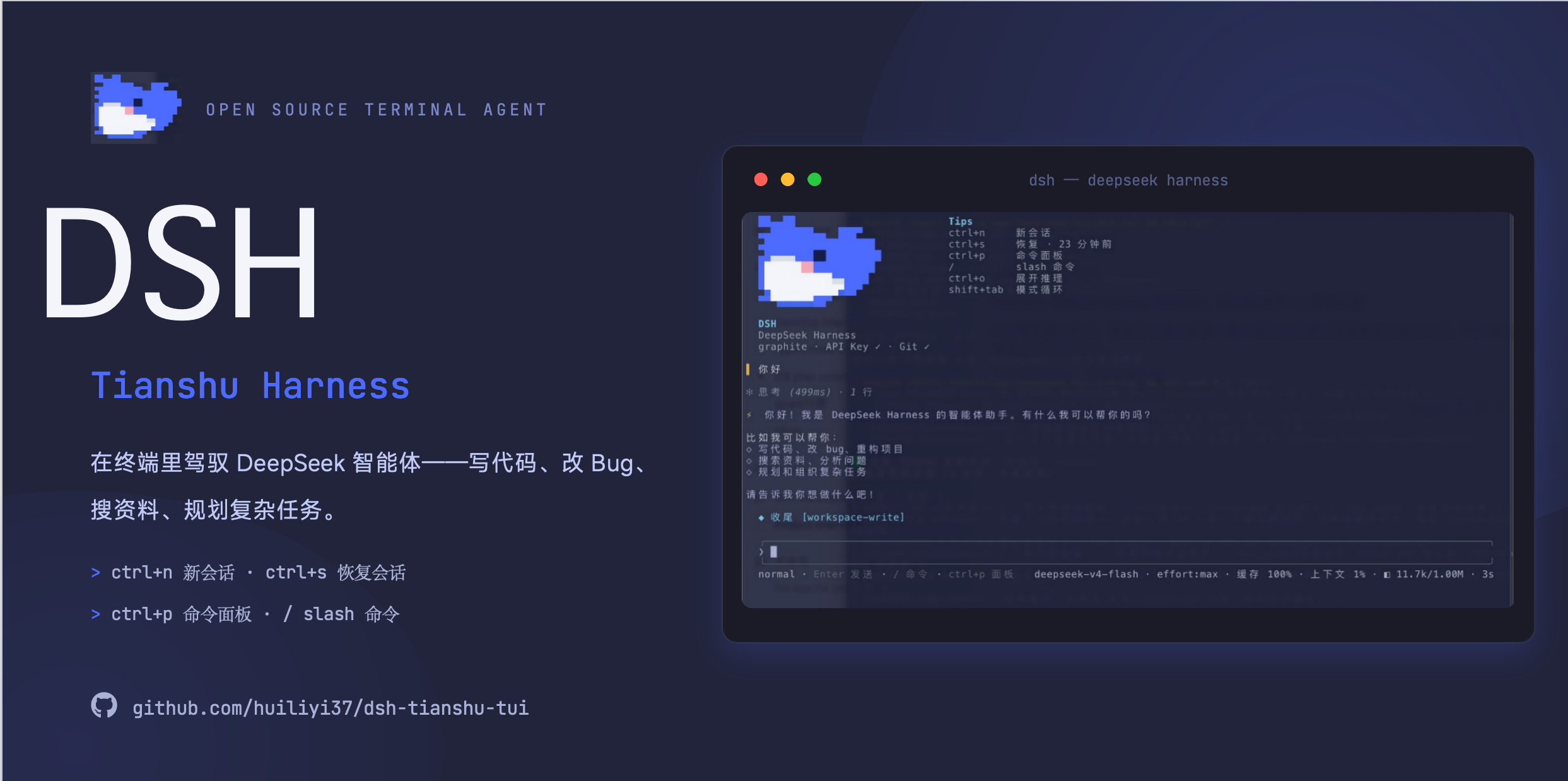
dsh-tianshu-tui (@huiliyi37/dsh-tianshu-tui) is the interactive terminal UI plugin for the official DeepSeek Harness. The render core is a self-built minimal ANSI engine (evolved from the author's own open-source Tianshu-Tui, Apache-2.0; file-by-file provenance in SOURCE-MAP.md), keeping rendering lightweight and non-intrusive. The UI is a pure presentation layer: every piece of agent state arrives through the session event stream. On top of it, the plugin adds harness-level engineering niceties such as image & vision bridging, smart code retrieval, and memory with cross-session recall.
Documentation
| Doc | What it covers |
|---|---|
| Getting started | Install, launch, and troubleshooting |
| Interaction | Full keymap and command reference |
| Configuration | Assembly options, env vars, runtime config |
| Architecture | Layers, data flow, design decisions |
| Themes | The 16 built-in palettes and custom themes |
| Plugin ecosystem | Companion plugins and extension points |
| VS Code | Running inside VS Code |
| ADAPTER.md | TUI ↔ harness boundary contract |
| Contributing | PR guidelines and the verification matrix |
| Developing | Structure, build, release |
Install
This package is not a standalone app. You need the official CLI @deepseek-ai/dsh (npm latest, currently 0.1.5-rc.1; needs ≥ 0.1.5-rc.1, aligned with the peer deps). npm i of this package alone will not run.
One-click install (recommended): the repo ships cross-platform scripts that detect Node/pnpm, install the official CLI via pnpm, wire this plugin and launch (defaults to the npmmirror registry for CN networks):
# macOS / Linux (bash)
bash <(curl -fsSL https://raw.githubusercontent.com/huiliyi37/dsh-tianshu-tui/main/scripts/install-tui.sh)
# install only, no launch:
bash <(curl -fsSL https://raw.githubusercontent.com/huiliyi37/dsh-tianshu-tui/main/scripts/install-tui.sh) --no-launch

# Windows (PowerShell)
powershell -ExecutionPolicy Bypass -Command "irm https://raw.githubusercontent.com/huiliyi37/dsh-tianshu-tui/main/scripts/install-tui.ps1 | iex"
# install only, no launch (after cloning the repo):
powershell -ExecutionPolicy Bypass -File scripts\install-tui.ps1 -NoLaunch
1. Prerequisites
- Node.js
^22.19 || >=24 pnpmon PATH (dsh pluginforwards to it; if missing,corepack enable— Node ships corepack)
⚠ npm 11 OOM pitfall: the official CLI
@deepseek-ai/dshhas a large dependency tree (60+ sub-packages); npm 11 (bundled with Node 24) runs out of heap while installing it (hangs for minutes thenJavaScript heap out of memory— reproduced). Use pnpm (commands below). If you are already onnpx -y @deepseek-ai/dshand it hangs/throws heap OOM, switch to pnpm.
Do not type dsh by itself. An older dsh on PATH (for example ~/.local/bin/dsh, where dsh --version is below 0.1.0-rc.8) will hit a local staging tree and fail with ERR_FS_EISDIR / Path is a directory .../@deepseek-ai/dsh. Always use the pnpm dlx commands below.
2. Add this plugin to the tui profile
pnpm dlx @deepseek-ai/dsh plugin --profile tui add @huiliyi37/dsh-tianshu-tui
pnpm may warn about missing peers; ignore that. Peers come from the official dsh host. Without pnpm you can also use npx -y pnpm dlx @deepseek-ai/dsh plugin --profile tui add @huiliyi37/dsh-tianshu-tui.
After an npm install, each launch checks npm latest and writes a newer version into the profile, then asks you to restart. You can also run /update inside the TUI for a manual check (check-only; it prints the update command). Set DSH_TUI_SKIP_UPDATE=1 to skip the check. github: / link: installs are left alone.
You can also install from Git: pnpm dlx @deepseek-ai/dsh plugin --profile tui add github:huiliyi37/dsh-tianshu-tui (the repository ships lib/index.js; no rebuild).
3. Start
pnpm dlx @deepseek-ai/dsh --profile tui
Success looks like a welcome screen branded dsh-tianshu-tui. Quit with Ctrl+Q or /exit.
If the official CLI is installed globally (pnpm add -g @deepseek-ai/dsh) and dsh --version is at least 0.1.0-rc.8, you can use dsh in place of pnpm dlx @deepseek-ai/dsh.
4. Agent presets (/preset)
The command is /preset (there is no /presets). This bundle matches official web: it disables the host agent plane and mounts @deepseek-ai/dsh-agent-presets (pinned 0.1.5-rc.1; npm latest still points at stale 0.0.1-rc.1). Adding this plugin installs the roster; new sessions mount in setup. /preset switches the official shipped surface (standard / PTC / minimal / creative), rather than stacking on dsh-base tools.
Usage:
/preset— list each preset's capability and toolset,*marks the current one; the footer / welcome top bar also show the short name (Standard / PTC / Minimal / Creator). After a turn,wire:shows the last request's tool surface/preset <id>— switch to the given preset (blank sessions only:/session newfirst;ptc/creativealiascode/cordis)
If npx still raises ERR_FS_EISDIR, stale install fallbacks under ~/.dsh/profiles/node_modules are colliding with the official CLI. Use a clean home:
DSH_HOME=/tmp/dsh-tianshu pnpm dlx @deepseek-ai/dsh plugin --profile tui add @huiliyi37/dsh-tianshu-tui
DSH_HOME=/tmp/dsh-tianshu pnpm dlx @deepseek-ai/dsh --profile tui
Do not run tsdown for this package from the DeepSeek Harness workspace root: it rewrites imports to unpublished @deepseek-ai/dsh-root, and loading fails.
The companion vision plugin lives in vision-ask/ if you need image re-interrogation.
Release notes
Current npm latest: @huiliyi37/dsh-tianshu-tui@1.0.0-rc.1 (GitHub Release).
1.0.0-rc.1 (2026-09-14): first release candidate of 1.0.0; the version enters the 1.0 line. Four convergences on top of 0.1.2-rc.31 — retry-path body loss fixed (after a successful LLM retry the step's body was dropped whole: each host attempt is an independent attempt, so per-step dedup was a modelling error); failed attempts now get a ⟳ 未完成的尝试 (unfinished attempt) marker before their body so they are not read as one continuous answer with the successful one; assistant stream semantics merged into adapter/assistant-stream as the single implementation (previously four copies, so one host behaviour change needed four coordinated edits); two consumer-less dead states removed (SessionManager snapshot layer, TranscriptView.streaming aggregation). ⚠ Requires host ≥ 0.1.5-rc.1 and node ≥ 24.4.
0.1.2-rc.31 (2026-09-14): fixes #58 — assistant body text missing on normal turns against the 0.1.5 host (attempt events only occur on error/interrupt paths; normal turns deliver text embedded in assistant/message, now rendered at the message boundary with per-step streamed-text dedup). ⚠ Requires host ≥ 0.1.5-rc.1 and node ≥ 24.4 (the 0.1.5 host CLI entry depends on import.meta.main; older nodes exit silently with no output).
0.1.2-rc.30 (2026-09-12): host line moves to 0.1.5 (official latest is now 0.1.5-rc.1) — streaming events assistant/chunk→batched assistant/attempt, the new sessionPersistence contract (snapshot list + open/read handles), defensive rendering for missing timestamps in cross-format stores; real-machine pty e2e green. ⚠ Requires host ≥ 0.1.5-rc.1.
0.1.2-rc.29 (2026-09-09): host line moves to 0.1.2-rc.1 (now the official latest; fixes #56 boot crash) — Session.events removal adapted to snapshotEvents(), userQuestions migrated to a waterfall answerer (global registration), CallId→ToolCallId, preset code→ptc, fork lineage via isSeeded+inheritedEventCount, bundle patch gains subagent-model-selection-settings; older hosts (≤0.1.1-rc.2) fail loud at startup with upgrade/rollback guidance. ⚠ This release requires host ≥ 0.1.2-rc.1.
0.1.2-rc.28 (2026-08-29): vim improvements answering #55 — mode-distinct cursor (block in NORMAL / bar in insert), two-phase history search (queries may contain n/N; Enter to confirm then jump; the search target is now labelled), search-term highlight (also in /scroll); plus auto-refill of the input line on delivery failure and a README-keymap consistency guard.
0.1.2-rc.27 (2026-08-29): two backports from Tianshu — actionable errors (beyond the full error commit + recovery hint, the last delivered message is auto-refilled into the input line with a ↩ "may not have been fully processed" note; edit and re-send; cleared on successful turns, drafts never clobbered); plan-review decision-card visual layering (dim decision-zone divider + ❯/success primary-action highlight; rendering byte-identical when no theme is passed).
0.1.2-rc.23 (2026-08-27): LSP trio aligned to the upstream 0.6.0 official seam line (single lsp tool with four operations + local provider defaulting to tsserver), capability-gated diagnostic source prevents /lsp panel regression; host peers aligned to ^0.1.1-rc.2.
0.1.2-rc.22 (2026-08-27): LSP model tool surface shipped bundled first version (companion plugin auto-inserted; remove the legacy community plugin).
0.1.2-rc.21 (2026-08-27): three community fixes — inverse-video input caret (#50), preset defaults to standard (#48), root-cause + upstream report for malformed SSE payload (#49).
Full release history: CHANGELOG.md (zh) and GitHub Releases. In the TUI, /changelog shows the current release (/changelog all for everything).
Highlights
- Full session workspace in a terminal — live rendering, append-only scrollback, session restore on startup,
/forkexploration branches,/rewindrollback (session truncation + optional file rollback),/exportto Markdown transcripts, and mid-turn steering (/steer/Ctrl+T). - End-to-end images — paste from clipboard (
Ctrl+V/ terminal-menu paste), render as inline terminal graphics (kitty / iTerm2), deliver through the harness attachment service, and let a vision-capable model actually see them — with an automatic vision bridge that describes the image through a separate vision model when the main model cannot see. - A complete input surface — grok-style slash dropdown menu (fuzzy prefix matching, MRU ordering, ghost previews),
@-path Tab completion and@mentionexpansion, bracketed paste, optional vim keybindings, external editor (Ctrl+E), history search (Ctrl+F/Ctrl+R) — and a full keymap overlay behindCtrl+.. - In-terminal interaction surfaces — structured question panels (numeric selection, plan-review feedback mode), pending approval cards with inline
diffpreviews, mode cycle (Shift+Tab: normal → plan → always-approve), command palette, and live panels for status / config / skills / tasks / delegation / workflow. - Reasoning made visible — the think channel streams as a live header, folds into a compact scrollback line (
✻ 思考 (3.2s) · 12 行), and expands in place withCtrl+O(competitor-aligned: collapsed by default). - Personalized harness integrations —
/doctorterminal diagnostics,/memoryproject-memory browser,/btwside questions to a background agent,/model+/efforthot-switching that takes effect on the current session immediately. - Auditable by construction — the TUI registers no prompt, tool, or context surface of its own; user input becomes ordinary logged messages, and every rendered state derives from session events.
- Co-evolved with the harness — built in lockstep with harness-side capabilities on the 2026-08-09 baseline snapshot (250+ commits): the image/vision pipeline, DeepSeek Spark model engineering, session persistence and file snapshots, memory, the validation gate and failure routing, code intelligence, and the git tool. See the next section.
Co-evolved harness capabilities (since the 2026-08-09 baseline)
The terminal UI evolved from Tianshu-Tui (Apache-2.0; per-file provenance in SOURCE-MAP.md). This bundle then developed in lockstep with harness-side work on the DeepSeek Harness baseline snapshot snapshots/20260809T140917Z — 250+ commits between 2026-08-10 and 2026-08-13. The capabilities below live in the host harness (separate packages, not shipped in this bundle); the TUI is their primary interactive surface:
- Image pipeline & vision bridge — the
imageContentBlock joins the merge-extensible content vocabulary anddsh-llm-deepseekserializes user image blocks as OpenAI-styleimage_urlcontent parts, so user images reach the wire end-to-end (clipboard → input line → session → model request). Models declaresupportsVision(LlmModelInfo+ llm-deepseek catalog).dsh-vision-bridgecovers text-only main models: atagent/pre-stepit describes image attachments through a separate vision model (visionAutoBridgeauto-selects the first vision-capable model when provider/model are omitted; fallback model + data URL validation; the prompt auto-selects between general structure and OCR-level transcription based on UI/error keywords), injecting the description as a plugin-source user message — Model-visible ⟺ logged; bridge failure degrades to a visible hint, never a failed turn. - DeepSeek Spark aliases — the official API has no
sparkmodel and this host does not register adeepseek-sparkprovider./model spark-flash/spark-promap onto the registereddeepseek-officialroute with wire idsdeepseek-v4-flash/deepseek-v4-pro. - Session persistence & file snapshots —
Session.truncaterewinds the event log and resets derived state; persistence backends gaineddeleteFromplus a truncate coordinator, so rollback survives reload;dsh-fs-snapshotports FileHistory (trackEdit / rewindToBoundary) and snapshots before write-tool execution. TUI surface:/rewind(conversation truncation + optional file rollback). - Memory —
dsh-memory(MemoryService + Markdown file backend, non-git fallback) andtool-memory(memory_save/memory_search+ memory-digest injection) provide cross-session recall. TUI surface:/memory,/remember. - Validation gate & failure routing —
dsh-evidence-gateenforces RED-first verification: obligation state machine, edit/verify counters, TDD gate (enforcemode), probe suggestions with cooldown, and an L2 final-review gate, natively wired intostr_replace_editorand the headless-agent assembly.dsh-agent-routerpredicts step failure from turn history and routes work — verification-subagent dispatch and per-profile tool restriction — with real-turn e2e coverage. - Code intelligence & retrieval —
dsh-semantic-index(BM25 + salience/RRF/vector fusion, incremental updates) exposed as thesemantic_searchtool;dsh-meridiancode index (node:sqlite schema, tree-sitter parsers for TypeScript/Python/Go, graph/impact/flow queries, behavioral signals, background backfill) exposed asrepo_graphand the<codebase-index>digest;dsh-pheromonefile-level pheromones with atomic JSON persistence, surfaced throughfile_infoand the read tool'sfocussemantics. - Git service & tool —
dsh-gitservice seam (GitLocal CLI provider, service-class-as-plugin) plusdsh-tool-git, a single model-facing git tool with an operation discriminator (status / diff / log / commit), assembled in the base bundle.
Features
Session management
| Capability | Description |
|---|---|
/session new|list|switch |
Create, list, and switch sessions; resume replays the full transcript through the same render bridge |
| Restore panel | Recoverable sessions are listed in scrollback at startup |
/fork [directive] · /branch |
Fork the current session (history copied to a new child session) and optionally start it with a directive |
/rewind |
Roll back to a chosen message — conversation truncation and/or file rollback to the pre-boundary snapshot |
/export |
Export the current session transcript to a Markdown file |
/clear |
Clear the scrollback view of the current session |
Input surface
- Slash command menu — typing
/opens a dropdown with fuzzy prefix matching,↑↓/PageUp/PageDownselection,Tabaccept,Entersubmit, MRU ordering, argument-placeholder ghosts, and an input-line ghost preview. - Clipboard & image paste —
Ctrl+Vreads a clipboard image (falling back to text); terminal-menu paste detects images; pasted paths that look like images are loaded as attachments;Alt+W/ vim yank copies selection to the system clipboard via OSC52. - Image submission — attached images show a
📎 N imagesmarker, render inline under the user bubble on submit, and reach the model through the attachment service; the bubble carries a vision hint (forwarded / bridged via a vision model / not sent). Oversized pastes are adaptively compressed before send: 1568px long-edge clamp (PNG keeps transparency), degrading JPEG 0.82 → 0.55 → 1024px + 0.55 until under the provider cap, never upscaling. - Vim editing (#51) —
Escenters NORMAL; the keymap mirrors Claude Code:h j k l / w e b W B E / 0 $ ^ / gg G / f F t T ; ,, operatorsd c y × motionwith counts, text objectsiw aw iW aW, linewisedd cc yy Yplusp Ppaste,x X D C s S r o O J u .;v/Vvisual selections include the character under the cursor (vim ownership semantics). Multi-line drafts move column-wise withj/k; CJK runs count as single words. Toggle at runtime with/vim;/vim defaultmakes it the startup default. Insert-mode two-key sequence → Esc mappings (vimInsertRemaps, e.g.{"jj":"esc"}in prefs; 1s window guards against accidental triggers). Cursor shape follows the mode: block (reverse video) in NORMAL, bar in insert (#55). NORMAL / opens session-history search (two-phase: filter as you type, Enter to confirm then n/N jump — queries may contain n/N). - Editing — external editor (
Ctrl+E), Tab file completion,@mentionexpansion, input history, multi-line input, and bracketed paste (multi-line / long pastes land in the input line as one block instead of submitting line by line); the input line is drawn as a full rounded frame. - Message queue while running (Claude Code queue parity) — messages submitted while the agent is running enter a local queue shown above the input rail (echoed immediately, not sent); they flush in order at the next turn end, and an aborted turn does not auto-flush (leaving room to take them back with
↑); empty-input↑pops the first queued item back into the input; switching sessions drops the queue with an echo. Mid-turn immediate steering stays on/steer/Ctrl+T. - Image re-interrogation — the companion
@deepseek-ai/dsh-vision-askplugin registers sent images and answers targeted model questions viaask_image(see vision-ask).
Rendering & projection
- Conversation stream — markdown rendering, tool-family coloring with per-tool timing, and parallel tool calls folded into groups.
- Tool cards commit in real time — settled tool results render as scrollback cards consuming the harness presenter intent:
diffresults as structured red/green file diffs (shared with the approval preview),terminalresults with command title + cwd + exit/signal badge, everything else as folding cards. - Reasoning channel — shimmer live header while thinking, folded scrollback line at segment end,
Ctrl+Oexpands the full text in the live area. - Fluency folding — repetitive routine tool traffic collapses under a quiet strategy; compact mode (
/density) keeps header-only lines. - Turn status — braille spinner + phase text status line, workflow-run summaries, delegation tree, task pane, config/skills panels as live-region panels; a non-aborted turn with tool calls ends with a dim summary line (
turn N · 读X 改Y · elapsed) in the scrollback. - Subagent runs — a live spinner line per run; terminal states commit to scrollback as
✓/✗/◌entries. - Window chrome — welcome page (brand header, friendly short session ids, environment check line), top bar (cwd + git branch + model), and a three-line bottom area: input line (mode-colored bottom edge) → footer (mode badge + key hints) → metrics line (model / token usage / cache hit rate).
- Themes — built-in palettes plus
custom:<name>; auto terminal detection and 16-color fallbacks; honorsNO_COLOR; custom themes get contrast warnings on load (WCAG < 3.0 against the declared background, non-blocking).
Interaction panels
- Structured questions — numeric selection,
Esccancels, overlap protection; plan-review feedback mode (fto enter,Entersubmits Keep-planning + custom feedback). - Approval cards —
y/N/Ctrl+Csettle pending approvals; inline diff previews when the tool is diffable; blind-approval hint when the diff is invisible; non-current-session requests delegate to the next listener. - Mode cycle —
Shift+Tabcycles normal → plan → always-approve; the plan state drives the footer badge, and always-approve is session-local (resets on switch/exit). - Live panels —
/status(goal/todos/plan projection snapshot; the subagent domains surface under/subagents),/config(terminal notifications (completion OS notify + BEL bell — the bell still reaches you over SSH) / compact rendering + host settings / permission / credentials),/skillsbrowser (↑↓ details),/taskspane,/subagentsdelegation tree,/workflowruns. Inspect panels are exclusive;Esccloses them. Missing host sections collapse;/config's terminal section does not need the host. Other panels echo a⚠warning when their backing service is absent instead of going silently blank. - Command palette (
Ctrl+P) / keymap (Ctrl+.) / history search (Ctrl+F/Ctrl+R) overlays.
Models & vision
/model— view and switch the model (default + hot-switch for the current session);spark-flash/spark-proaliases map todeepseek-official+ the official wire idsdeepseek-v4-flash/deepseek-v4-pro./model <provider/model|alias> [off|high|max]sets the reasoning effort in the same command./effort— set the reasoning effort (off/high/max;autoreturns to the model default), hot-switched for the current session.- Vision bridge — vision capability is declared per model (
supportsVision, auto-refreshed from the llm catalog) and drives the bubble hint; when the main model cannot see images, an automatically selected vision model describes them before submission (one-shot path; see Known Limitations). Bridge availability comes from the assembly layer (vision.bridgeEnabled) or from a host vision-bridge plugin providing thevisionBridgeservice — the TUI probes service presence before submitting images; with neither, images are not sent and a warning is shown. - Vision co-pilot — with the companion
@deepseek-ai/dsh-vision-askplugin (same repository), every sent image is registered under a short id (img_1, …) and the model can re-interrogate it withask_image— targeted questions, different angles, any number of times; repeated same-angle asks hit the per-image description cache. Details and config in the vision-ask README. /mcp— list connected MCP servers and tool counts;tools <name>inspects a server's tool list.
Commands
| Command | What it does |
|---|---|
/session new|list|switch |
Session management (list/picker grouped by today / yesterday / this week / earlier) |
/fork [directive] · /branch |
Fork the current session, optionally with a starting directive |
/rewind |
Two-phase rollback (message list → granularity) |
/export [path] |
Export the transcript to Markdown |
/scroll |
Pager: browse the transcript in full (scroll / live search / n·N jump / g·G top-bottom) |
/clear |
Clear the scrollback view |
/compact |
Compact the session context |
/steer <text> |
Mid-turn steering (correct course without interrupting) |
/model [target] [effort] |
View/switch model (aliases: spark-flash, spark-pro) |
/effort off|high|max|auto |
Set reasoning effort (hot-switched) |
/theme [name] |
Switch theme |
/density |
Toggle compact tool-card rendering |
/vim [on|off|default] |
Toggle vi/vim editing keybindings; default persists as startup default |
/status |
Toggle the status panel (goal/todos/plan projections + session totals) |
/config [notify [on|off]] |
Toggle the settings panel (empty-input n notify, d density). No-arg opens/closes the panel |
/skills |
Toggle the skills browser |
/tasks |
Task pane (background tasks) |
/goal |
Goal management (create / pause / resume / complete / block) |
/subagents |
Delegation tree panel |
/workflow |
Workflow runs panel |
/btw <question> |
Side question to a background agent |
/remember <text> |
Save a memory |
/memory |
Memory browser (list / filter / delete / preview) |
/doctor |
Terminal diagnostics + fix guidance |
/mcp [tools <name>] |
List MCP servers; inspect a server's tools |
Keyboard shortcuts
| Key | Action |
|---|---|
Enter |
Send |
Shift+Enter |
Newline (or \+Enter to continue) |
Ctrl+N |
New session |
Ctrl+S |
Restore the most recent session |
Ctrl+Q |
Quit (same as /exit) |
Ctrl+P |
Command palette |
Ctrl+. |
Keymap overlay |
Ctrl+F / Ctrl+R |
History search (n/N next, p/P previous) |
Ctrl+O |
Expand/collapse the latest reasoning block |
Ctrl+E |
Open the input line in $EDITOR (configurable via editorKey) |
Ctrl+T |
Mid-turn steering |
Ctrl+Enter |
Cut in line: interrupt the in-flight turn and send the draft immediately (requires kitty keyboard protocol support; RIVET_KITTY_KEYBOARD=1 force-enables it) |
Ctrl+C |
Interrupt the in-flight turn (double-press on idle empty input exits) |
Ctrl+V |
Paste clipboard image (falls back to clipboard text) |
Alt+W |
Copy selection to the system clipboard (OSC52) |
Shift+Tab |
Mode cycle: normal → plan → always-approve |
Tab |
@-path completion; accept the slash-menu selection |
Ctrl+U |
Delete to line start |
↑/↓ |
Input history (selection while the slash menu is open; with queued messages, empty-input ↑ takes back the first) |
PageUp/PageDown |
Slash menu paging |
Esc |
Close menu/overlay/inspect panel; cancel a pending question; double-Esc rewind when idle |
t |
Approval card: remember this tool (auto-approve for the rest of this session) |
a |
Approval card: allow this session (always-approve + settle the current request) |
Assembly
The bundle patch inserts the tui-runner plugin over dsh-base:
- id: tui-runner
  name: '@huiliyi37/dsh-tianshu-tui'
TuiRunnerConfig (all optional): stdin/stdout (stream injection, defaults to process streams), initialSessionId, editorKey (default ctrl_e; ctrl+o is reserved for reasoning expansion), vimEnabled (default false), vision (supportsVision / bridgeEnabled / bridgeSource; when omitted, supportsVision auto-refreshes from the llm catalog and bridgeEnabled is auto-probed from the presence of the host visionBridge service — a vision-bridge plugin should provide it), workflowHistoryLimit (default 50).
Service dependencies: sessions/agents/agentDefaultModel required (mandatory inject); goals/subagents/memory/compact/tasks/skills/sessionProjections/workflowEngine/planMode optional — when unassembled, the affected commands and panels degrade fails-loud with an availability message, never silently, and never block TUI startup.
Verification
npm test
Model Experience
None, as the TUI renders logged session events and forwards ordinary user input; it registers no prompt, tool, or context surface.
KV Cache effect
None directly; user input submitted through the TUI becomes ordinary logged messages whose request effects belong to the session and loop packages.
Known Limitations and Deferred Work
- LSP bridge runtime limits — the model tool surface (goto/find/diagnostics) ships bundled (
@huiliyi37/dsh-lspcompanion plugin, auto-inserted by the bundle patch); deeper integrations like Tianshu's edit-diff diagnostics-narrowing remain future work. Servers slower than the timeout (default 2s) silently yield no diagnostics until the file is touched again; large-repo tsserver stays resident (lazy start mitigates, no idle reclaim); switching sessions does not restart servers (rootUri follows the first session's cwd). - Image re-interrogation requires the companion plugin — the
ask_imagetool and the session image registry live in@deepseek-ai/dsh-vision-ask(same repository, separate package); the TUI bundle itself does not ship them. Without the plugin, an already-sent image cannot be re-queried and repeated same-angle descriptions re-call the vision model; the vision bridge still covers the one-shot submit-time description path. - app.ts monolith (~3.2k lines) — the pending-state state machines are controller-ized (question/approval), while render composition and key arbitration remain in app.ts; the C4 split plan (pure-function panel segments) keeps advancing.
- Projection layer partially wired — of the four pure fold models, turn-summary (turn/end summary line) and summary-state (the
/statussession-totals section, which keeps working even when the host projection bus is absent) are wired; activity-status/activity-store stay deliberately unwired (the statusline is a self-contained projection, so replacing it buys nothing; activity-store has no current consumer). Current state is recorded in docs/projection-layer.md.
License & Provenance
Apache-2.0. The terminal render engine evolved from Tianshu-Tui (Apache-2.0); per-file provenance and modification statements live in SOURCE-MAP.md and NOTICE.
Friends
| Project | About |
|---|---|
| dsh-web-ui | Plugin and skin collection for DSH Web UI |
| dshfind | Chinese learning and sharing community for DeepSeek Harness |
| deepseek-harness-ux | Long agent tasks without transcript clutter: focused progress, auto-folded history |
| dsh-TUI | Claude Code-style fullscreen interactive terminal plugin |
| DSH-better-sidebar | Full sidebar workbench: third-party tabs, files/terminal/Git/subagents |
| DSH Desktop | Community desktop client for DeepSeek Harness (Electron; Windows x64 / macOS Apple Silicon installers) — download and run, no Node.js/pnpm setup. Ships a managed local Harness host with its plugin system, plus iOS/Android remote control to dispatch tasks and track agent progress. Community project, unaffiliated with DeepSeek (MIT) |
| dsh-meme-hub | A tour of playful DSH plugins (28 projects, with screenshots) |
| dsh-whale-report | Turns sessions, tokens, cost, tool calls, risks and anomalies into Agent reports you can actually read |
Links
More in this category
zhu1090093659/dsh-web#packages/dsh-task-board★ 8076
Task board for the dsh web GUI: a sidebar multi-column kanban whose cards run in real DSH agent sessions and can also be scheduled with cron expressions, executed host-side even with the browser closed.
zhu1090093659/dsh-web#packages/dsh-web-all★ 8076
Plugin and skin collection for the DSH Web UI: task board, Git graph, right-side panel, remote mobile UI, pet, live token stats, and a skin center.
omdsh-dev/DSH-better-sidebar★ 3828
Full sidebar workbench with file rendering and editing, terminal, Git, and subagents; third-party plugins can register new tabs.
ccch1mneyyy/dsh-TUI★ 3661
Claude Code-style full-screen terminal UI: pixel-whale header, live status line, and streaming thought expansion.
MeteorNOX/DeepSeek-Balance-Whale-Widget★ 3277
A fixed-corner whale widget for the DSH web GUI — balance, today's usage and per-turn cost with peak/off-peak pricing, editable balance-alert and daily-budget bubbles, a module-based custom bubble queue with A/B weighted choices and random lines or images, 30+ vendor templates (OpenAI, OpenRouter, Kimi, SiliconFlow, Ark, Zhipu, MiniMax and more) with per-model balance and subscription quota, plus task-end sound, imported audio, custom roles and a resource manager. Local-only, no telemetry.
Devin-AXIS/deepseek-design#deepseek-idesign★ 1628
Visual design studio for websites, app prototypes, posters, cards, reports, and magazines, with templates, direct element editing, selection-aware AI draft handoff, and export.
Community comments
Comments are public GitHub Discussions. Loading them connects to GitHub and Giscus; a GitHub account is required to post.