Forgetting-curve in-place dialogue compression for DeepSeek Harness: recent turns stay verbatim, middle turns are structurally dehydrated (zero-LLM), ancient turns fold into a bounded summary pair — unbounded conversations on a bounded memory budget.
Install
# from npm (prebuilt)
dsh plugin --profile web add mosaic-memory-compress
# from GitHub (first run asks for allowBuilds approval — follow the hint, retry)
dsh plugin --profile web add github:TuringCorp-net/mosaic-memory-compress
Any plugin you install runs third-party code with your own permissions — it can read your files, use your credentials, and reach the network, and tool approvals don’t sandbox it. GitHub-sourced plugins also run build scripts at install time — pnpm blocks those until you allow them, so an install can stop with ERR_PNPM_GIT_DEP_PREPARE_NOT_ALLOWED or ERR_PNPM_IGNORED_BUILDS; dsh prints the exact key to add under allowBuilds in your profile’s pnpm-workspace.yaml, and the install works on the next run. Allowing a build is a trust decision: only install sources you trust, and pin a commit (github:owner/repo#sha).
README
A generic, pluggable stateless dialogue compression algorithm — works with any LLM agent framework, and ships a ready-to-use adapter module for DeepSeek Harness (DSH).
LLM conversations grow linearly. MosaicMemoryCompress keeps them bounded — automatically, invisibly, and without the user ever knowing what a "Session" is.
How It Works
Your message array (R rounds, oldest → newest):

Round 1 ────→ Round (R-30)   │ Heavy zone → ALL → 2 msgs
Round (R-29) → Round (R-10)  │ Light zone → structural truncation, count unchanged
Round (R-9) ────→ Round R    │ Raw zone  → keep as-is
Steady state: constant message count — 2 + heavyStart × (messages per round), e.g. 62 messages (31 user rounds) for pure two-message rounds, whether at round 60 or round 15,000 (higher, but still constant, when tool-call rounds add messages). The compression ratio approaches 100%.
Philosophy: Alive Memory, Not a Handover Brief
The industry-standard answer to unbounded conversations is threshold summarization: when the window fills up, summarize everything into one brief and hand it to a fresh model. The conversation looks like it continues. But structurally it is amnesia followed by reading a diary:
- A switch moment. Memory breaks, then is rebuilt from a single summary call.
- Indiscriminate loss. The freshest instructions are paraphrased too — the exact part that must stay vivid. In a controlled A/B experiment the brief paraphrased the user's latest instruction and silently dropped an action item ("write the key points into MEMORY").
- Invisible loss. The next model cannot know what the brief omitted, so it cannot compensate.
MosaicMemoryCompress models the opposite: biological forgetting. A human does not remember round 3 of a 300-round conversation — they keep the lesson, the rules, the relationship. The algorithm reproduces that curve inside one message array:
recent 10 rounds   → verbatim (vivid — what you are actually working on)
rounds 10–40       → structural truncation (reasoning/args/results trimmed, text kept)
rounds 40+         → one heavy checkpoint: identity, environment, permissions, rules
No switch moment, no reset, no length limit. The heavy zone is semantic memory (rules that must never be forgotten); the middle is recent episodic memory; the raw zone is the vivid present. Loss is visible: the zone structure tells the model what it no longer knows, so it can fetch detail from shadowed storage on demand.
| Threshold summarization (industry) | MosaicMemoryCompress | |
|---|---|---|
| Metaphor | amnesia + diary | continuous vivid memory |
| Continuity | resets on every compaction | never resets |
| Loss | indiscriminate, invisible | graduated, visible |
| Recent turns | paraphrased at the worst moment | always verbatim |
| Purpose | portable handover brief | unbounded human–AI dialogue |
The two philosophies complement each other: a handover brief serves cold starts and long pauses; MosaicMemoryCompress serves staying in the conversation. Combined with a durable host-side store (e.g. a MEMORY.md file), human and AI keep talking under the same forgetting curve indefinitely. See docs/design.md §8/§10 for the formal position-is-age model behind this design.
Quick Start
npm install mosaic-memory-compress
import { mosaicMemoryCompress, type MosaicMemoryConfig } from 'mosaic-memory-compress';

const config: MosaicMemoryConfig = {
  lightStart: 10,    // keep 10 most recent rounds raw (vivid)
  lightWindow: 30,   // compress every 30 rounds (aligned with heavy)
  heavyStart: 40,    // rounds before this enter the heavy zone
  heavyWindow: 30,   // heavy fold cadence (30-round interval)
  callLLM: async (systemPrompt, userInput) => {
    // Wire to OpenAI, Anthropic, or any LLM provider
    const res = await openai.chat.completions.create({
      model: 'gpt-4o-mini',
      messages: [
        { role: 'system', content: systemPrompt },
        { role: 'user', content: userInput },
      ],
    });
    return res.choices[0].message.content ?? '';
  },
};

// Call every turn — zero cost below threshold; structural light is millisecond-fast,
// Heavy folds take ~1-2s (one LLM summary call)
const compressed = await mosaicMemoryCompress(messages, config);
Features
- Stateless & repeatable — no session state; call it every turn, and the output can be fed back in as input
- Zero-cost below threshold — returns immediately if no compression is due
- Anti-jitter — compression only at configurable window boundaries
- LLM-agnostic — bring your own
callLLMfunction for Heavy (OpenAI, Anthropic, local models…); light runs zero-LLM - DeepSeek Harness (DSH) adapter — ships with
dsh-module/for seamless integration; the core algorithm stays framework-agnostic - Tool-call safe — tool messages don't break round counting
- Graceful degradation — LLM failures don't block the conversation
API
mosaicMemoryCompress(messages, config)
| Param | Type | Description |
|---|---|---|
messages |
Message[] |
Full message array. System prompt at [0] is preserved as-is. |
config |
MosaicMemoryConfig |
Compression config (see below). |
| Returns | Promise<Message[]> |
Compressed message array. |
MosaicMemoryConfig
| Field | Type | Default | Description |
|---|---|---|---|
lightStart |
number |
30 |
Most recent N rounds kept raw |
lightWindow |
number |
10 |
Anti-jitter: compress every N rounds |
heavyStart |
number |
50 |
Rounds beyond this → Heavy zone |
heavyWindow |
number |
10 |
Anti-jitter for heavy compression |
callLLM |
(sys: string, user: string) => Promise<string> |
optional | Your LLM call function — Heavy zone only; light is structural truncation. Omit it for light-only usage |
onCompress |
(event: CompressEvent) => void | Promise<void> |
optional | Hook after each compression; receives the original payload for host-side archiving |
DEFAULT_CONFIG
Prefer starting from the exported defaults and overriding only what you need:
import { mosaicMemoryCompress, DEFAULT_CONFIG, type MosaicMemoryConfig } from 'mosaic-memory-compress';

const config: MosaicMemoryConfig = { ...DEFAULT_CONFIG, callLLM: async (sys, user) => { /* ... */ } };
All numeric fields must be positive integers (windows) / non-negative integers (starts),
and heavyStart must be greater than lightStart. Invalid configs throw a TypeError.
Message
interface Message {
  role: 'system' | 'user' | 'assistant' | 'tool';
  content: string;
  tool_call_id?: string;
  tool_calls?: { id: string; type: 'function'; function: { name: string; arguments: string } }[];
}
Design
Read the full design document (English) or 中文设计文档.
Architecture Boundaries
MosaicMemoryCompress is intentionally stateless and lossy:
- Durable storage is the host's responsibility. The library compresses
the message array in place and never persists original payloads. Hosts
that need lossless history must archive the raw messages themselves —
through their own code, a database, or the host platform's persistence
layer (the
onCompresscallback hands every compressed-away original to the host for archiving). - Compression is lossy by design. Like any summarization approach, early details fade progressively. That is the point: the goal is an unbounded conversation, not lossless archival. If exact retrieval of early turns matters, pair this library with a persistence layer and re-read on demand.
Integration Notes
MosaicMemoryCompress is host-agnostic and works wherever a callLLM function
exists. Its primary integration reference is DeepSeek Harness (DSH)
(deepseek-ai/deepseek-harness
— everything is a plugin), whose task-level compaction / output retention /
spill complement this library's message-level compression (roles and order
preserved).
DSH compatibility
⚠️ DSH 0.1.5 and newer: use the built-in compaction, do not mount this adapter.
The stock
compaction-basicbackend in 0.1.5 already implements this adapter's core logic: the recent window stays verbatim (default = 16% of the window — 160k tokens on a 1M window) and everything older folds into one bounded checkpoint, on a pressure trigger that never interrupts the conversation. It adds overflow recovery, a durable lock, a fullcompaction/start|summary|endtransaction, replay-stability checks and a KV-cache-reusing summarization call — a far stronger safety story than this adapter. The only feature without an official equivalent is the Light zone (age-based, zero-LLM structural dehydration); carrying a second compaction engine plus per-version DSH adaptation for that one feature is not worth it, and official configuration approximates the same effect:# the compaction-basic row inside a preset composition (0.1.5 moved these rows # from the host plane into each preset's realm) config: thresholdRatio: 0.15 # condense at 15% of the window (150k on a 1M window) retainRatio: 0.05 # keep the newest 5% verbatim (50k)Alternatively leave the preset alone and lower the declared
defaultContextWindowin thellm-deepseek:section of$DSH_HOME/settings.yaml(hot-reloaded, no restart; the real request still uses the model's true window). KeepretainRatiobelowthresholdRatio: a badretainTokensbudget only warns once and then silently stops automatic compaction, so read the boot log after changing anything.Full code-level comparison and rationale (including the 0.1.5 move of compaction into each preset's isolated realm):
dsh-module/INTEGRATION-NOTES.md§21. Hosts at ≤ 0.1.2 can still use this adapter; the framework-agnostic library is unaffected either way.
Install the adapter into a DSH profile (the package declares a dsh.bundle):
dsh plugin --profile web add mosaic-memory-compress      # registry package
# no npm? straight from the public repo:
dsh plugin --profile web add github:TuringCorp-net/mosaic-memory-compress
Compression stays off until a session is listed — set
config.sessionAllowlist in the profile patch (see the safety gate below).
The adapter probes the host at runtime and adapts to its session API:
| DSH | session events | replace surfaceOp fields | status |
|---|---|---|---|
| 0.1.0 | session.events |
start / end |
supported |
| 0.1.2 | snapshotEvents() |
start / end |
supported (production, 2026-09-06) |
| 0.1.5+ | snapshotEvents() |
startSeq / endSeq |
supported (probe-verified) |
Detection is behavioural, not version parsing — and self-correcting: the
module replays a minimal append+replace log through the exported pure
foldSurface to pick an initial spelling (the two are mutually exclusive:
0.1.5 also enforces exactly three keys), and if the host still rejects a
replacement it flips the spelling and retries once. A probe can only be as
correct as the module resolution it runs under (a symlinked dev checkout
carries its own node_modules/@deepseek-ai, which shadows the host's), so
the host's own validation has the final word.
0.1.5 note: that host forbids sourceEventSeqs on assistant/message
("embeds its source stream") while requiring every shadowed node to be cited
— so assistant nodes cannot be replaced there. The light pass skips them
(user and tool nodes are still dehydrated); the heavy fold is unaffected
because it replaces a user/message with the full citation list. Optional diagnostics: set MOSAIC_DIAG=<path> to log pre-step and
exception lines to a file (journald buffering can hide stdout).
⚠️ Upgrading an existing host to 0.1.5. Conversations that mosaic
compressed before v1.3.2 on DSH ≤ 0.1.2 carry assistant-level 1:1
replacements whose citation cannot satisfy 0.1.5's migration audit, so 0.1.5
refuses to load them (assistant/message … chunk provenance is not one complete ordered attempt). The stored log itself is never modified — nothing
is lost, but the conversation will not open again, and no plugin-side repair
exists. Salvage the transcript read-only with
scripts/salvage-session.py (it reads the
.jsonl.zstd directly). Mount mosaic v1.3.2 or later before upgrading
DSH: from there the engine never writes those events on 0.1.5. Full analysis:
dsh-module/INTEGRATION-NOTES.md §19.
DSH adapter: session allowlist (safety gate)
By default the adapter compresses nothing until you explicitly list session ids — a first-time trial can never touch your other conversations:
# cordis.patch.yml (or the plugin config)
config:
  sessionAllowlist:
    - fb80be2a-99aa-42e1-9de8-2f7017d2c0b6   # only this session is compressed
Use ['*'] to allow every session (the pre-allowlist behavior). Sessions
not listed are a zero-cost no-op.
A denylist (sessionDenylist) always wins over the allowlist — it keeps
selected sessions out of a fleet-wide rollout, e.g. one reference
conversation that should stay unmanaged for diagnosis:
config:
  sessionAllowlist: ['*']              # fleet-wide
  sessionDenylist:                     # except these
    - fb80be2a-99aa-42e1-9de8-2f7017d2c0b6   # reference conversation, never compressed
A ready-to-use DSH plugin backend lives in
dsh-module/ (design docs in EN/中文).
Related:
- DeepSeek Harness — the host platform
- awesome-dsh-plugin — curated DSH plugin list
- awesome-deepseek-harness — DSH ecosystem list
- design docs (EN) / 设计文档(中文) — theory and empirical case study
See the Roadmap for upcoming work.
Benchmark
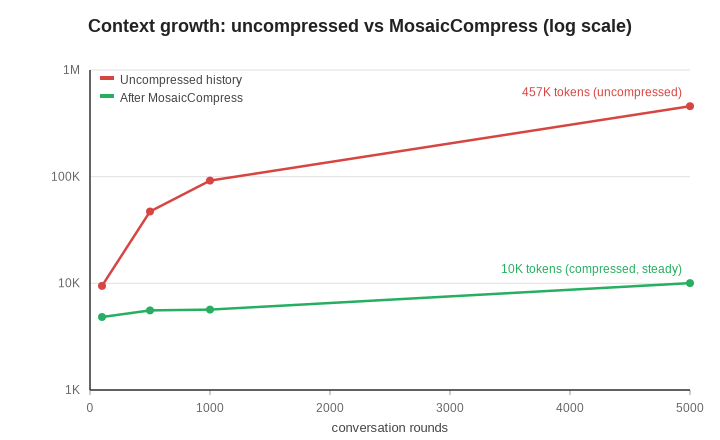
A deterministic simulation (zero LLM cost, reproducible) runs the real algorithm with a rule-based pseudo-LLM. Latest sweep (default parameters):
| Rounds | msgs in | msgs out | tokens in | tokens out | ratio | facts kept |
|---|---|---|---|---|---|---|
| 100 | 234 | 120 | 9,451 | 4,580 | 51.5% | 100% |
| 1,000 | 2,310 | 122 | 91,869 | 5,523 | 94.0% | 100% |
| 5,000 | 11,500 | 120 | 457,484 | 9,913 | 97.8% | 100% |
npm run bench                        # synthetic sweep: 100 / 500 / 1000 / 5000 rounds
npm run bench -- --file chat.json    # analyze your own conversation file
The file mode accepts any JSON array of messages in the library's
Message shape and reports the compression ratio:
[{"role": "system", "content": "..."},
 {"role": "user", "content": "..."},
 {"role": "assistant", "content": "..."}]
See benchmark/README.md for the full method, data
generation, findings, limitations, and the real-LLM spot check
(npm run bench:real — DeepSeek V4 Flash, <$0.01, 5/5 facts retained).
Development
# Run tests (zero LLM cost — uses mock responses)
npm test

# Type-check the whole project
npm run typecheck

# Or directly:
npx tsx tests/index.test.ts
License
MIT — TuringCorp | iAsk@turingcorp.net
Links
More in this category
vectorize-io/hindsight#coding-agents★ 63211
Hindsight, agent memory that learns: long-term project memory with auto recall and retain, knowledge pages, deep reflection, and per-repo memory banks.
volcengine/OpenViking#examples/dsh-memory-plugin★ 42706
OpenViking memory and context bundle for DeepSeek Harness: pre-step auto-recall and profile injection, session capture, `viking://` URI guarding, and recall/write memory tools backed by an OpenViking server.
MemTensor/MemOS#memos-local-plugin★ 12502
Local-first memory plugin for DeepSeek Harness: layered L1/L2/L3 memory with automatic capture, manual memos_* retrieval tools, and a built-in memory viewer.
agentscope-ai/ReMe#dsh★ 3839
Connects DeepSeek Harness to ReMe's local-first, self-evolving personal knowledge base: automatically captures completed main-agent conversations as user-owned Markdown memory, searches conversations and source material through reme_search with BM25, optional embeddings, and wikilink expansion, and schedules daily memory consolidation.
zilliztech/memsearch#MemSearch★ 2933
Shared Markdown memory for DSH and other coding agents, with automatic capture, pre-step context injection, searchable recall, and memory-to-skill self-evolution through a review panel.
vshulcz/deja-vu#extensions/dsh★ 1665
Cross-session memory and context recovery across forty-five other coding agents (45+) on this machine, reading session files they already wrote before install (Claude Code, Codex, Cursor, Windsurf, Trae, Antigravity, VS Code Copilot Chat, opencode, OpenClaw, Hermes, Kimi, Qoder, Cline, Zed, Magpie and more): six tools (deja_recall, deja_session, deja_blame, deja_fix, deja_how, deja_remember), a /deja command, and optional automatic recall injected into runtime context. Local BM25 CLI/MCP index, no LLM, no embeddings, no network (dsh plugin --profile web add dsh-deja).
Community comments
Comments are public GitHub Discussions. Loading them connects to GitHub and Giscus; a GitHub account is required to post.