Multi-platform IM gateway for DSH: Feishu (Lark) WebSocket long connection (no public URL), WeCom AES-encrypted callbacks, and Telegram long polling — per-chat agent sessions, whitelist access, and a visual settings card in the web GUI.
Install
# from npm (prebuilt)
dsh plugin --profile web add dsh-im-hub
# from GitHub (first run asks for allowBuilds approval — follow the hint, retry)
dsh plugin --profile web add github:ThreeBody6666/dsh-im-hub
Any plugin you install runs third-party code with your own permissions — it can read your files, use your credentials, and reach the network, and tool approvals don’t sandbox it. GitHub-sourced plugins also run build scripts at install time — pnpm blocks those until you allow them, so an install can stop with ERR_PNPM_GIT_DEP_PREPARE_NOT_ALLOWED or ERR_PNPM_IGNORED_BUILDS; dsh prints the exact key to add under allowBuilds in your profile’s pnpm-workspace.yaml, and the install works on the next run. Allowing a build is a trust decision: only install sources you trust, and pin a commit (github:owner/repo#sha).
README
dsh-im-hub
A multi-platform IM gateway plugin for DeepSeek Harness (dsh): connect your dsh agent to Feishu (Lark), WeCom (WeChat Work), and Telegram, and chat with it from the messaging apps you already use.
One agent per chat. Multi-turn context. Whitelist access control. Idle reaping. No public endpoint required (Feishu long connection / Telegram long polling; WeCom uses an HTTP callback).
Highlights
- Feishu (Lark) — official WebSocket long connection (
/callback/ws/endpoint+ protobuf frames, client-driven ping keepalive, 3s event ACK, message-id dedup), or webhook mode. No public URL needed for the default mode. The same adapter also serves the international Lark edition (open.larksuite.com) viaadapters.lark. - WeCom (WeChat Work) — app message callback with full
WXBizMsgCryptAES-256-CBC decryption and SHA1 signature verification, plus active replies via the messaging API. - Telegram — Bot API long polling (
getUpdates), automatic message splitting at the 4096-char limit. - Mock adapter — stdin + local HTTP endpoint for testing without any real platform credentials.
- Per-chat agent sessions: conversation context is retained, each chat is serialized (no interleaved turns), and idle agents are disposed after a configurable timeout.
- Whitelist enforcement (
allowedUserIds) on every adapter; empty means everyone — set it in production. - Slack-style commands:
/help,/reset,/status,/model.
Install
# From npm (recommended):
dsh plugin --profile im add dsh-im-hub

# From a Git repo or a local checkout (development):
dsh plugin --profile im add link:D:/projects/dsh-im-hub
This creates a headless profile im whose bundles are @deepseek-ai/dsh-base + dsh-im-hub. Boot it with:
dsh --profile im
Configure
Option A — Web GUI settings card (v0.2.0+)
When the plugin runs inside the Web GUI (dsh web profile), a visual
configuration card appears at Settings → Plugins → Configurable plugins →
IM Gateway (dsh-im-hub). It edits the same configuration live — no
cordis.patch.yml hand-editing, no restart needed (the bridge hot-reloads on
save). Credential fields are stored server-side and shown as write-only
"configured / not set" badges.
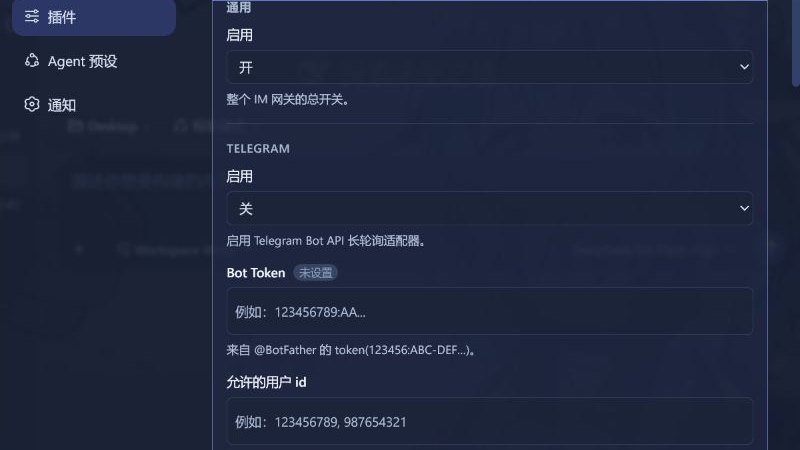
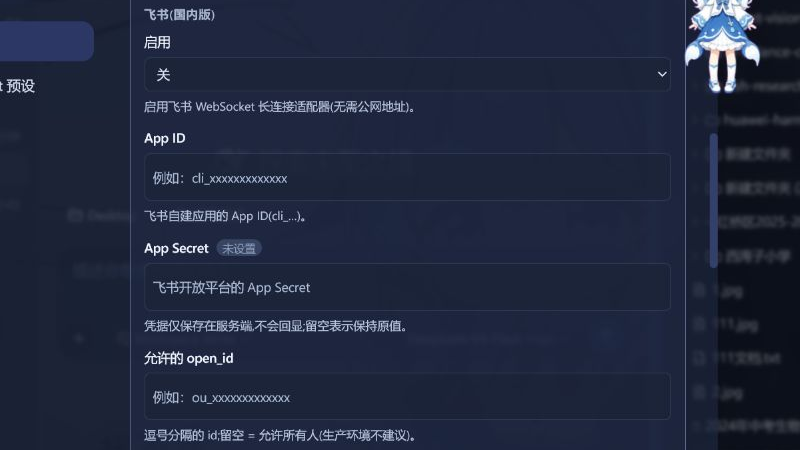
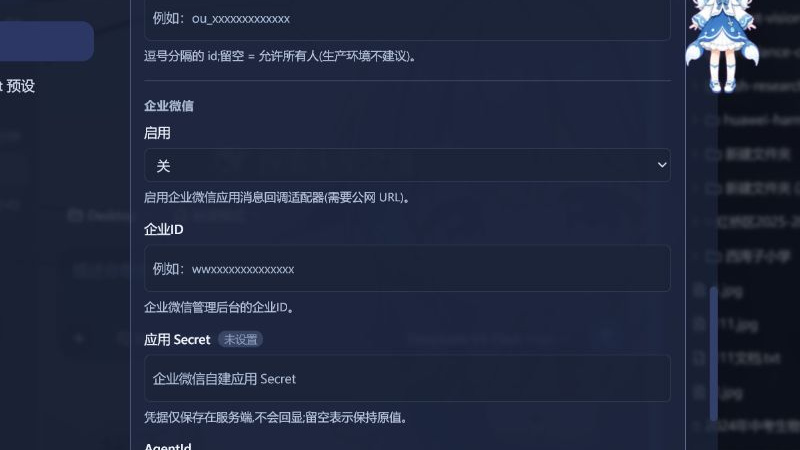
Guided configuration
Every control states its purpose and every empty input includes a safe example. Credential values remain write-only: the screenshots below use placeholders, not real tokens or secrets.
Telegram: Bot Token and access whitelist
Feishu: App ID, App Secret, and Open ID whitelist
WeCom: enterprise ID, application credentials, and callback Token
Option B — YAML (cordis.patch.yml)
The plugin row is disabled by default. Enable it from the profile's own cordis.patch.yml ($DSH_HOME/profiles/im/cordis.patch.yml):
- id: dsh-im-hub
  disabled: false
  config:
    adapters:
      telegram:
        enabled: true
        token: '123456:ABC-DEF...'
        allowedUserIds: [123456789]        # numeric Telegram user ids; empty = everyone
Full configuration reference:
| Key | Default | Description |
|---|---|---|
adapters.telegram.enabled |
false |
Enable the Telegram Bot API adapter (long polling). |
adapters.telegram.token |
'' |
Bot token from @BotFather. |
adapters.telegram.allowedUserIds |
[] |
Numeric user ids allowed to talk to the bot. |
adapters.telegram.timeoutSeconds |
50 |
getUpdates long-poll timeout. |
adapters.telegram.pollIntervalMs |
500 |
Gap after a poll timeout/error. |
adapters.feishu.enabled |
false |
Enable the Feishu adapter. |
adapters.feishu.appId / appSecret |
'' |
Feishu/Lark custom app credentials. |
adapters.feishu.mode |
'websocket' |
websocket (official long connection, no public URL) or webhook. |
adapters.feishu.webhookPath |
'/feishu' |
HTTP path for webhook mode. |
adapters.feishu.verificationToken |
'' |
Webhook event verification token. |
adapters.feishu.allowedUserIds |
[] |
Open ids allowed to talk to the bot. |
adapters.lark.enabled |
false |
Enable the international Lark adapter (same open platform as Feishu, open.larksuite.com). |
adapters.lark.appId / appSecret |
'' |
Lark custom app credentials. |
adapters.lark.mode |
'websocket' |
websocket (official long connection, no public URL) or webhook. |
adapters.lark.webhookPath |
'/lark' |
HTTP path for webhook mode. |
adapters.lark.verificationToken |
'' |
Webhook event verification token. |
adapters.lark.allowedUserIds |
[] |
Open ids allowed to talk to the bot. |
adapters.wecom.enabled |
false |
Enable the WeCom app-message callback adapter. |
adapters.wecom.corpId / corpSecret / agentId |
'' |
WeCom app credentials. |
adapters.wecom.token / encodingAesKey |
'' |
Callback Token / EncodingAESKey from the WeCom admin console. |
adapters.wecom.path |
'/wecom' |
HTTP callback path. |
adapters.wecom.allowedUserIds |
[] |
User ids allowed to talk to the bot. |
adapters.mock.enabled |
false |
Test-only adapter (stdin + local HTTP). |
adapters.mock.port |
0 |
Fixed HTTP port for the mock endpoint (0 = ephemeral). |
agent.cwd |
'' |
Working directory for agent sessions (defaults to dsh's cwd). |
agent.provider / agent.model |
'' |
Override the model selection; empty = deployment default. |
agent.maxMessageLength |
4000 |
Max chars per outbound IM message (longer replies split). |
agent.idleTimeoutMs |
1800000 |
Idle time before a chat's agent is disposed (0 = never). |
agent.instructionPrefix |
'' |
Prefix prepended to every user message. |
http.host / http.port |
0.0.0.0 / 8080 |
Bind address for webhook-mode HTTP servers (feishu webhook / wecom callback). |
Feishu / Lark prerequisites
- Create a custom app in the Feishu Open Platform (or the Lark Open Platform for the international edition), enable the
im.message.receive_v1event subscription, and grant the message permissions (im:message:send_as_bot,im:message:p2p_msg,im:message:group_msg/group_at_msg). - Long-connection mode is available to self-built (enterprise) apps. In the admin console choose Event subscription → 使用长连接接收事件 (long connection) or configure the webhook URL for webhook mode.
WeCom prerequisites
- In the WeCom admin console create an app, configure 接收消息服务器 (callback server) with the URL
https://your-public-host/wecom, a random Token and a 43-char EncodingAESKey, and copy them into the config. - The callback server needs a public HTTPS URL (or a tunnel) — WeCom does not offer a long-connection mode.
Commands
| Command | Effect |
|---|---|
/help |
Show command help. |
/reset |
Clear this chat's conversation context (fresh agent). |
/status |
Show active chats / agents / adapters. |
/model |
Show the current model selection. |
How it works
IM platform ──(adapter)──► Bridge ──► ctx.agents.create({ sessionId })
   ▲                          │                │
   └──── reply text ◄─────────┴── session/event listener ◄── agent turn
- Each
platform:chatIdmaps to one agent session (like@deepseek-ai/dsh-headless, but kept alive per chat). - Inbound IM messages enter the session with
source.kind = 'plugin'/form = 'relay'(community norm), and outbound text is read back fromsession/event(assistant/message, aggregated per turn, then chunked tomaxMessageLength). - Turns per chat are serialized through a busy-promise chain; a message queue prevents interleaving.
- Idle agents are disposed after
agent.idleTimeoutMsand re-created on the next message.
Security notes
- Force a whitelist. Set
allowedUserIdson every enabled adapter before exposing the bot publicly. An empty list means anyone can drive your agent — which can execute tools on the host. - IM messages are injected into the agent session as plugin-originated user messages; they do not bypass the deployment's own approval/guardrail policy — treat them like any other user input.
- Platform secrets (
token,appSecret,encodingAesKey) live in the profile'scordis.patch.yml; keep that file private.
Development
node --test test/                          # unit tests (protobuf frame codec)
dsh plugin --profile im add link:D:/projects/dsh-im-hub   # install from checkout
dsh --profile im --patch test/disable-skin.overlay.yml         # boot with mock adapter
# POST a message: curl -X POST http://127.0.0.1:9099/mock -H 'content-type: application/json' -d '{"text":"hi","chatId":"test"}'
Tip: if the dsh-skin manager (
$DSH_HOME/cordis.patch.yml) inserted a UI-skin row that your headless profile cannot resolve, disable it via a--patchoverlay (seetest/disable-skin.overlay.yml) — the home layer outranks the profile layer, so an overlay is the reliable place to turn it off.
License
MIT
Links
More in this category
xmanrui/dsh-im★ 1525
Connect IM bots to DeepSeek Harness via QR codes or bot credentials (9 channels: Feishu, WeChat, DingTalk, WeCom, QQ, Slack, Telegram, Discord, and WhatsApp).
shaobeichen/dsh-pocket★ 1396
Remote phone access to the DSH Web UI: scan a QR code for LAN or public (cloudflared tunnel) access with real-time sync, a mobile-adaptive layout, and a settings tab.
inclusionAI/Avernet#deepseek-harness-channel-bcn★ 572
Connects DeepSeek Harness to Avernet's Bot Collaboration Network over WebSocket V2, with automatic onboarding, isolated agent sessions, tool-call events, and multi-bot routing tools.
omdsh-dev/dsh-notification★ 85
Desktop notifications for turn completions, with per-outcome controls and keyword rules.
whyihaveyou/dsh-suite#plugin-notify★ 57
IM webhook and local notifications on turn completion, errors, or approval (Feishu/WeCom/DingTalk/Slack/Discord/custom).
omdsh-dev/dsh-lark★ 55
Lark/Feishu bot channel for DeepSeek Harness: each chat drives its own agent, and tool approvals, model questions, and plan reviews return as cards answered by a button or a reply. Switch workspace and model from the chat (`/cd`, `/model`, `/new`), and run several bots that keep separate sessions and can hand turns to each other in one group.
Community comments
Comments are public GitHub Discussions. Loading them connects to GitHub and Giscus; a GitHub account is required to post.