Evidence-first attention supervision for DeepSeek Harness with C0–C3 policy, deduplicated Inbox alerts, quiet hours, and redacted outcome records.
Install
# from npm (prebuilt)
dsh plugin --profile web add dsh-deepcanary
# from GitHub (first run asks for allowBuilds approval — follow the hint, retry)
dsh plugin --profile web add github:Oscar-Williams/dsh-deepcanary
Any plugin you install runs third-party code with your own permissions — it can read your files, use your credentials, and reach the network, and tool approvals don’t sandbox it. GitHub-sourced plugins also run build scripts at install time — pnpm blocks those until you allow them, so an install can stop with ERR_PNPM_GIT_DEP_PREPARE_NOT_ALLOWED or ERR_PNPM_IGNORED_BUILDS; dsh prints the exact key to add under allowBuilds in your profile’s pnpm-workspace.yaml, and the install works on the next run. Allowing a build is a trust decision: only install sources you trust, and pin a commit (github:owner/repo#sha).
README
Let tasks run quietly. Know when they need you. Return to the right session.

English · 简体中文 · Documentation · Changelog
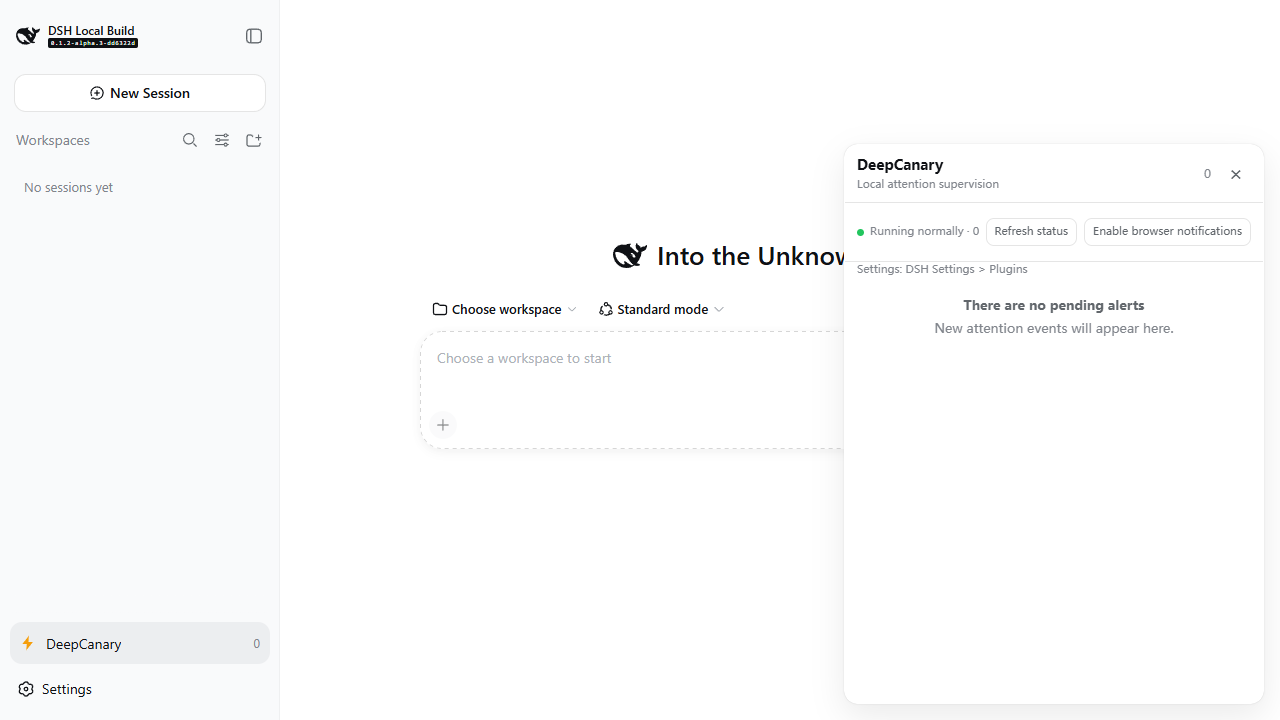
DeepCanary adds a local task inbox to DeepSeek Harness. It brings questions, approvals, failures and completion summaries together, with quiet notification policies and a direct return to the relevant session.
Version: 0.1.4-rc.1 · Host baseline: DSH 0.2.0-rc.2. This is a release candidate. The npm latest and next channels both select this RC; their channel names describe installation defaults. See compatibility and device coverage for the supported scope.
Install
Desktop
Open DSH Plugins, use its official package installation control, and enter:
dsh-deepcanary@0.1.4-rc.1
Apply the change using the manager's enable/restart instructions. Save active work before restarting. Desktop manages its own reserved profile; use the application's manager for installation, update and removal.
WebUI with the DSH CLI
Check that your installed host is DSH 0.2.0-rc.2, then install into the web profile:
dsh --version
dsh plugin --profile web add dsh-deepcanary@0.1.4-rc.1
dsh --profile web
Open the authenticated URL printed by DSH. The fixed package version makes installation reproducible. You can also pass the downloaded .tgz from GitHub Releases to plugin add. Use the official npm registry if a mirror has not synchronized the release.
Existing DSH source checkout
From a built checkout at dsh-v0.2.0-rc.2 (commit 639ed015397290b3745d163aafe02ffee4aa3f84), run the checkout's CLI script:
npx --yes pnpm@11.7.0 run dsh plugin --profile web add dsh-deepcanary@0.1.4-rc.1
npx --yes pnpm@11.7.0 run dsh --profile web
Follow DSH's source setup instructions to prepare that checkout. The plugin repository uses its own npm lockfile; its development commands are in development.
Update and remove
To update the Web profile, rerun the fixed-version installation command and follow DSH's reload instructions. To remove it:
dsh plugin --profile web remove dsh-deepcanary
In a source checkout, use npx --yes pnpm@11.7.0 run dsh plugin --profile web remove dsh-deepcanary. Removal preserves the host profile, sessions and saved reminder data.
Use
- Open DeepCanary from the DSH sidebar.
- Configure it under Settings → Plugins → DeepCanary. Choose the notification level, hourly budget and quiet hours.
- Enable browser notifications if you want them, then run your tasks normally.
- Open an Inbox item to return to its session, inspect its evidence, snooze it or give explicit feedback.
| Level | Meaning | Behavior |
|---|---|---|
| C1 | Suggested check | Routine outcomes and completion summaries remain available in Inbox. |
| C2 | Needs attention | Failures and possible stalls are evaluated against your notification policy. |
| C3 | Immediate human attention | Requires authoritative Host/runtime evidence, including open human questions and approval boundaries. |
Related events are grouped and deduplicated. Healthy long tools keep bounded progress grace; parallel tool completion updates that grace. Timed questions remain answerable after timeout, and accepted replies close their reminder. Completion summaries survive recovery and reload.
The resizable Inbox has opaque light/dark surfaces, keyboard controls and expandable evidence. Navigation uses DSH's public session-opening capability. When a target is unavailable, the item explains its availability and preserves the summary.
Settings use DSH's revision-aware configuration service. A concurrent change produces a conflict while retaining your draft; discard and reread before editing against the current snapshot.
Privacy
Reminder state stays in the local profile. Stored fields are bounded metadata, hashed references, explicit feedback and the local session handle used for navigation. Conversation text, prompts, model output, tool arguments and API credentials remain outside captured reminder state.
Plugin HTTP endpoints use DSH's authenticated shared API, with Host/Origin checks, bounded JSON input and sanitized errors. Feedback collection is optional. Open and acknowledge actions describe interaction; usefulness is supplied by explicit feedback. See security and feedback calibration.
Limits
- Notifications require the Host and renderer to remain running, browser permission and suitable OS settings. Operating-system delivery remains unknown until observed.
- Desktop shares the deterministic core, settings and Inbox. Hidden-window notification wake-up and Toast click return require public Host support and device evidence; this RC provides the renderer notification path.
- Windows WebUI is the current development and device-validation entry. Other operating systems have automated source coverage where CI runs; native delivery coverage is documented separately.
- Supervisor remains experimental and disabled by default. Its local projection lasts while its owning Host process runs.
- Natural feedback currently supports specific defect investigation. Cross-workday policy calibration and model Judge adoption retain their evidence gates; current live policy is deterministic.
See compatibility for coverage and troubleshooting, architecture for the implementation, and contributing to help improve it.
License
MIT. Built on the public DeepSeek Harness plugin APIs.
Links
More in this category
xmanrui/dsh-im★ 2032
Connect IM bots to DeepSeek Harness via QR codes or bot credentials (9 channels: Feishu, WeChat, DingTalk, WeCom, QQ, Slack, Telegram, Discord, and WhatsApp).
shaobeichen/dsh-pocket★ 1771
Remote phone access to the DSH Web UI: scan a QR code for LAN or public (cloudflared tunnel) access with real-time sync, a mobile-adaptive layout, and a settings tab.
inclusionAI/Avernet#deepseek-harness-channel-bcn★ 642
Connects DeepSeek Harness to Avernet's Bot Collaboration Network over WebSocket V2, with automatic onboarding, isolated agent sessions, tool-call events, and multi-bot routing tools.
omdsh-dev/dsh-notification★ 89
Desktop notifications for turn completions, with per-outcome controls and keyword rules.
whyihaveyou/dsh-suite#plugin-notify★ 60
IM webhook and local notifications on turn completion, errors, or approval (Feishu/WeCom/DingTalk/Slack/Discord/custom).
MichengAI/dsh-im-connect★ 59
Connects WeChat, WeCom, DingTalk, Feishu, Lark, QQ, and Telegram to a local DeepSeek Harness agent, with each IM chat as a separate workspace channel.
Community comments
Comments are public GitHub Discussions. Loading them connects to GitHub and Giscus; a GitHub account is required to post.