Long-term cross-session markdown memory with an LLM-Wiki structure and a SOUL.md persona, injected at session start (by default only after the first user message and only in the active session), plus remember/recall/consolidate/forget workflows, an embedded memory skill, pack/unpack migration tooling, and an idle-time first-person recall nudge that surfaces real memories in a companion voice. Also gives the store observability and upkeep it lacked: a per-file boot-block budget that keeps the index routing table from being truncated, automatic last_access stamping so salience decay actually works, a read-only memory health dashboard (size, freshness, lint-parity checks), a declarative index compiler (pages declare summary:, one command re-lines the index), an interactive memory graph (page links plus shared tags, draggable, wheel zoom), structured queries (tag/type/salience/hot/stale filters), cross-link suggestions for pages that have no relationship yet, and a `checkup` report that ends in a prioritised action list. The boot payload was also cut by ~23% by moving operational detail into the on-demand skill. Its settings section now carries its own navigation mark (a brain half wired to a node cluster, since the shell offers no icon slot to plugins) and a feedback entry that opens this repository. Requires DSH session format v4 (official DeepSeek Harness 0.1.7+): injected messages declare the producer-owned source kind plugin:memory. v0.11 added a bilingual settings panel whose copy and sidebar label follow DSH language setting (中文「记忆」/ English "Memory"); v0.12 added the shared cross-plugin speech floor, a context-sensitive tone section and a weekly growth recap; v0.13 declares its DSH compatibility via engines.dsh (official 0.2.1-rc.5 series; older hosts are refused by the gate), adds a "Review now" button (POST /api/memory/control, action growth-now) that sends one growth recap immediately while still respecting the speech floor, panel accessibility (aria labels, status and alert roles, focus-visible rings), and the public PROACTIVE-PROTOCOL.md. v0.14 adds per-session memory: a composer chip with a dropdown (this session / workspace default), the /memory on|off|status command, and a settings-panel switch all flip the same gate — off means no boot injection, no digest/recall nudges and no last_access stamping for that session (nothing is deleted); disabledWorkspaces lets whole projects default to off, and session choices persist for 7 days. v0.15 adds a Basic soul (quick forging) card: my name / what I call you / baseline persona, saved into a managed block inside SOUL.md (the rest of the file is left untouched) and marks BOOTSTRAP complete; existing chat-forged souls are echoed from the SOUL text, and the boot block now asks the agent to remind the user to forge first when no soul exists yet. v0.16 turns the memory graph into an interactive 3D sphere (Canvas, zero dependency): drag to rotate, wheel to zoom, drag nodes to arrange them in 3D, double-click empty space to reset, auto-spin (reduced-motion aware); hover or click a node to instantly light up its neighbours (displacement+duration click threshold), and colours adapt to light/dark panel themes. v0.17 adds graph search (ranked matches, the camera flies to the hit and lights up its neighbours), Reveal in Finder / Copy path for any node (the host command is awaited, and the absolute path is copied automatically when reveal fails), Windows support (path-variable expansion, CRLF parsing with style-preserving writes, explorer /select, argv and exit-code handling, case-insensitive workspace matching), plus a much shorter README with real screenshots. v0.18 (issue #8) adds a boot snapshot mode: session freezes the boot block for the session so mid-session memory writes no longer invalidate the prompt-prefix cache (the volatile recent-log tail now rides in its own late context segment), with live kept as the default; double-clicking a memory node now opens the note in the DSH right sidebar (falling back to Finder/Explorer). v0.19 makes the plugin compatible with DSH 0.2.2-rc.2: the agent registry is read with agents.roots() when available and falls back to agents.list() on rc.2, and every agent/created listener is exception-guarded — on rc.2 an unguarded throw there rejects agent registration and no session can be created, so rc.2 users must upgrade to 0.19.2 or newer (0.19.5 is latest). Settings, dashboard and composer chip keep working on both the legacy and the rc.2 host APIs.
Install
# from npm (prebuilt)
dsh plugin --profile web add dsh-plugin-memory
# from GitHub (first run asks for allowBuilds approval — follow the hint, retry)
dsh plugin --profile web add github:LittleBlackTong/dsh-plugin-memory
Any plugin you install runs third-party code with your own permissions — it can read your files, use your credentials, and reach the network, and tool approvals don’t sandbox it. GitHub-sourced plugins also run build scripts at install time — pnpm blocks those until you allow them, so an install can stop with ERR_PNPM_GIT_DEP_PREPARE_NOT_ALLOWED or ERR_PNPM_IGNORED_BUILDS; dsh prints the exact key to add under allowBuilds in your profile’s pnpm-workspace.yaml, and the install works on the next run. Allowing a build is a trust decision: only install sources you trust, and pin a commit (github:owner/repo#sha).
README
English | 中文
Long-term memory for DeepSeek Harness — a portable markdown memory store with a soul, injected at every session start.
macOS · Windows · Linux · Node ≥ 18 · DSH ^0.2.1-rc.5 / 0.2.2-rc.2 · MIT
⚠️ Using DSH 0.2.2-rc.2 or newer? Upgrade the plugin to 0.19.2+ first. Early 0.19.x reads
ctx.agents.roots(), which rc.2 replaced withlist(); the resulting throw happens inside the serialagent/createdlistener, which rejects agent registration — the visible symptom is sessions can no longer be created while the plugin is enabled. 0.19.2 reads the registry compatibly (never throws) and the change needs a full DSH restart to take effect/memoryand the panel stay offline-safe meanwhile.
Compatibility is two-way. 0.19.2+ reads the agent registry with
agents.roots()first and falls back toagents.list(), so the same build runs on legacy hosts (0.2.1-rc.5 … 0.2.2-rc.1) and on rc.2. Upgrading the plugin never breaks an older DSH install, and rc.2 support does not drop older versions.
What it does
A Cordis plugin that gives DSH agents persistent, cross-session, migratable memory: plain markdown + git (the LLM Wiki pattern), a SOUL.md persona, and a boot block auto-injected through runtime context — a hard guarantee, not a hope that the model decides to call a skill.
Quickstart
# 1. install
dsh plugin --profile <profile> add dsh-plugin-memory
Or install from a plugin index: enable Custom plugin indexes under Plugins → Experimental, open Discover → Add index source, paste
https://raw.githubusercontent.com/LittleBlackTong/dsh-plugin-memory/main/docs/market/index.json
then install Memory from the list. (A JSON index in the official format, served from this repo.)
- Restart the app. In the first session the agent starts the soul-forging conversation itself (or skip it: Settings → Memory → Basic soul, one save).
- Verify:
dsh-memory doctor, or open Settings → Memory for the health dashboard and hot settings.
Features
- Remembering across sessions — boot block = SOUL + MEMORY protocol +
index.md+ recent activity, with a per-file budget so the index tail is not truncated first. - A soul, not just storage — SOUL + BOOTSTRAP forging; a quick-setup card writes a managed block; persona names are read from SOUL, never hard-coded.
- You stay in control — per-session switch (chip /
/memory on|off/ panel) anddisabledWorkspacesdefaults. - A companion — digest nudge, proactive recall, weekly growth recap, context-sensitive tone; shared speech floor with other proactive plugins.
- Portable — plain markdown + git,
pack/unpack, optional auto-commit. - Memory graph — interactive 3D sphere: rotate / zoom / drag nodes, search-to-focus, hover or click to light up neighbours; select a node → Reveal in Finder or Copy path; double-click a node to open its file in the DSH sidebar (falls back to the OS file manager).
- Timeline — the same store on a time axis: one draggable metro-style line of log events; wheel zoom switches day/week/month/year granularity automatically; event descriptions show on nodes whenever they fit; click for details, double-click to open the page (falls back to
log.md); follows the light/dark DSH theme. - Health tools — dashboard,
checkup,lint,doctor, automaticlast_accessstamping. - Zero build, bilingual panel, hot-editable config.
Screenshots
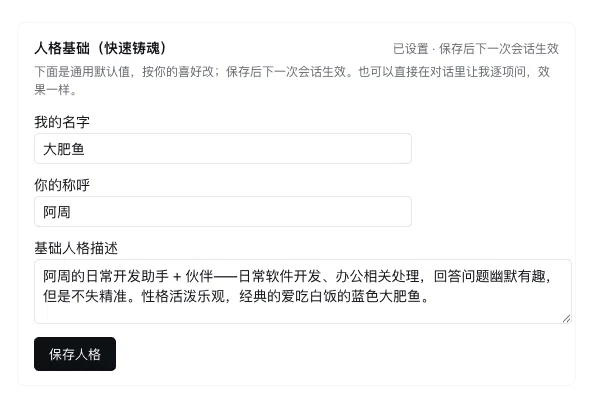
Basic soul (quick forging) — set the agent's name, what it calls you and a baseline persona in one save; the next session uses it, no restart. Chat-forged souls are echoed back from SOUL.md.
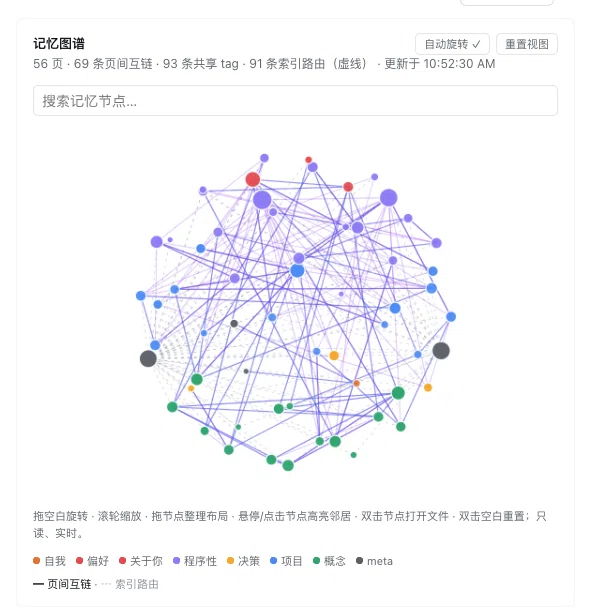
Memory graph (3D) — a live projection of the store: rotate / wheel-zoom / drag nodes to arrange, search-to-focus (the camera flies to the hit), hover or click to light up the neighbourhood. Select a node to Reveal in Finder or Copy path; double-click empty space to reset.
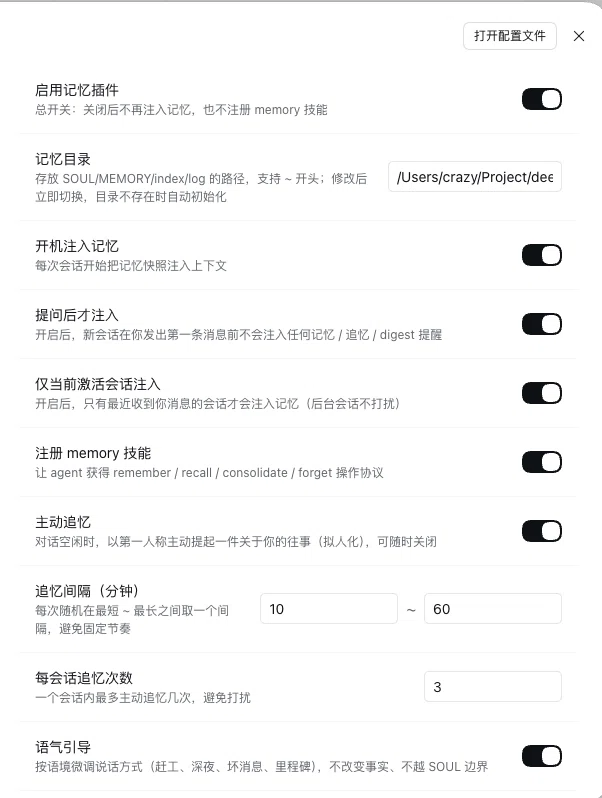
Settings panel — sixteen settings apply immediately (per-session switch, boot gates, recall cadence, tone, disabled workspaces…). The health dashboard and the graph sit right below.
Cross-platform
macOS, Windows and Linux are supported. Path settings expand ~, ~\, %USERPROFILE% and $HOME; CRLF files are parsed as LF and **written back with their own newline style**; *Reveal in Finder* maps to open -R (macOS), explorer /select, (Windows, space-safe argv) and xdg-open (Linux); disabledWorkspaces matching is case-insensitive on Windows. Details: docs/CONFIGURATION.md.
Configuration
Seventeen hot keys edit live under Settings → Memory — including bootSnapshot (live by default; session freezes the boot block for the session so mid-session writes can't invalidate the prompt-prefix cache). The full table, boot-budget rules and composition overrides are in docs/CONFIGURATION.md.
CLI
dsh-memory init [dir]        # scaffold the store
dsh-memory search <query>    # full-text search
dsh-memory checkup           # one prioritised health report
dsh-memory doctor            # environment check-up
dsh-memory graph --suggest   # who should link to whom (report only)
dsh-memory pack / unpack     # move the store between machines
Store resolution: $MEMORY_DIR → ./.memory → ~/.memory.
Docs
Configuration · Design notes · Migration · Proactive protocol · Contributing · Security · Changelog
FAQ
Does it burn tokens every request? No — runtime context is deduplicated by projection; an unchanged payload is injected once.
File skill vs plugin? The file skill is a soft guarantee (only its blurb is injected); this plugin is a hard one. They coexist (the file skill ranks higher); remove any hand-written persona to avoid double injection.
Where should the store live? ~/.memory by default; point memoryDir inside a project for isolation.
Development
git clone https://github.com/LittleBlackTong/dsh-plugin-memory.git
cd dsh-plugin-memory
node scripts/memory.mjs --self-test   # smoke test, nothing to install
node --test                          # full suite
Zero build: lib/ is runtime code as-is. CI runs both commands.
Roadmap
- Embedding / BM25 retrieval
- MCP server for non-DSH agents
- Encrypted store option
- TypeScript rewrite
Feedback & community
- Bugs / features / PRs: open an issue — that is where feedback and questions are tracked.
- WeChat group「dsh-plugin-memory 插件沟通」: scan below (QR codes expire every ~7 days; open an issue if it no longer works).

License
Links
More in this category
vectorize-io/hindsight#coding-agents★ 61444
Hindsight, agent memory that learns: long-term project memory with auto recall and retain, knowledge pages, deep reflection, and per-repo memory banks.
volcengine/OpenViking#examples/dsh-memory-plugin★ 42323
OpenViking memory and context bundle for DeepSeek Harness: pre-step auto-recall and profile injection, session capture, `viking://` URI guarding, and recall/write memory tools backed by an OpenViking server.
MemTensor/MemOS#memos-local-plugin★ 12418
Local-first memory plugin for DeepSeek Harness: layered L1/L2/L3 memory with automatic capture, manual memos_* retrieval tools, and a built-in memory viewer.
agentscope-ai/ReMe#dsh★ 3814
Connects DeepSeek Harness to ReMe's local-first, self-evolving personal knowledge base: automatically captures completed main-agent conversations as user-owned Markdown memory, searches conversations and source material through reme_search with BM25, optional embeddings, and wikilink expansion, and schedules daily memory consolidation.
zilliztech/memsearch#MemSearch★ 2892
Shared Markdown memory for DSH and other coding agents, with automatic capture, pre-step context injection, searchable recall, and memory-to-skill self-evolution through a review panel.
vshulcz/deja-vu#extensions/dsh★ 1578
Cross-session memory and context recovery across forty-five other coding agents (45+) on this machine, reading session files they already wrote before install (Claude Code, Codex, Cursor, Windsurf, Trae, Antigravity, VS Code Copilot Chat, opencode, OpenClaw, Hermes, Kimi, Qoder, Cline, Zed, Magpie and more): six tools (deja_recall, deja_session, deja_blame, deja_fix, deja_how, deja_remember), a /deja command, and optional automatic recall injected into runtime context. Local BM25 CLI/MCP index, no LLM, no embeddings, no network (dsh plugin --profile web add dsh-deja).
Community comments
Comments are public GitHub Discussions. Loading them connects to GitHub and Giscus; a GitHub account is required to post.