AIEO (GEO/AEO) delivery method as one isolated skill provider: AI-visibility diagnosis on a 0-9 score, positioning, search-term mining restricted to whitelisted platform exports, periodic monitoring and an HTML monitoring dashboard, chained by one shared question library, plus a landing-page cloner.
Install
# from GitHub (first run asks for allowBuilds approval — follow the hint, retry)
dsh plugin --profile web add github:Kenerlee/dsh-moments-aieo
Any plugin you install runs third-party code with your own permissions — it can read your files, use your credentials, and reach the network, and tool approvals don’t sandbox it. GitHub-sourced plugins also run build scripts at install time — pnpm blocks those until you allow them, so an install can stop with ERR_PNPM_GIT_DEP_PREPARE_NOT_ALLOWED or ERR_PNPM_IGNORED_BUILDS; dsh prints the exact key to add under allowBuilds in your profile’s pnpm-workspace.yaml, and the install works on the next run. Allowing a build is a trust decision: only install sources you trust, and pin a commit (github:owner/repo#sha).
README

dsh-moments-aieo
English | 中文
An AIEO (AI Engine Optimization — the GEO/AEO practice of getting a brand cited by ChatGPT, DeepSeek, Doubao, Kimi, Perplexity and friends) delivery method, packaged as one DeepSeek Harness bundle. The method runs in four stages — diagnosis → positioning → content → monitoring — chained by one question bank: diagnosis drafts it, positioning corrects it, content consumes it, monitoring measures against it. This bundle ships the three stages that are method rather than writing — diagnosis, positioning, monitoring — plus the question bank itself, as one named skill provider. The content stage consumes the bank through whatever writing skill you already use.
Plugin
Requires ctx.skills (inject: ['skills']).
The plugin body is deliberately thin: it mounts @deepseek-ai/dsh-skill-filesystem with includeDefaultRoots: false over its own skills/ directory, so this set registers under one provider name and never collides with same-named skills in ~/.dsh/skills or ~/.agents/skills. No scanner, watcher, or frontmatter parser is reimplemented here.
Config
| Field | Default | Meaning |
|---|---|---|
skillsDir |
the package's own skills/ |
Directory holding the <name>/SKILL.md bundles. Point it at a working tree during development. |
providerName |
moments-aieo |
Provider name registered on ctx.skills, keeping this set separable from the user's own roots. |
Install
dsh plugin --profile web add github:Kenerlee/dsh-moments-aieo   # straight from GitHub
dsh plugin --profile web add file:/path/to/clone                # from a local clone
Then add the package to the profile's bundle list in ~/.dsh/profiles/web/package.json:
{ "dsh": { "profile": { "bundles": [
  "@deepseek-ai/dsh-base",
  "@deepseek-ai/dsh-web-app",
  "dsh-moments-aieo"
] } } }
The bundle's own cordis.patch.yml inserts the row, so no profile patch is required. Override it by id in ~/.dsh/profiles/web/cordis.patch.yml when you want your own skill directory:
- id: moments-aieo
  config:
    skillsDir: /absolute/path/to/your/skills
Verify without booting:
dsh --profile web --dump-config | grep -A 4 'id: moments-aieo'
Browser automation
moments-aieo-diagnosis collects real answers through bb-browser (install it and log in to each AI platform in its managed browser); it renders a visual client report plus an evidence zip with stdlib-only Python scripts. moments-aieo-monitoring drives the platforms through Playwright. dsh reaches MCP servers through dsh-mcp-client, which registers their tools under mcp__<serverName>__<rawName> — the same server-qualified shape Claude Code uses, so the mcp__playwright__browser_* names in the monitoring skill resolve as long as the server is named playwright:
- insert:
    - id: mcp-playwright
      name: '@deepseek-ai/dsh-mcp-client'
      config:
        serverName: playwright
        command: npx
        args: ['@playwright/mcp@latest']
Without the browser tooling both skills still produce a website audit and the question bank; the platform-visibility measurements are what go missing.
Screenshots
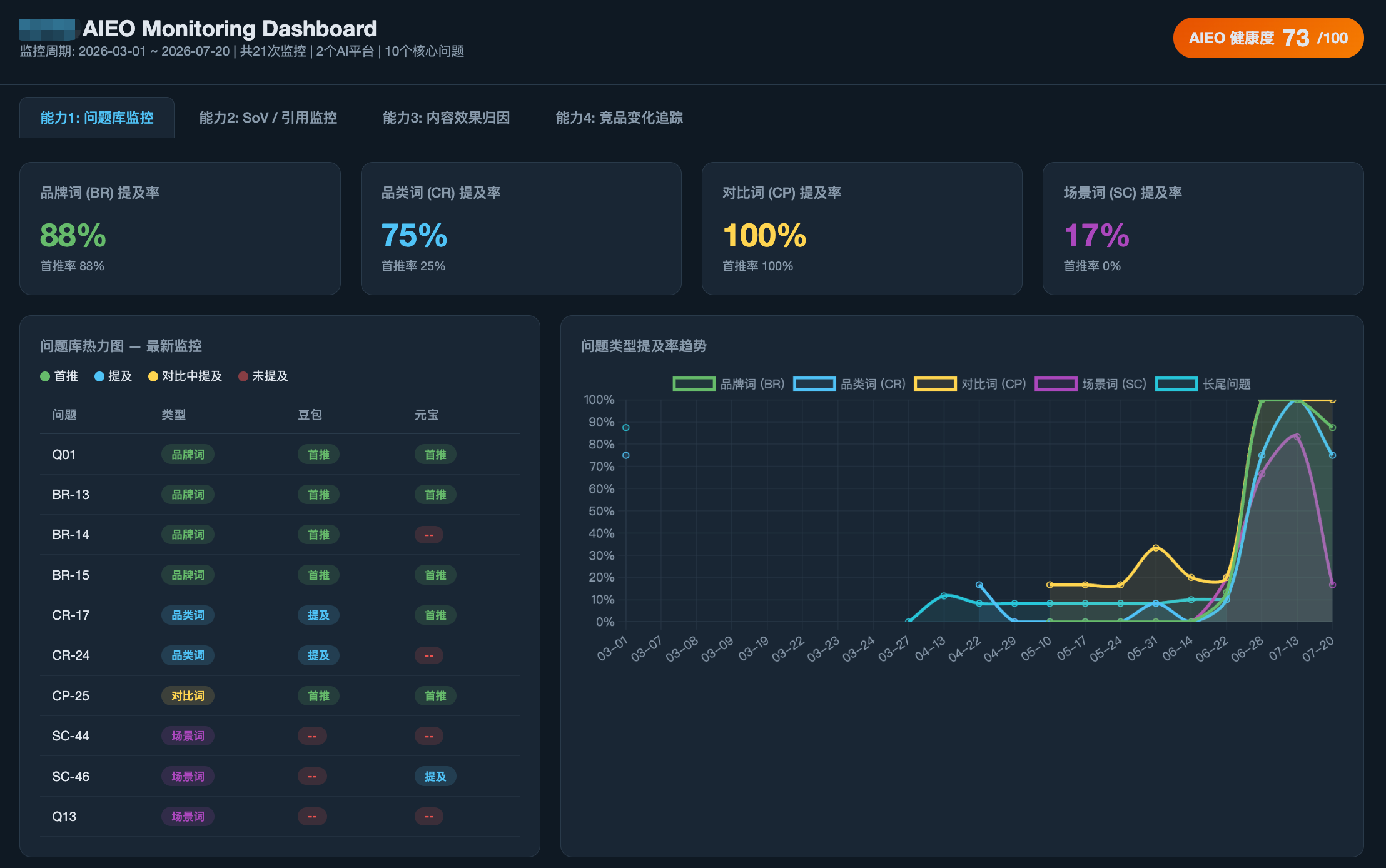
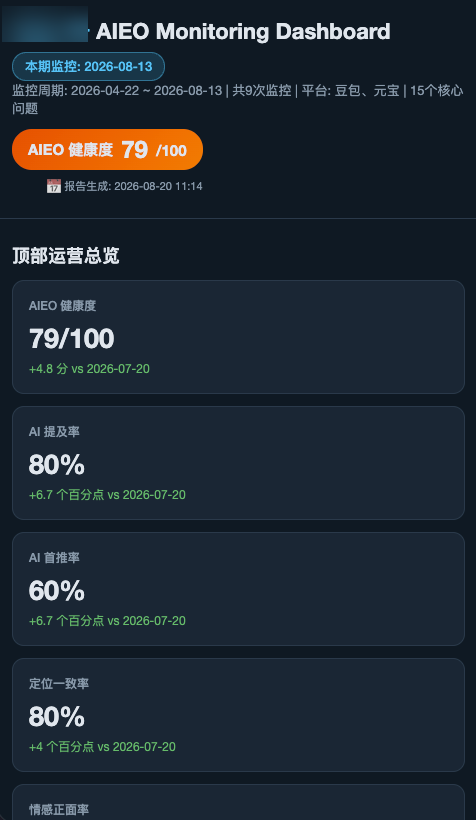
A diagnosis report and the monitoring dashboard, both from real client runs with the brand redacted.
Skills
| Skill | Purpose |
|---|---|
moments-aieo-diagnosis |
Brand AI-visibility diagnosis; emits a visual client report (snapshot, competitor visibility, question × brand matrix, fact accuracy, sources, 90-day roadmap), an evidence zip and the first draft of the question bank |
moments-aieo-positioning |
Positioning analysis on an AIEO-adapted April Dunford method; iterates the question bank |
moments-aieo-query-miner |
Real search-term mining from whitelisted platform exports only; refuses to invent terms |
moments-aieo-monitoring |
Periodic visibility, share-of-voice, content-quality and conversion tracking |
moments-aieo-dashboard |
Renders monitoring reports into an interactive HTML dashboard |
moments-landing-page-cloner |
High-fidelity landing-page replication |
Diagnosis, positioning, query mining and monitoring share one artifact chain: the question bank the diagnosis drafts is what positioning corrects, content consumes, and monitoring measures against. Running them out of order is allowed and produces a weaker bank.
Model Experience
Indirectly, through @deepseek-ai/dsh-tool-skill: this provider's names and capped descriptions appear in the model's skill catalog, and skill(name) loads the selected SKILL.md body plus its resource base. Paths, provider ranks, and the mount configuration stay hidden from the model.
KV Cache effect
Catalog only. Registration adds eight rows to the catalog digest once; skill bodies enter history only when the model loads one.
Known Limitations and Deferred Work
- The frontmatter
allowed-toolskey does nothing under dsh — the parser readsname,description,whenToUse,metadataand the two invocation flags, and ignores the rest. It neither errors nor restricts anything; the key is kept for Claude Code compatibility. Harness tool names in the bodies were corrected to dsh spellings (read,glob,web_fetch); MCP names need the server configured above. - Web mode disables the host-level provider —
dsh-web-appsetsskill-filesystem: disabledbecause agent presets own local discovery. This bundle registers globally and preset agents read the merged catalog, so the set stays visible; a deployment that isolates its presets from global registrations would not see it. - No build step — the plugin ships as plain
.mjswith no TypeScript source, nolib/, and no type declarations. It is twenty lines; a consumer wanting types writes them. - Reference cases are not distributed — the diagnosis skill's worked client examples live outside this repository.
- Chinese-first content — every AIEO skill body is written in Chinese, and the scoring rubrics assume Chinese-language AI search platforms.
Who built this
The method comes from real AIEO delivery work — brand diagnosis, positioning, question-bank construction and monitoring for consumer, healthcare, SaaS and franchise clients. The tooling is open source; the industry baselines and the judgement of what to do with a low score are not things a Markdown file can carry. moments.top
Ran a diagnosis? Open a Discussion with your score and industry (no brand name needed). Real numbers across industries are what turn a scoring rubric into a benchmark, and the aggregate goes back into this repo.
License
MIT
Links
More in this category
zhu1090093659/dsh-web#packages/dsh-skill-explorer★ 8405
Skill center for the dsh web GUI: browse all loaded skills grouped by source, enable or disable model invocation, create new skills, and delete into a recoverable trash.
GanyuanRan/Aegis★ 1322
Software-engineering method pack for coding agents, with skills for baseline-first planning, systematic debugging, prompt hygiene, verification before completion, and repair/retirement tracking.
superdesigndev/superdesign-skill★ 624
Design skill for UI and marketing graphics on the Superdesign canvas: reads the repo for context, extracts its design system, then generates and iterates branchable design drafts, flow pages, and reusable components through the Superdesign CLI.
linhay/harmony-next.skills★ 360
HarmonyOS NEXT skill bundle for DeepSeek Harness with offline API references and DevEco, HDC, and emulator automation guidance.
dhicoc/dsh-reverse-skill★ 206
Complete reverse-skill pack (85 SKILL.md) as a DeepSeek Harness Cordis plugin: reverse engineering, authorized pentesting and security-research skill router.
sandbaseai/sandbase-skills★ 201
Mounts 88 packaged research, social-intelligence, marketing and business Agent Skills into dsh through the filesystem Skill provider.
Community comments
Comments are public GitHub Discussions. Loading them connects to GitHub and Giscus; a GitHub account is required to post.