Local development service console for DSH: lists every listening service on the machine and lets users inspect, safely stop, or restart services that were started during development.
Install
# from npm (prebuilt)
dsh plugin --profile web add @jiyr0119/dsh-service-console
# from GitHub (first run asks for allowBuilds approval — follow the hint, retry)
dsh plugin --profile web add github:Jiyr0119/dsh-service-console
Any plugin you install runs third-party code with your own permissions — it can read your files, use your credentials, and reach the network, and tool approvals don’t sandbox it. GitHub-sourced plugins also run build scripts at install time — pnpm blocks those until you allow them, so an install can stop with ERR_PNPM_GIT_DEP_PREPARE_NOT_ALLOWED or ERR_PNPM_IGNORED_BUILDS; dsh prints the exact key to add under allowBuilds in your profile’s pnpm-workspace.yaml, and the install works on the next run. Allowing a build is a trust decision: only install sources you trust, and pin a commit (github:owner/repo#sha).
README
A local development service console for DSH: discover listening ports, identify services related to the current conversation or workspace, and safely inspect, stop, or restart them.
Single-purpose plugin for the DeepSeek Harness web UI. When the model (or you) starts a local dev server (npm run dev, Vite, Next.js, Uvicorn, Express, Rust, …), Service Console shows it in one place: which ports it listens on, which command and working directory started it, whether it belongs to this conversation or workspace, and whether it is safe to stop or restart.
Features
- Discovery — scans listening TCP ports and correlates PID, PPID, command, working directory, process group and start time (macOS/Linux).
- Ownership & risk — five-level attribution:
This chat(matched against the session launch ledger),Workspace,Other local,Unknown,Protected. - Control — graceful stop to the process group, restart with a safe saved launch command. Every action is confirmed twice and re-validated against the current snapshot.
- Safeguards — PID-reuse / fingerprint checks before any signal; unknown and protected services are read-only; force-kill is off by default; no implicit auto-cleanup; command output is redacted.
- All local services — every listening service on this machine is visible; ownership is shown as a safety signal rather than a hidden category filter.
- Search, config, i18n — keyword filtering, graceful timeout / force-kill settings, and automatic Chinese/English labels from DSH's active locale.
- On-demand scanning — opening the console fetches the current snapshot once; use the refresh button for an explicit rescan. There is no background polling.
- DSH-native inspector — an expanded service record card presents process identity, ports, command, working directory and ownership evidence in the Web UI's token-based visual language.
Install
Native package (recommended):
dsh plugin --profile web add -w @jiyr0119/dsh-service-console@latest
Then refresh the DSH web UI — a 🖥 SC entry appears in the conversation header and opens the console panel.
Note: a plugin being listed in dsh-market/awesome does not mean its UI auto-appears — this package ships both Host routes and a browser bundle, so after
dsh plugin addthe panel is present. Works on macOS / Linux; Windows is not supported yet.
Alternative — dynamic paste (zero-build, process-local): paste dynamic/host.js + dynamic/client.js via the dynamic Cordis plugin flow.
UI preview
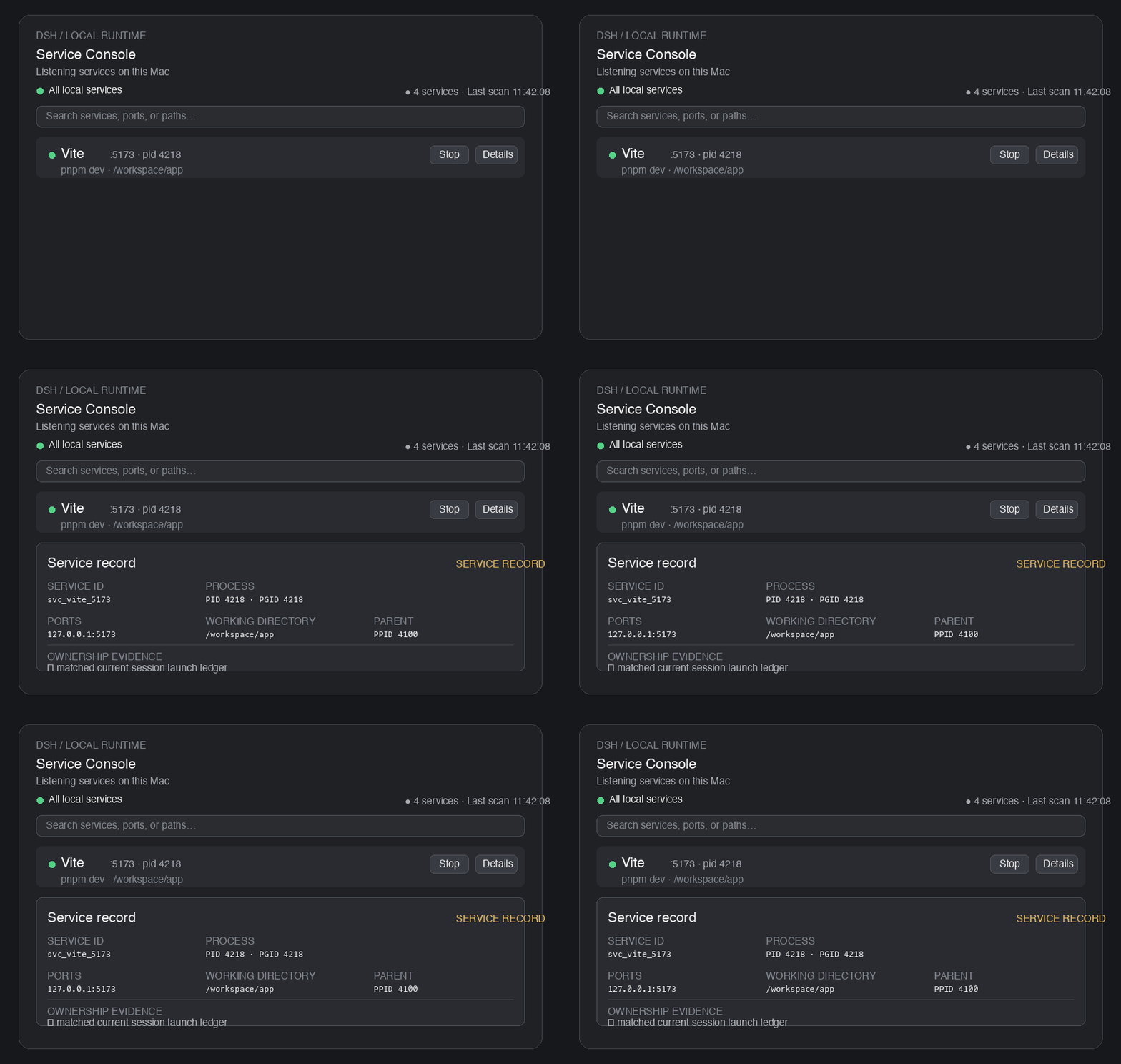
The preview shows the complete local listening-service list and the expanded inspector card. The ownership badge remains visible as a safety signal, while the list itself is no longer split into conversation/workspace/machine categories.
→ Interactive Demo — try the Service Console UI in your browser (no installation required).
Permissions & safety
- The client never sends raw PIDs or shell commands; it targets a service ID and the Host re-validates PID / start time / fingerprint before acting.
- Graceful termination first (SIGTERM to the process group); SIGKILL only when explicitly enabled and confirmed.
- Sensitive tokens/passwords in command summaries are redacted.
- This plugin is not a general process manager: system-critical, high-privilege, unknown and protected processes are read-only.
Development
pnpm install
npm run typecheck
npm run build
npm test          # unit + integration tests (node --test)
Testing
npm test builds once and runs the whole suite with Node's built-in test runner (node --test). No extra test framework is required.
| File | Type | What it covers |
|---|---|---|
test/process-inspector.test.mjs |
Unit | Platform output parsing (parseLstart, parseListenRows, parsePsRows, parseAddress), command redaction, five-level ownership classification |
test/host-more.test.mjs |
Unit | Config validation, session ledger, lifecycle state machine (stop/restart) with fake dependencies, service aggregation & fingerprint stability |
test/integration.test.mjs |
Integration | Real system commands + a temporary HTTP server spawned by the test itself; signals are only ever sent to test-owned processes |
npm test                                   # full suite
npm run build && node --test test/process-inspector.test.mjs   # run a single file
Unit tests import the built output under lib/, so the sources must be compiled first — npm test handles this automatically.
License
MIT
Links
More in this category
yjh051108/dsh-routing-suite★ 6991
One repository, three parts: a runtime injector for DSH plugin packages (inject, hot-reload, unload, promote a dev staging tool to the front, route self-heal, plus a settings-page plugin manager that lists, unloads and drags folders in to internalize), a task-aware reasoning-mode router agent preset (router-standard / router-spec / router-react), and a graded two-level task protocol whose six tools (commit_star, lock_stage, revise_do, edit_plan, mark_task, redteam_verdict) pin task state to disk. The injector implementation ships in-tree, so the install carries its own behaviour rather than a dependency list.
strukto-ai/mirage#dsh★ 3674
Swaps the filesystem and bash providers for a mirage virtual workspace: file tools and shell commands run over mounted resources (RAM, S3, Redis, Slack, Gmail, Notion, Postgres) instead of the host disk, with per-mount read/write/exec modes, per-command sandbox routing (monty, pyodide, quickjs in process; docker, e2b, daytona remote), and installed CLIs (git, gh, slack, linear, ntn, gws, or one you register) as head words in the virtual terminal.
hust-open-atom-club/oh-dsh★ 326
Community distribution: TUI, desktop, and Web UI as one bundle with layered installation.
weijiafu14/pi2dsh★ 211
Pi Host ABI compatibility engine: after one install, unmodified Pi extensions from npm mount as native DSH plugins with `dsh plugin add <pi-package>`. Verified end to end on stock DSH with pi-mcp-adapter (full MCP manager: OAuth, resources, prompts, MCP Apps, elicitation, sampling), @tintinweb/pi-subagents, pi-code, pi-hermes-memory and pi-background-tasks; `pi2dsh inspect` reports a package's compatibility before installing.
Fishquito7/dsh-skill-mcp-panel★ 172
Manages DSH skills and MCP servers from the web settings: skill cards with hot enable/disable, workspace scopes, groups, batch migration and drag-and-drop import, plus stdio/HTTP MCP CRUD with connection tests, secret redaction and the unified dsh-panel CLI.
lire1131/dsh-undo-savepoint★ 170
Undo/redo & rollback system for DSH: every config change is auto-snapshotted; undo/redo/restore to any version from the WebUI or the offline CLI/GUI tools (works even when DSH fails to boot).
Community comments
Comments are public GitHub Discussions. Loading them connects to GitHub and Giscus; a GitHub account is required to post.