MCP server installer and verifier for DeepSeek Harness: interactive init writes real patch entries into a profile, list and validate inspect them, and a CI-enforced verifier connects to every curated server.
Install
# from npm (prebuilt)
dsh plugin --profile web add dsh-mcp-bridge
# from GitHub (first run asks for allowBuilds approval — follow the hint, retry)
dsh plugin --profile web add github:Edge-Echo/dsh-mcp-bridge
Any plugin you install runs third-party code with your own permissions — it can read your files, use your credentials, and reach the network, and tool approvals don’t sandbox it. GitHub-sourced plugins also run build scripts at install time — pnpm blocks those until you allow them, so an install can stop with ERR_PNPM_GIT_DEP_PREPARE_NOT_ALLOWED or ERR_PNPM_IGNORED_BUILDS; dsh prints the exact key to add under allowBuilds in your profile’s pnpm-workspace.yaml, and the install works on the next run. Allowing a build is a trust decision: only install sources you trust, and pin a commit (github:owner/repo#sha).
README
dsh-mcp-bridge
Part of the dsh-toolkit family: dsh-mcp-bridge · dsh-win-toolkit · dsh-netassist · dsh-driftwatch
Curated, verified MCP server bundle for DeepSeek Harness (dsh).
One install gives your dsh agent a set of battle-tested MCP servers — not a raw YAML you have to figure out. Every curated server has a machine-readable definition in servers/, and scripts/verify-servers.mjs checks each one's connectivity, so "verified" is a CI-guaranteed claim, not marketing.
Tools appear to the model as mcp__<serverName>__<toolName> (same server-qualified shape as Claude Code / Codex). The bridge itself is DSH's built-in @deepseek-ai/dsh-mcp-client: stdio + streamable-http, auto-reconnect, HMR hot-swap.
中文文档见 README.zh.md。
Interactive installer
npx dsh-mcp-bridge init          # pick servers interactively
npx dsh-mcp-bridge list          # catalog + verification status
npx dsh-mcp-bridge validate      # list the MCP entries already in a profile
init writes real insert: entries into the profile's user patch layer
($DSH_HOME/profiles/<name>/cordis.patch.yml), so your selection survives plugin
upgrades and coexists with your own patches. It warns about servers that need
environment variables or a placeholder path to edit.
Why not just configure the MCP servers yourself?
Because the fiddly parts are not the YAML — they are everything around it.
- The user patch layer overrides existing entries; naming a new id there fails with
patch: entry "x" not found. New servers needinsert:. - Config nested one level too shallow parses to
config: null, and the server silently never starts. - A server that connects but exposes no tools looks exactly like a working one until you ask the model.
This bundle ships working shapes, an installer that writes them correctly (init), inspectors
(list, validate) and a verifier that actually connects.
Quick start
Prereqs: dsh and pnpm on PATH (dsh plugin forwards to pnpm; install with npm i -g pnpm).
dsh plugin --profile web add dsh-mcp-bridge
# local checkout:  dsh plugin --profile web add ./dsh-mcp-bridge
dsh web        # restart the profile
The demo server (MCP official everything) is enabled by default — no API key, pure local npx. After restart, ask your model to "call the everything server's echo tool with hello" and it should use mcp__everything__echo.
First run downloads the server packages via
npx; subsequent runs are cached.
Curated catalog
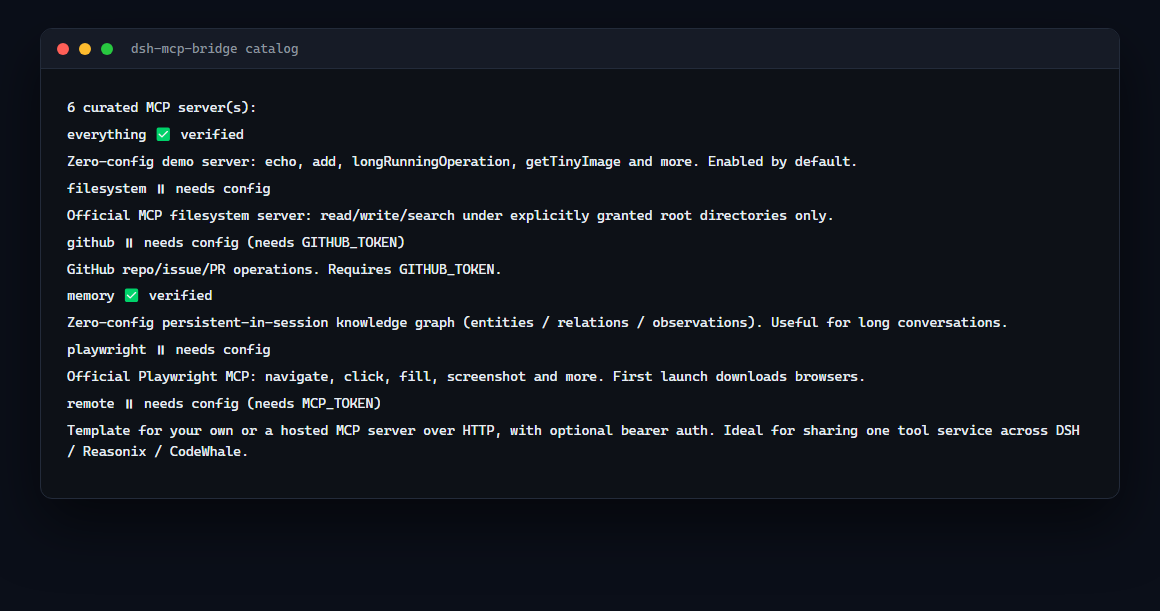
| Server | What it gives you | Config needed | Verified |
|---|---|---|---|
everything |
Demo tools: echo, add, long-running ops, tiny image | none (default on) | ✅ 13 tools |
memory |
In-session knowledge graph (entities/relations) | none | ✅ 9 tools |
filesystem |
File read/write/search, scoped to explicit roots | root dir (edit args) | ✅ 14 tools (given a real dir) |
github |
Repos / issues / PRs | GITHUB_TOKEN |
⏸ needs config |
playwright |
Browser automation (navigate/click/screenshot) | first-run browser download | ⏸ heavy, excluded from CI |
remote-http |
Your own / hosted HTTP MCP server | URL (+ optional token) | ⏸ needs config |
To enable a commented preset, uncomment its block in the profile's cordis.patch.yml (hot-reloaded via HMR) or edit cordis.patch.yml in this package.
Verify the catalog yourself
npm install          # brings @deepseek-ai/dsh-mcp-client → the MCP SDK
npm run verify       # or: node scripts/verify-servers.mjs
Prints PASS / SKIP / FAIL per server; exits non-zero on any failure. VERIFY_TIMEOUT_MS=15000 tunes the per-server timeout. Single-server troubleshooting: node scripts/probe-server.mjs npx -y your-mcp-server.
Adding your own MCP server
Each server is one @deepseek-ai/dsh-mcp-client entry. Either add it to the profile's user patch layer (recommended, HMR applies it without restart):
# $DSH_HOME/profiles/<name>/cordis.patch.yml
- id: mcp-myserver
  name: '@deepseek-ai/dsh-mcp-client'
  config:
    serverName: myserver          # namespace, unique per process ([A-Za-z0-9_-]{1,32})
    transport: stdio              # or streamable-http
    command: npx
    args: ['-y', 'your-mcp-server']
    env:
      YOUR_TOKEN: !!js process.env.YOUR_TOKEN
…or drop a definition into servers/ (so verify covers it) and add the matching entry to cordis.patch.yml here.
Config fields (from dsh-mcp-client)
| Field | Transports | Required | Meaning |
|---|---|---|---|
transport |
both | yes | "stdio" or "streamable-http" |
serverName |
both | yes | tool namespace, unique among live instances |
command / args / env / cwd |
stdio | command yes | child process spec |
url / headers |
http | url yes | endpoint + auth headers |
toolCallTimeoutMs |
both | no | per-call timeout, default 60000 |
failOnStartupError |
both | no | reject activation on connect failure (default false) |
reconnect.* |
both | no | auto-reconnect backoff (default on) |
Linking up with Reasonix / CodeWhale
All three are agent harnesses — MCP is the shared language. Any server you run for Reasonix or CodeWhale can be added here, and a local streamable-http server you own can serve DSH, Reasonix and CodeWhale from one process. See servers/remote-http.json.
Troubleshooting (Windows)
- Headless verification hangs (
dsh --profile <name> "task"): the profile needs@deepseek-ai/dsh-headlessindsh.profile.bundles(add it manually;dsh plugin add @deepseek-ai/dsh-headlessfails with 404 on its unpublished dependency). Without it the tree activates but no agent consumes the task. npxis fine on Windows: the MCP SDK usescross-spawn, which resolves.cmdshims — nonpx.exeneeded.- Server connects but no tools: check the profile logs;
failOnStartupError: falsemeans the entry activates without tools on failure.
Releasing (npm)
npm version patch(or bumppackage.jsonmanually), commit, tagvX.Y.Z.git push origin main --tags.- GitHub Actions (
publish.yml) publishes to npm — requires npm trusted publisher (OIDC) linked to the repo. Setup: npm → Access Tokens → Generate new token → Publish with GitHub Actions.
Give the repo the GitHub topic dsh-plugin so it shows up in the community lists (awesome-dsh-plugin, WhaleHub).
License
MIT — see LICENSE.
Links
More in this category
Tencent/WeKnora#dsh-weknora★ 31002
Four read-only tools over a WeKnora knowledge base: list knowledge bases, hybrid passage search, reassemble one document's chunks in order, and WeKnora's own cited RAG or ReAct-agent answer with a resumable session id.
superdesigndev/treg★ 3752
Tool catalog for agents: search ~2,600 external endpoints (SEO and SERP, backlinks, social, people and company enrichment, ad libraries, scraping) by the task you want done, read each one's parameters and per-call price, then call it with the credential injected server-side. Ships the skill plus an MCP row that stays disabled until TREG_TOKEN is set.
TencentCloudBase/CloudBase-AI-Toolkit#dsh-plugin★ 1127
Tencent CloudBase backend for DeepSeek Harness — scaffold and deploy full-stack apps from chat, render query results as table cards with paging, sorting and CSV export, preview a deployment on its domain, and call the CloudBase MCP toolset (`mcp__cloudbase__*`) with device-code login.
gitroomhq/postiz-agent#dsh-postiz★ 498
Connects DeepSeek Harness to Postiz over MCP: list connected social media channels, fetch per-platform posting rules, and schedule, draft, or publish posts to X, LinkedIn, Instagram, Facebook, Threads, TikTok, YouTube, Reddit, Bluesky, Mastodon, Discord, Slack, Telegram and more; adds a postiz workflow skill.
EthanYoQ/Invoice-Downloader#dsh-invoice-downloader★ 465
Local IMAP invoice download, OCR, archive, and Excel reimbursement summaries for DeepSeek Harness.
anysearch-team/anysearch-dsh★ 432
AnySearch-powered real-time web and vertical search provider for DeepSeek Harness.
Community comments
Comments are public GitHub Discussions. Loading them connects to GitHub and Giscus; a GitHub account is required to post.