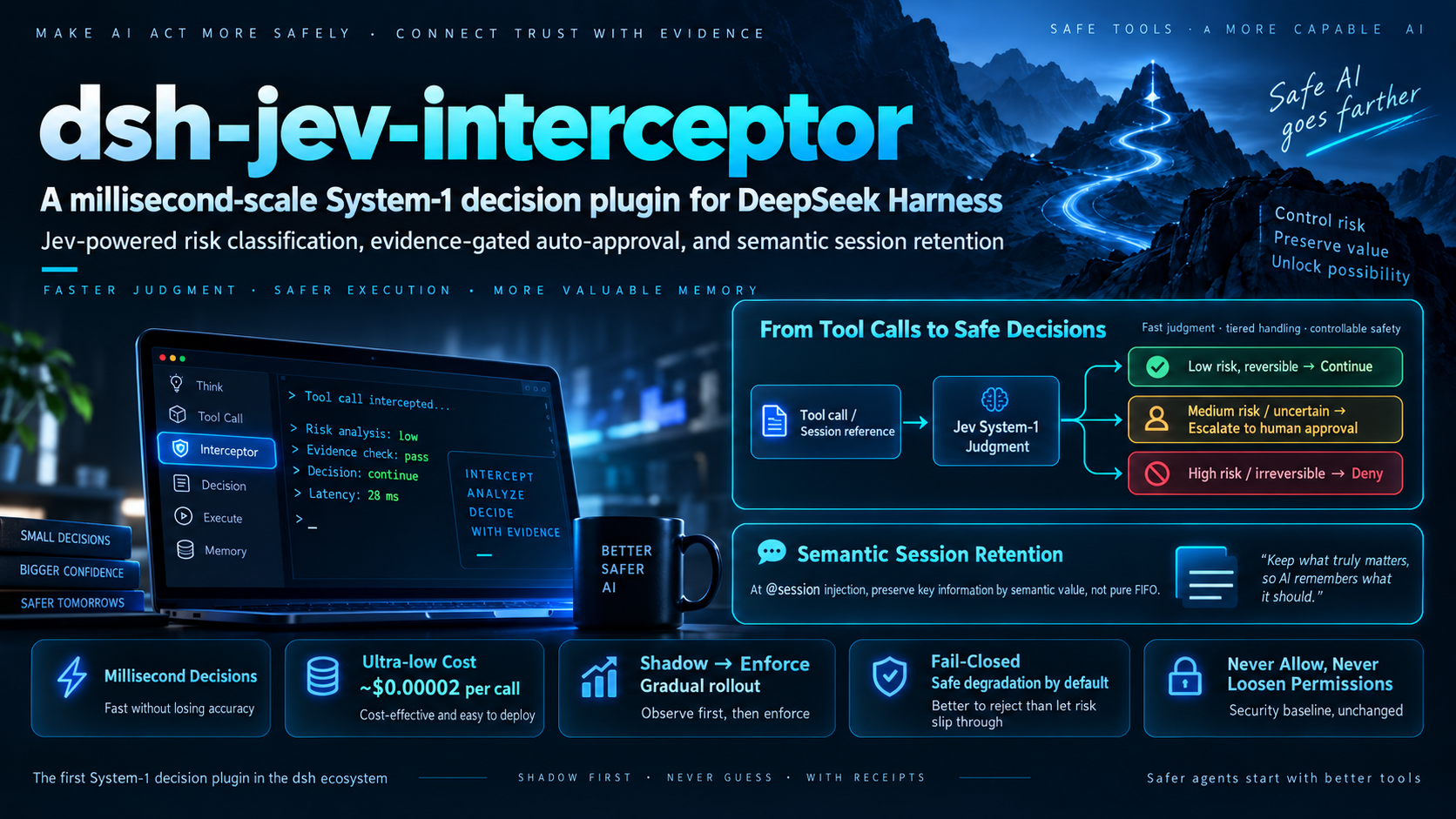
Classifies pending tool calls with Jev (TypeSafe AI's non-generative decision model) on tools/pre-execute — confident high-risk calls are denied, ambiguous ones escalated to approval — and auto-approves clearly-granted reversible calls on approval/request behind argument-evidence gating. Also subclasses the session-reference resolver so snapshots keep Jev-scored messages instead of dropping oldest-first. Degrades to stock behavior on any provider failure; shadow mode with a /jev-stats command; TypeSafe or OpenRouter endpoints; 64 tests.
Install
# from npm (prebuilt)
dsh plugin --profile web add dsh-jev-interceptor
# from GitHub (first run asks for allowBuilds approval — follow the hint, retry)
dsh plugin --profile web add github:AskTheWay/dsh-jev-interceptor
Any plugin you install runs third-party code with your own permissions — it can read your files, use your credentials, and reach the network, and tool approvals don’t sandbox it. GitHub-sourced plugins also run build scripts at install time — pnpm blocks those until you allow them, so an install can stop with ERR_PNPM_GIT_DEP_PREPARE_NOT_ALLOWED or ERR_PNPM_IGNORED_BUILDS; dsh prints the exact key to add under allowBuilds in your profile’s pnpm-workspace.yaml, and the install works on the next run. Allowing a build is a trust decision: only install sources you trust, and pin a commit (github:owner/repo#sha).
README

⚡ Millisecond judgement for every tool call and every recalled message — for about two millionths of a dollar each.
Your agent's most expensive habits: asking a poetry-writing LLM yes/no questions, and amputating your context by age. This plugin wires Jev — the non-generative "System One" model that broke everyone's feed — into the decision points of DeepSeek Harness where an LLM is overkill and rules are blind.
English | 中文
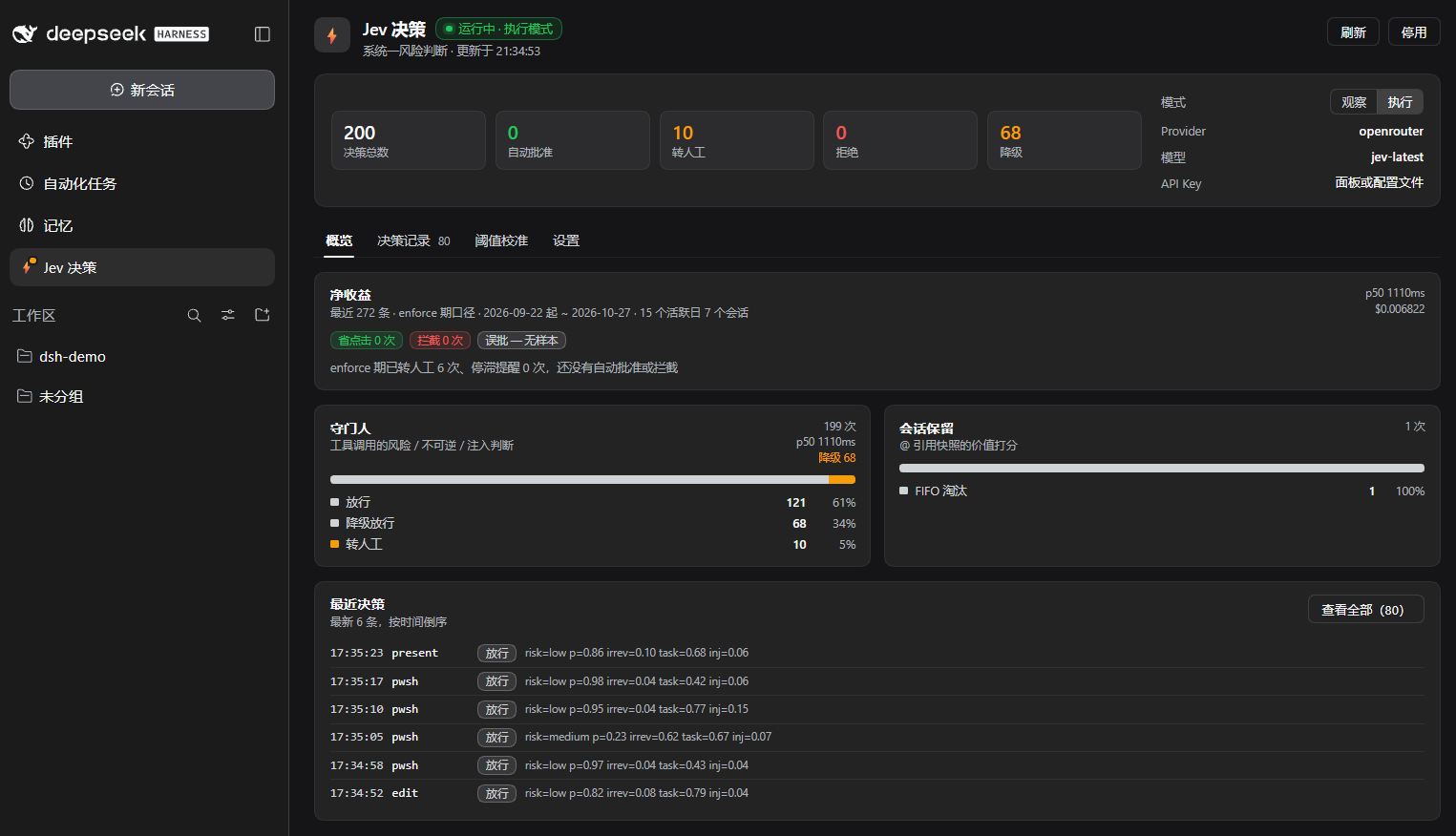
The Web panel (sidebar ⚡ → Jev 决策): live KPIs and net-benefit card, a filterable decision log with full evidence per row, shadow-data threshold advice that tracks whether you adopted it, and one-click connection test. Every screenshot above is the real plugin running real decisions.
What it does, in one breath: before a tool call runs, Jev classifies its risk, irreversibility, task-fit, and injection-suspicion in one ~$0.00002 request — confident high-risk calls get denied, medium ones escalate to a human, and clearly-granted reversible ones stop wasting your clicks on approval dialogs. And when an @session snapshot gets injected, Jev scores every message's value for the citing task so the error traceback survives the byte budget instead of the oldest small talk. Every doubt, every timeout, every missing key degrades to stock dsh behavior. Nothing to configure away, nothing that can widen a permission.
Why this exists
dsh ships zero per-call risk classification — the pre-execute waterfall's default is a bare allow. Its only built-in precedent, experimental/auto-review, does the classification with a generative LLM: one full model request per tool call, temperature 0, hand-rolled JSON text protocol, self-described as slow, expensive, and experimental. That's a System-2 scribe doing a System-1 reflex's job:
| auto-review (generative LLM) | dsh-jev-interceptor (Jev) | |
|---|---|---|
| Decision shape | emits JSON token-by-token, then parses it and prays | typed choice/noul answers — type errors are structurally impossible |
| Cost per call | one full LLM request | ~$0.00002 (measured: 501 input tokens) |
| Latency | seconds | ~100ms provider-side (TypeSafe-reported p50); ~1s end-to-end from outside US-West |
| Uncertainty | buried in prose | per-question probability distributions + calibrated confidence |
| Failure path | parse fallback → deny | low confidence → next() — it never guesses |
Jev's maker TypeSafe reports up to 200× faster / 400× cheaper than LLMs on classification workflows — and this plugin is that number, landed in a real agent harness, with receipts in /jev-stats.
We believe this is the first System-1 decision plugin in the dsh ecosystem. The full map of where decision models fit in dsh — this plugin's two hooks plus eleven more verified hooks (semantic model routing, context-retention scoring, image-offload pre-planning, worker-report verification...) — is in docs/jev-usage-points.md.
The FIFO pain point nobody talks about
When you @-mention a past session in dsh, the harness injects a bounded snapshot of it — and when that snapshot exceeds its byte budget, it drops messages oldest-first. Pure FIFO. Zero semantics. The bug report you pasted at the top of the session and the three-line question that started it all? Dropped first. The "thanks!" and "ok, continue"? Kept — they were newer.
dsh's own retention code is honest about it: drop the oldest, then truncate the longest, done. This plugin's jev-session-reference row takes that decision over (by subclassing the upstream resolver, so @-completion, budgets, spill, and cancellation stay inherited): one Jev fan-out scores each droppable message — noise / background / relevant / critical — and the drop order becomes least valuable first, with truncation cutting padding before substance. Checkpoints and the newest message stay protected exactly as upstream; the byte budget is honored exactly as upstream; and with sessionReferenceEnabled: false (the default) the row renders byte-for-byte like stock.
In shadow mode you get the receipts before trusting it: every injection logs the counterfactual — which messages FIFO dropped that scoring would have kept — then flip to enforce.
The 60-second tour
dsh plugin --profile <name> add dsh-jev-interceptor
# in your profile's cordis.patch.yml
- id: jev-interceptor
  name: dsh-jev-interceptor
  config:
    enabled: true
    mode: shadow            # watch mode first: records every decision, enforces nothing
    provider: typesafe      # or 'openrouter' (works today, no waitlist) | 'custom'
No YAML needed. Once installed, control everything from the chat box — commands persist to the profile and take effect on the next tool call, no reload:
/jev-on                 # enable (starts in shadow mode — records, never acts)
/jev-stats              # watch what it decides, with full probability distributions
/jev-log 20 --json      # the last N decisions, one per line; --json/--csv export
/jev-impact             # the bottom line: clicks saved, denials, cost, latency
/jev-calibrate          # shadow-data threshold advice — apply with one click
/jev-allowlist          # pre-approve allowlist: view suggestions, add/remove tools
/jev-mode enforce       # promote once the numbers look right
/jev-off                # back to stock behavior
Use your agent normally. In shadow mode every decision lands in telemetry with its full probability distribution; /jev-stats summarizes:
[guard] calls: 41  degraded: 0  cached: 9
  actions: delegate=33 ask=6 deny=2
  input tokens: 18234  est. cost: $0.000766
  latency: p50 247ms  p95 512ms  max 611ms
Happy with the numbers? Flip mode: enforce. That's the whole rollout plan — shadow first, then trust, never guess.
Receipts (real usage, not benchmarks)
Six weeks of dogfooding (2026-09-22 → 11-07, 19 active days, 10 sessions, 310 decisions — /jev-impact renders this from your own telemetry any time):
- the pre-approve path has not fired yet (allowlist still empty on purpose — the guard telemetry shows every candidate tool has at least one past medium-risk or injection-suspect call, so the recommender honestly recommends nothing), so the mis-approval metric has no samples yet (0/0, honestly rendered as "无样本" rather than "0") — what was exercised: 8 uncertain calls escalated to the human, 0 high-risk calls missed
- total decision cost: $0.0090 (214,323 input tokens across 180 billed decisions)
- 129 decisions degraded to stock behavior at zero behavioral cost — the fail-closed posture doing exactly what it promises
Calibration closes its own loop: every /jev-calibrate run snapshots the report; the next run tells you which of its previous suggestions you adopted (✓ 已采纳), ignored, or manually overrode (↔), and how the agreement buckets moved since.
Safety model (the part you should actually read)
- Never
allow. "No objection" is expressed asnext(), so downstream listeners (external hooks, auto-review) keep their veto. - Fail-closed everywhere. No key / provider cooldown / timeout / parse mismatch / internal error → delegate to stock behavior. The approval service's
neverpolicy is enforced upstream of every listener, so this plugin structurally cannot relax it. - Evidence-gated auto-approval.
allowed-oncerequires captured argument evidence: only a call the guard escalated (fresh pending entry, matching session and tool) can be auto-approved. Hook asks and sandbox escalations carry no arguments and always go to the human. - Injection-aware. Tool arguments enter the Jev
statedata field only;instructionsare fixed strings; a suspected-injection answer escalates rather than suppresses. (Jev's maker acknowledges adversarial inputs can sway classifiers — so denial here is an accelerator, never the last line of defense.) - Bounded input. Head+tail argument previews and trailing-message digests — Jev's own guidance is to filter in code and send only what a question needs.
- Resilient by construction. Wall-clock timeout per attempt, single retry on 429/529, cooldown after consecutive failures (timeouts count), concurrency cap, LRU decision cache, queue-bound semaphore. A dead provider costs you zero behavior, not your harness.
- Takeover rows disable as a layer. The
jev-session-referencerow replaces the upstreamsession-referencerow; toggling only this row off in the Plugins UI would leave no session-reference active. Remove the takeover by disabling the wholedsh-jev-interceptorbundle layer (setBundleEnabled(false)), which restores the upstream row. - Explainable enforcement. Every
ask/denycarries a human-readable reason with the full evidence summary (jev-guard: 中风险调用,需人工确认(risk=medium 0.72 · irrev=0.30 · inj=0.01)) straight into the approval card and the denied tool result. Thejev-guard:prefix is a safety protocol — the pre-approver refuses to auto-approve its sibling's escalations. - Observable. Every decision lands in
<dsh-home>/plugins/dsh-jev-interceptor/telemetry.jsonl(honoring$DSH_HOME), withcallIdcorrelation and full-precisionscoresfor calibration replays; the log rotates at 20 MB./jev-statsaggregates per hook,/jev-logshows per-decision detail, and the Web panel charts it all. - Calibratable, not guessed.
/jev-calibratereplays your shadow telemetry through the same decision matrix and suggests threshold moves (±0.05 steps, ≥30 samples for routine moves — ≥10 once a mis-approval danger signal appears, tighten-only; injection thresholds never relaxed, nothing auto-applied).
All of this is enforced by 169 tests, including adversarial-review regression cases (a concurrency leak that could hang the tool pipeline, cross-session callId collisions, evidence-free auto-approval).
Configure
Everything is a config field — timeouts, cooldown, concurrency, cache, per-hook thresholds, tool lists — see the Config schema in src/config.ts. Notable defaults:
- read-only tools (
read,read_image,grep,glob,todo_write) short-circuit with zero cost; - the Auto permission preset is left entirely to
auto-review(no double review, no double billing); - the pre-approval allowlist starts empty — until you name tools in
preapproveToolAllowlist, nothing is ever auto-approved.
Stagnation detection (v0.5, opt-in, default off) — dsh's repeat-tool-reminder only catches exact repeats; a doomed retry loop that varies its arguments is invisible to it. When the same tool fails ≥4 times with different arguments, one Jev fan-out judges "no progress + same failure mode"; on high confidence (enforce mode only — shadow logs the would-be alert in telemetry) a plugin-notice reminder tells the agent to stop and change strategy (observe-and-enrich — never vetoes a result):
    stagnationEnabled: true        # default false
    stagnationTriggerCount: 4      # failed varied attempts before judging
    stagnationConfidenceMin: 0.85  # both nouls must clear this to alert
    stagnationCooldownMs: 300000   # one alert per 5 minutes per tool
Semantic session retention lives on its own row (disabled and byte-for-byte stock until you arm it):
- id: jev-session-reference
  config:
    sessionReferenceEnabled: true   # false (default) = pure passthrough
    mode: shadow                    # records would-be retention, renders stock FIFO
    provider: openrouter
    apiKeyEnv: OPENROUTER_API_KEY
OpenRouter works today with no waitlist (decisions models live on a dedicated endpoint there):
    provider: openrouter
    apiKeyEnv: OPENROUTER_API_KEY
The client speaks the plain state + questions wire shape shared by TypeSafe direct, OpenRouter, and the Apache-2.0 local alternative Laya — providers stay swappable, and a closed provider never becomes a lock-in.
Development
npm install --legacy-peer-deps   # devDeps pin a current dsh API generation
npm run typecheck                # src + tests, against real @deepseek-ai types
npm test                         # vitest, 169 tests, no network
npm run build                    # tsc -> lib/
node scripts/smoke.mjs           # one real decision against a live provider
Roadmap
The approval loop (v0.1), semantic session retention (v0.2), image-offload pre-planning (v0.4), and stagnation detection (v0.5) are in. The verified next frontiers — where selection, not just safety, meets System-1 (full catalog):
- Content-aware model routing — routine steps on the cheap route, deep work on the strong one
- Worker-report verification — when a subagent says "done", something checks
License
Links
More in this category
kenryu42/cc-safety-net★ 1900
Pre-execution guard that blocks destructive Git and filesystem commands and access to secrets such as SSH keys and .env files before a tool call runs.
ADWMC/helm-d#helmd★ 984
Security-analysis plugin for DeepSeek Harness: 33 tools spanning six security domains, evidence/reporting and toolbox, plus the case lifecycle, routing and tool ledger; a session-bound case workflow with an evidence chain, E-id validation and reproducible findings; 362 on-demand references; three hot-swappable persona profiles; and a four-tab workbench (armor / case / intercept / about) with case-state recovery after context compaction.
toby-bridges/api-relay-audit★ 904
Runs local security audits of AI API relays and LLM proxies from DeepSeek Harness, producing Markdown reports for prompt injection, model substitution signals, tool-call rewriting, error leakage, stream integrity, and profile-gated Web3 risks.
SeaOf0/dsh-redteam-model★ 807
Authorized-security DSH collection: nine work modes (redteam coordinator, pentest, code audit, binary analysis, attack-defense, AV evasion, incident response, cloud security, CTF solving) and fifteen runtime plugins, managed from a settings page with one-click deploy, install, update and uninstall.
howmp/dsh-pentest★ 616
Authorized pentest mode for DeepSeek Harness — exploration chain, assets and findings with a Web view.
PerryLink/dsh-auto-review★ 244
Second-model auto-review on the approval answerer chain: a read-only reviewer subagent returns structured allow/deny verdicts with reasons, fail-closed by default.
Community comments
Comments are public GitHub Discussions. Loading them connects to GitHub and Giscus; a GitHub account is required to post.