J-Space Cognition Suite SV1 native agent preset and standalone Cordis plugin: 13 modules, persistent controller and decoupled workspace.
Install
# from npm (prebuilt)
dsh plugin --profile web add @anonyjcy/dsh-j-space
# from GitHub (first run asks for allowBuilds approval — follow the hint, retry)
dsh plugin --profile web add github:AnonyJcy/dsh-j-space
Any plugin you install runs third-party code with your own permissions — it can read your files, use your credentials, and reach the network, and tool approvals don’t sandbox it. GitHub-sourced plugins also run build scripts at install time — pnpm blocks those until you allow them, so an install can stop with ERR_PNPM_GIT_DEP_PREPARE_NOT_ALLOWED or ERR_PNPM_IGNORED_BUILDS; dsh prints the exact key to add under allowBuilds in your profile’s pnpm-workspace.yaml, and the install works on the next run. Allowing a build is a trust decision: only install sources you trust, and pin a commit (github:owner/repo#sha).
README

简体中文 | English
J-Space Cognition Suite SV1 native Agent Preset & standalone Cordis plugin for DeepSeek Harness (DSH).
Bringing internal thought representations, externalized workspace ledgers (.jspace/), and adaptive verification to unlock full LLM reasoning potential.
Compatibility: adapted to DSH 0.1.6
dsh-workflow-ptcand DSH 0.1.5dsh-personaschema (config.prefix/config.suffix).
🌟 Overview
dsh-j-space integrates the J-Space Cognition Suite (SV1 release, continuing V3.7 evolution) into DeepSeek Harness as a native Agent Preset.
Unlike traditional flat prompt injections, this plugin provides full agent scope isolation, multi-tier reasoning routes, externalized workspace ledgers (.jspace/), and adaptive verification across any compatible LLM model (DeepSeek, Claude, GPT, etc.).
📸 Screenshots & Preview
| DSH Preset Selection (Zero-Config) | J-Space Cognition Session in Action |
|---|---|
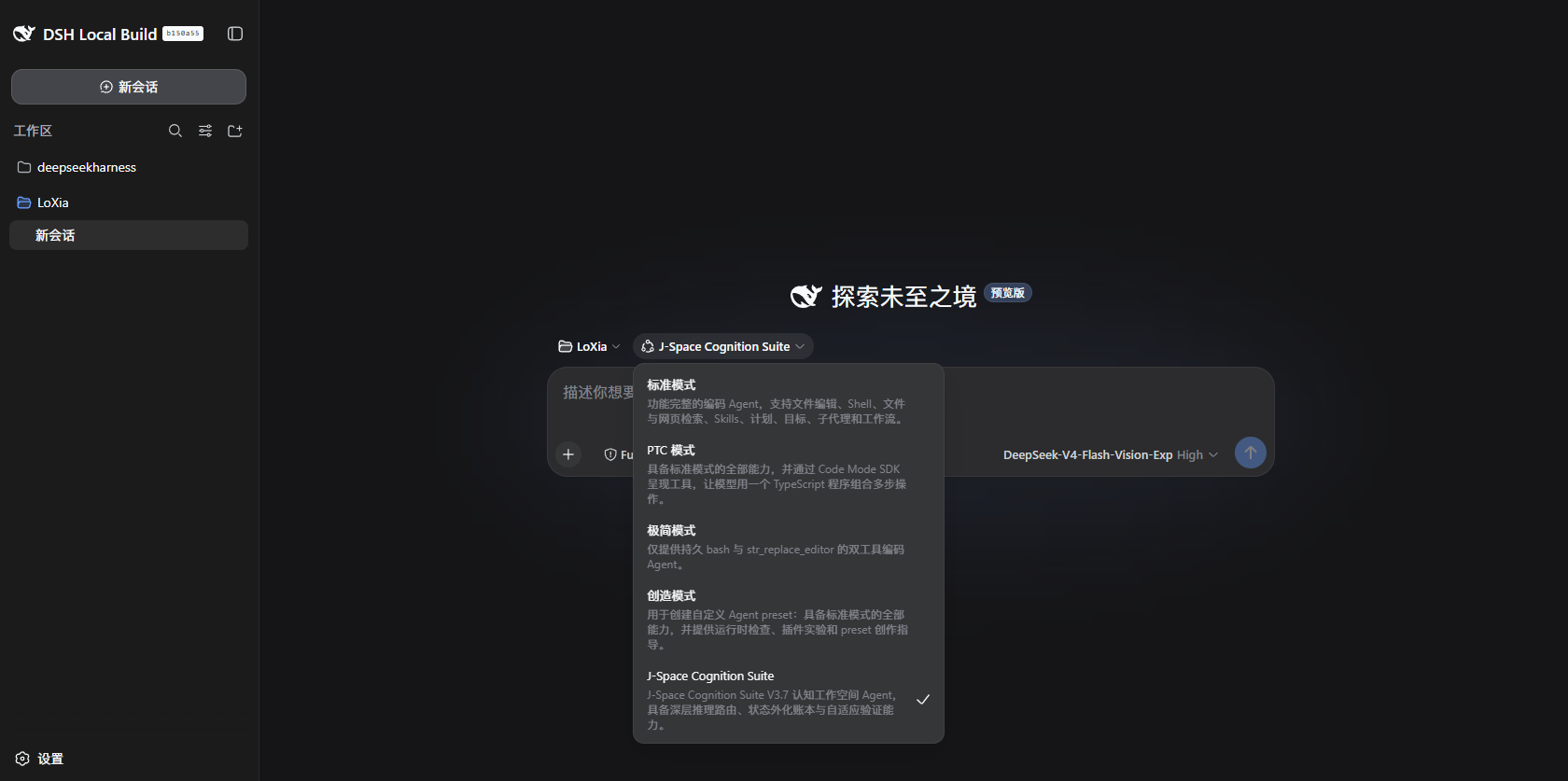 |
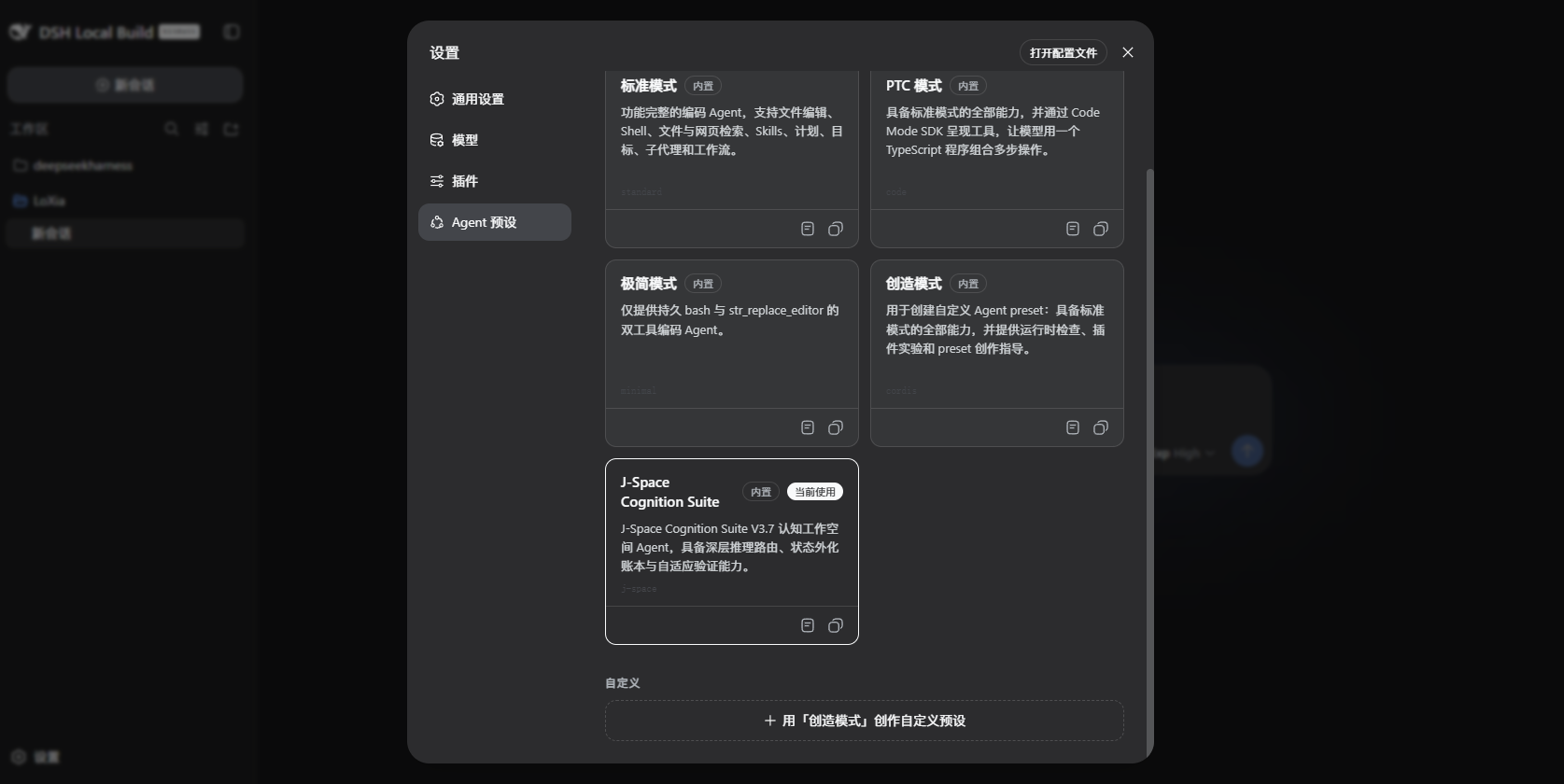 |
📊 Empirical Capability Realization Report
Full evaluation reports by the original author:
- Current Benchmark Report: GLM-5.3-Flash-J-Space-Capability-Realization-Report
- Earlier Comparative Report (Preserved Archive): DeepSeek-V4-J-Space-Capability-Realization-Report
🔬 Benchmark 1: GLM-5.3-Flash Evaluation (Latest Report)
1. Main Benchmark Table (Accuracy Comparison)
| Benchmark | GLM-5.3-Flash (Baseline) | GLM-5.3-Flash + J-Space V3.7/SV1† | GLM-5.3 | Opus-5 | Fable 5.1 |
|---|---|---|---|---|---|
| HLE (w/ tools) | 55.3 | 59.2 | 62.5 | 64.7 | 65.0 |
| Terminal Bench 2.1 | 84.3 | 88.8 | 88.2 | *89.1 | *91.4 |
| DeepSWE v1.1 | 63.4 | 68.0 | 66.9 | 68.8 | 67.4 |
| Agents' Last Exam | 26.3 | 30.5 | 28.5 | 31.6 | — |
| AutomationBench (Public) | 48.8 | 51.1 | 48.2 | 50.3 | — |
* Note: Terminal Bench 2.1 figures for Opus-5 and Fable 5.1 are independently measured by a third party; no official entries exist.
\† Estimated, based on limited controlled experiments.
2. Speed and Token Efficiency Table (GAIA Controlled Pair)
| Metric | Factor / Improvement |
|---|---|
| Speed | 1.87× |
| Token Efficiency | 1.41× |
🔬 Benchmark 2: DeepSeek-V4-Flash Evaluation (Historical Archive)
- Base Model:
DeepSeek-V4-Flash-Vision-Exp - Harness: DeepSeek Harness (Standard Mode)
- Methodology: Rigorous A/B Testing with and without J-Space on authoritative benchmark subsets and same-type mini-sets (Terminal-Bench 2.1: 20 medium / 10 hard; DeepSWE: 10 TypeScript / 10 Python / 10 Go / 2 JavaScript / 2 Rust; GAIA: level 1 / level 3, etc.), with identical model, environment, and sampling — only the J-Space toggle differs.
- Evaluation Dimensions: ① Accuracy / Pass Rate; ② Wall-clock & Token Efficiency.
1. Main Benchmark Table (Accuracy Comparison)
| Benchmark | DeepSeek V4-Flash (Baseline) | DeepSeek V4-Flash + J-Space V3.7 | GLM-5.3 | Kimi-K3 | Opus-4.8 | Fable 5 (w/ fallback) |
|---|---|---|---|---|---|---|
| HLE (w/o tools) | *37.8 | 37.8 | — | 43.5 | 49.8 | 53.3 |
| HLE (w/ tools) | *51.5 | 51.9 | 62.5 | 56.0 | 57.9 | 63.0 |
| Terminal Bench 2.1 | 83.9 | 85.5 | 88.2 | 88.3 | 85.0 | 88.0 |
| NL2Repo | 57.7 | 60.4 | 58.0 | 58.0 | 69.7 | — |
| CyberGym | 75.3 | 77.8 | 84.5 | 80.0 | 78.3 | 83.1 |
| DeepSWE | 59.3 | 61.8 | 66.9 | 67.5 | 58.0 | 70.0 |
| Toolathlon-Verified | 75.9 | 77.4 | 73.0 | 76.5 | 76.2 | 77.9 |
| Agents' Last Exam | 27.3 | 28.3 | 28.5 | 27.6 | 25.7 | 23.8 |
| AutomationBench (Public) | 25.7 | 27.6 | 48.2 | 30.8 | 27.2 | 29.1 |
| ⭐ Average Score | 56.99 | 58.61 | 64.54 | 60.96 | 58.33 | 62.13 |
* Note: HLE scores were not disclosed and follow DeepSeek V4-Flash-0731. The average covers the 7 rows where all six columns have values.
2. Speed and Token Efficiency Table
| Benchmark | Wall-clock τ | Speedup | Output Tokens | Total Tokens | Score per Unit Time | Cost per Successful Task |
|---|---|---|---|---|---|---|
| HLE (w/o tools) | *1.02 | −2% | −10% | +5% | 0.98× | +5% |
| HLE (w/ tools) | 0.88 | +14% | −22% | +3% | 1.15× | +2% |
| Terminal Bench 2.1 | 0.79 | +27% | −28% | −3% | 1.29× | −5% |
| DeepSWE | 0.78 | +28% | −28% | −3% | 1.34× | −7% |
| Toolathlon-Verified | 0.86 | +16% | −25% | +2% | 1.19× | +0% |
| AutomationBench (Public) | 0.76 | +32% | −31% | −5% | 1.41× | −12% |
** Note: For HLE (w/o tools), τ=1.02 is intentionally positive (i.e. slower) because on single-turn tasks without tools, injecting the full skill entry is net overhead. On long-horizon and multi-turn coding/agentic benchmarks (e.g. Terminal Bench, DeepSWE, AutomationBench), J-Space delivers +14% ~ +32% faster execution, cuts 28%~31% of output token redundancy, and boosts score per unit time by 1.15× ~ 1.41×.*
🚀 Installation & Deployment
Method 1: Install from npm / pnpm (Official Registry)
# via npm
npm install -D @anonyjcy/dsh-j-space

# via pnpm
pnpm add -D @anonyjcy/dsh-j-space

# Deploy preset to ~/.dsh/.agent-presets/j-space
npx @anonyjcy/dsh-j-space install
Method 2: Direct Clone & Install (Local Use)
git clone https://github.com/AnonyJcy/dsh-j-space.git
cd dsh-j-space

# Deploy J-Space preset to ~/.dsh/.agent-presets/j-space/
node bin/cli.js install

# Check status
node bin/cli.js status
💡 Usage
1. In DeepSeek Harness Web UI
- Create a new Session.
- Select J-Space Cognition Suite in the Agent Preset dropdown.
- Pick any compatible model (
deepseek-chat,deepseek-reasoner, etc.) and start your task.
2. In DeepSeek Harness CLI
dsh --preset j-space "Analyze this architecture and implement feature X"
3. In Cordis Composition (cordis.yml)
- id: j-space-plugin
  name: '@anonyjcy/dsh-j-space'
  config:
    autoDeploy: true
🧩 Architecture & Data Flow
flowchart TD
    A[New Session] --> B[Select j-space Preset]
    B --> C[Preset Discovery: AgentPresets.list]
    C --> D[Preset Mount: AgentPresets.mount]
    D --> E[Agent Scope]
    E --> F1[Persona: J-Space SV1 Architecture]
    E --> F2[Tools: Full Coding & Reasoning Tools]
    E --> F3[Skill Filesystem: Mounted skills/j-space/]
    E --> F4[J-Space Suite: SKILL.md, 13 modules, 7 references, controller & adapters]
    E --> G[Session Model Route: Any Model]
    G --> H[Agent Executes J-Space Cognition Loop]
    H --> I[Task Workspace: Managed .jspace/ Ledger & Control State]
🛠️ CLI Commands
node bin/cli.js install    # Deploy J-Space preset to ~/.dsh/.agent-presets/j-space
node bin/cli.js uninstall  # Cleanly remove J-Space preset
node bin/cli.js verify     # Verify integrity of installed preset files
node bin/cli.js status     # Display current installation status
📄 License
MIT License. See LICENSE and THIRD_PARTY_NOTICES.md.
Maintenance
See CHANGELOG.md for release notes.
Links
More in this category
FuRongJun-1999/dsh-memory★ 225
White-box AGI architecture exploration: metacognition (self-cognition loop), continual learning (knowledge flywheel), world model (condition space, spatiotemporal memory graph), self-improvement (bootstrap discipline), zero-LLM white-box pipeline, and auditable trust guardrails.
Jonah-Wu23/dsh-gungnir#dsh-plugin★ 5
Evidence-driven goal verification plugin for DeepSeek Harness. Locks goals via /ultragoal and verifies completion against command exit codes and generated artifacts, preventing the model from falsely reporting task completion.
kenz1117/dsh-engram★ 4
Cross-session long-term memory under the "memory palace" metaphor: dual-scope SQLite stores (user + per-git-origin project), hybrid FTS5 + local-vector retrieval with RRF fusion and recency/proof ranking boost, automatic capture from the session log (including the final turn), provenance audit chains, consolidation distillation and decay forgetting, and a settings-page Memory Library panel with corridor topology, tour butler, and refurb list.
dsh-answer-reviewer★ 3
Agentic answer reviewer for DeepSeek Harness: each final assistant turn is re-reviewed by a separate LLM graded 1-100; below-threshold scores steer the agent back with concrete feedback. The score is shown as a chip on the answer's action row (green pass / red needs-work, with retry count and reason on hover). Live gate config over a 127.0.0.1 HTTP server, plus a collapsed dock above the composer and an optional right-sidebar tab via dsh-better-sidebar.
Kanadego/dsh-heartbeat★ 3
Heartbeat loop for DeepSeek Harness: every 20 minutes (by default) the agent wakes on its own to keep a local profile of your interests and preferences, search the web for things you care about, and keep what it finds. When it has something worth sharing, it sends a short package of notes to the sessions you link it to. A set of rules in code - quiet hours, busy windows, a daily limit, a cooldown - decides whether it may speak at all, and the agent in that session decides whether to actually say anything. Windows only.
MichengAI/dsh-pua★ 3
Adds /pua to steer the agent to try another approach and verify results before claiming completion, with 15 company styles, persona modes, global and per-conversation settings, and an optional loop that continues until a verification command passes, the iteration limit is reached, or the user cancels.
Community comments
Comments are public GitHub Discussions. Loading them connects to GitHub and Giscus; a GitHub account is required to post.