MySQL connector for DeepSeek Harness: configure multiple connections in the settings page with per-connection table allowlist and write permission, switch the active connection from the composer, and expose mysql_query / mysql_tables / mysql_execute tools to every agent preset.
Install
# from GitHub (first run asks for allowBuilds approval — follow the hint, retry)
dsh plugin --profile web add github:1321928757/dsh-mysql
Any plugin you install runs third-party code with your own permissions — it can read your files, use your credentials, and reach the network, and tool approvals don’t sandbox it. GitHub-sourced plugins also run build scripts at install time — pnpm blocks those until you allow them, so an install can stop with ERR_PNPM_GIT_DEP_PREPARE_NOT_ALLOWED or ERR_PNPM_IGNORED_BUILDS; dsh prints the exact key to add under allowBuilds in your profile’s pnpm-workspace.yaml, and the install works on the next run. Allowing a build is a trust decision: only install sources you trust, and pin a commit (github:owner/repo#sha).
README
English | 中文
dsh-mysql is a profile bundle for DeepSeek Harness (DSH). It adds a settings page for multiple MySQL connections, a per-session connection picker beside the composer, and four guarded tools that every agent preset can use. No preset edits are required.
Data boundary: connection settings and passwords stay in your local DSH storage. Database schema and query results are sent to the LLM provider as ordinary tool output when the agent uses a database tool.
At a glance
| Surface | What it provides |
|---|---|
| Settings → MySQL 数据库 | Add, edit, delete, and test connections. Configure host, port, user, password, default database, table scope, row-write permission, and independent schema-change permission. |
| Composer database button | Select or deselect one or more data sources for the current session. Each click takes effect immediately; the composer pill shows the single name or a compact selected count. |
| Agent tools + runtime context | mysql_tables, mysql_query, mysql_execute, and mysql_ddl, plus a per-turn context snapshot listing this session's selected sources and capabilities. |
Features
- Multiple connections: keep separate development, staging, or production data sources in one DSH installation.
- Per-session multi-selection: each conversation independently selects zero, one, or multiple sources. Select/deselect takes effect immediately; clearing the last selection leaves the session without database access until a source is selected again. A session with multiple configured sources starts empty; a sole configured source is auto-selected on first initialization. Selection is runtime-only and is not restored after a DSH restart.
- One target per tool call: when multiple sources are selected, the agent passes one selected
connectionIdto each tool call. A single selected source may be inferred. Queries are never broadcast or merged across sources. - Schema-first workflow:
mysql_tablesexposes readable columns, types, nullability, keys, and comments before a query is written. - Read-only by default: row-write access and schema-change access are independent per-connection settings, both disabled by default and each requiring its own risk acknowledgement.
- Scoped schema changes:
mysql_ddlis separate frommysql_execute; changed/deleted targets are checked against the table allowlist, and explicit database qualifiers must match the connection's default database. Account/privilege and database-level statements remain refused. - Local-first configuration: the browser receives a safe connection view with
hasPassword, never the stored password. - No preset changes: the tools are registered globally by the profile bundle and are available under every agent preset.
Agent tools
| Tool | Accepted input and behavior |
|---|---|
mysql_tables |
Lists columns from one selected database through information_schema. Pass connectionId when multiple sources are selected; it may be omitted when exactly one is selected. Optional table filtering is case-insensitive. Results respect that source's table allowlist. |
mysql_query |
Executes one read-only SELECT, SHOW, DESCRIBE/DESC, or EXPLAIN statement against one selected source. Pass connectionId when multiple sources are selected; it may be omitted for a single selection. Optional ? parameters are supported. It rejects multi-statement SQL, applies the target source's table-scope check, and returns up to 2,000 serialized rows with a truncated flag. |
mysql_execute |
Executes one INSERT, UPDATE, or DELETE statement against one selected source. Pass connectionId when multiple sources are selected; it may be omitted for a single selection. Requires that target's allowWrite: true; DDL, transaction-control statements, multi-statement SQL, and other statement types are rejected. |
mysql_ddl |
Executes one CREATE/ALTER/DROP/RENAME/TRUNCATE statement on tables, views, or indexes in one selected source. Pass connectionId when multiple sources are selected; it may be omitted for a single selection. It requires that target's independent allowDdl: true setting; changed/deleted targets obey its allowlist and all explicit database qualifiers must match its default database. Account/privilege statements and database-level DDL are always rejected. |
Schema changes require a separate opt-in and risk acknowledgement. Once enabled, you can ask the agent to create a table, for example:
Inspect the current schema with mysql_tables, then create `agent_notes` in this connection's default database with an auto-increment id, title, and created_at timestamp. Show the CREATE TABLE SQL and execute it with mysql_ddl. Do not modify other tables.
If the connection has a non-empty table allowlist, add the new table to that list before asking the agent to read or write it with the existing tools.
A typical read-only request is:
Use mysql_tables to inspect the available schema first, then use mysql_query to answer my question. Do not modify data.
Multi-source routing example
When a conversation has more than one selected source, route every database call explicitly:
Inspect both selected sources separately. For each source, call mysql_tables and then run:
SELECT @@port AS server_port, DATABASE() AS database_name, VERSION() AS server_version
Pass exactly one selected connectionId per call, label every result with its source, and do not merge or broadcast results.
The picker changes the session's selected set immediately. A session with multiple configured sources starts empty, a sole configured source is auto-selected on first initialization, and clearing the final source leaves the session explicitly empty until the user selects a source again. Selection is kept in memory and is not restored after a DSH restart.
Requirements and compatibility
- A DSH installation with the Web profile and Node.js 20 or newer.
- DSH 0.2.0-rc.2 or newer, below 0.3.0. Version 0.2.0 of this plugin migrates its Typert RPC manifest to the DSH 0.2 strict codec contract (
create()factory) and no longer loads on DSH 0.1.x — use plugin 0.1.11 there. - A MySQL-compatible server reachable through the configured TCP host and port.
- The connection form currently supports host, port, username, password, default database, table allowlist, and write permission. It does not expose SSL/TLS, Unix socket/named-pipe, or charset options.
- The
MAX_EXECUTION_TIMEoptimizer hint is intended for MySQL versions that support it (MySQL 5.7.8+). MariaDB may handle this hint differently;SHOW,DESCRIBE, andEXPLAINdo not receive the hint. mysql_tablesdiscovers tables inDATABASE(). Configure a default database if you want schema discovery; a connection without one can return an empty table list.
Install, update, or remove
Install from GitHub
dsh plugin --profile web add github:1321928757/dsh-mysql#v0.3.1
Install from npm
Use this after dsh-mysql is available in the npm registry:
dsh plugin --profile web add dsh-mysql
PowerShell installer
The repository also provides a Windows installer that checks for dsh, prepares a pinned pnpm helper under %USERPROFILE%\.dsh-tmp, and installs the selected GitHub tag into the web profile:
irm https://raw.githubusercontent.com/1321928757/dsh-mysql/v0.3.0/scripts/install.ps1 | iex
After installation, restart dsh web. Then open Settings → MySQL 数据库, add and test one or more connections, and select them from the database button beside the composer.
Verify that the bundle is in the profile:
dsh --profile web --dump-config | findstr dsh-mysql
Remove it with:
dsh plugin --profile web remove dsh-mysql
Update the installed package from GitHub:
dsh plugin --profile web update dsh-mysql@latest
For local development, install the checkout or a packed tarball into a separate profile first:
dsh plugin --profile demo add E:\path\to\dsh-mysql
dsh --profile demo --dump-config
Quick start
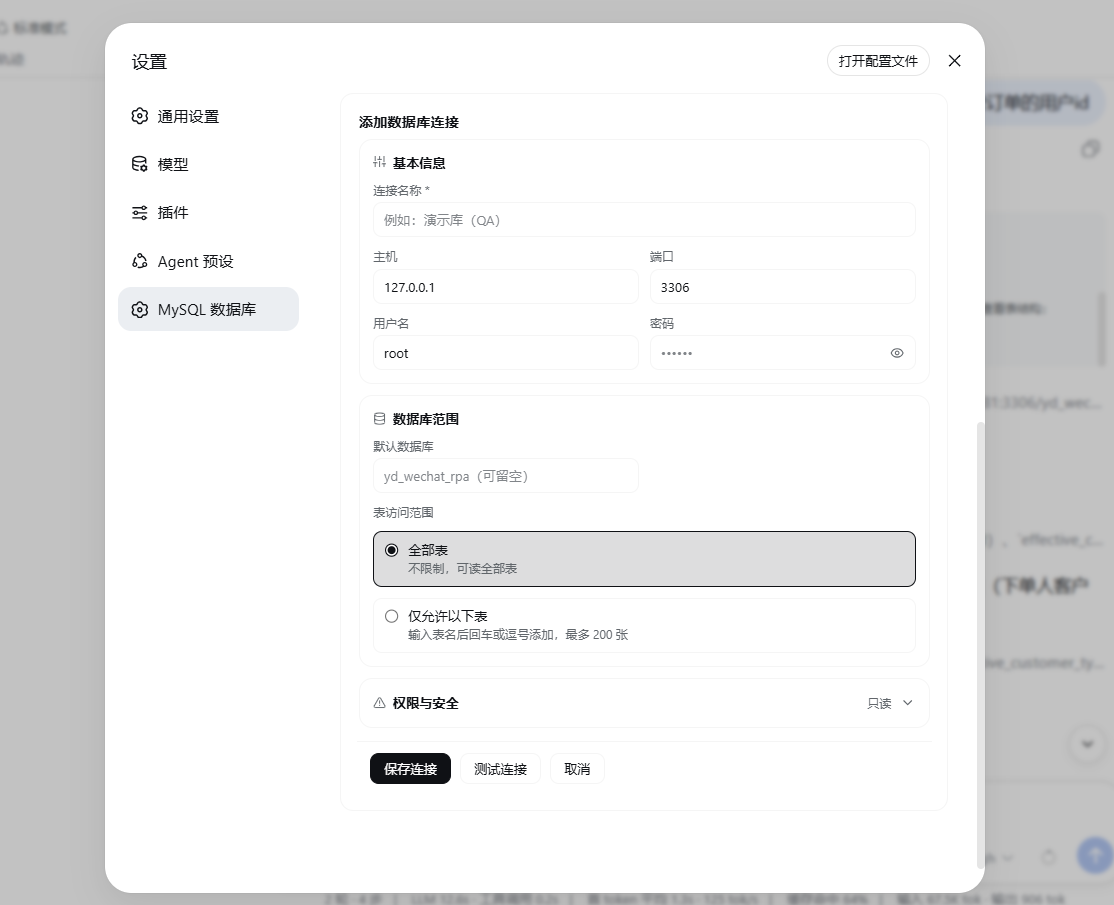
- Open Settings → MySQL 数据库 and click 添加连接. Fill in the host, port, username, password, and default database. Optionally add readable table names and enable write permission only when needed. Test the connection, then save it.
- Open a conversation and click the database button on the left of the composer. Select or deselect one or more connections for that session; each click takes effect immediately and the picker stays open. If exactly one connection is configured, it is selected automatically when the session first initializes. With multiple selections, the agent chooses a target per tool call by
connectionId; deselecting every source disables database tools for that session. Selection is not persisted across a DSH restart. - Ask a database question. The agent can inspect the schema with
mysql_tables, read withmysql_query, usemysql_executeonly for an explicitly writable connection, or usemysql_ddlonly when the separate schema-change permission is enabled.
Screenshots
The screenshots below were captured from the real DSH Web shell with the plugin loaded. Connection names and account names in the settings example are illustrative; passwords are not shown.
Configure a connection
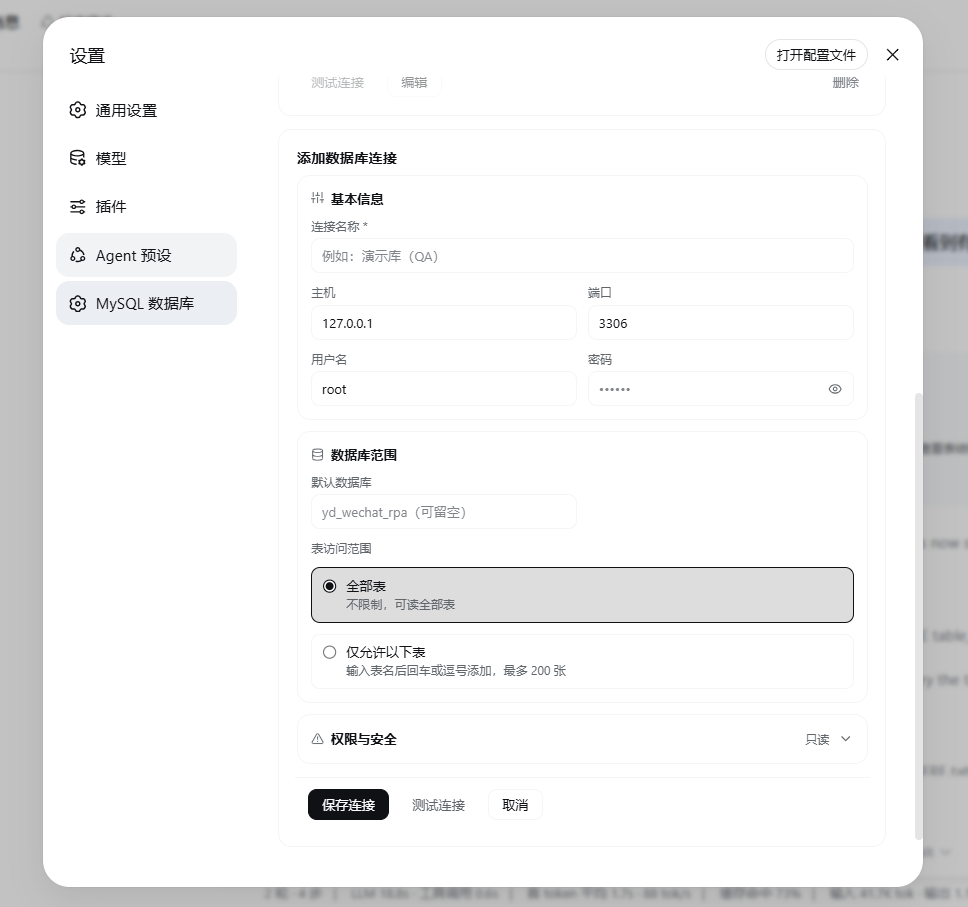
The settings page groups connection details, database scope, and permissions. Read-only is the default. The add-connection form keeps 保存连接 as the primary action, while 测试连接 remains a quieter secondary action.
The form can be opened below the saved connection cards without leaving the settings page:
Select data sources for a session
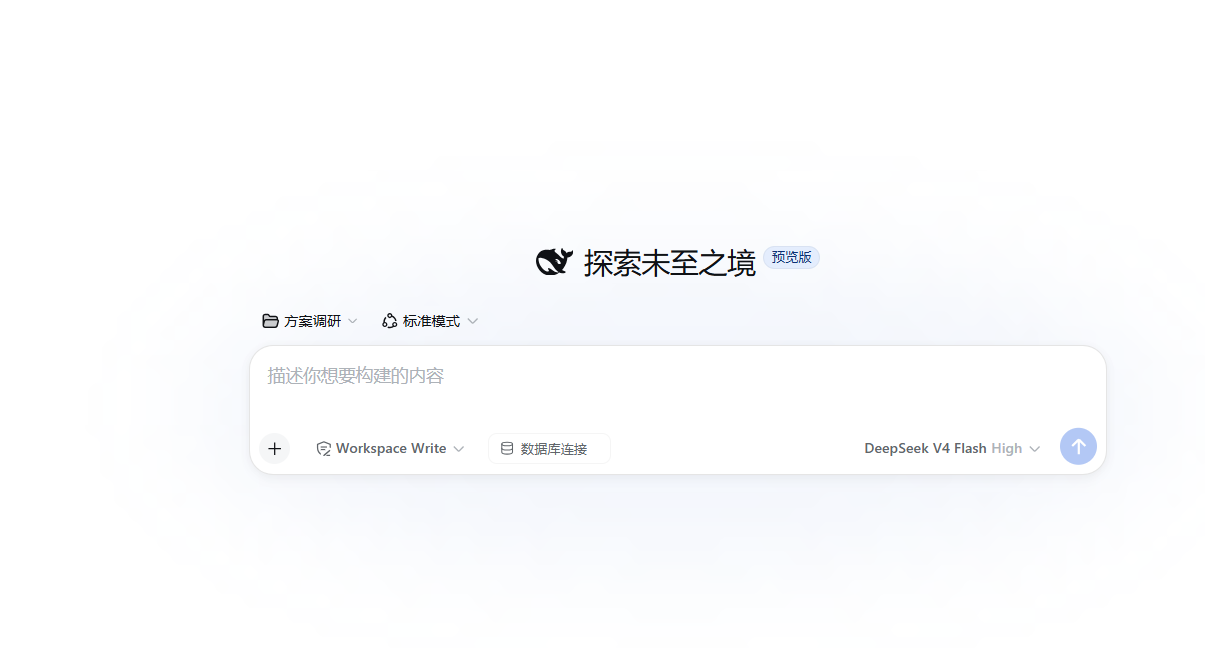
The composer shows the database control even before a connection is selected. Its arrow points down while the picker is closed:
Click it to search and choose from the configured connections. The arrow points up while the list is expanded:
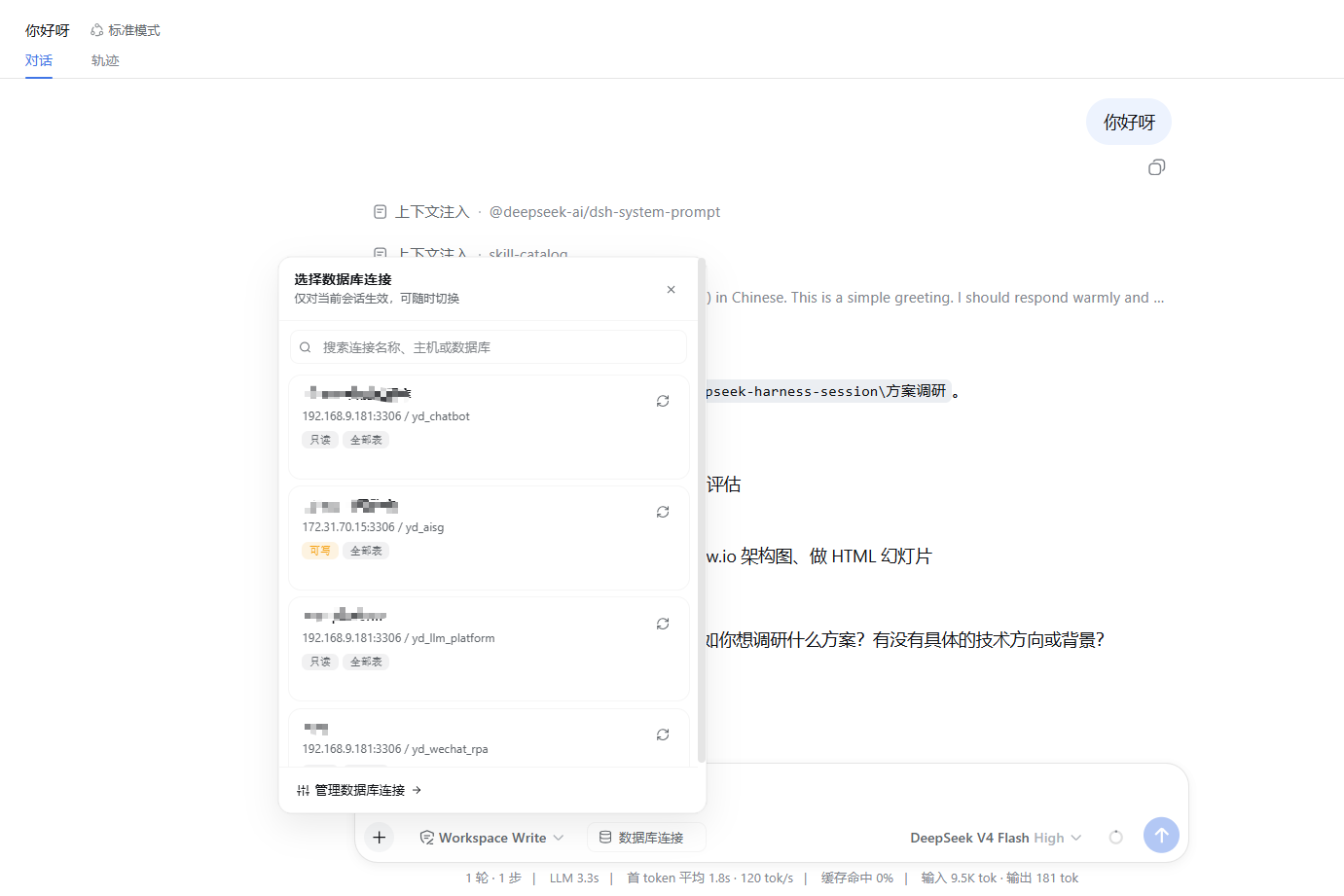
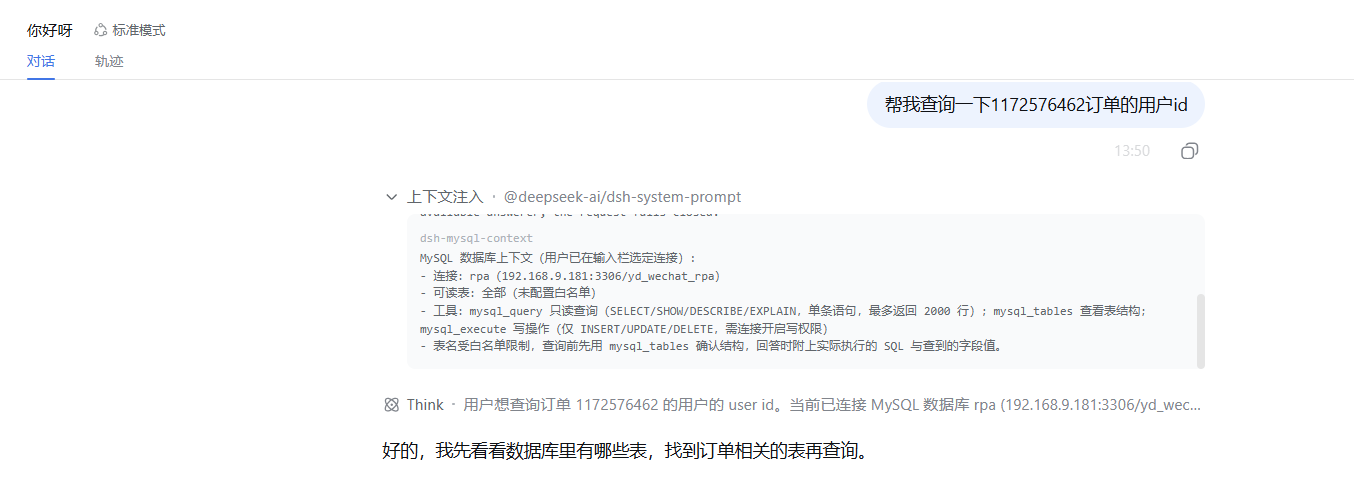
After one connection is selected, its name, green status dot, and down arrow appear in the composer. With multiple selections, the compact composer pill shows the selected count instead of stacking connection-name chips. The picker uses the existing card layout and selected-row treatment; each change applies immediately. The selected sources and their individual capabilities are included in the conversation context shown to the agent:
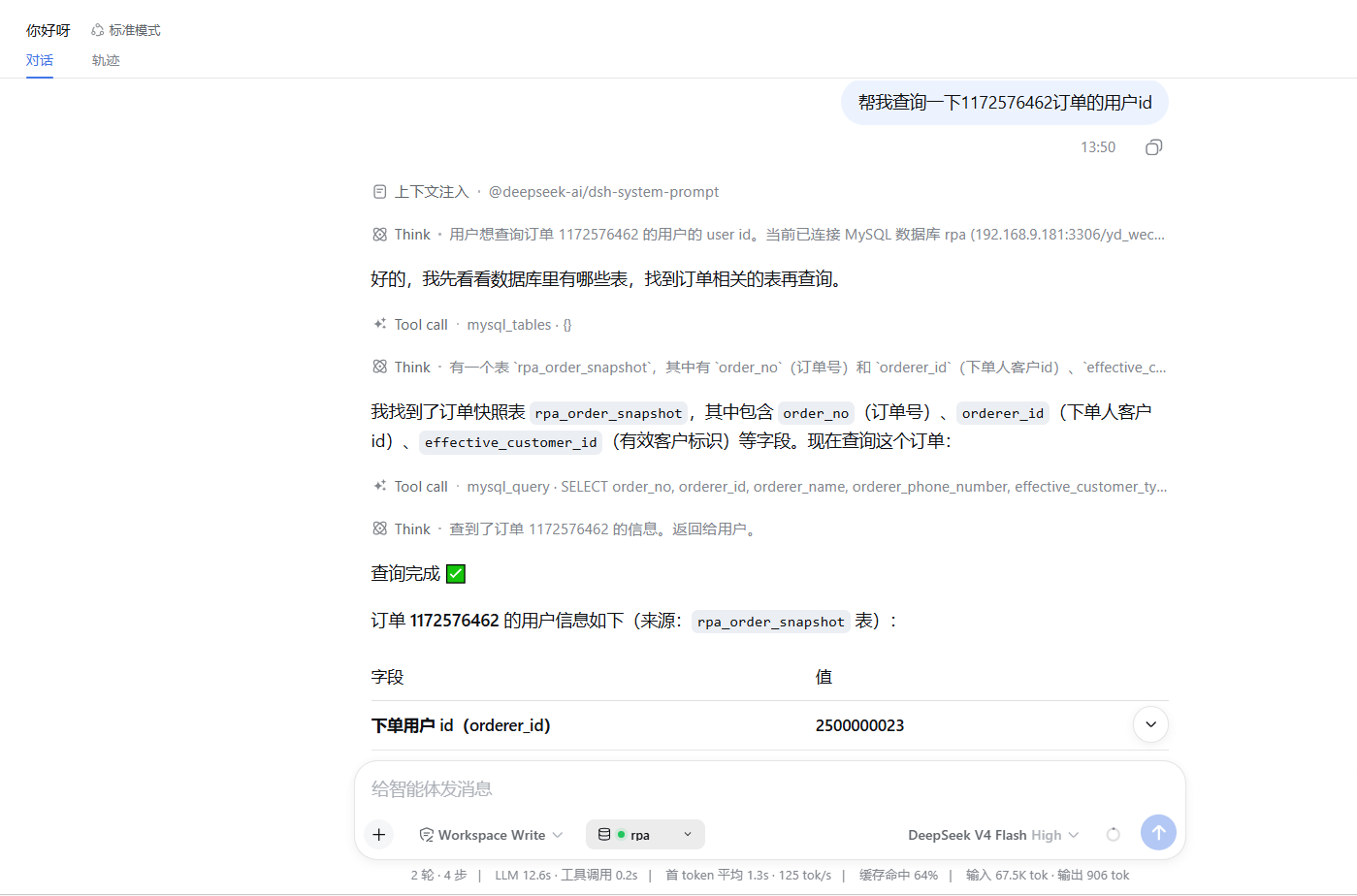
After the agent runs a read-only query, the tool result is displayed in the conversation:
Security and permissions
The plugin uses multiple guardrails, but it does not replace database permissions. Use a dedicated MySQL account with the least privileges possible; for read-only work, a SELECT-only account is recommended.
| Guardrail | What is enforced | Important boundary |
|---|---|---|
| Statement type | mysql_query accepts read statements; mysql_execute accepts only INSERT/UPDATE/DELETE; mysql_ddl accepts the supported table/view/index schema changes. |
The tool layer is not a general SQL console. |
| Row-write permission | mysql_execute requires the selected connection's allowWrite flag. |
Per connection, default off, with a separate risk acknowledgement. |
| Schema-change permission | mysql_ddl requires the independent allowDdl flag; changed/deleted targets obey the allowlist, and explicit database qualifiers must match the default database. |
Default off with a separate acknowledgement; account/privilege and database-level statements stay refused. |
| Multi-statement SQL | Multiple statements and transaction/control statements are rejected. | Schema changes are issued one statement per call. |
| Table allowlist | Checks table references detected after FROM, JOIN, UPDATE, and INTO. An empty list means no configured table restriction. |
This is a lexical check, not a full SQL parser. Forms such as DESCRIBE t or SHOW CREATE TABLE t do not use those reference keywords; combine the allowlist with database-level grants. |
| Result size | The serialized tool response contains at most 2,000 rows and reports truncated: true when rows were omitted. |
The query is fetched before the response is truncated; this is not a server-side scan or network limit. |
| Credential exposure | Passwords are stored in local connections.json; the browser receives only hasPassword. |
Query results, schema, and tool arguments are still sent to the configured LLM provider. |
Passwords are stored as plain text in $DSH_HOME/storages/dsh-mysql/connections.json. Protect this file with operating-system permissions and do not commit or share it.
Known limitations
- Each conversation session independently selects zero, one, or multiple database sources; changes do not affect other sessions. An empty selection disables database tools for that session. Selection state is kept in memory and reinitialized after a DSH restart.
- Each tool call targets exactly one source; when multiple sources are selected,
connectionIdis required. The plugin does not broadcast queries or merge results across databases. mysql_tablesuses the connection'sDATABASE()value, so schema discovery may be empty when no default database is configured. It does not browse arbitrary databases.- The table allowlist is intentionally lightweight and checks common table-reference positions rather than parsing every MySQL grammar form.
- The 2,000-row limit applies to the returned JSON payload after the database response has been fetched.
mysql_executeremains limited to row writes; it does not provide transaction management or a confirmation workflow.mysql_ddlhas no per-call approval; it is guarded by a per-connection opt-in, allowlist, and default-database boundary. Use a narrowly scoped database account.- Connection configuration is TCP-oriented and has no UI for SSL/TLS, Unix sockets/named pipes, or character-set selection.
How it works
Composer / Settings UI
        │  browser slot + Typert RPC (remote.mysql.*)
        ▼
Host mysql service
        │  per-session selection + lazy mysql2 pool
        ├── local JSON: $DSH_HOME/storages/dsh-mysql/connections.json
        └── systemPrompt.context: selected sources + per-source scopes/capabilities
- Host bundle (
lib/index.js) registers the four model tools, manages lazy mysql2 pools, persists connections, tracks each session's selected source set, and provides themysqlservice. Every resolved tool result includes the selected source name andconnectionId; a resolved error is prefixed the same way without exposing credentials. - Typert manifest (
lib/typert.host.js) exposes connection CRUD, testing, selection, and table-list methods to the browser throughremote.mysql.*. - Browser bundle (
lib/client.js) registers theconversation.input.leftdatabase control and thesettings.sectionconnection-management page. UI styles consume DSH--dsw-*theme tokens. - The selected sources are added through
systemPrompt.contextas a dynamic tail section, so changing the selection set does not rewrite the stable cached system-prompt prefix. When multiple sources are selected, the context instructs the model to pass exactly one selectedconnectionIdper tool call.
Migrating from a preset-embedded MySQL tool
If a preset previously embedded mysql_query or mysql_execute through a local tool row:
- Install this plugin into the profile.
- Remove the old MySQL tool row and connection configuration from the preset's
agent.cordis.yml; keep the business persona text. - Restart
dsh web, then recreate the connection in Settings → MySQL 数据库. The tool names are unchanged, so prompts that mention them continue to work.
FAQ and troubleshooting
Restart the DSH Web process after installation or update. Then verify the profile composition with dsh --profile web --dump-config | findstr dsh-mysql. Make sure the plugin was installed into the same profile that you started.
Open Settings → MySQL 数据库 and save at least one connection. In the conversation, click the database button and select one or more sources for this session. A single saved source is auto-selected when the session first initializes; multiple configured sources start with none selected. If you have cleared all selections, select a source again to restore tool access.
Check the host and port, credentials, default database, server reachability, and the MySQL account's network permissions. The plugin connects from the DSH host, not from the browser. For startup diagnostics, inspect $DSH_HOME/storages/dsh-mysql/boot.log.
Set a default database in the connection form. mysql_tables queries information_schema.columns for table_schema = DATABASE() and will not enumerate another schema automatically.
Use mysql_query for one read statement and mysql_execute only for one INSERT/UPDATE/DELETE when allowWrite is enabled. To change schema, enable the independent allowDdl permission with its acknowledgement and use mysql_ddl; it accepts only table/view/index CREATE, ALTER, DROP, RENAME, or TRUNCATE in the default database. Account/privilege statements, database-level DDL, transaction/control statements, multiple statements, and references outside the configured table scope remain blocked. The allowlist is a lexical check; database-level grants remain the final boundary.
No. The browser receives a safe connection view containing hasPassword, not the password value. The local JSON file still stores the password in plain text, so protect that file.
Development
Syntax-check each JavaScript file individually, run the shared-function and Typert contract tests, then pack a local artifact:
Get-ChildItem lib\*.js | ForEach-Object { node --check $_.FullName }
node test\shared.test.mjs
node test\typert.test.mjs
node test\client-typert.test.mjs
pnpm pack
node test\typert.test.mjs validates the Host ./typert manifest (seven strict create() codecs), and node test\client-typert.test.mjs materializes lib/client.js in a controlled environment to validate the Client remote descriptors and slot registrations against the DSH 0.2 rules.
The repository also ships isolated DSH 0.2 acceptance scripts. They never touch an existing dsh web instance: both use a throwaway DSH_HOME, a throwaway profile, and a one-shot port.
pwsh -NoProfile -File scripts\dsh02-headless-smoke.ps1   # Host composition, Typert loader, tool registration
pwsh -NoProfile -File scripts\dsh02-web-smoke.ps1        # Client boot graph, slot rendering, real headless browser
pwsh -NoProfile -File scripts\dsh02-web-smoke.ps1 -RpcProbe   # ... plus a UI-driven pass over the MySQL RPC surface
-RpcProbe drives the rendered UI through a real browser to exercise listConnections, saveConnection, testConnection, getSelection, selectConnection, and deleteConnection, and checks that schema-change authorization defaults off, cannot be saved without its separate acknowledgement, is preserved when editing an authorized connection, that capability badges are distinguishable, the plaintext password never reaches the DOM, a saved connection survives a page reload, and the probe removes its own connection afterwards. listTables is never called by the client (it exists for the Host tools), so it is covered by the contract tests instead.
Install the packed artifact into a scratch profile and verify the real bundle:
dsh plugin --profile demo add .\dsh-mysql-0.3.1.tgz
dsh --profile demo --dump-config
When releasing a new version, update the version in package.json, the $Rev value in scripts/install.ps1, the tagged install URLs in both README files, and screenshots.json if the screenshot set changes. Package version and supported DSH range move together: a Typert codec contract change is breaking for the older runtime, so bump the version and the engines.dsh range in the same release.
License
MIT. This project is not affiliated with DeepSeek. Installing the plugin runs third-party code on your machine; review the source before use.
Links
More in this category
Tencent/WeKnora#dsh-weknora★ 33277
Four read-only tools over a WeKnora knowledge base: list knowledge bases, hybrid passage search, reassemble one document's chunks in order, and WeKnora's own cited RAG or ReAct-agent answer with a resumable session id.
superdesigndev/treg★ 4991
Tool catalog for agents: search ~2,600 external endpoints (SEO and SERP, backlinks, social, people and company enrichment, ad libraries, scraping) by the task you want done, read each one's parameters and per-call price, then call it with the credential injected server-side. Ships the skill plus an MCP row that stays disabled until TREG_TOKEN is set.
TencentCloudBase/CloudBase-AI-Toolkit#dsh-plugin★ 1136
Tencent CloudBase backend for DeepSeek Harness — scaffold and deploy full-stack apps from chat, render query results as table cards with paging, sorting and CSV export, preview a deployment on its domain, and call the CloudBase MCP toolset (`mcp__cloudbase__*`) with device-code login.
gitroomhq/postiz-agent#dsh-postiz★ 511
Connects DeepSeek Harness to Postiz over MCP: list connected social media channels, fetch per-platform posting rules, and schedule, draft, or publish posts to X, LinkedIn, Instagram, Facebook, Threads, TikTok, YouTube, Reddit, Bluesky, Mastodon, Discord, Slack, Telegram and more; adds a postiz workflow skill.
EthanYoQ/Invoice-Downloader#dsh-invoice-downloader★ 503
Local IMAP invoice download, OCR, archive, and Excel reimbursement summaries for DeepSeek Harness.
anysearch-team/anysearch-dsh★ 458
AnySearch-powered real-time web and vertical search provider for DeepSeek Harness.
Community comments
Comments are public GitHub Discussions. Loading them connects to GitHub and Giscus; a GitHub account is required to post.