Appends local hash-chained JSONL receipts for tool results and session events without storing prompts, tool arguments, result text, or raw session IDs.
Install
# from npm (prebuilt)
dsh plugin --profile web add qiushi-dsh-evidence-audit
# from GitHub (first run asks for allowBuilds approval — follow the hint, retry)
dsh plugin --profile web add github:030611/qiushi-dsh-evidence-audit
Any plugin you install runs third-party code with your own permissions — it can read your files, use your credentials, and reach the network, and tool approvals don’t sandbox it. GitHub-sourced plugins also run build scripts at install time — pnpm blocks those until you allow them, so an install can stop with ERR_PNPM_GIT_DEP_PREPARE_NOT_ALLOWED or ERR_PNPM_IGNORED_BUILDS; dsh prints the exact key to add under allowBuilds in your profile’s pnpm-workspace.yaml, and the install works on the next run. Allowing a build is a trust decision: only install sources you trust, and pin a commit (github:owner/repo#sha).
README
English | 简体中文

Leave a locally checkable execution trail without storing prompts, tool arguments, tool results, or session IDs in plaintext.
dsh plugin --profile web add qiushi-dsh-evidence-audit
Community-maintained and not an official DeepSeek project. Related trust-layer plugins: Telemetry Redactor, Verification Receipt, and Context Provenance.
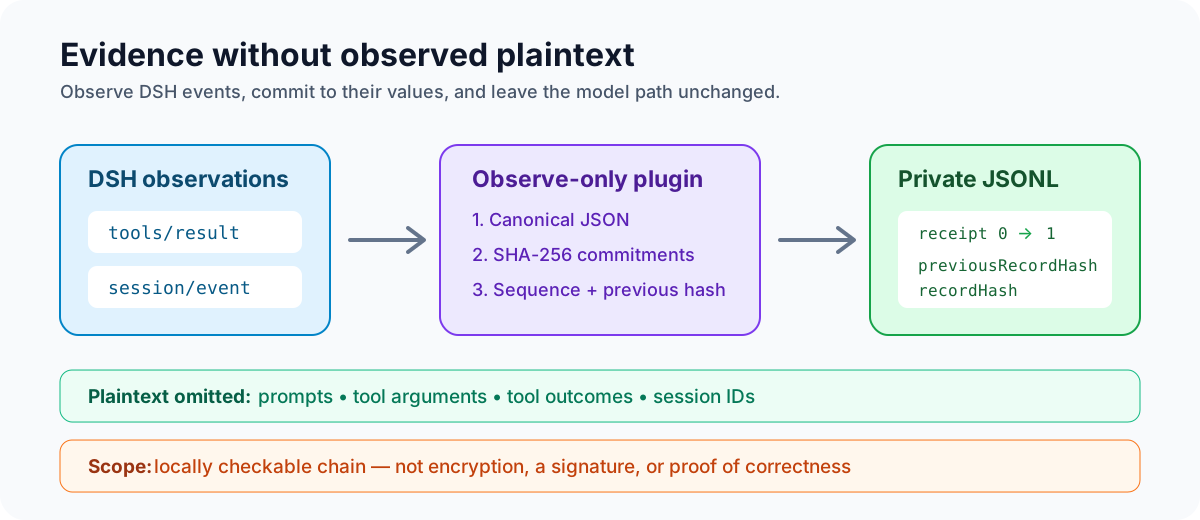
Qiushi DSH Evidence Audit is an observe-only DeepSeek Harness Profile Bundle. It listens to the official tools/result and session/event extension points and appends deterministic, hash-chained JSONL evidence receipts. It never registers a model-facing tool, changes a prompt, transforms a tool result, or appends to a session.
Install from npm
Prerequisites are Node.js ^22.19.0 || >=24.0.0 and a DSH installation built from the tested commit.
dsh plugin --profile <profile> add qiushi-dsh-evidence-audit
dsh --profile <profile> --dump-config
The config dump should contain a row with id qiushi-evidence-audit and name qiushi-dsh-evidence-audit. Receipts then default to $DSH_HOME/evidence-audit/evidence-receipts.jsonl, or ~/.dsh/evidence-audit/evidence-receipts.jsonl when DSH_HOME is unset. If running DSH from its source checkout, replace dsh with that checkout's documented pnpm dsh launcher.
To remove the bundle:
dsh plugin --profile <profile> remove qiushi-dsh-evidence-audit
What it can and cannot establish
- It can make edits to retained records, untouched-prefix removal, broken links, and partial final lines detectable when the existing file is verified.
- It can show that this observer saw specific event categories and hashes in a particular local sequence.
- It cannot prove that a command ran correctly, that a result was truthful, who produced the file, or that a valid suffix was not deleted.
- Its hashes are not redaction, encryption, digital signatures, or an external trust anchor. Protect the receipt file as sensitive pseudonymous data.
Compatibility
This release has one deliberately narrow compatibility claim: it was implemented and tested against deepseek-ai/deepseek-harness commit 47f943859bef60e4160492346772ded9b24f765a on 2026-08-13. That checkout identifies its packages as 0.1.0-rc.5, but that version was not available from npm during verification. This is therefore a commit-pinned claim, not a promise for npm release 0.0.1-rc.1, future DSH commits, or a semver range.
The official installer reads package.json#dsh.bundle.patch. dsh.plugin.json is additional project metadata with a local schema; the pinned DSH commit does not read that file and this project does not claim otherwise.
Receipt data
The default file is $DSH_HOME/evidence-audit/evidence-receipts.jsonl, or ~/.dsh/evidence-audit/evidence-receipts.jsonl when DSH_HOME is unset or blank. The plugin creates the default directory with owner-only mode 0700 and the file with owner-only mode 0600 where the operating system honors POSIX modes. It never defaults to the current working directory.
Every line contains schemaVersion, sequence, collectedAt, previousRecordHash, and recordHash. recordHash is SHA-256 over canonical JSON for every field except recordHash itself. The next line commits to it through previousRecordHash; the first line uses null. Startup verifies the complete existing file and refuses to append if a line, sequence, record hash, or previous-hash link is invalid.
A session-event receipt stores the hashed session ID, event type, event sequence and time, a hash of event data, and the optional ignorable marker. A tool-result receipt stores the tool name, hashed call/root-call/session IDs, argument hash, final outcome hash, error flag, parent-presence flag, and optional error code.
[!WARNING]
eventDataHash,argumentsHash, andoutcomeHashare not redaction, encryption, or digital signatures. The JSONL excludes the observed plaintext, but an attacker who can guess a low-entropy value can hash candidates and confirm a match offline. Treat the receipt file as sensitive pseudonymous data and protect it accordingly.
Event types and tool names remain readable because they are the stable audit categories. The two feeds are not deduplicated: DSH may publish one logical tool outcome first on tools/result and then durably as a tool/result session/event. In that case this plugin intentionally writes two receipts describing two observations. Do not sum those receipts as independent tool executions.
Canonical JSON boundary
hashObservedValue accepts only lossless JSON values: null, booleans, finite numbers, strings, dense arrays, and plain objects with string keys. Object keys are sorted recursively using JavaScript's default UTF-16 code-unit order. Strings use JSON.stringify escaping, SHA-256 consumes the resulting UTF-8 bytes, and Unicode normalization is not performed; canonically equivalent NFC and NFD strings therefore hash differently.
undefined (including an object property), BigInt, non-finite numbers, functions, symbols, sparse array holes, extra array properties, accessors, non-enumerable or symbol keys, circular references, proxies, array subclasses, and non-plain objects such as Date, Map, or class instances are rejected. Accessor getters are not invoked. Direct callers receive a path-bearing TypeError; observer callbacks catch the failure, log a warning, omit only that receipt, and leave the DSH publication unchanged. Existing-file verification still fails plugin startup loudly.
Observe-only behavior
Both listeners are ordinary contained observers. They do not return a waterfall decision and do not mutate either callback argument. A receipt serialization or append error is logged and contained so the tool outcome and session publication continue unchanged. A startup error, including an invalid output path or damaged existing chain, fails plugin loading loudly instead of silently discarding audit records.
One cleanup effect explicitly unregisters both listeners before closing the writer; Cordis's automatic listener disposers are idempotent with that cleanup. Appends and close are synchronous (writeSync/closeSync), with no promise-backed write queue left pending at unload. A real Cordis test awaits disposal and verifies that a later emission does not change the file.
Model experience: no prompt text, tool schema, token, model request, result, or KV-cache behavior changes. The only runtime costs are canonical serialization, SHA-256, synchronous append I/O per observed record, and complete chain verification at plugin startup.
Optional output override
The override must be absolute. A later profile patch replaces the complete row config, so keep the row name and provide the full config:
- id: qiushi-evidence-audit
  name: qiushi-dsh-evidence-audit
  config:
    outputPath: 'D:\private-audit\evidence-receipts.jsonl'
The configured destination is operator-owned; its parent-directory permissions and link safety are not changed by the plugin. Prefer a private directory that other users cannot write.
Verify and build
pnpm run typecheck
pnpm run test
pnpm run build
pnpm run test:built
pnpm run publint
pnpm pack --dry-run
pnpm run test:tarball
$env:DSH_UPSTREAM_CHECKOUT='D:\path\to\pinned\deepseek-harness'
pnpm run test:upstream
Tests cover canonical JSON acceptance/rejection and Unicode behavior, a fixed SHA-256 vector, deterministic chain creation, exact mutation/truncation boundaries, a real two-process append race, plaintext exclusion, duplicate feed observations, fail containment, safe default resolution, real Cordis mount/event/disposal, built-artifact loading, publint, an exact pack list, install/import/mount from the tarball, and commit-pinned bundle composition with the byte-identical official applyEntryPatches implementation.
Integrity detection boundaries
This file is not generically tamper-evident. It has an unkeyed, self-contained hash chain with no external anchor. The tested boundaries are:
| Scenario | Detected? | Exact boundary |
|---|---|---|
| Edit a retained line or link | Yes, at verification/startup | Unless an attacker recomputes that line and every following hash. |
| Remove an untouched prefix | Yes, at verification/startup | The first remaining sequence/link no longer starts at 0/null; rewritten and re-chained files can evade this. |
| Leave a partial final line | Yes, at verification/startup | A non-empty file must end with a newline after a complete JSON record. |
| Delete the whole file | No | Re-creation is indistinguishable from first use without an external anchor. |
| Remove a complete suffix | No | The shorter retained prefix remains a valid chain. |
| Two processes append one file | Not prevented | There is no cross-process lock. The adversarial test makes two processes open the same head; later verification rejects the resulting duplicate/stale sequence. Use a separate file per process. |
| Attacker rewrites and re-chains records | No | SHA-256 is unkeyed and the file carries no trusted signature/checkpoint. |
Known limitations and remaining risks
- Hashes do not prove author identity and provide neither a digital signature nor a checkpoint anchored outside the host.
- A completed
writeSyncis not anfsyncdurability guarantee. A power loss or kernel/storage failure can lose the last receipt. - Multiple DSH processes must not write the same file concurrently. Detection occurs only on a later verification and is not recovery; use one output file per process/profile.
- Startup verification is linear in the existing file size, and synchronous append I/O adds latency to the event publisher.
- POSIX modes do not express full Windows ACL policy. Verify ACLs for sensitive deployments.
- The plugin observes live publications after it mounts. Constructor seed/replay events that DSH deliberately does not publish on
session/eventare not backfilled. - The compatibility smoke did not perform a model-backed DSH turn: the pinned shallow checkout had no installed/built workspace dependencies or API credential. It did exercise the real Cordis runtime and the official bundle patch parser/application semantics.
Project links
License
Links
More in this category
toby-bridges/api-relay-audit★ 860
Runs local security audits of AI API relays and LLM proxies from DeepSeek Harness, producing Markdown reports for prompt injection, model substitution signals, tool-call rewriting, error leakage, stream integrity, and profile-gated Web3 risks.
SeaOf0/dsh-redteam-model★ 638
Authorized-security DSH collection: nine work modes (redteam coordinator, pentest, code audit, binary analysis, attack-defense, AV evasion, incident response, cloud security, CTF solving) and fifteen runtime plugins, managed from a settings page with one-click deploy, install, update and uninstall.
howmp/dsh-pentest★ 558
Authorized pentest mode for DeepSeek Harness — exploration chain, assets and findings with a Web view.
PerryLink/dsh-auto-review★ 206
Second-model auto-review on the approval answerer chain: a read-only reviewer subagent returns structured allow/deny verdicts with reasons, fail-closed by default.
NanmiCoder/dsh-auto-mode★ 163
Adds an Auto permission preset between Workspace Write and Full access: routine work stays in the official workspace-write sandbox while the current session model reviews escalation and destructive calls, granting one exact wider access once, asking when the intent is ambiguous, and denying critical paths.
PerryLink/dsh-permission-rules★ 114
Claude Code-style declarative permission rules: ordered allow/deny/ask YAML rules matching tool names, arguments, workspace paths, and agent identity on the tools/pre-execute waterfall, with full session-log audit, dry-run mode, and hot reload.
Community comments
Comments are public GitHub Discussions. Loading them connects to GitHub and Giscus; a GitHub account is required to post.