Redacts supported secret patterns from the `session-telemetry/record` export copy before configured telemetry backends receive it.
Install
# from npm (prebuilt)
dsh plugin --profile web add dsh-telemetry-redactor
# from GitHub (first run asks for allowBuilds approval — follow the hint, retry)
dsh plugin --profile web add github:030611/dsh-telemetry-redactor
Any plugin you install runs third-party code with your own permissions — it can read your files, use your credentials, and reach the network, and tool approvals don’t sandbox it. GitHub-sourced plugins also run build scripts at install time — pnpm blocks those until you allow them, so an install can stop with ERR_PNPM_GIT_DEP_PREPARE_NOT_ALLOWED or ERR_PNPM_IGNORED_BUILDS; dsh prints the exact key to add under allowBuilds in your profile’s pnpm-workspace.yaml, and the install works on the next run. Allowing a build is a trust decision: only install sources you trust, and pin a commit (github:owner/repo#sha).
README

English | 中文
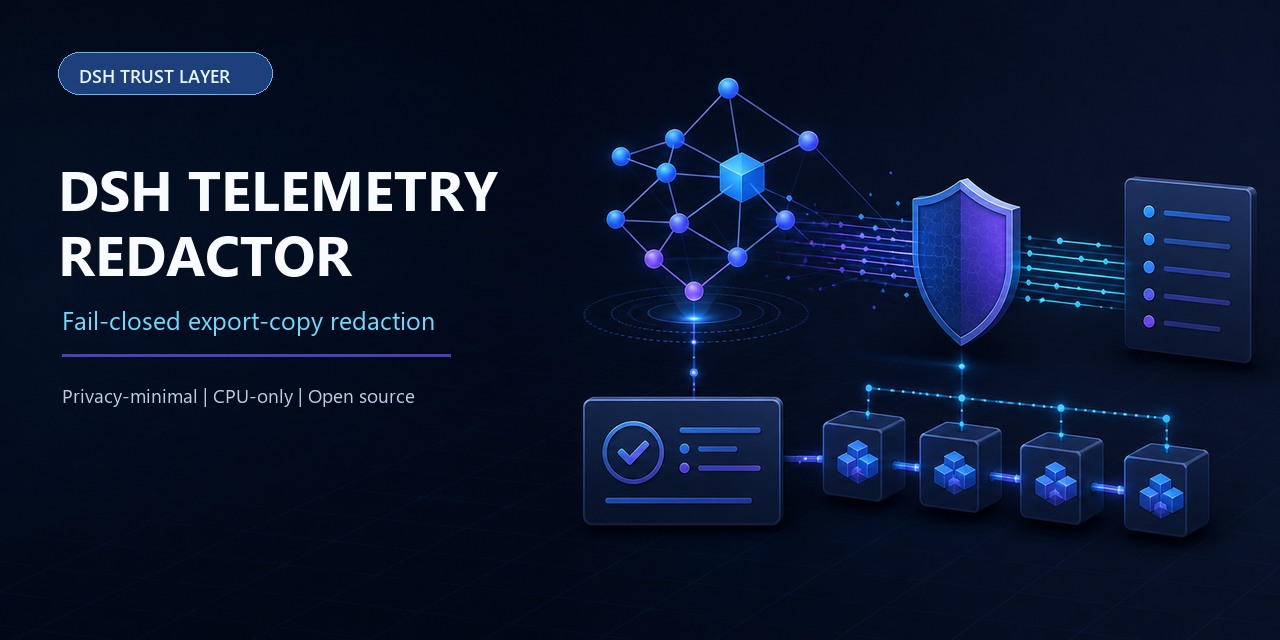
Redact supported credential patterns from outbound telemetry copies before configured backends receive them—without rewriting canonical session logs.
dsh plugin --profile web add dsh-telemetry-redactor
Community-maintained and not an official DeepSeek project. Related trust-layer plugins: Verification Receipt, Evidence Audit, and Context Provenance.
dsh-telemetry-redactor is a minimal DeepSeek Harness Profile Bundle that redacts sensitive values from session telemetry before a backend receives them. It mounts on the official session-telemetry/record waterfall, calls next() so other deployment rules still compose, and returns a new recursively redacted record.
The official telemetry coordinator deep-copies canonical session events before this waterfall and contains thrown rules per record. Therefore this plugin changes only the outbound copy: it never rewrites the canonical session log. In this document, fail-closed means only that this coordinator withholds one failing export copy and continues the agent loop. It is not a claim that every telemetry path or listener order is impossible to bypass.
What it redacts
- Values under high-risk key names such as
authorization,cookie,credential,password,secret,token,apiKey,access_token,clientSecret, andprivateKey; recognized credential patterns in key names are replaced too. - Bearer and Basic authorization values embedded in strings.
- Common credential forms including
sk-..., GitHub tokens, Slack tokens, JWT-like triples, andtoken=.../api_key: ...assignments.
Keys are tokenized before matching, so telemetry counters such as inputTokens, output_tokens, tokenUsage, tokenCount, and contextTokenCount, and ordinary fields such as tokenizer, remain intact. Redaction is a safety filter, not a proof that an arbitrary unknown secret format is absent. The exact supported and unsupported cases are in SECRET-MATRIX.md; see SECURITY.md for the trust boundary.
The listener is prepended so it normally wraps deployment rules mounted before or after it and redacts their final output. A deliberately prepended outer listener can still add content after this plugin; review the complete waterfall listener set in security-sensitive deployments.
Install
Install the public package into the selected DSH profile, then inspect the resolved configuration:
dsh plugin --profile web add dsh-telemetry-redactor
dsh --profile web --dump-config
The dump must contain the inserted telemetry-redactor row. The bundle does not add, replace, or enable a telemetry backend; it only protects records handled by whatever backend the deployment already selected.
Configuration
The only option is replacement, which defaults to [REDACTED]. It must contain 1 to 128 characters and must not itself match a supported credential pattern; invalid values fail loudly when the Cordis plugin fiber is awaited.
- id: telemetry-redactor
  config:
    replacement: '[TELEMETRY-REDACTED]'
The key and pattern rules are fixed security behavior and cannot be disabled through configuration.
Verification
pnpm run typecheck
pnpm test
pnpm run build
pnpm run test:smoke
pnpm run test:performance
pnpm run test:official-head
pnpm run test:official-patch
pnpm run test:packed:clean-env
The tests include a real Cordis Loader composition with the SessionTelemetryCoordinator: the backend receives the replacement while the authoritative session event retains the fixture secret, and an over-deep record is withheld without escaping the capture handler. Release smokes use the packaged frozen fixture for official commit 47f943859bef60e4160492346772ded9b24f765a: it pins the reviewed source hashes, exact published runtime versions and runtime-file hashes, then verifies the required Cordis/session/LLM/coordinator API surface before composing it with the built or tarball-installed plugin. test:official-patch similarly pins the reviewed Include source hash before applying cordis.patch.yml. No environment variable or installed official checkout is required.
Model Experience
None. The plugin observes an outbound telemetry copy after session logging and contributes no prompt text, tool schema, message, or provider request.
KV Cache effect
None; no model request changes.
Known limitations
- Unknown secret formats that have neither a sensitive key nor a recognized string pattern may pass through. Add deterministic coverage before extending the fixed patterns.
- Accessor properties and non-plain objects are rejected rather than read or silently converted. Enumerable JSON data in arrays, ordinary objects, and null-prototype objects is supported; non-enumerable fields are outside the telemetry contract.
- A key-name match redacts the complete value. This favors safety over retaining structure beneath fields named as credentials.
- Redaction occurs synchronously on the telemetry capture path. The implementation is recursive and bounded to 64 nested containers; very large but shallow records still cost linear CPU time.
- A Proxy can run or throw from reflection traps before the plugin can inspect its contents. The official coordinator's own
structuredClonenormally rejects a Proxy before this waterfall; direct third-party dispatch is not a supported hostile-object sandbox. dsh.plugin.jsonis supplemental community metadata. DSH installation is controlled bypackage.json'sdsh.bundlefield andcordis.patch.yml.
License
MIT
Links
More in this category
toby-bridges/api-relay-audit★ 860
Runs local security audits of AI API relays and LLM proxies from DeepSeek Harness, producing Markdown reports for prompt injection, model substitution signals, tool-call rewriting, error leakage, stream integrity, and profile-gated Web3 risks.
SeaOf0/dsh-redteam-model★ 638
Authorized-security DSH collection: nine work modes (redteam coordinator, pentest, code audit, binary analysis, attack-defense, AV evasion, incident response, cloud security, CTF solving) and fifteen runtime plugins, managed from a settings page with one-click deploy, install, update and uninstall.
howmp/dsh-pentest★ 558
Authorized pentest mode for DeepSeek Harness — exploration chain, assets and findings with a Web view.
PerryLink/dsh-auto-review★ 206
Second-model auto-review on the approval answerer chain: a read-only reviewer subagent returns structured allow/deny verdicts with reasons, fail-closed by default.
NanmiCoder/dsh-auto-mode★ 163
Adds an Auto permission preset between Workspace Write and Full access: routine work stays in the official workspace-write sandbox while the current session model reviews escalation and destructive calls, granting one exact wider access once, asking when the intent is ambiguous, and denying critical paths.
PerryLink/dsh-permission-rules★ 114
Claude Code-style declarative permission rules: ordered allow/deny/ask YAML rules matching tool names, arguments, workspace paths, and agent identity on the tools/pre-execute waterfall, with full session-log audit, dry-run mode, and hot reload.
Community comments
Comments are public GitHub Discussions. Loading them connects to GitHub and Giscus; a GitHub account is required to post.